

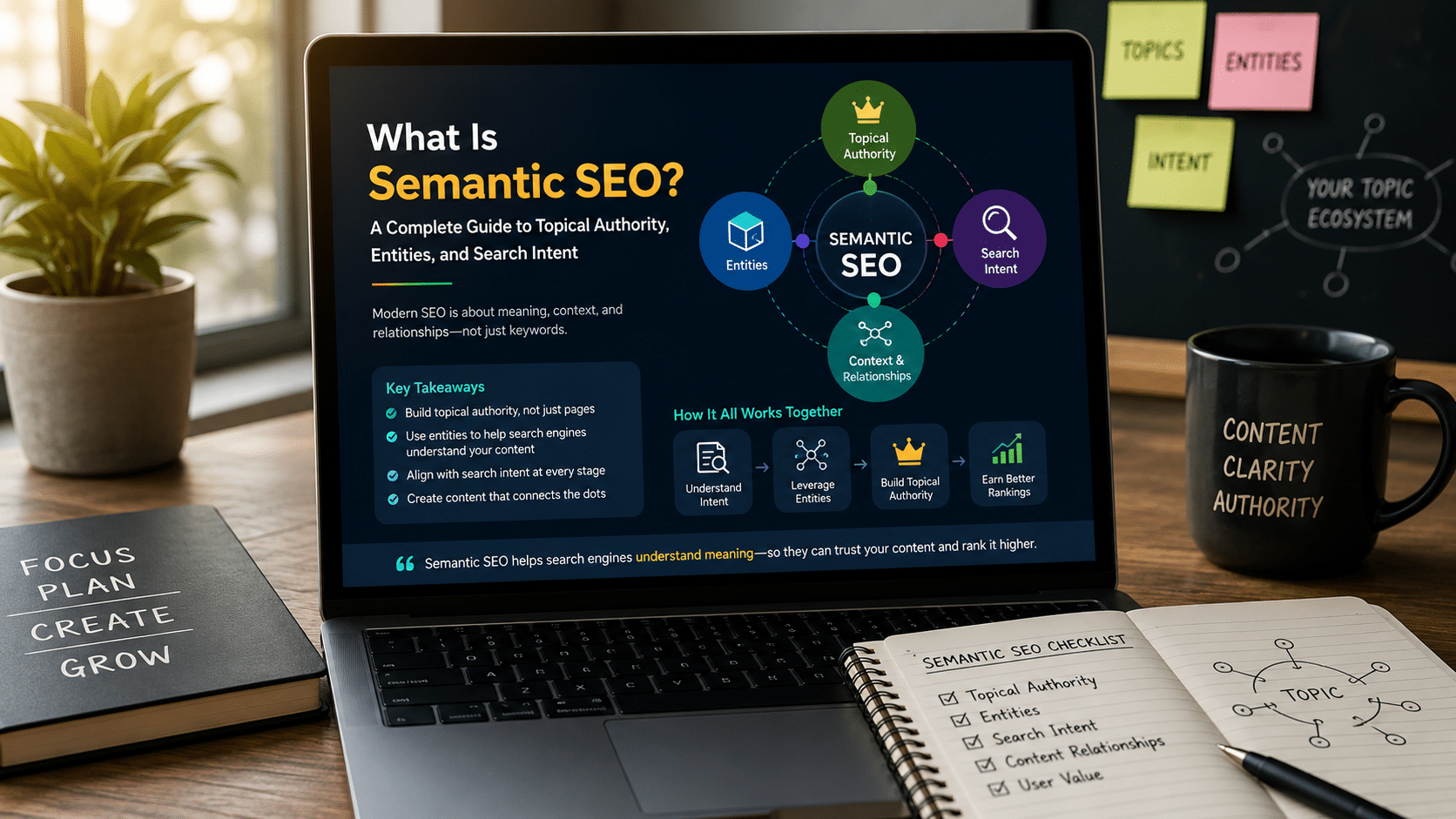
Type a question into Google today and you’ll often get a direct answer before you even click a link. Ask a follow-up question, and Google somehow knows you’re still talking about the same topic. None of that happens by matching your exact words to the exact words on a webpage. It happens because modern search engines read for meaning, not just text – and that shift is what people mean when they talk about semantic SEO.
For years, SEO meant picking a keyword, repeating it a certain number of times, and hoping the page ranked. That approach is largely dead. Google’s algorithms now interpret context, relationships between ideas, and the intent behind a search – which means the sites that rank well are the ones that demonstrate real, structured understanding of a topic, not just keyword frequency.
This guide breaks down what semantic SEO actually is, how it works under the hood, and how to build a content strategy around it – including topical authority, entity optimization, keyword mapping, and the mistakes that trip up even experienced marketers.
What Is Semantic SEO?
Semantic SEO is the practice of optimizing content around meaning, context, and the relationships between concepts – rather than around a single exact-match keyword. Instead of asking “how many times should I use this phrase,” semantic SEO asks “what does a person actually need to understand this topic completely?”
In practice, that means a page about “espresso machines” doesn’t just repeat that phrase. It naturally discusses grind size, water pressure, portafilters, milk steaming, machine types, common troubleshooting issues, and how espresso machines compare to drip coffee makers – because those are the concepts a search engine (and a real reader) would associate with genuine expertise on the subject.
Semantic SEO vs. traditional keyword-based SEO
The differences are easiest to see side by side.
| Aspect | Traditional Keyword SEO | Semantic SEO |
| Core unit | Exact-match keyword | Topic and related entities |
| Content goal | Rank for one phrase | Fully answer a user’s question |
| Structure | Single page targeting one term | Content clusters covering a topic in depth |
| Signals used | Keyword density, backlinks | Context, entities, intent, structure, relationships |
| Risk of overuse | Keyword stuffing | Low, since language stays natural |
| Typical outcome | Rankings for narrow phrases | Broader visibility across related queries |
Neither approach ignores keywords entirely – semantic SEO still uses them, just as one signal among many rather than the whole strategy.
Why Semantic SEO Matters Now
Search engines didn’t start out understanding language this way. Early algorithms were essentially pattern-matchers: they compared the words in a query to the words on a page and ranked based on frequency and placement. That system was easy to game and often produced poor results for the actual searcher.
Google has released several major updates that pushed search toward meaning-based understanding:
- Hummingbird (2013) shifted Google away from matching individual keywords toward interpreting the intent of an entire query.
- RankBrain (2015) introduced machine learning to help Google interpret queries it had never seen before by relating them to concepts it already understood.
- BERT (2019) improved Google’s ability to understand the context of words in a sentence – including prepositions and phrasing that change meaning entirely.
- MUM (2021) extended that understanding across languages and formats, allowing Google to connect information from multiple sources to answer complex questions.
- The Helpful Content Update (starting 2022) began rewarding content written primarily to satisfy a reader’s need, and downranking content produced mainly to attract search traffic.
Together, these updates explain why an article stuffed with one repeated phrase performs worse today than a well-organized page that thoroughly explains a topic using natural language. Google isn’t just checking whether your words match a query – it’s checking whether your content actually demonstrates understanding of the subject.
The Building Blocks of a Semantic SEO Strategy

A real semantic SEO strategy is made up of several interconnected pieces. Skipping any one of them tends to leave gaps that a competitor’s more complete content can exploit.
Semantic keyword research
Semantic keyword research goes beyond a single search-volume list. It involves identifying the full set of terms, questions, and subtopics connected to a subject – the way a subject-matter expert would naturally talk about it.
For a topic like “personal budgeting,” that might include:
- Related concepts: income allocation, emergency funds, debt-to-income ratio
- Common questions: “How much should I save each month?”
- Comparisons: budgeting apps vs. spreadsheets
- Problems and solutions: overspending, irregular income, unexpected expenses
Semantic keyword mapping
Once related terms and questions are identified, they need to be mapped to specific pages or sections, so the content stays organized rather than repeating the same ground on multiple pages. Mapping prevents “keyword cannibalization,” where two pages on a site compete against each other for the same search instead of reinforcing each other.
Entity-based SEO
An entity is a distinct, identifiable thing – a person, place, organization, product, or concept – that Google can recognize independently of the words used to describe it. Google builds an understanding of entities through its Knowledge Graph, which stores relationships between people, places, and things across the web.
Entity-based SEO means writing content that clearly identifies and connects relevant entities. For a travel article about Kyoto, that might mean naming specific temples, historical periods, transit systems, and neighborhoods – not just describing “temples” and “streets” in generic terms. Specificity helps search engines confirm exactly what a page is about and how it relates to other verified information.
Search intent optimization
Every query carries an intent behind it, and content that mismatches that intent tends to underperform regardless of how well it’s written. Intent generally falls into a few categories:
- Informational — the searcher wants to learn something (“what is semantic SEO”)
- Navigational — the searcher wants a specific site or page (“Google Search Console login”)
- Commercial investigation — the searcher is comparing options before buying (“best budgeting apps 2026”)
- Transactional — the searcher is ready to take action (“buy budgeting app subscription”)
A page written for the wrong intent – say, a sales page targeting a purely informational query – usually struggles to rank, because it doesn’t match what the searcher actually wants.
Topical Authority: Why Depth Beats Volume
Topical authority is the degree to which a website is recognized – by both search engines and readers – as a comprehensive, trustworthy source on a given subject. It isn’t built by one great article. It’s built by covering a topic from enough angles that a reader never has to leave the site to find the rest of the answer.
What a topical map looks like
A topical map is a planning document that lays out every subtopic, question, and related entity connected to a core subject before any content gets written. For a site covering “home coffee brewing,” a simplified topical map might include:
- Core topic: Home coffee brewing
- Subtopics: brewing methods, grind size, water quality, equipment maintenance, bean storage
- Related entities: pour-over, French press, espresso, AeroPress, burr grinder
- Common questions: “Why does my coffee taste bitter?”, “How long does ground coffee stay fresh?”
Mapping this out ahead of time keeps a site’s content organized into clusters instead of a scattered collection of loosely related posts.
Topic clusters and pillar content
Most topical authority strategies are organized around pillar pages and cluster content:
- A pillar page broadly covers a core topic (e.g., “A Complete Guide to Home Coffee Brewing”).
- Cluster pages go deep on individual subtopics (e.g., “Pour-Over vs. French Press,” “How to Store Coffee Beans Properly”).
- Internal links connect the cluster pages back to the pillar page and to each other, forming a network rather than isolated articles.
This structure benefits readers, who can navigate naturally from a general overview into specific detail, and it benefits search engines, which can use the internal linking pattern to understand which pages matter most within a topic.
Content relevance and depth vs. content length
A frequent misunderstanding is that longer content automatically ranks better. Length isn’t the goal – completeness is. A 900-word article that fully answers a narrow question can outperform a padded 3,000-word article that repeats itself to hit a word count. The right length is however long it takes to genuinely serve the reader’s question, no more and no less.
How Google – and Readers – Judge Content Quality

Google’s quality guidelines describe evaluating content through the lens of E-E-A-T: Experience, Expertise, Authoritativeness, and Trustworthiness. While E-E-A-T isn’t a single ranking factor that can be measured directly, it reflects the kinds of signals Google’s systems are designed to reward:
- Experience — does the content show firsthand knowledge of the subject?
- Expertise — is the information accurate and well-informed?
- Authoritativeness — is the source recognized as credible within its field?
- Trustworthiness — is the site transparent, accurate, and safe to rely on?
Semantic SEO and E-E-A-T reinforce each other. Comprehensive topical coverage, accurate detail, and clear sourcing are exactly the signals that support both search engine understanding and reader trust.
Building a Semantic SEO Strategy: A Practical Process
For teams putting this into practice, the process usually follows a repeatable sequence:
- Choose a core topic broad enough to support multiple related pages, but specific enough to stay focused.
- Research subtopics, entities, and questions connected to that topic, using search data, competitor content, and genuine subject knowledge.
- Build a topical map that organizes those subtopics into a pillar-and-cluster structure.
- Write content that satisfies intent first, using semantic keywords and entities naturally rather than forcing them in.
- Interlink related pages so authority and relevance flow between them.
- Use structured data (schema markup) where relevant, to help search engines confirm what entities and content types are present on a page.
- Measure results – rankings, impressions, and organic traffic – and refine gaps in coverage over time.
A short example
Imagine a site building topical authority around “electric vehicle charging.” Instead of publishing one general article and hoping it ranks for every EV-related query, a semantic approach would map out clusters like charging connector types, home charging installation, public charging networks, charging costs, and battery health – each as its own page, interlinked under a pillar guide. A reader researching any one of those subtopics finds a complete, specific answer, and the site as a whole builds recognizable authority on EV charging rather than a single lucky ranking.
Where structured data fits in
Schema markup is code added to a page’s HTML that explicitly labels what certain content represents – a recipe, a product, an FAQ, a review, an event. It doesn’t change what a page says, but it removes ambiguity for search engines trying to identify entities and content types.
For semantic SEO specifically, structured data acts as a confirmation layer. If an article discusses a specific entity – a product, an organization, a place – schema can explicitly tag that relationship rather than leaving it for the algorithm to infer purely from surrounding text. It’s not a substitute for well-written, comprehensive content, but it can reinforce the same signals that entity-based SEO is already trying to send.
Measuring whether a semantic SEO strategy is working
Because topical authority builds gradually, it helps to track a few different signals rather than watching a single keyword’s ranking:
- Ranking breadth – how many related keywords and long-tail variations a page or cluster ranks for, not just the primary target term.
- Impressions and click-through rate in search console tools, which show whether a page is being surfaced for a wider range of relevant queries over time.
- Organic traffic trends across an entire topic cluster, rather than a single article, since the goal is cumulative authority.
- Engagement signals such as time on page and pages per session, which indicate whether readers are finding what they need and continuing to explore related content on the site.
- Featured snippet and answer-box appearances, which often reflect that a search engine considers a page to be a clear, well-structured answer to a specific question.
A strategy that’s working usually shows a widening footprint – a growing number of related queries a site shows up for – rather than a single spike tied to one article.
Common Semantic SEO Mistakes
Even teams that understand the theory often stumble on execution. Some of the most frequent mistakes include:
- Treating semantic SEO as a synonym-swapping exercise. Sprinkling in related words without adding real depth doesn’t create topical authority – it just avoids obvious repetition.
- Skipping the topical map. Writing content reactively, one keyword idea at a time, tends to produce overlapping or duplicate pages instead of a coherent cluster.
- Ignoring search intent. Ranking for a keyword means little if the content doesn’t match what the searcher actually wants to do next.
- Weak internal linking. Without links connecting cluster content to pillar pages, search engines have a harder time understanding which pages are central to a topic.
- Chasing word count instead of completeness. Padding content to hit a target length dilutes relevance rather than strengthening it.
- Forgetting the human reader. Content built purely around what a search engine might reward, without regard for readability, tends to underperform anyway – Google’s systems are specifically designed to detect content written primarily for algorithms rather than people.
Limitations of Semantic SEO
Semantic SEO isn’t a guaranteed formula, and it’s worth being realistic about its limits:
- It requires more upfront research and planning than single-keyword content, which takes more time.
- Results are usually gradual – topical authority builds over months of consistent, connected content rather than appearing after one article.
- It doesn’t replace other fundamentals. Technical SEO (site speed, crawlability, mobile usability) and off-site signals like backlinks still matter alongside semantic content quality.
- Search engines’ understanding of entities and context continues to evolve, so a topical map built today may need revisiting as a subject or the algorithm changes.
Semantic SEO and Search Intent Optimization Compared
It’s easy to conflate semantic SEO with intent optimization, since they’re closely related but not identical.
| Semantic SEO | Search Intent Optimization | |
| Primary focus | Meaning, entities, and topical depth | Matching content format to what the searcher wants |
| Main question | “What related concepts belong on this page?” | “Is the searcher trying to learn, compare, or buy?” |
| Typical output | Topic clusters, entity-rich content | Correct content type (guide, comparison, product page) |
| How they work together | Provides the depth within a page | Ensures the page’s format matches the query |
In a mature strategy, the two work together: intent determines what kind of page to build, and semantic depth determines how well that page actually covers the subject.
Frequently Asked Questions
What is semantic SEO in simple terms?
Semantic SEO means writing and organizing content around the full meaning of a topic – related concepts, entities, and questions – instead of repeating a single keyword phrase.
How is semantic SEO different from keyword research?
Traditional keyword research focuses on finding individual high-volume search terms. Semantic SEO uses that research as a starting point but expands it into a full map of related subtopics, entities, and user questions that need to be covered together.
What is topical authority in SEO?
Topical authority is the recognition – from both search engines and readers – that a website comprehensively and credibly covers a given subject, usually built through a connected cluster of in-depth content rather than a single page.
What is an entity in SEO?
An entity is a specific, identifiable thing – a person, place, brand, or concept – that search engines can recognize and connect to other verified information, often through Google’s Knowledge Graph.
Do I still need to use keywords if I’m doing semantic SEO?
Yes. Keywords still matter as one signal, but they’re used naturally within content that addresses the topic’s full scope, rather than being repeated for their own sake.
How long does it take to build topical authority?
There’s no fixed timeline, since it depends on competition, publishing consistency, and site history, but it’s typically a gradual process measured in months of connected content rather than a single publish.
Does semantic SEO replace technical SEO?
No. Site speed, mobile usability, crawlability, and structured data still matter. Semantic SEO addresses content depth and relevance, not the technical foundation a site is built on.
Can a small website benefit from semantic SEO?
Yes. Because topical authority rewards depth and organization rather than sheer volume of pages, a smaller site that thoroughly covers a focused topic can outperform a much larger site that covers the same subject shallowly.
The Takeaway
Semantic SEO reflects how search itself has changed: engines now read for meaning, context, and relationships between ideas rather than just matching text. Building a strategy around it means researching a topic completely, mapping it into pillar-and-cluster content, naming the specific entities involved, matching content to real search intent, and connecting it all with deliberate internal linking.
None of that happens overnight, and it doesn’t replace the technical and off-site fundamentals that still support rankings. But for anyone building a site meant to last, understanding a topic well enough to explain it completely – the way semantic SEO asks writers to do – tends to serve readers and search engines at the same time, which is really the point.