

Foundation repair SEO in St. Clair Shores means understanding who already ranks well in this specific market and building a strategy around what a smaller, local business can realistically compete on. It’s not generic advice — it’s about knowing your actual competition and where the real openings are.
This article analyzes the real competitive landscape for foundation repair search in St. Clair Shores, Michigan — what established players are doing well, where smaller local operators can genuinely differentiate, and which advantages simply can’t be replicated overnight. We’ll cover hyperlocal content strategy, Michigan-specific angles, Google Business Profile positioning, symptom-based content, service-area expansion, how to track progress, and honest limitations of what SEO alone can accomplish against better-funded competitors.
The Competitive Landscape for Foundation Repair SEO in St. Clair Shores
St. Clair Shores sits in Macomb County, roughly 13 miles northeast of Detroit, bordering Roseville, Eastpointe, and Fraser. The foundation repair market here includes a mix of national franchise operations and long-standing independent local contractors, and understanding who’s who matters before building any strategy.
Foundation Systems of Michigan, operating under the Groundworks umbrella, has served the area for over 16 years according to their website, with BBB A+ accreditation and lifetime warranties as core trust signals. Independent local competitors show up too — Calculus Foundation Repair and Waterproofing leans heavily on owner Rich Piccirilli’s 35 years of personal experience, Tom’s Basement Waterproofing cites over 50 years in business, and HomeSpec Waterproofing and Foundation Repair has served the area since 1994. These figures come directly from each company’s own website, not independent verification, but they establish the baseline a new or smaller competitor is up against.
What the Established Players Are Doing Well
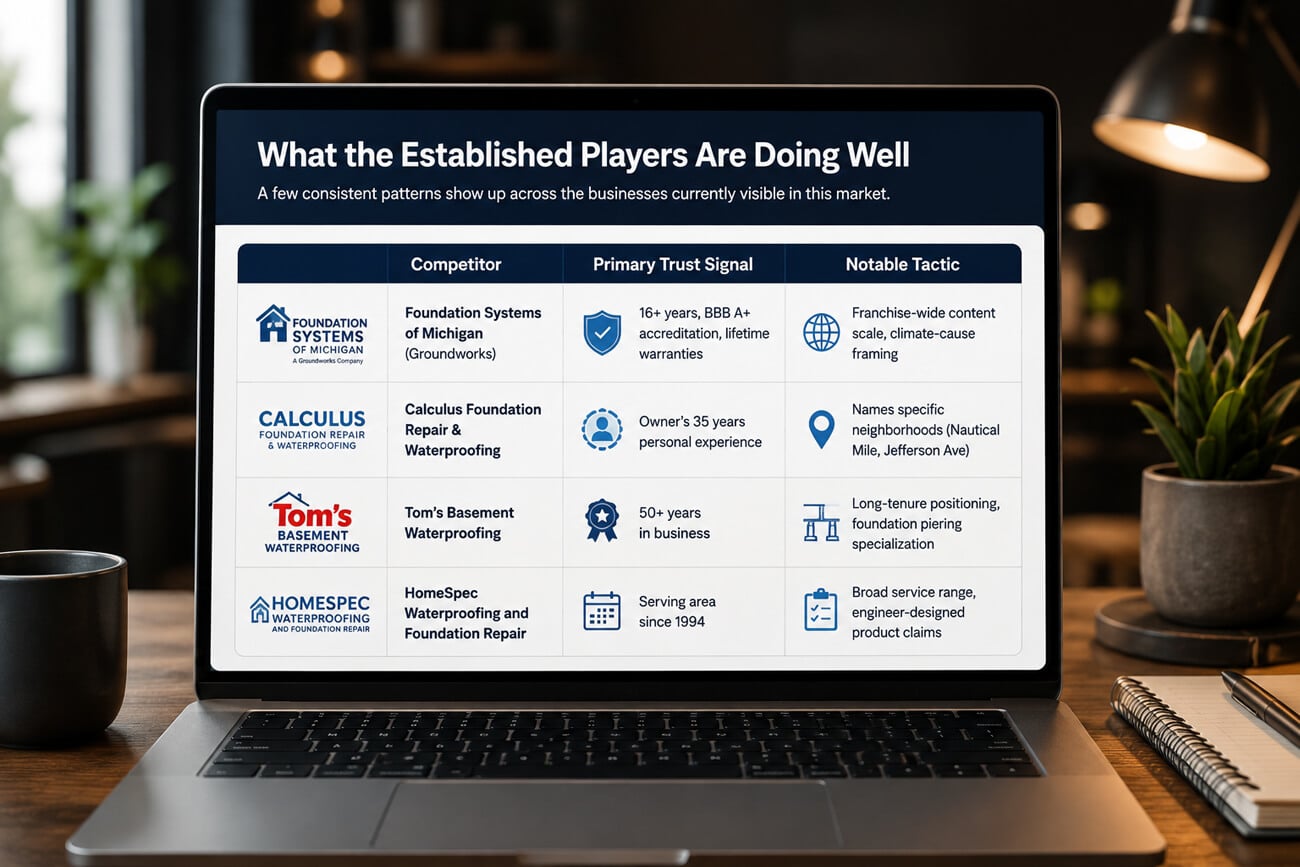
A few consistent patterns show up across the businesses currently visible in this market.
| Competitor | Primary Trust Signal | Notable Tactic |
| Foundation Systems of Michigan (Groundworks) | 16+ years, BBB A+ accreditation, lifetime warranties | Franchise-wide content scale, climate-cause framing |
| Calculus Foundation Repair & Waterproofing | Owner’s 35 years personal experience | Names specific neighborhoods (Nautical Mile, Jefferson Ave) |
| Tom’s Basement Waterproofing | 50+ years in business | Long-tenure positioning, foundation piering specialization |
| HomeSpec Waterproofing and Foundation Repair | Serving area since 1994 | Broad service range, engineer-designed product claims |
(Figures reflect each company’s own website claims, not independently verified data.)
Tenure and accreditation get prominent placement across all four — years in business, BBB status, and warranty length are treated as the primary trust signals, repeated across service pages and homepage copy alike. This is the default playbook, and it works, but it also means every one of these businesses is competing on the same axis.
Several competitors also reference Michigan’s climate and soil conditions directly. One franchise page explicitly connects the area’s significant rainfall and temperature fluctuations to cracking, settling, and moisture problems local homes experience — tying the service to a locally specific cause, not just a generic pitch. This kind of framing does double duty: it reads as more credible to homeowners experiencing real symptoms, and it naturally works in region-specific language that matches how people search.
One local competitor goes further than the rest, using genuinely hyperlocal references — naming the Nautical Mile and Jefferson Avenue specifically, along with waterfront areas along Lake St. Clair. This goes beyond just repeating the city name; it signals real familiarity with specific neighborhoods, which is a harder thing for a national franchise to replicate convincingly at scale across hundreds of service areas nationwide.
Where Smaller, Local Operators Can Actually Compete
A smaller business can’t out-resource a national franchise’s decades of built-up local pages or immediate BBB accreditation. But a few areas remain genuinely open ground, and they map closely to what the strongest local competitor above is already doing on a smaller scale — meaning there’s proof this approach works in this exact market, not just theory.
Hyperlocal Content (Neighborhoods, Landmarks)
Naming specific neighborhoods, streets, and landmarks — the Nautical Mile, Jefferson Avenue, Lake St. Clair waterfront properties — does more for local relevance than repeating “St. Clair Shores” alone. A smaller operator can go further than a franchise typically bothers to: writing about foundation issues specific to older homes near the lakefront, drainage patterns in a particular neighborhood, or how homes near the water table differ from those further inland creates content a mass-market competitor is unlikely to match page-for-page.
Michigan Climate and Soil-Specific Content
Content that explains why Michigan’s freeze-thaw cycles and clay-heavy soil cause foundation movement — not just that they do — builds genuine topical relevance. This matches how homeowners actually search when they’re trying to understand a problem (“why does my foundation crack every winter”) rather than only searching for the service itself. A smaller business willing to write this kind of explanatory content has a real opening, since much of the competitor copy reviewed states the climate connection briefly without developing it into full, standalone articles.
Differentiated Trust Signals
Since a newer or smaller business can’t compete on 35 or 50 years of tenure, the trust signal needs to shift. Response time, transparent pricing (even rough ranges rather than “call for a quote”), direct owner accessibility, and specific before-and-after documentation of local jobs can substitute for tenure-based trust. Homeowners comparing options in the map pack aren’t only weighing years in business — recency and volume of reviews, and how a business responds to them, matter too, and this is an area where a smaller, more attentive operator can genuinely outperform a franchise’s more generic review-response process.
Google Business Profile Optimization for This Market
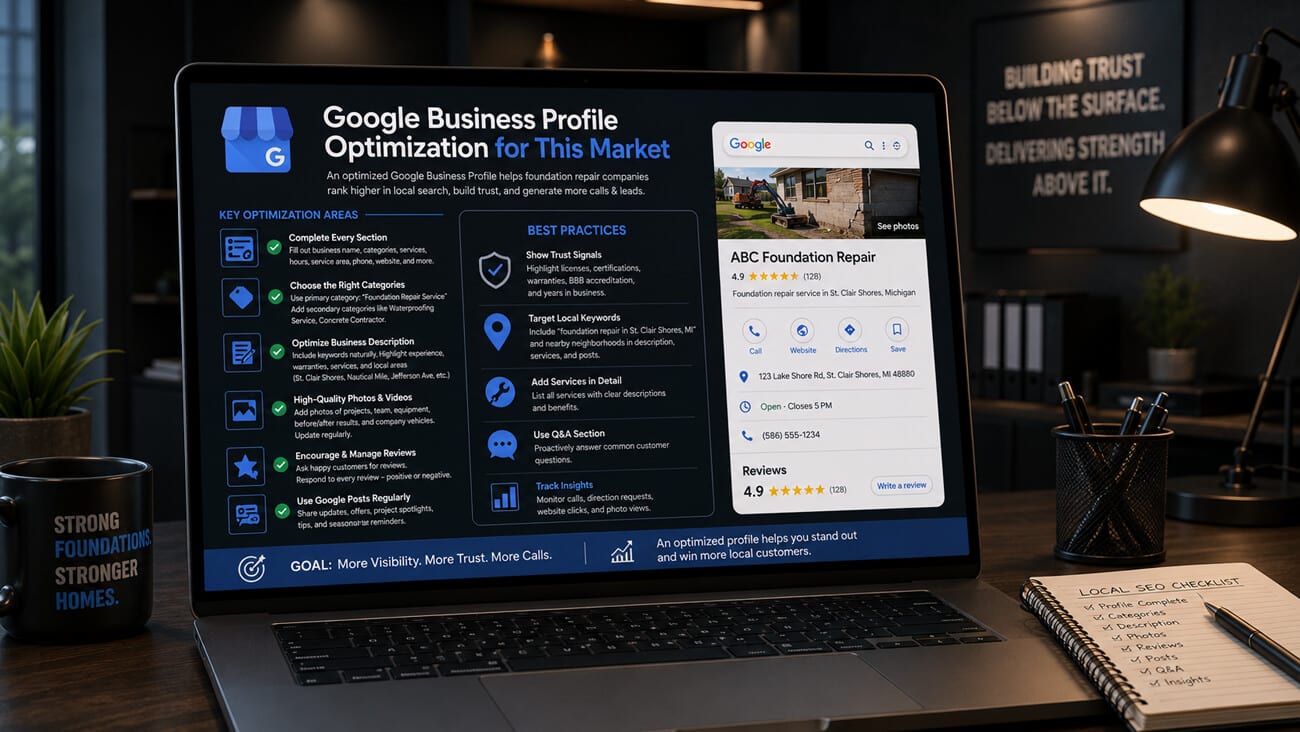
Beyond content, the Google Business Profile itself deserves market-specific attention. Choosing “Foundation Repair Contractor” or the closest available category, and listing St. Clair Shores plus the realistic service radius (Roseville, Eastpointe, Fraser, and other nearby Macomb County communities) rather than an inflated statewide radius, keeps relevance tight for the searches that actually matter.
Photos matter more in a market this competitive. Real job photos from St. Clair Shores properties — a lakefront basement, a foundation crack in a specific neighborhood — carry more local signal than generic stock or even generic “before/after” shots without local context. Given that several established competitors emphasize warranty and tenure in their profile descriptions, a smaller business’s profile description is a natural place to lead with responsiveness and transparency instead, reinforcing the differentiated trust-signal approach described above.
Symptom-Based Content Opportunities
Homeowners researching foundation problems before they’ve decided who to call are searching for symptoms, not services. Common signs referenced across competitor content include a crumbling or cracking foundation, cracked driveway, uneven or cracked floors, windows and doors sticking in their frames, and bowing, buckling, or cracking walls. Content built around these specific symptoms — written for the anxious, early-research homeowner — is a lower-competition entry point than head terms like “foundation repair St. Clair Shores” alone, and it captures people earlier in their decision process, before they’ve started comparing specific contractors.
Service-Area Expansion Strategy
For a contractor willing to serve the wider area, Roseville, Eastpointe, and Fraser represent adjacent, realistic expansion targets — all bordering St. Clair Shores directly. Rather than one generic “Macomb County” page, dedicated pages for each neighboring city, with genuinely distinct content rather than swapped city names, can capture searches specific to each community without diluting the primary St. Clair Shores focus. A page for Eastpointe should read like it was written by someone who knows Eastpointe, not St. Clair Shores content with the city name changed.
Measuring Whether This Strategy Is Working
Since this is a competitive analysis rather than a guaranteed formula, tracking real signals matters more than assuming the strategy is working. Reasonable indicators to watch include ranking position for the St. Clair Shores–specific pages over time, whether the business appears in the local map pack for symptom-based searches (not just service-name searches), growth in Google reviews relative to competitors, and whether hyperlocal content pages (neighborhood or landmark-specific) begin attracting organic traffic on their own. None of these numbers isolate the effect of this specific strategy cleanly from other factors, but a consistent upward trend across several of them over a few months is a reasonable sign the approach is working.
Realistic Limitations of This Strategy
This analysis reflects a snapshot of the current competitive landscape, and search results shift as competitors update their own sites and strategies. A few honest limitations are worth naming directly:
- Tenure and accreditation can’t be manufactured quickly. A 16-year track record or BBB A+ status takes time to build; no content strategy shortcuts that.
- Franchise resources are substantial. National operations can outspend a local business on advertising and content volume, even if a smaller operator wins on hyperlocal specificity.
- This is competitive analysis, not a guarantee. What’s working for competitors today may change, and results from applying similar strategies will vary based on execution, budget, and how aggressively competitors respond to a new entrant using similar tactics.
Frequently Asked Questions
How much does foundation repair cost in St. Clair Shores, MI?
One commonly cited estimate puts average spending around $2,502, though actual cost varies significantly based on the extent of damage, home size, and repair method needed. Treat this as a rough benchmark, not a firm quote.
Can a small local foundation repair business compete with national franchises in search results?
Not on every front, but yes on specific ones — hyperlocal content, faster response and transparency as trust signals, and depth on Michigan-specific causes of foundation problems are all realistic areas where a smaller business can differentiate rather than simply losing on resources alone.
Why do foundation repair companies mention Michigan’s climate and soil in their content?
Because it’s both accurate and strategically useful — it explains a real cause of local foundation problems, which builds credibility, and it naturally uses the kind of regional language homeowners search with.
Should I target St. Clair Shores specifically, or the broader Macomb County area?
Both, structured properly — a strong St. Clair Shores–specific page as the primary focus, with genuinely distinct pages for bordering cities like Roseville, Eastpointe, and Fraser if you serve them.
What’s the difference between foundation piers and helical piers?
Foundation piers are driven or pushed into the ground to reach stable soil and support a settling foundation; helical piers are a specific type with a screw-like design that’s twisted into the ground, often used where deeper or more stable anchoring is needed. Several local competitors offer both, positioning helical piers for more demanding conditions.
Do I need a permit for foundation repair in St. Clair Shores?
A permit is normally required for foundation repair, though the contractor typically handles obtaining it as part of the service rather than the homeowner.
How important are BBB accreditation and warranties for local SEO trust signals?
They matter, particularly for homeowners comparing several options, but they’re not the only path to trust — a smaller business without decades of accreditation history can lean on transparent pricing, responsiveness, and strong recent reviews instead.
What neighborhoods or landmarks should a St. Clair Shores contractor mention in their content?
Specific, real references work best — the Nautical Mile, Jefferson Avenue, and Lake St. Clair waterfront areas are already used by at least one local competitor and reflect genuine local knowledge rather than generic city-name repetition.
Read This Blog: https://linkneon.com/ben-stace-semantic-seo-client-testimonials/
Conclusion
The foundation repair market in St. Clair Shores has established players with real advantages — tenure, accreditation, and resources a smaller business can’t replicate quickly. But the competitive analysis also shows real openings: hyperlocal specificity, deeper Michigan climate content, Google Business Profile positioning built around responsiveness, and trust signals grounded in transparency rather than decades in business.
If you’re a smaller operator starting from here, don’t try to out-market the franchises directly. Start with one piece of genuinely hyperlocal content — a page addressing foundation issues specific to a neighborhood like the Nautical Mile or waterfront properties along Lake St. Clair — track how it performs over a few months, and build outward from there.