

How to get SEO clients without cold calling comes down to one shift in thinking: instead of interrupting people who weren’t looking for help, you show up in front of people who already are. Cold calling puts you in front of strangers. Inbound strategies put you in front of people actively searching for a solution. That difference changes everything — how fast conversations move, how much trust exists before you even speak, and how many of those conversations turn into paying clients.
This guide walks through practical, easy-to-apply ways to attract SEO clients without picking up the phone to cold-call anyone.
Why Cold Calling Doesn’t Work Well for SEO Agencies
Cold calling has a few built-in problems when it comes to selling SEO specifically. The person answering the phone usually wasn’t thinking about SEO before you called, so you’re starting from zero interest. It’s also limited by volume — even a strong sales team can only make so many calls in a day. And there’s a quieter issue too: if an SEO agency can’t generate its own leads, it raises a fair question about whether they can generate leads for someone else.
None of this means outreach is useless. It just means the outreach works better when it’s warm — based on something specific you’ve already noticed about a prospect, like a slow-loading website or a missing Google Business Profile, rather than a random cold call.
The data backs this up. Cold calling typically converts at roughly 2–3% based on large-scale industry analysis, while SEO and inbound-generated leads have been reported to close at closer to 14–15% — nearly a 9x difference. That gap doesn’t mean cold calling never works, but it does explain why so many SEO agencies are shifting their time toward inbound channels instead.
Build a Content Engine That Attracts Clients on Its Own

Content is the foundation of inbound lead generation for SEO agencies. The idea is simple: write articles that answer real questions your ideal clients are already searching for, and let those articles keep working for you long after you hit publish.
A useful way to structure this is around pillar and cluster content — one broad, comprehensive guide (a pillar) supported by several narrower articles (clusters) that link back to it. Over time, this builds a cluster of related pages that reinforce each other in search results.
Focus on buyer-intent phrases rather than just high-traffic ones. Someone searching “how to improve local search rankings” or “hire an SEO consultant” is closer to making a decision than someone searching a broad, generic term. Each article should open with the reader’s actual problem, walk through practical steps to solve it, and end with a clear next step — such as offering a free SEO audit.
Repurposing content stretches its value further. A long guide can become several LinkedIn posts, a short video walkthrough, or a guest post on another site — each one bringing a different audience back to your main content.
Topical Depth and AI-Driven Search (AEO)
Search itself is changing. Beyond traditional Google results, tools like ChatGPT and Perplexity now recommend businesses directly when people ask for a service provider — a practice sometimes called Answer Engine Optimization (AEO). These AI tools tend to favor content that’s clearly structured, well-organized around specific topics, and backed by credible signals like consistent publishing and clear expertise. Agencies that build this kind of deep, structured content now are positioning themselves for a search landscape that’s shifting beyond just Google’s blue links.
Use LinkedIn Without Sounding Like a Pitch
LinkedIn can be an effective channel for SEO client acquisition — but only when the approach avoids the instant sales pitch. Connecting with someone and immediately pitching your services (sometimes called a “pitchslap”) tends to end conversations before they start.
A steadier approach is to be visibly active before reaching out: commenting thoughtfully on relevant posts, sharing short insights from your own experience, and optimizing your profile so it clearly states your specialty. Consistent, genuine engagement means people start recognizing your name in conversations relevant to their problems — so that by the time you do reach out, you’re not a stranger.
When you do send a message, lead with something specific and useful — a resource, an observation about their website, or a quick tip — rather than a sales pitch. LinkedIn Sales Navigator can also help narrow your search by industry, company size, or location, so your outreach reaches people more likely to actually need SEO help.
Qualify Leads So You’re Not Wasting Time
Getting inbound interest matters less if it’s the wrong kind of interest. This is where defining an Ideal Customer Profile (ICP) becomes useful — a clear description of the industry, company size, budget range, and specific challenges that make a prospect a strong fit for your services.
Buyer personas take this further by mapping out who’s actually involved in the decision. For a small local business, that might be the owner. For a larger company, it could be a marketing director alongside someone who signs off on budget. Understanding both helps you speak to the right concerns in your content and outreach.
Focusing on niche keywords — like “SEO for dentists” or “ecommerce SEO consultant” — tends to attract prospects with clearer intent and less competition than broad, generic terms.
Comparing Client-Acquisition Channels
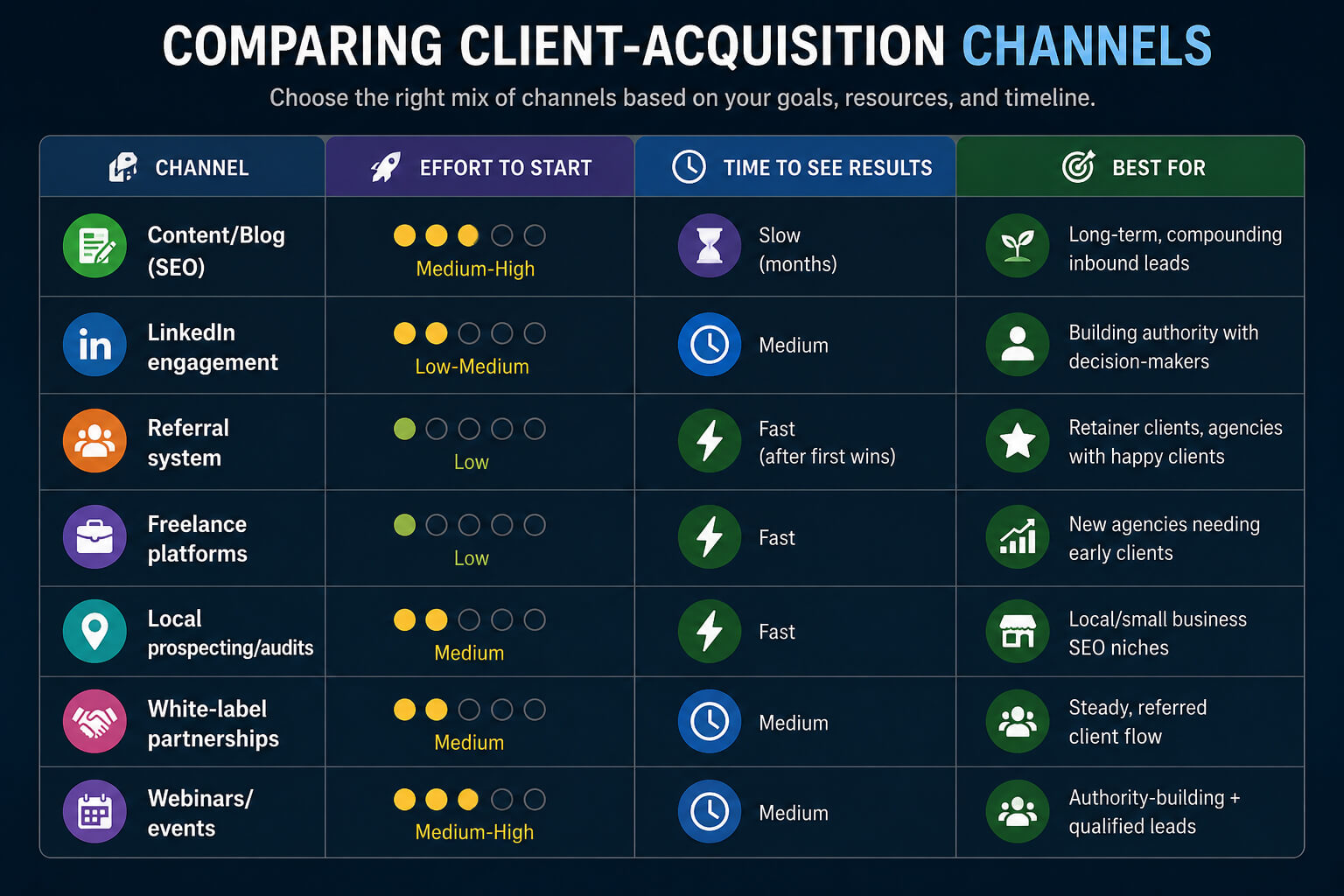
| Channel | Effort to Start | Time to See Results | Best For |
| Content/Blog (SEO) | Medium-High | Slow (months) | Long-term, compounding inbound leads |
| LinkedIn engagement | Low-Medium | Medium | Building authority with decision-makers |
| Referral system | Low | Fast (after first wins) | Retainer clients, agencies with happy clients |
| Freelance platforms | Low | Fast | New agencies needing early clients |
| Local prospecting/audits | Medium | Fast | Local/small business SEO niches |
| White-label partnerships | Medium | Medium | Steady, referred client flow |
| Webinars/events | Medium-High | Medium | Authority-building + qualified leads |
Choose a Service Model That Attracts the Right Clients
How you structure your services shapes who finds you and how they evaluate you.
White-label SEO partnerships are one option — partnering with web design firms, marketing agencies, or PR companies that don’t offer SEO themselves, and becoming their behind-the-scenes SEO resource. This can create a steady stream of referred work without you having to find every client yourself.
Freelance platforms like Upwork and Fiverr are another entry point, especially for newer agencies. A profile focused on one specific niche — such as local SEO for home service businesses — tends to stand out more than a generic profile claiming to do everything.
Some agencies also use performance-based pricing, tying part of their fee to measurable results rather than charging a flat rate regardless of outcome. This can appeal to prospects who are cautious about committing to an unproven provider, since it signals confidence in your process.
Build a Referral System, Don’t Just Hope for Referrals
Referrals rarely happen automatically — they tend to work best when there’s a simple, repeatable system behind them.
The best time to ask is right after a clear, visible win — a keyword moving into the top results, a noticeable increase in leads, or a milestone the client themselves is excited about. Being specific in the ask helps too: rather than a vague “let me know if you hear of anyone,” try asking directly whether they know one or two other business owners who’ve mentioned struggling with online visibility.
Keep the incentive simple and appropriate to the relationship — a discount on an ongoing retainer, or a complimentary audit for a one-off project. A short, ready-to-forward message or referral link makes it easy for a happy client to actually follow through.
Combine Multiple Channels Into One System
No single tactic reliably fills a pipeline on its own — a mix of channels working together tends to perform more consistently. Blog content can bring in organic traffic, LinkedIn activity builds visibility with decision-makers, and involvement in local business communities — such as Chamber of Commerce events or local meetups — creates warm, in-person introductions.
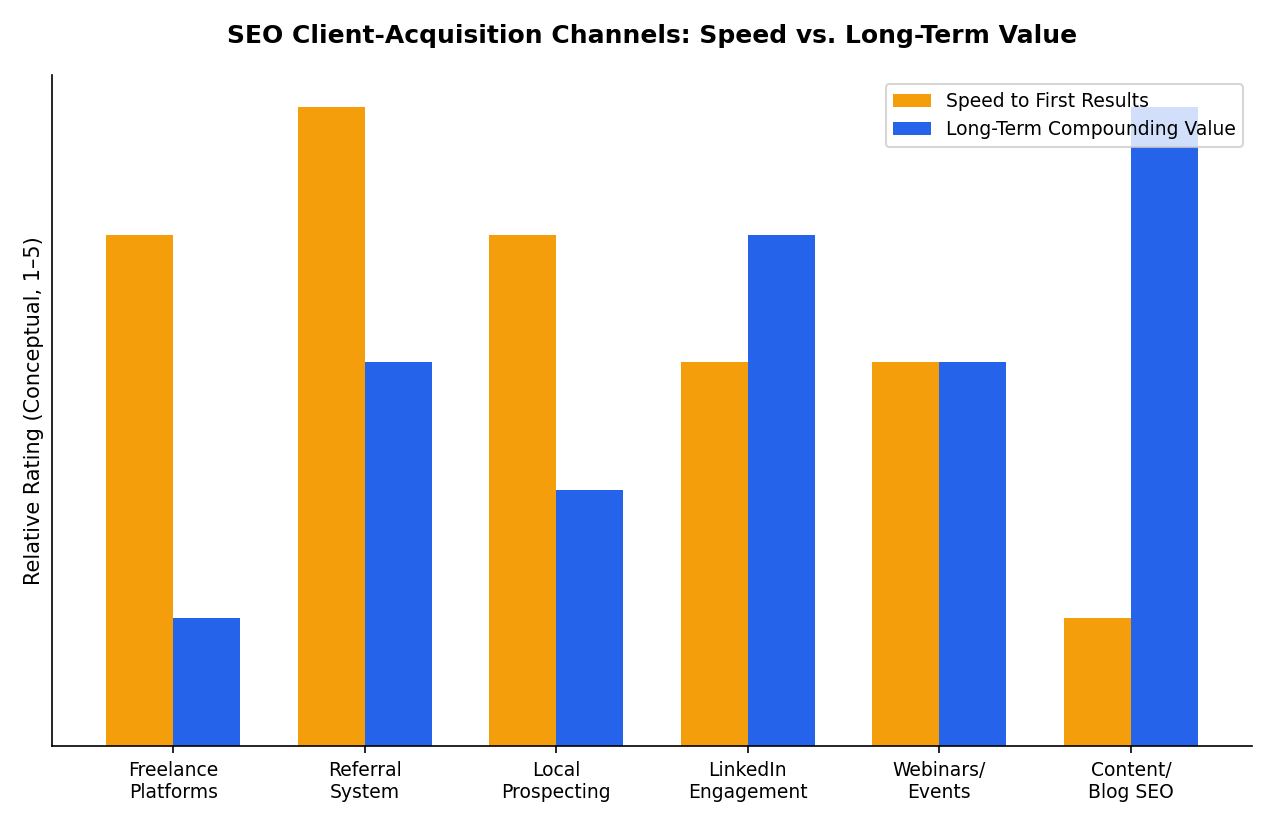
A general, conceptual comparison — not measured data. Faster channels like freelance platforms and referrals tend to produce early results, while content-driven SEO typically takes longer but compounds more over time.
Speaking at a webinar or local event serves two purposes at once: it generates direct leads from attendees, and it builds the kind of third-party visibility that supports your broader authority online. Partnering with a complementary service provider — like a paid ads agency or web design firm — on a joint webinar can also introduce you to an audience you wouldn’t reach alone.
Use Freelance Platforms and Local Prospecting Thoughtfully
On platforms like Upwork and Fiverr, specificity tends to outperform generalism. A profile clearly focused on one service — such as Google Business Profile optimization for a specific industry — is often more convincing than one claiming broad expertise in everything.
Local prospecting can also work without feeling like cold outreach. Identifying a local business that’s ranking on page two of Google, running a quick, free audit of their site or Google Business Profile, and sharing what you found is a value-first approach — you’re starting the conversation with evidence of a specific, fixable problem rather than a generic pitch.
Common Mistakes to Avoid
Even with the right channels, a few habits quietly undermine client-acquisition efforts:
- Pitching before providing value. Reaching out with a sales message before ever engaging genuinely tends to get ignored.
- Chasing every lead equally. Without a clear ICP, time gets spent on prospects who were never a good fit to begin with.
- Inconsistent content publishing. A blog that posts sporadically loses the compounding effect that makes content marketing work in the first place.
- No referral system. Waiting for referrals to happen naturally, instead of asking specifically and at the right moment, leaves a reliable channel underused.
- Ignoring follow-up. Inbound leads still need timely follow-up — a slow response can lose a warm lead as easily as a cold one.
- Generic freelance-platform profiles. A profile claiming to do “all types of SEO” tends to blend in; a focused, niche profile stands out.
- No tracking. Without measuring which channel actually produces clients, it’s easy to keep investing time in a channel that isn’t working.
Track What’s Actually Working
Running a client acquisition strategy without measuring it is mostly guesswork. A few categories of metrics are worth tracking consistently:
- Pipeline metrics — how many inbound leads you’re getting each week, which channels they’re coming from, and how many turn into an actual conversation.
- Business metrics — how much it costs to acquire a client, how much a client is worth over time, and what share of new business comes from referrals.
- Content metrics — organic traffic, how content ranks for target keywords, and how many people engage with lead magnets like a free audit offer.
Reviewing these regularly helps you see which channels are genuinely producing results, so you can invest more time where it’s working and adjust where it isn’t.
When It’s Time to Bring in Extra Help
At a certain point, handling both client delivery work and consistent outreach becomes difficult for one person or a small team. A common signal is having qualified leads that aren’t getting timely follow-up because delivery work is taking priority.
At that stage, options include hiring someone dedicated to outreach, partnering with a specialist outreach or white-label firm, or exploring tools that can help manage initial conversations at scale. There’s no single right answer — it depends on your team’s capacity and how quickly your pipeline is growing.
FAQs About Getting SEO Clients Without Cold Calling
Is cold calling completely ineffective for SEO agencies? Not necessarily ineffective, but it tends to be less efficient for this specific service — prospects often question why an SEO agency would rely on cold calling instead of demonstrating its own inbound skills.
What kind of content works best for attracting SEO clients? Content built around buyer-intent phrases — questions and problems your ideal client is actively searching for — tends to convert better than broad, general topics.
How do you use LinkedIn without seeming pushy? Engage genuinely before reaching out — comments, posts, and visibility over time — so that outreach, when it happens, feels like a continuation of a conversation rather than a cold pitch.
Do freelance platforms like Upwork still work for finding SEO clients? They can, particularly with a narrow, specific profile focused on one niche or service rather than general SEO expertise.
How soon should you expect results from these strategies? Content and referral-based strategies tend to build gradually rather than instantly — most of these channels compound over weeks and months rather than producing immediate results.
Read This Blog: https://linkneon.com/local-seo-for-taxi-companies/
Final Thought
Getting SEO clients without cold calling isn’t really a shortcut — it’s a different kind of consistency. Instead of interrupting strangers, you’re building content, relationships, and a reputation that bring the right people to you already interested. None of these channels work instantly on their own, but layered together — content, LinkedIn, referrals, local prospecting, and clear tracking — they tend to compound over time in a way cold calling never quite does. Start with one channel, do it consistently, and build from there.
Cold-calling and inbound conversion figures referenced in this article are based on 2025–2026 industry data compiled by Cognism, Martal, and LeadResponse (citing HubSpot’s 2026 marketing statistics).