

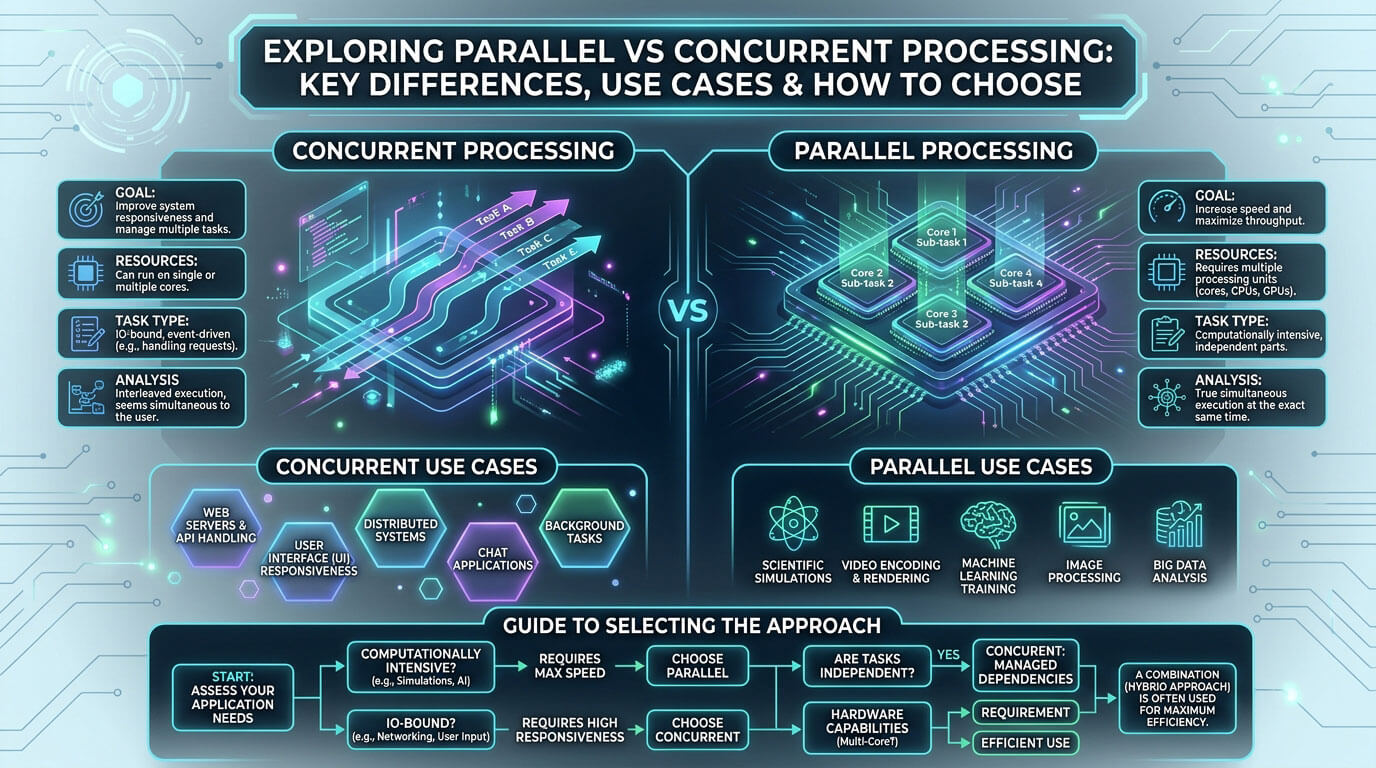
Two terms get mixed up constantly in software design conversations: concurrency and parallelism. Parallel vs concurrent processing sounds like a single question, but it’s really two related ones – how a system structures multiple tasks, and how many physically run at the same instant.
Get the distinction wrong and you’ll either over-engineer a simple I/O-bound service with threading complexity it doesn’t need, or under-power a compute-heavy job sitting idle on cores it never touches.
This article covers what separates parallel vs concurrent processing, where each helps, and how they show up in real systems – from a Python script using asyncio to Oracle E-Business Suite distributing jobs across a cluster.
It also covers the hardware classification system, common pitfalls, why speedup has mathematical limits, and a straightforward way to decide which approach fits a given workload.
What Is Parallel Processing?
The other half of parallel vs concurrent processing: parallel processing means literally running multiple tasks at the same instant, on separate physical processing units – separate CPU cores, separate machines, or GPU threads.
The task is split into independent chunks, each chunk runs on its own core, and the results are combined when everything finishes. Unlike concurrency, parallel processing has a hardware requirement: without at least two execution units, true simultaneous execution isn’t possible.
This is the model for CPU-bound work – tasks where the bottleneck is computation, not waiting. Training a machine learning model, rendering a 3D animation frame-by-frame, or running a large climate simulation all benefit from splitting work across cores. The goal: finish a large computation faster by throwing more processing power at it simultaneously.
What Is Concurrent Processing?
Concurrent processing structures a program so multiple tasks can make progress without waiting for each other to finish. It doesn’t require multiple processors – a single CPU core can run one task, pause it, switch to another, and cycle back, fast enough that everything looks like it’s happening at once. This switching is called context switching, and the operating system handles it constantly.
The point of concurrent processing isn’t raw speed – it’s responsiveness. A web server juggling thousands of client requests, a mobile app downloading data in the background while the interface stays usable, a chat client waiting on a network response without freezing – these are concurrency problems.
The tasks spend most of their time waiting on something external, so interleaving them keeps the system busy. This category of workload is often called I/O-bound, since the bottleneck is waiting on input/output rather than computation.
Parallel vs Concurrent Processing – Key Differences
The two models solve different problems, and in parallel vs concurrent processing, the differences show up clearly once you compare them side by side.
| Dimension | Concurrent Processing | Parallel Processing |
| Task Behavior | Tasks interleave, making independent progress | Tasks execute at the exact same moment |
| Hardware Requirement | Works on a single core via time-sharing | Requires multiple cores, processors, or machines |
| Primary Goal | Responsiveness, coordination, multitasking | Raw throughput, faster computation |
| Best Suited For | I/O-bound work (network calls, user interaction) | CPU-bound work (data processing, simulations) |
| Common Tools | Event loops, async/await, message queues | Multiprocessing, GPU compute, MPI clusters |
(Source: Gem Corp; GloryCloud; Everconnect)
Programming complexity differs too in parallel vs concurrent processing. Concurrent systems mean managing shared state and task scheduling – developers work with threads, event loops, and message queues, and the main risk is tasks stepping on each other’s data. Parallel programming introduces a different headache: splitting work evenly, keeping results consistent, and minimizing communication overhead between processors.
Common Misconception – Does Concurrency Always Mean Parallelism?
Not quite, and this is where parallel vs concurrent processing confuses people most. All parallel systems are concurrent – if tasks run at the same instant, they’re also making independent progress. But concurrency doesn’t require parallelism – a single-core system running an event loop handles concurrent tasks without ever executing two instructions simultaneously (Source: Everconnect; GloryCloud). Node.js is a practical example: a single JavaScript thread handles code execution, yet it manages thousands of concurrent connections by offloading I/O to the system kernel and a background thread pool (Source: Node.js official documentation). Parallelism is hardware doing more than one thing at once; concurrency is software structure allowing multiple things to be in progress.
Flynn’s Taxonomy: Classifying Parallel Architectures

Parallel hardware isn’t one category – computer architects classify it using a 1960s scheme called Flynn’s Taxonomy, based on how many instruction and data streams a system processes at once.
- SISD (Single Instruction, Single Data): A traditional single-core processor. The baseline, non-parallel case.
- SIMD (Single Instruction, Multiple Data): One instruction applies to many data points at once. GPUs work this way, which is why they excel at image processing and matrix math.
- MISD (Multiple Instruction, Single Data): Multiple processors run different instructions on the same data stream. Rare outside fault-tolerant systems like redundant flight-control computers that cross-check each other.
- MIMD (Multiple Instruction, Multiple Data): Multiple processors run independent instructions on independent data – most modern multi-core CPUs and server clusters fall here.
This explains why some tasks map cleanly onto GPUs (SIMD-friendly, like rendering) while others need general-purpose multi-core CPUs (MIMD-friendly, like independent microservices).
Benefits of Parallel and Concurrent Processing
- Faster completion for large workloads — splitting a computation across cores cuts wall-clock time for data-heavy jobs.
- Better resource utilization — idle CPU cores or network wait time get put to use.
- Improved responsiveness — concurrent systems keep handling new requests instead of blocking on one slow operation.
- Scalability — adding more cores or nodes increases capacity for workloads designed with that flexibility in mind.
- Fault tolerance in distributed setups — a node failure doesn’t necessarily take down the whole job, in systems designed with failover in mind (Source: Everconnect).
None of these are automatic – badly structured concurrent or parallel code can introduce more overhead than it saves.
Challenges & Common Pitfalls in Parallel vs Concurrent Processing
Race Conditions
A race condition happens when two or more tasks access shared data at the same time, and the result depends on the unpredictable order they execute in. A classic example: two threads both read a counter’s value, increment it, and write it back – one increment gets silently lost. Race conditions are hard to debug since they rarely show up in testing and appear only intermittently under real load.
Deadlocks
A deadlock occurs when two or more tasks each hold a resource the other needs, and neither can proceed. Task A holds Lock 1 and waits for Lock 2; Task B holds Lock 2 and waits for Lock 1 – both wait forever. Deadlocks are typically avoided through consistent lock ordering, timeouts, or higher-level concurrency primitives.
Synchronization Overhead
Coordinating shared access to data – through locks, semaphores, or message passing – isn’t free. Every synchronization point adds latency, and in systems with heavy contention, the overhead of coordinating threads can outweigh the benefit of parallel execution.
This is why fine-grained parallelism (small units) sometimes performs worse than coarse-grained parallelism (larger chunks, less coordination) – communication cost between small tasks eats into the time saved.
Amdahl’s Law: Why Parallel Speedup Has Limits
Adding more cores doesn’t scale a task’s speed indefinitely, and there’s a formula for why. Amdahl’s Law, proposed by computer architect Gene Amdahl in 1967, states that the maximum speedup from parallelizing a task is capped by the portion that must still run sequentially: S(N) = 1 / ((1 − P) + P/N), where P is the fraction of the task that can be parallelized and N is the number of processors.
If 95% of a task can run in parallel but 5% can’t, even unlimited processors cap the speedup around 20x – the sequential 5% becomes the bottleneck regardless of parallel hardware.
This is the mathematical reason “nearly linear” scaling is rare in practice, and why profiling which part of a workload is sequential matters more than simply adding cores (Source: Amdahl, 1967).
Tools & Frameworks by Language
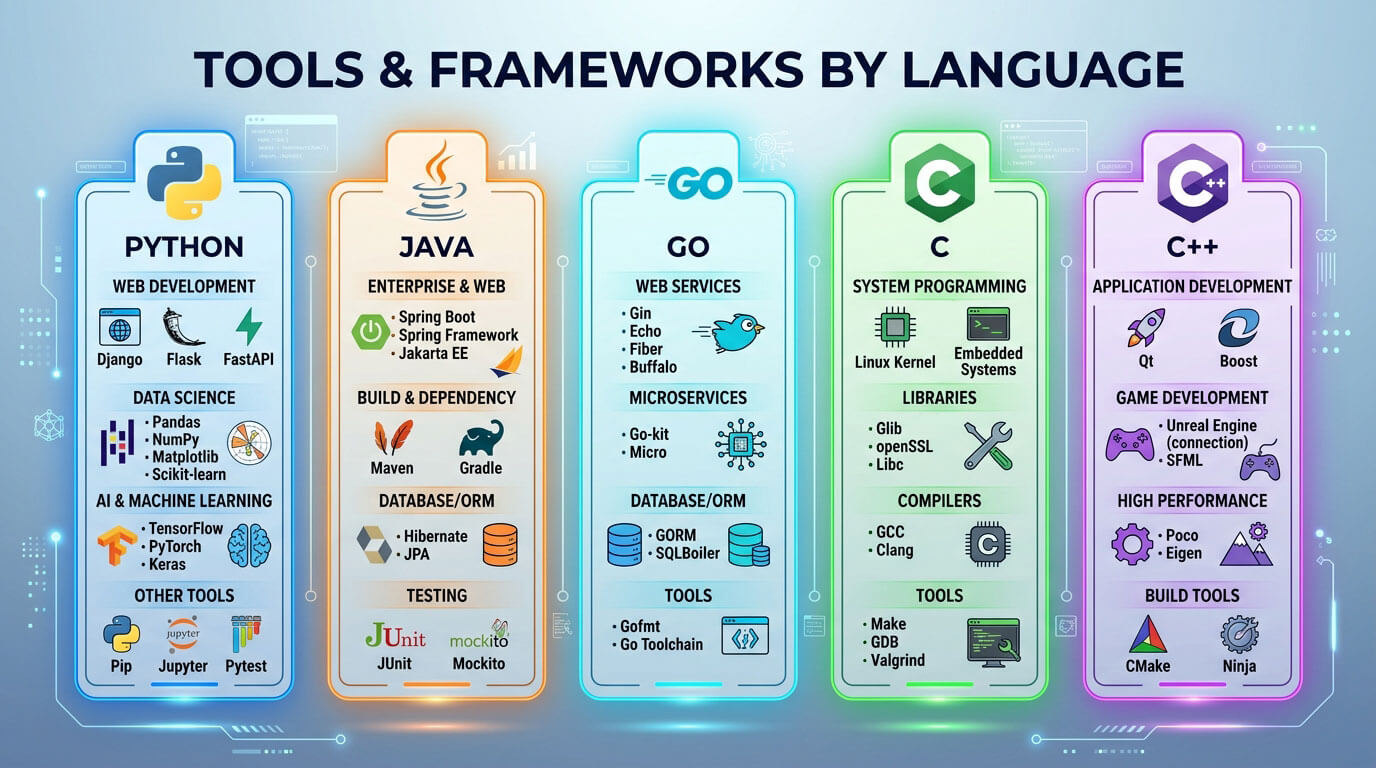
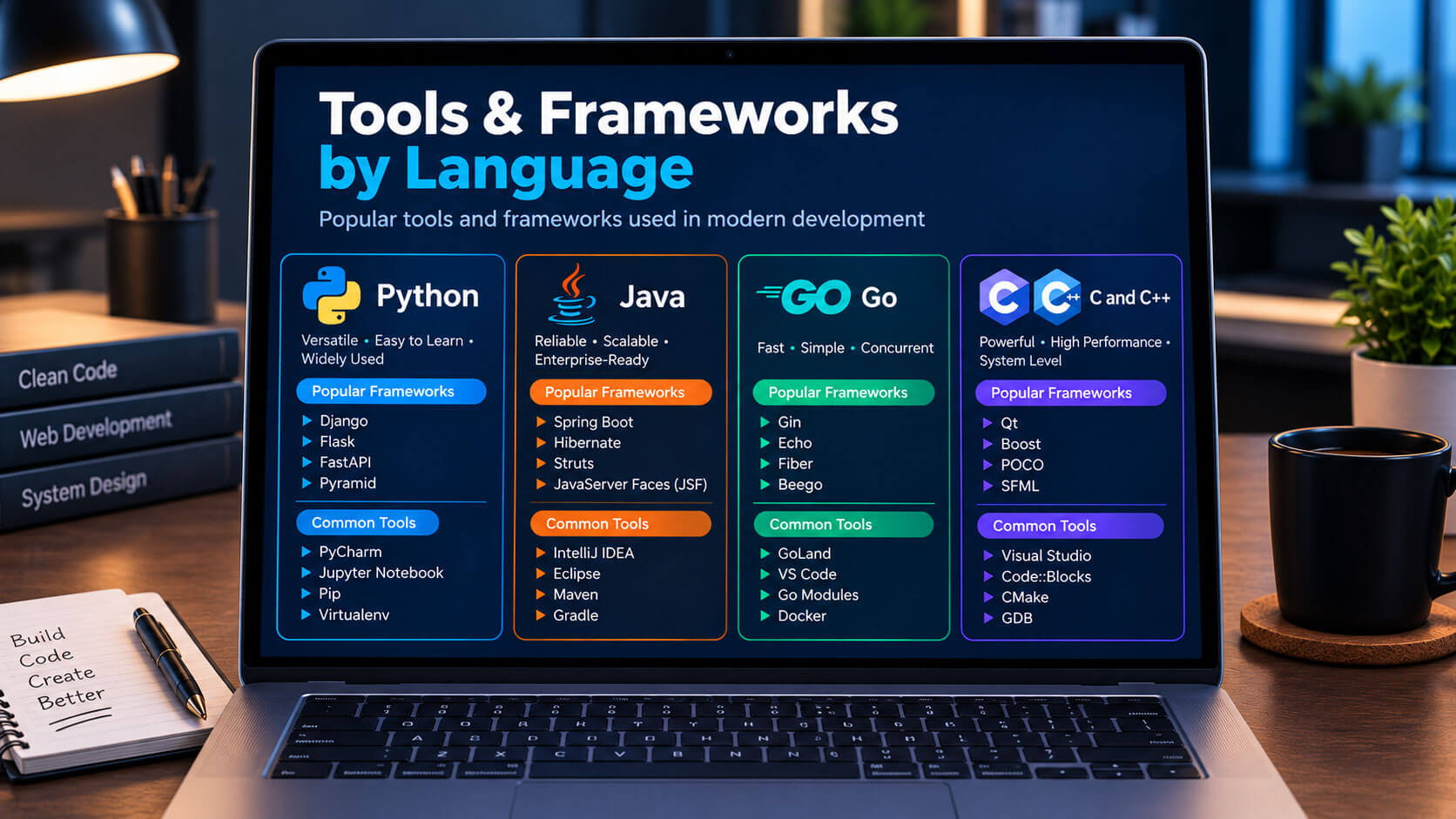
Every major language approaches parallel vs concurrent processing differently, and the right tool depends on which model the workload needs.
Python
Python separates the two cleanly. asyncio handles concurrency for I/O-bound work using an event loop and async/await syntax. For CPU-bound parallel work, the multiprocessing module spins up separate processes, each with its own interpreter, sidestepping the Global Interpreter Lock (GIL) that otherwise blocks true multi-core parallelism within a process. concurrent.futures.ThreadPoolExecutor sits in between, useful for I/O-bound tasks that benefit from a simple thread-based interface (Source: GloryCloud; CodeWithC).
This is changing. Since Python 3.13 (2024), CPython has supported an experimental free-threaded build that disables the GIL entirely, and as of Python 3.14, that mode is officially supported – no longer experimental – under PEP 779, though not yet the default build (Source: Python official documentation).
Java
Thread and ExecutorService manage concurrent execution through thread pools. Since Java threads run on separate cores without Python’s GIL limitation, the same threading model supports both concurrent and genuinely parallel workloads.
Go
Go was built with concurrency as a first-class feature. Goroutines are lightweight, independently scheduled functions – far cheaper to create than OS threads – and channels handle communication between them safely, cutting down on manual locking.
C and C++
OpenMP handles shared-memory parallelism within a single machine, adding parallel execution to existing loops with minimal code changes. MPI (Message Passing Interface) handles distributed-memory setups, where separate machines communicate by explicitly passing messages. The standard approach in high-performance computing clusters (Source: CodeWithC).
Real-World Use Cases
- Machine learning training: For many large models, splitting matrix operations across GPU cores cuts training time from days down to hours.
- Enterprise financial closing: Journal entries, currency revaluations, and intercompany eliminations run across separate nodes, each handling a specific ledger (Source: Gem Corp).
- Insurance claims processing: Eligibility checks, document verification, and payment validation distribute across separate job queues so one slow step doesn’t block the pipeline (Source: Gem Corp).
- Digital commerce fulfillment: Order capture, stock validation, and delivery coordination process independently across warehouses, letting retail platforms handle more requests without queuing delays (Source: Gem Corp).
- Manufacturing order management: Job queues for order creation, component checks, and dispatch requests distribute across nodes tied to a specific plant (Source: Gem Corp).
- Video rendering: Each frame processes independently, so rendering software generally scales well with added cores, though coordination overhead keeps it short of perfectly linear.
Parallel Concurrent Processing in Oracle E-Business Suite
Outside general computer science, “parallel concurrent processing” has a specific, narrower meaning inside Oracle E-Business Suite (EBS), where it refers to distributing background jobs – called concurrent requests – across multiple application nodes instead of one machine (Source: Everconnect; GloryCloud).
How It’s Structured
An EBS deployment runs concurrent managers. Processes that execute scheduled jobs on multiple nodes at once. Administrators assign each manager a primary and secondary node; if the primary fails, managers migrate automatically to the secondary.
Three environment types support this: clustered systems (shared disk pool), massively parallel systems (multiple nodes in one hardware platform), and homogeneous networked systems (identical machines on a LAN sharing a database) (Source: Everconnect; Gem Corp).
A Real Security Consideration
This isn’t purely theoretical. In October 2025, Oracle disclosed CVE-2025-61882, a critical (CVSS 9.8) unauthenticated remote code execution vulnerability in the Concurrent Processing / BI Publisher Integration component of EBS versions 12.2.3 through 12.2.14. The flaw was actively exploited in the wild reportedly by the Cl0p ransomware group before Oracle’s patch shipped. It’s a reminder that infrastructure coordinating concurrent processing at scale is part of the attack surface, not just a performance concern.
Choosing Between Parallel and Concurrent Processing
A simple way to frame the decision:
- Mostly waiting on external systems? Lean toward concurrency an event loop or async model uses resources efficiently without extra hardware.
- Mostly heavy computation? Lean toward parallelism – spread the work across cores or machines to cut processing time.
- Both at once? Common in practice a web server (concurrent) that offloads a CPU-heavy report job to a worker pool (parallel) is a normal pattern, not an edge case.
A reasonable approach for teams new to parallel vs concurrent processing decisions is to profile the workload first. If most time is spent waiting rather than computing, adding parallelism won’t help the bottleneck isn’t CPU cycles. Throwing more concurrency at a CPU-bound task doesn’t speed up the math either; it just adds scheduling overhead.
Future Trends
Cloud-native architectures are pushing workloads toward hybrid models concurrency for coordinating requests across services, parallelism for compute-heavy work offloaded to worker pools or GPU instances. Quantum computing remains an early-stage but closely watched development, since quantum systems handle certain problems through fundamentally different principles than classical multi-core hardware, though general-purpose use is still emerging.
Frequently Asked Questions
Is parallel processing always faster than concurrent processing?
Not for every task. Parallel processing speeds up CPU-bound work by splitting computation across cores, but for I/O-bound tasks, concurrency is usually the more efficient model, since adding more processors doesn’t make a network response arrive faster.
Can a system be parallel without being concurrent?
In practice, no. If multiple tasks execute at the same time, they’re also, by definition, making independent progress which is what concurrency describes. Parallelism is concurrency with the added requirement of simultaneous hardware execution.
What causes a race condition, and how is it usually prevented?
A race condition happens when multiple tasks access shared data without coordination, and timing determines the outcome. It’s typically prevented with locks, atomic operations, or by giving each task its own copy of the data.
Does Python support true parallelism?
The traditional GIL limits true multi-core parallelism for CPU-bound code within a single process, though multiprocessing works around this with separate processes, and Python 3.14’s free-threaded build can now disable the GIL directly (see the Python section above for details).
What’s the difference between multithreading and multiprocessing?
Multithreading runs multiple threads within a single process, sharing memory useful for concurrency, especially I/O-bound work. Multiprocessing runs separate processes with independent memory, necessary for true CPU parallelism in languages like Python.
Is Oracle’s “Parallel Concurrent Processing” the same as the general computing concept?
Related but more specific. Oracle’s PCP distributes background job processing across multiple application nodes, combining concurrency (jobs progressing independently) and parallelism (nodes executing simultaneously) within one enterprise architecture.
How do I decide between fine-grained and coarse-grained parallelism?
Fine-grained parallelism splits work into many small tasks, balancing load evenly but adding coordination overhead. Coarse-grained parallelism uses fewer, larger chunks, reducing overhead but risking uneven load. The right choice depends on how expensive coordination is relative to the computation itself.
Read More: https://linkneon.com/free-magento-themes-2026/
Conclusion
Parallel vs concurrent processing isn’t about picking the “better” model, it’s matching the model to the workload. Concurrency solves coordination and responsiveness problems for I/O-bound work, without needing special hardware. Parallelism solves throughput problems for CPU-bound work, and requires multiple execution units to deliver real gains.
Most production systems use both at different layers exactly what Python’s asyncio plus multiprocessing, or Oracle’s concurrent managers spread across clustered nodes, are built to support. Before reaching for either one, profile where the bottleneck sits waiting or computing since that answer determines which model is worth the added complexity.