


The Ben Stace semantic SEO writing tool is a content optimization tool that helps writers cover a topic through meaning, context and user intent instead of repeating one keyword. It was created by Ben Stace, a UK-based semantic SEO consultant and the founder of Eleven Bananas, whose work centers on topical authority and entity-based content.
This guide explains who is behind the tool, what it does, who it suits, and how to use it step by step with a practical example. It also covers why semantic SEO matters now, the tool’s benefits and limitations, common mistakes, pricing and access, and how it compares with alternatives, so you can decide whether it belongs in your content workflow.
How the Tool Works and Where It Fits in Semantic SEO
Who Is Ben Stace?
Ben Stace is a semantic SEO consultant known for his work on topical authority, topical maps and entity-based content.
- He is reported to have worked in SEO since 1998, in competitive niches such as health, gaming, law and tech.
- He created two tools, Semantic SEO Writer and Semantic Scan.
- He has spoken at SEO conferences including CMSEO and Ubud SEO and Business.
The tool is often called “Semantic SEO Writer,” so you may see both names used for the same product.
What Is the Ben Stace Semantic SEO Writing Tool?
The Ben Stace semantic SEO writing tool is a content optimization platform that compares your draft with top-ranking pages, finds topic gaps, and suggests related terms. The goal is to cover a subject completely rather than repeat a single keyword.
For example, an espresso article that never mentions “crema” or “extraction time” would be flagged. That isn’t about keyword stuffing; those concepts simply belong in thorough coverage of the topic.
Semantic SEO Writer vs. Semantic Scan
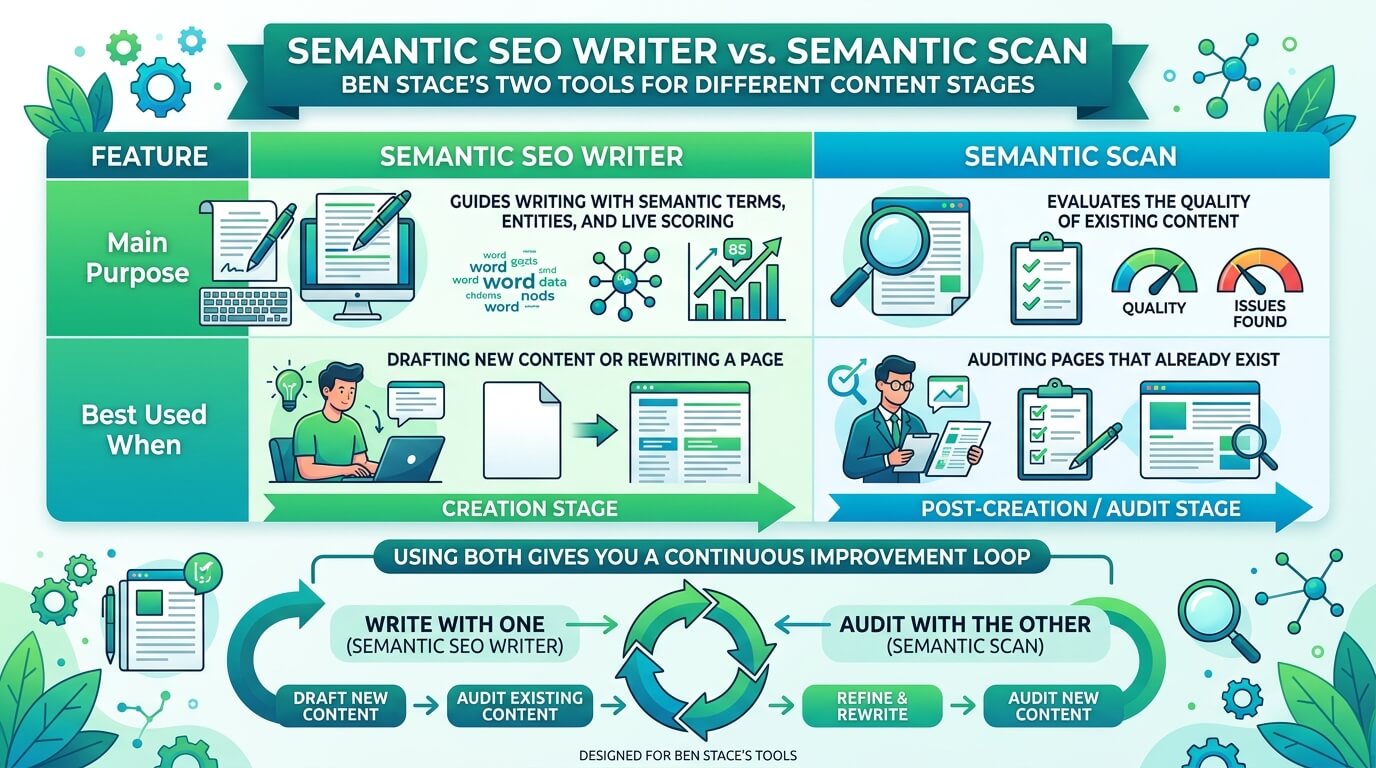
Ben Stace’s two tools serve different stages of the content process:
| Tool | Main Purpose | Best Used When |
| Semantic SEO Writer | Guides writing with semantic terms, entities and live scoring | Drafting new content or rewriting a page |
| Semantic Scan | Evaluates the quality of existing content | Auditing pages that already exist |
Using both gives you a loop: write with one, then audit with the other.
Key Features
| Feature | What It Does |
| Semantic term suggestions | Recommends related terms and synonyms based on top-ranking pages |
| Competitor analysis | Shows which concepts competing pages cover |
| Live content scoring | Scores your draft as you write and helps prevent over-optimization |
| Entity and topic coverage | Highlights missing concepts and entities |
| Internal linking suggestions | Points to linking opportunities between related pages |
| Readability feedback | Reviews sentence flow and paragraph balance |
The tool also supports topic cluster generation and search intent alignment. Its term extraction relies on NLP (natural language processing), the same kind of technology search engines use to understand language.
Who Should Use the Tool?
The semantic SEO writing tool is best suited to people who publish content regularly and care about topical depth:
- Bloggers and niche site owners building authority in one subject area.
- Freelance writers who want their drafts to meet SEO expectations before delivery.
- SEO professionals running content audits and topical map projects.
- Digital marketing agencies managing content for several clients.
It is less useful if you publish rarely, write mostly news, or need a full project management platform for a large content team.
How to Use the Tool
Once you enter a topic, the semantic SEO writing tool compares your draft with pages that already rank. A typical workflow looks like this:
- Research the topic. Enter your primary keyword and define your audience.
- Analyze competitors. The tool reportedly scans the top 20 search results.
- Build an outline. Group suggested subtopics into a logical structure.
- Write naturally. Use synonyms and related phrases where they fit.
- Finish on-page SEO. Add meta tags, headers, internal links and schema.
A Practical Example: Optimizing an Espresso Guide
Here is how that workflow might look for an article targeting “how to make espresso at home.” This is an illustration of the process, not a recorded test.
| Stage | What You Do | What the Tool Helps You Find |
| Research | Enter the primary keyword and set a home-barista audience | The core topic and reader level |
| Competitor analysis | Review which concepts top pages share | Terms such as grind size, tamping, crema and extraction time |
| Outline | Turn repeated concepts into sections | Subtopics such as equipment, dosing, brewing and troubleshooting |
| Writing | Explain each concept in plain language | Missing entities, like types of espresso machines or burr grinders |
| On-page SEO | Link to related guides and add schema | Opportunities to link to guides on coffee beans or milk frothing |
The result is an article that answers the full question a home barista has, not one that repeats “espresso at home” twenty times.
Why Semantic SEO Matters
Search engines now judge whether content covers a topic in depth, not just whether it repeats exact keywords. Three Google updates drove this shift:
| Google Update | Year | Focus |
| Hummingbird | 2013 | Interpreting the meaning of whole queries |
| BERT | 2019 | Understanding word context in natural language |
| MUM | 2021 | Understanding complex information across formats and languages |
As a result, pages that cover a whole topic can rank for many related queries, while exact-match targeting loses ground.
Importance of Search Intent
Search intent is what the user actually wants from a query. Most intent falls into four types:
| Intent Type | What the User Wants | Example Query |
| Informational | To learn something | “what is semantic SEO” |
| Navigational | To reach a specific site | “Ben Stace SEO website” |
| Commercial | To compare options before buying | “best semantic SEO tools” |
| Transactional | To take action or buy | “semantic SEO tool pricing” |
Content that matches the right intent, using the terms a reader expects, tends to earn stronger engagement and more relevant rankings. Semantic tools help by showing how top pages already meet that need.
Semantic vs. Traditional SEO
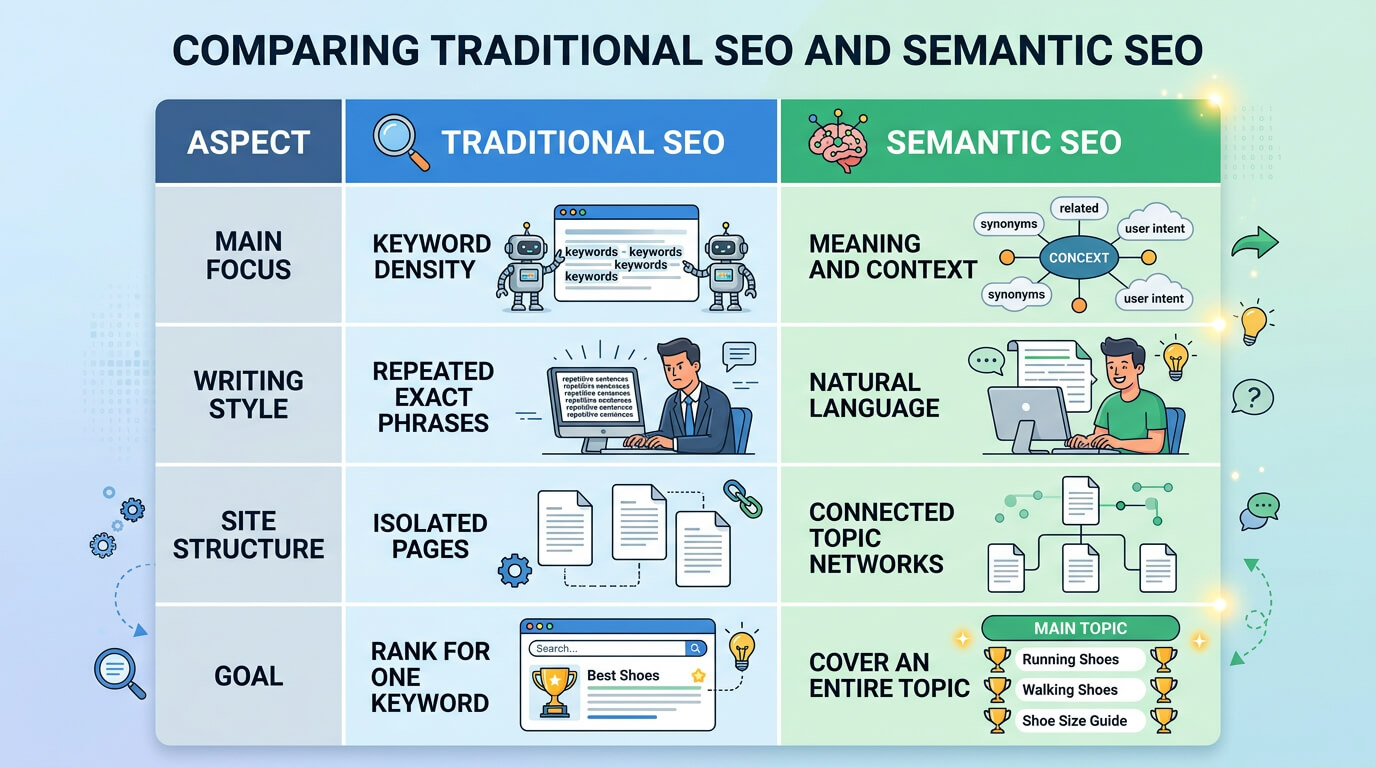
| Aspect | Traditional SEO | Semantic SEO |
| Main focus | Keyword density | Meaning and context |
| Writing style | Repeated exact phrases | Natural language |
| Site structure | Isolated pages | Connected topic networks |
| Goal | Rank for one keyword | Cover an entire topic |
Building Semantic Networks and Internal Linking
Internal links connect subtopics into topic clusters. This approach:
- Passes authority between related pages.
- Shows expertise across a whole subject.
- Makes the site easier to navigate.
Because the tool flags linking opportunities, building a semantic network takes less guesswork. Use descriptive anchor text that tells readers and search engines what the linked page covers.
Benefits
Manual research for a single article can take hours: opening competitor pages, noting shared concepts, and checking what each one misses. The tool compresses that work into a structured list of related terms, entities and subtopics, so you spend less time collecting data and more time writing. Its main value is that it makes comprehensive coverage repeatable, page after page, instead of depending on how thorough a writer happens to be that day.
- Deeper topical coverage and fewer missed concepts.
- Better readability through flow and structure feedback.
- Faster research than reviewing competitor pages by hand.
- Content shaped around user intent rather than keyword counts.
- More chances to appear for related searches and featured snippets.
Limitations
- Learning curve. The number of features, charts and scores can feel overwhelming if you’re new to SEO.
- No ranking guarantee. No semantic SEO writing tool can guarantee rankings. Authority, backlinks and content quality still matter.
- Suggestions need judgment. Adding every suggested term can make writing feel forced.
- Limited official documentation. Most available information comes from third-party reviews rather than official product pages.
Common Mistakes to Avoid
- Chasing a perfect score. A higher content score doesn’t always mean a better article. Stop when the topic is fully covered and the writing reads well.
- Copying competitor structure. Competitor pages show what to cover, not how to organize it. Build an outline around your reader’s questions.
- Ignoring intent. A commercial query needs comparisons and pricing, not a long definition.
- Skipping internal links. An optimized page that stands alone misses the topical authority a connected cluster builds.
- Never updating. Top-ranking pages change over time, so re-check important articles every few months.
Pricing and Access
Public pricing for the Ben Stace semantic SEO writing tool isn’t clearly listed. For current plans and access, check Ben Stace’s official website or contact Eleven Bananas directly.
Alternatives
| Tool | Best Known For |
| Surfer SEO | Content editor with optimization scoring |
| Frase | Research and content briefs |
| Clearscope | Content grading against top results |
| MarketMuse | Topic modeling and content planning |
| InLinks | Entity mapping and internal linking |
The Ben Stace tool puts more weight on user intent and topic coverage than on mechanical optimization scores. If you mainly need content briefs or team workflows, one of these alternatives may suit you better.
Implementation and Best Practices
- Write for readers first, and treat the tool’s suggestions as guidance rather than rules.
- Keep facts accurate and cite reliable sources for statistics.
- Start from search intent and answer questions in plain language.
- Cover related subtopics in depth instead of adding more keywords.
Why Local Businesses Need Semantic SEO
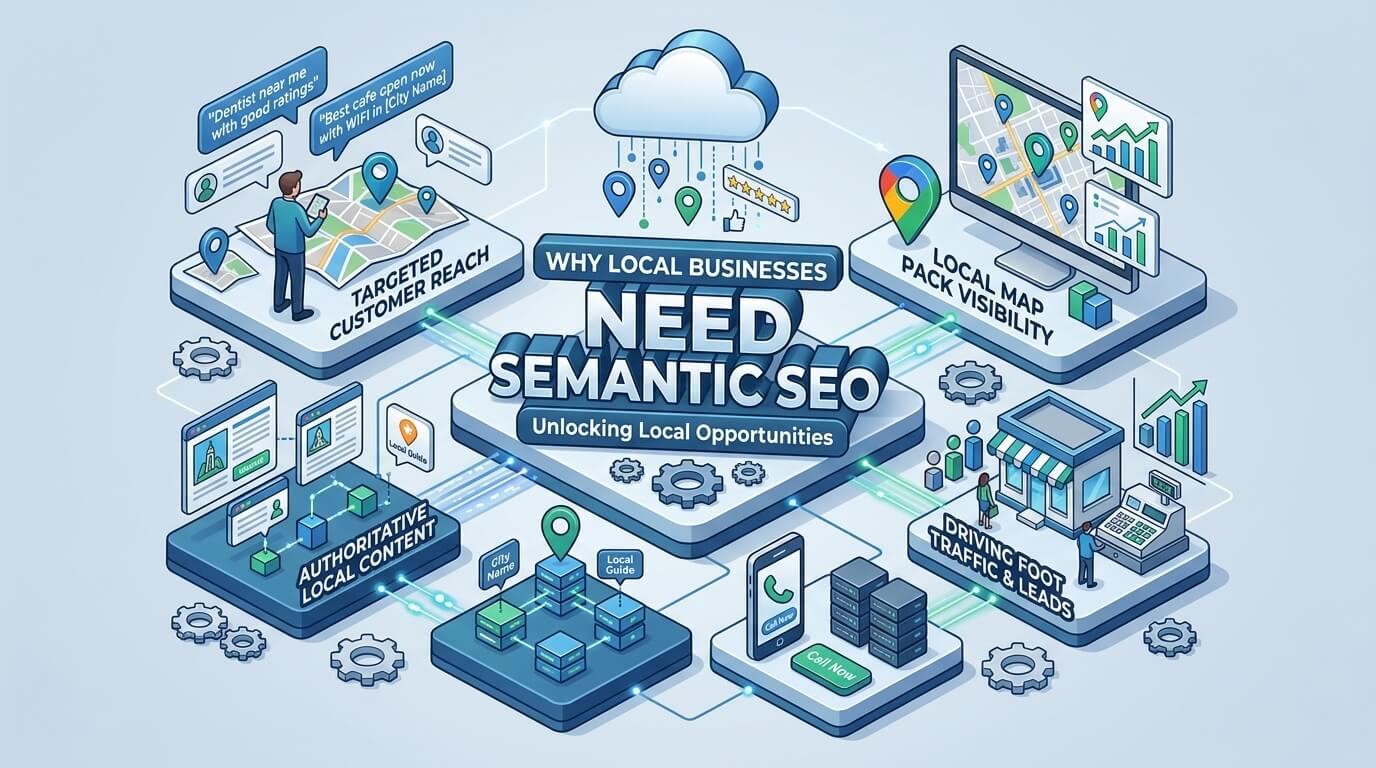
Google ranks local results mainly on relevance, distance and prominence. Semantic content supports the relevance factor, while a complete Google Business Profile, customer reviews and accurate business details drive most local visibility.
For local businesses, a semantic SEO writing tool can help service pages answer the questions nearby customers ask, including “near me” searches. Treat it as one part of a local strategy, not a replacement for profile optimization.
Case Studies and Results
Agencies publish client stories claiming traffic growth, page-one rankings and lower bounce rates after adopting semantic content workflows. These are self-reported and not independently verified, so treat them as examples, not benchmarks.
To measure your own results, compare these metrics in Google Search Console before and after optimizing a page:
- Impressions, to see whether the page appears for more queries.
- Number of ranking queries, a direct sign of broader topical coverage.
- Average position for the primary keyword and related terms.
- Click-through rate, to check that titles and snippets match intent.
Lessons from Real-World Use
The writers who get the most from semantic tools treat optimization as an ongoing process, not a one-time task. A page that was fully optimized six months ago may now miss concepts that new competitors cover, and search results for the same query can shift as user behavior and ranking signals change. The lessons below come down to one habit: let the data guide your decisions, but keep editorial judgment in charge of the final page.
- Keep monitoring and optimizing, because Google’s algorithm keeps changing.
- Review suggested terms before adding them. A term that fits the data but not the sentence hurts the reading experience.
- Start with pages that already get impressions but rank on page two. They usually respond fastest to better topical coverage.
Future of Semantic SEO and Trends
Search is moving from matching words to understanding concepts and the relationships between them. AI-powered search features now summarize answers directly in results, which means content must be clear, well structured and complete enough to be understood as a reliable source. Entity-based optimization and topical authority are likely to matter even more as search engines connect information across many pages instead of judging each page alone.
- Voice search favors question-and-answer structures.
- AI-driven search rewards content that explains topics clearly and completely.
- Google continues to weigh user experience, which makes full topic coverage more important.
Is the Ben Stace Semantic SEO Writing Tool Beginner-Friendly?
Opinions are mixed. Some users find it easy to use, while others say the number of scores can overwhelm beginners. Expect a short learning period.
Is the Ben Stace Tool Worth It?
It is worth considering if you publish content regularly and want deeper topical coverage. If you publish occasionally, the manual version of the same process may be enough: review top pages, list shared concepts and cover them in your own words.
Does the Ben Stace Tool Improve Rankings?
It improves topical coverage and relevance, which are two factors that support rankings. Like any semantic SEO writing tool, it works best alongside strong links and site authority.
Does the Ben Stace Tool Suggest Keywords and Topics?
Yes. It suggests related terms, synonyms, entities and subtopics based on competing pages.
Can the Ben Stace Tool Analyze Existing Content?
Yes. It can score pages you’ve already published and show which concepts are missing. For a deeper quality audit, Semantic Scan is built for that job.
Does the Ben Stace Tool Work With WordPress?
WordPress support is reported by reviewers but not officially confirmed. Check with the developer before you commit.
Key Takeaways
- The Ben Stace semantic SEO writing tool focuses on meaning, context and user intent rather than keyword density.
- It compares drafts with competing pages and suggests semantic terms, entities and subtopics.
- Live scoring and readability feedback help you avoid over-optimization while you write.
- Internal links and topic clusters turn separate pages into a connected semantic network.
- Hummingbird, BERT and MUM made topical depth more valuable than exact-match keywords.
- The tool strengthens relevance, but content quality and site authority still decide final rankings.
Read More: https://linkneon.com/b2b-seo-audit/
Final Thoughts
Semantic SEO has moved content strategy away from counting keywords and toward explaining topics completely. A semantic SEO writing tool fits that shift by showing which related concepts and questions your content is missing compared with competing pages.
Start from search intent, write in natural language for real readers, and use the tool to spot coverage gaps you might otherwise miss. Pair it with accurate facts, regular content updates and a sound internal linking strategy, and you’ll build pages that serve both search engines and the people using them.