

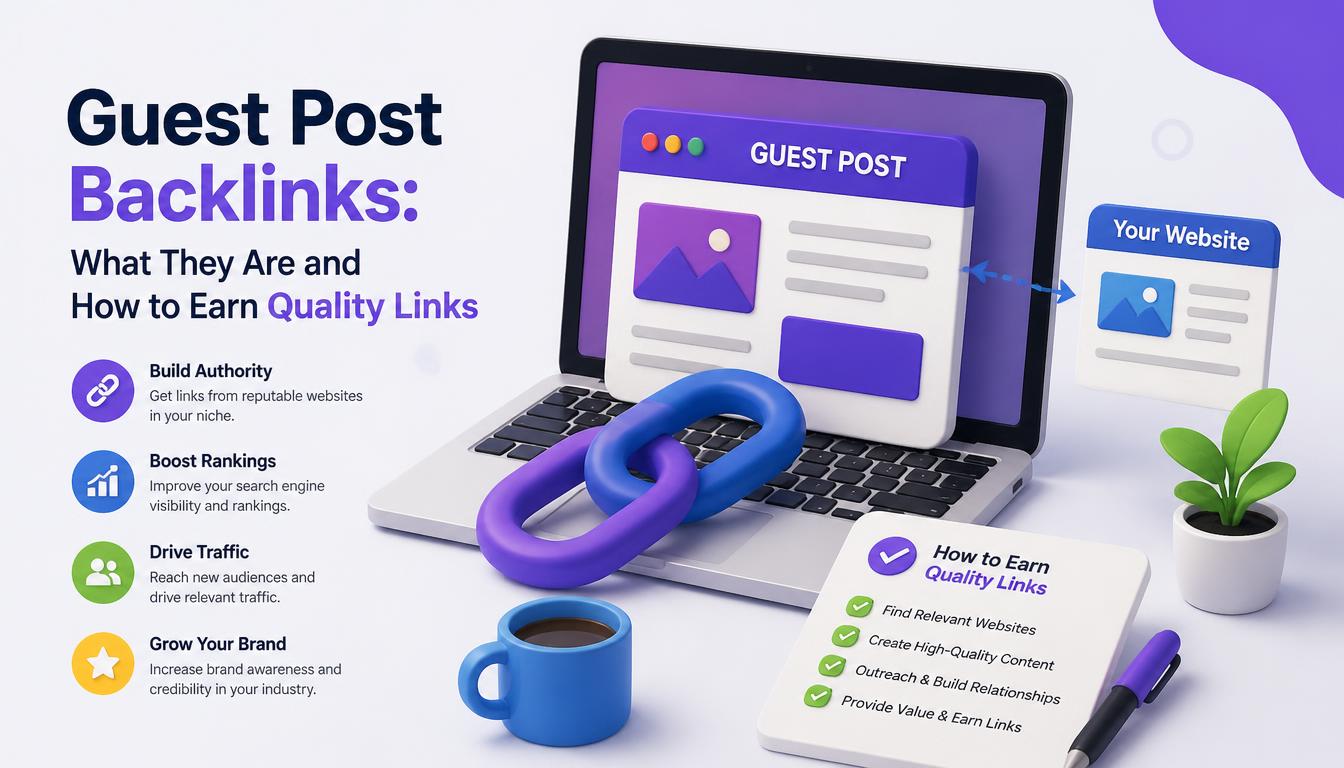
Guest post backlinks are links you earn by publishing an article on another website that points back to your own site. Search engines treat these contextual links inside editorial content as signals of trust, which is why they remain one of the most reliable ways to build domain authority, improve search rankings, and reach new audiences in your niche.
This guide explains what guest post backlinks are, why they still matter for SEO, and how Google’s link spam policy affects them. You’ll learn how to find and vet guest posting sites, pitch editors, write content that gets accepted, place links with the right anchor text, track results, and avoid the mistakes that waste time and effort.
What Are Guest Post Backlinks?
A guest post backlink is a hyperlink to your website placed inside an article you write for another publisher. The host site gets free, useful content for its readers, and you get a contextual backlink, brand exposure, and access to an established audience. The value depends on context: search engines evaluate the linking page, the linking domain, and the text around the link together, so a link inside a relevant article on a trusted publication carries far more weight than the same link in an unrelated post.
How Guest Posting Earns a Backlink
Guest posting, also called guest blogging, follows a simple exchange. You contribute an original article, the editor reviews it against their editorial guidelines, and the published version includes a link back to your site. That link usually appears either as an in-content link within the body of the article, where it carries the most contextual relevance, or as an author bio link in the short author byline at the top or end of the post.
For example, a SaaS company might write a marketing blog article about email automation and link to its own in-depth guide on the topic. Editors control what goes live, though. Many publications limit contributors to one or two outbound links, reserve the right to edit anchor text, or add a rel attribute of their choosing, so reading the host’s guidelines before you write saves revisions later.
Guest Posting vs. Link Insertion
Guest posting is often confused with link insertion, also called a niche edit. The difference is whether the content is new or already published.
| Factor | Guest Posting | Link Insertion |
| Content | A brand-new article | An existing, published article |
| Context | Written around your topic | Link fitted into existing text |
| Page history | New page, builds authority over time | Aged page with existing authority |
| Control over context | High | Limited |
Both tactics have a place in a link building strategy. Guest posting gives you full control over the context around your link, while link insertion borrows the page authority an older article has already earned, and many SEO teams use a mix of both to keep their backlink profile varied.
Why Guest Post Backlinks Still Matter for SEO
Links from other websites are still one of the main ways search engines judge whether a page is trustworthy, and Google’s original PageRank algorithm was built on that idea. That doesn’t mean every link helps equally. Search engines weigh relevance, authority, and link placement, so a handful of strong editorial links usually does more for rankings than dozens of weak ones from unrelated sites.
Higher Domain Authority and Search Rankings
Every relevant link from an authoritative site strengthens your link profile. Over time this lifts third-party scores such as Domain Authority (DA) from Moz and Domain Rating (DR) from Ahrefs, and more importantly, it helps your pages compete for competitive keywords in the SERPs. Authority that flows into one page can also pass to other pages through internal linking, lifting related content alongside the page that earned the link.
Keep in mind that DA and DR are estimates built by SEO tool providers. Google does not use them, so treat them as directional signals rather than ranking factors.
Referral Traffic from Niche Audiences
A guest post puts your brand in front of readers who already care about your topic. When they click your link, you get referral traffic from people who have already seen your expertise. To get the most from these visits, link to a page that continues the reader’s journey, such as an in-depth guide, a free tool, or a resource page, rather than a generic homepage.
Brand Credibility and Thought Leadership
Appearing on respected publications signals that others in your industry value your knowledge. Consistent contributions build brand credibility, brand awareness, and a reputation for thought leadership. Readers who see your name across several trusted publications begin to associate your brand with expertise, which can lead to more branded searches and partnership opportunities.
Stronger Keyword Relevance and Topical Signals
Links from sites in your niche, surrounded by text about your subject, send strong topical relevance signals. Search engines read the surrounding content and anchor text to understand what your linked page is about. This is why a link from a smaller site in your exact niche can outperform a link from a larger general site: the semantic context connects your page to the right topic cluster.
A Diverse, Natural Backlink Profile
A healthy backlink profile includes links from many referring domains, page types, and anchor text variations. Guest posting adds editorial links that diversify your link sources. A profile built from a single tactic or a narrow group of sites looks unnatural, while a mix of guest posts, brand mentions, and organic links signals genuine recognition.
| Benefit | What It Does for Your Site |
| Domain authority | Strengthens your link profile and ranking potential |
| Referral traffic | Sends targeted visitors from niche audiences |
| Brand credibility | Associates your brand with trusted publications |
| Topical relevance | Reinforces what your pages are about |
| Profile diversity | Adds editorial links from new referring domains |
Are Guest Post Backlinks Safe? Google’s Link Spam Policy
Guest post backlinks are safe when the content earns its place on the host site and the links are not built to manipulate rankings. Problems start when guest posting turns into a large-scale link scheme.
Google has warned about this for years. In 2014, then-head of webspam Matt Cutts declared that guest blogging done mainly for links had become a spammy practice. Guest posting itself never stopped, but Google now looks at the intent and pattern behind the links rather than the existence of a guest post, so quality and relevance decide whether a placement helps or creates risk.
What Google Considers a Link Scheme
Google’s spam policies list several practices under link spam. These include links with optimized anchor text in articles, guest posts, or press releases distributed on other sites, buying or selling links for ranking purposes, excessive link exchanges between sites, and using automated programs to create links. The common thread is intent: links created mainly to pass ranking credit rather than to help readers count as link spam regardless of format. The same policy notes that paid links are a normal part of advertising and sponsorship, and are not a violation when they are properly qualified.
Using rel=”sponsored” and rel=”nofollow” Correctly
In September 2019, Google introduced new link attributes so publishers could describe the nature of a link.
| Attribute | When to Use It |
| rel=”sponsored” | Paid placements, advertisements, and sponsored content |
| rel=”nofollow” | Links you don’t want to endorse or pass ranking credit to |
| rel=”ugc” | User-generated content such as comments and forum posts |
| No attribute (dofollow) | Editorial links the publisher chooses to vouch for |
To keep your guest posting strategy on the right side of these rules, write for relevant sites whose readers genuinely benefit from your article, use branded and natural anchor text instead of exact-match keywords, avoid repeating the same article or link pattern across many sites, and disclose paid placements as the host site requires. If you’re unsure how a placement should be marked, ask the publisher about their disclosure policy; reputable sites always have a clear one.
How Guest Post Backlinks Work: Step-by-Step Process
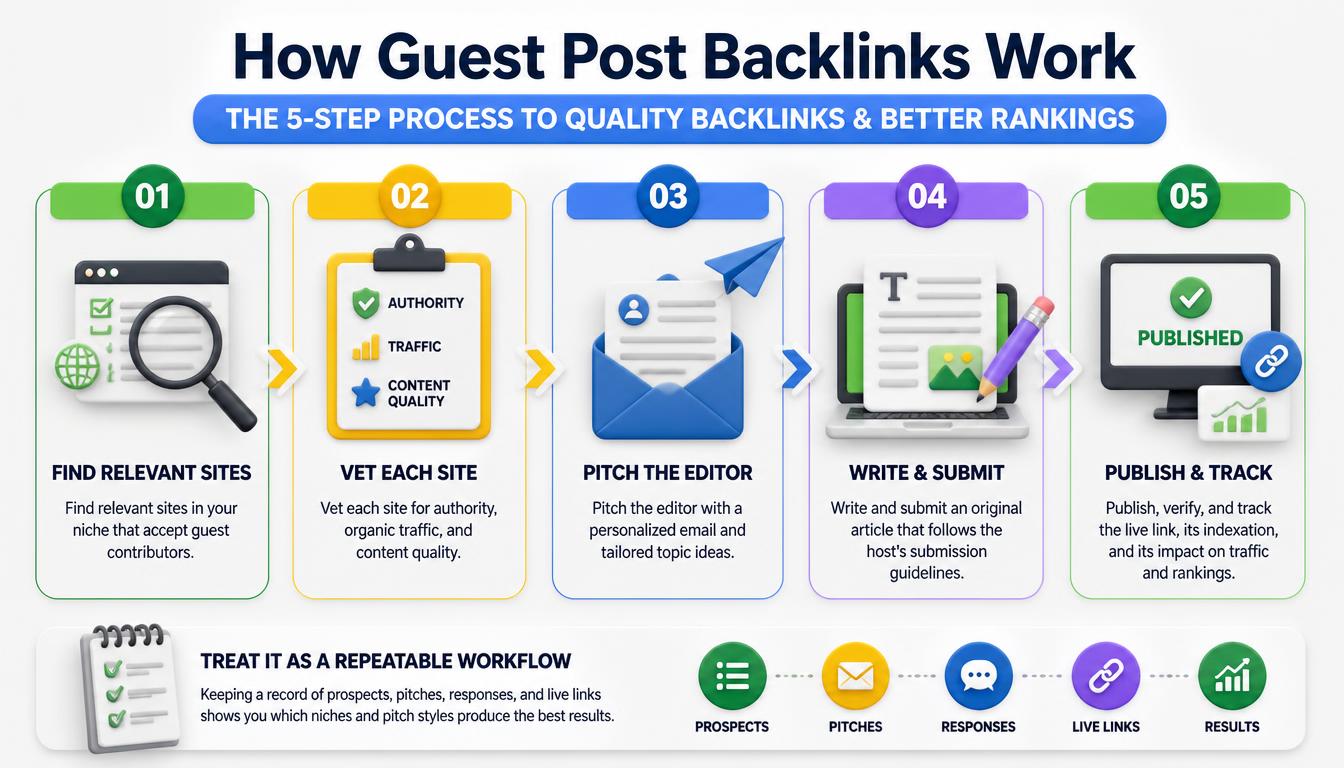
Every successful guest post moves through the same five stages, and the sections that follow explain each one in depth.
- Find relevant sites in your niche that accept guest contributors
- Vet each site for authority, organic traffic, and content quality
- Pitch the editor with a personalized email and tailored topic ideas
- Write and submit an original article that follows the host’s submission guidelines
- Publish, verify, and track the live link, its indexation, and its impact on traffic and rankings
Treat these stages as a repeatable workflow. Keeping a record of prospects, pitches, responses, and live links shows you which niches and pitch styles produce the best results.
How to Find Guest Posting Sites
The best guest posting opportunities come from three sources: targeted Google searches, SEO tools, and broken links on sites that already reference content like yours. Whichever method you use, build a prospect list that records each site’s niche, contact, and quality notes, so your outreach stays organized and you never contact the same editor twice.
Google Search Operators for Guest Post Opportunities
Search operators narrow Google results to pages that invite guest contributors. Combine each one with your niche keyword for tighter matches, such as “write for us” + “personal finance”.
| Search Query | What It Finds |
| “write for us” + keyword | Pages inviting guest submissions |
| “guest post guidelines” + keyword | Sites with published contributor guidelines |
| “become a contributor” + keyword | Publications recruiting regular writers |
| “guest post by” + keyword | Sites that have already published guest posts |
| inurl:write-for-us + keyword | URLs built for guest submissions |
| intitle:”submit a guest post” + keyword | Pages titled for guest submissions |
Treat these results as a starting point, not a shortlist. Pages that rank for these queries often receive heavy pitch volume, and some high-quality sites accept guest posts without advertising it, so every site still needs the quality checks in the next section.
Using SEO Tools to Discover Sites That Accept Guest Posts
SEO tools reveal opportunities that search operators miss. In Ahrefs Content Explorer, you can search for articles in your niche and check the author names to spot sites that publish outside writers. Competitor backlink analysis with Ahrefs Link Intersect or the Semrush Backlink Gap tool shows where competitors have earned guest posts, and a publication that accepted a competitor’s article has already shown it is open to contributions in your space. You can also research prolific guest authors in your niche and review where their bylines appear.
Broken Link Building as a Guest Post Opportunity
Broken link building turns dead links into openings. When a relevant site links to a page that no longer exists, you can offer your content, or a new guest article, as a replacement resource. Scan pages with the Check My Links Chrome extension or the broken links report in Ahrefs Site Explorer, note the exact broken URL and the page it appears on, and pitch the editor politely. This approach works because you solve a user experience problem for the site owner before asking for anything.
How to Evaluate Quality Guest Post Sites
The site you publish on decides how much value your guest post backlinks carry. No single metric tells the whole story, so judge each opportunity on the five factors below rather than on one number.
Niche Relevance vs. Authority
Relevance comes first. A link from a site about your industry tells search engines your page belongs in that topic, while a high-authority site with no connection to your niche passes far less useful context. The ideal opportunity balances strong topical relevance with solid site authority, and when you must choose, a smaller, closely aligned site is usually the safer pick.
Domain Authority, Domain Rating, and Referring Domains
Use Moz Link Explorer, Ahrefs Site Explorer, or Majestic Trust Flow to get a quick snapshot of a site’s strength. Look at DA or DR as a rough measure of link strength, the number of referring domains linking to the publisher, and the site’s link history to catch inflated metrics or expired domains rebuilt for selling links. Because these are third-party estimates, compare tools when a site looks borderline, and look closer at its real content and traffic when they disagree.
Organic Traffic and Algorithm Update Hits
A site with steady organic traffic is ranking for real searches, which suggests Google trusts it. Review the traffic trend graph in Ahrefs or Semrush and look for sharp drops that line up with Google algorithm updates. Google’s March 2024 core update folded its helpful content signals into its core ranking systems, so avoid sites whose traffic fell around that update and never recovered. Also check where the traffic goes: if most of it lands on one or two unrelated pages, the site’s strength in your topic is weaker than its total suggests.
Content Quality and E-E-A-T Signals
Read several recent articles. Red flags include thin posts, unrelated topics crammed together, and articles that exist only to hold outbound links. Then check for E-E-A-T (Experience, Expertise, Authoritativeness, Trustworthiness); Google added the extra “E” for Experience to its quality rater guidelines in December 2022. Strong signals include named authors with real credentials, an informative About page, and industry recognition from other reputable sites. If contributed posts match the quality of staff articles, the site has real editorial standards.
Audience Engagement and Technical Health
Real engagement shows real people run the site, so check whether its social media profiles are active and whether comments get genuine replies. Then confirm the technical basics: HTTPS/SSL is in place, pages are indexed (search site:domain.com in Google), and the site isn’t flooded with sponsored posts and unrelated outbound links.
| Check | Green Flag | Red Flag |
| Relevance | Covers your niche | Publishes anything for a link |
| Authority | Steady DR/DA and many referring domains | Inflated metrics, thin link history |
| Traffic | Stable or growing organic traffic | Sharp drop after an algorithm update |
| Content | Expert authors, well-researched posts | Thin, off-topic, link-stuffed articles |
| Engagement | Active social profiles and comments | Dead or missing social profiles |
| Technical | HTTPS, indexed pages | Deindexed pages, security warnings |
Use this table as a quick screening checklist. A site with two or more red flags is rarely worth the time it takes to write a quality article for it.
Outreach and Pitching to Editors
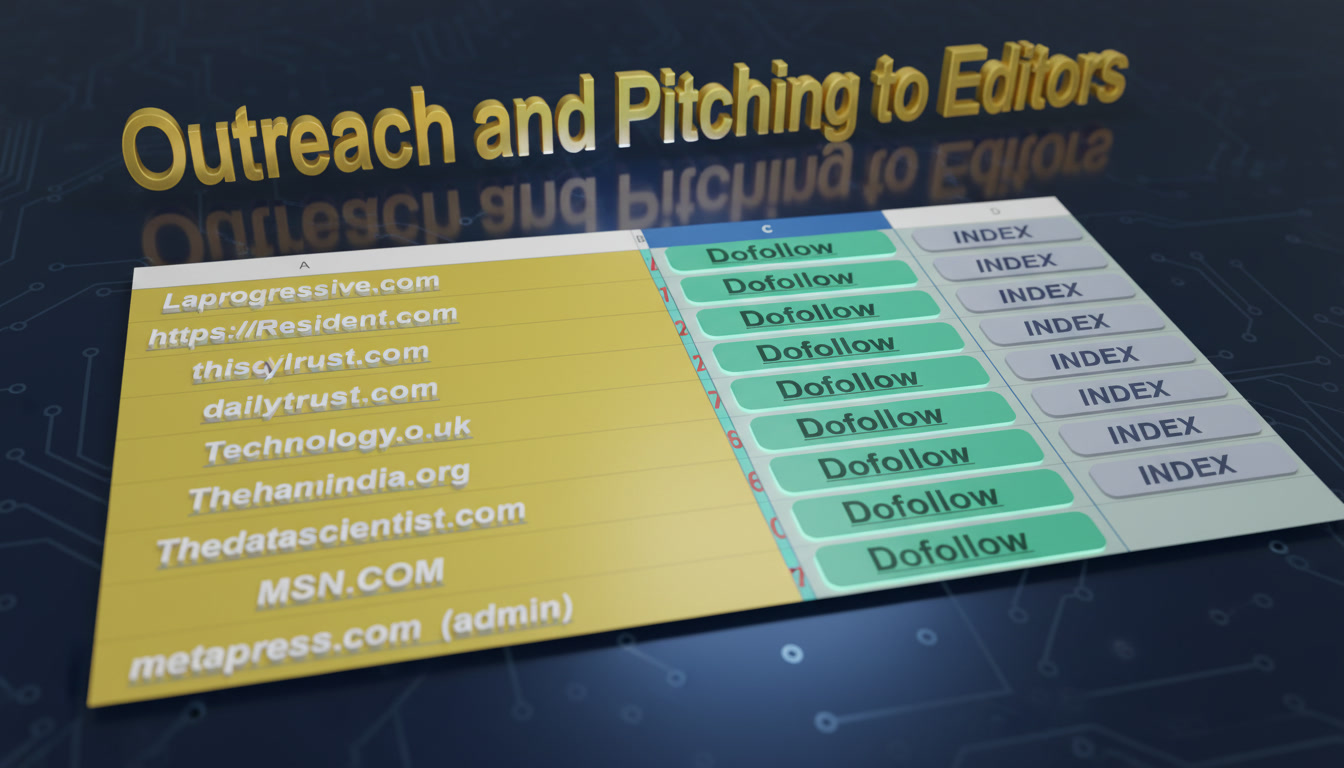
Editors receive pitches every day, and most read like templates. Think of outreach as a professional introduction: the goal of the first email is to start a conversation with an editor who could become a long-term publishing partner.
Writing a Personalized Pitch Email
Start by finding the right contact; tools like Hunter.io help you locate the editor’s email address. Build your outreach email around the site, not around your link. Use a clear subject line that names your topic, reference a recent article of theirs instead of vague flattery, suggest two or three tailored topic ideas that fill a gap in their content, explain briefly why you’re qualified, and link to one or two writing samples. Keep the whole email short enough to read in under a minute.
Editors are busy, so silence is rarely a rejection. Send one or two short follow-up emails several days apart, each adding something new, such as another topic idea. When an editor responds, reply quickly and deliver exactly what they ask for.
Building Long-Term Relationships with Site Owners
The most valuable opportunities often come from repeat contributions. Share the publication’s content on social media, leave thoughtful comments, overdeliver on your first article, and pitch follow-up topics once it performs well. Over time, a one-time guest author can become a regular contributor or columnist, and an editor who already knows your work can approve new pitches without a lengthy review.
Creating Guest Posts That Earn Links
A guest post is first a piece of content for someone else’s readers. Editors judge submissions by the same standards they apply to their own writers, and the better your article serves their audience, the more valuable your guest post backlinks become.
Tailoring Content to the Host Site’s Audience
Study the publication before you write. Match its tone, reading level, and content format, and solve a problem its readers actually have. If the site favors step-by-step guides with screenshots, a dense opinion essay will feel out of place even when the subject fits. Generic advice rarely gets accepted, while specific, actionable insights do.
Finding Topics with Content Gap Analysis
Content gap analysis shows what the host site hasn’t covered yet. The content gap tools in Semrush and Ahrefs compare the keywords a site ranks for against its competitors, BuzzSumo surfaces trending topics in your niche, and a quick review of the site’s archive reveals outdated or missing subjects. The strongest topics sit where that gap overlaps with something you know deeply, which makes the editor’s decision easy.
Using Storytelling and Case Studies
Stories and case studies make your article memorable and demonstrate first-hand experience, which supports E-E-A-T. A simple structure works well: set the scene with a relatable challenge, show the struggle including what didn’t work, and deliver the insight backed by real results. Specific numbers, timelines, and lessons from your own projects are far more convincing than hypothetical scenarios and much harder for competitors to copy.
Adding Linkable Assets
Linkable assets give readers and other publishers a reason to reference your work long after the post goes live. Original research, survey data, free calculators, templates, checklists, and custom infographics all work well. When the host site embeds or references these resources, your article becomes a source others cite, which can attract additional natural backlinks.
Link Placement and Anchor Text Best Practices
Where your link sits and what words it uses shape both its SEO value and its risk. Well-placed guest post backlinks read as a natural recommendation, not an advertisement, so write the article first and then place the link where it genuinely adds information for the reader.
Placing Links Naturally in Context
Place your main link within the body of the article, where it supports the point being made, and keep it to one or two links to your site; overloading a post looks promotional and editors often remove extra links. Link to the page that best answers the reader’s question, often a detailed guide rather than your homepage. If the host only allows an author bio link, accept it, because a bio link on a relevant, trusted site still delivers brand visibility and referral clicks.
Diversifying Anchor Text Safely
Google’s spam policies specifically name optimized anchor text in guest posts as link spam, so lean on natural variations.
| Anchor Type | Example | Risk Level |
| Branded | YourBrand | Low |
| Naked URL | yourbrand.com | Low |
| Generic | this guide, learn more | Low |
| Partial match | tips for guest posting outreach | Moderate |
| Exact match | guest posting service | High when repeated at scale |
A natural anchor text profile leans on branded, URL, and descriptive anchors, with exact-match keywords used sparingly. Before choosing an anchor, review the anchors already pointing to your target page; if one phrase dominates, use branded or descriptive anchors for your next few placements to rebalance it.
Linking to the Right Target Page
Choose a target page that deserves the link. A thin sales page rarely earns trust from editors or readers, while an in-depth resource on the article’s topic fits naturally and gives the link lasting contextual relevance. Spread your links across several strong pages rather than one URL, and support them with internal links so the authority they receive flows to your key pages.
How to Track and Measure Guest Post Backlinks
Publishing the post is not the finish line. Tracking confirms that each link is live, indexed, and moving your numbers, and over time your records show which publishers and topics are worth repeating.
Verify the Live Link
Within a day or two of publication, open the article and confirm the link points to the correct URL with the agreed anchor text. Inspect its rel attribute to see whether it is dofollow, nofollow, or sponsored, then record the live URL, host site, and publish date in a link tracking sheet. Editors sometimes change anchors during final edits, and fixes are easier to request while the post is fresh.
Check Indexation
Search site: followed by the article URL in Google to see whether the page is indexed. A guest post that never gets indexed passes little value. Indexing can take time on smaller sites, so give the page a reasonable window before raising it with the editor.
Monitor Referral Traffic and Rankings
In Google Analytics 4, the traffic acquisition report shows referral sessions from the host site, and in Google Search Console, the Links report lists the top sites linking to you. Track keyword rankings for the target page over the following months, and judge results across your whole campaign rather than expecting one link to move rankings on its own.
Audit for Lost Links
Publishers update, redesign, or remove old content. Run a periodic backlink audit with the lost backlinks reports in Ahrefs or Semrush, contact the editor when a link disappears, and update your tracking sheet after each audit.
| What to Check | Tool | When |
| Link is live and correct | Manual check in the browser | Right after publishing |
| Page is indexed | Google site: search | A week or two after publishing |
| Referral visits | Google Analytics 4 | Monthly |
| Linking domains | Google Search Console Links report | Monthly |
| Lost links | Ahrefs or Semrush | Quarterly |
How to Amplify Your Guest Post’s Reach
Publishing is only the start. Promoting your guest post sends more referral traffic, builds goodwill with the host editor, and increases the chance that other sites discover and link to it.
Social Media Crossovers
Match the message to each platform rather than posting the same link everywhere. On LinkedIn, share a short excerpt with your key insight and tag the publication. On X (Twitter), turn the main points into a thread; on Instagram, use a carousel or short reel; and in niche Facebook groups or your own email newsletter, share the post where it genuinely helps readers. You can also repurpose it into infographics, polls, or quizzes that point back to the full article.
Expert Roundups for Built-In Promotion
An expert roundup collects short insights from several industry voices into one article. Choose a focused topic, invite experts with relevant experience and an active audience, ask one clear question, then compile the answers and credit each contributor with a link. Because every contributor has a reason to share the published post, roundups multiply reach and often earn extra links. LinkedIn polls and niche forums can help you find willing contributors.
Common Guest Posting Mistakes to Avoid
Most guest posting failures come from treating it as a numbers game. Slowing down to choose better sites and write better articles prevents nearly all of the mistakes below.
Ignoring Host Site Guidelines
Every publication has its own submission guidelines for word count, formatting, images, and links. Ignoring them is the fastest route to rejection, or to your post being heavily edited or removed later. Saving each site’s guidelines with your prospect notes prevents these small errors.
Publishing on Low-Quality or Penalized Sites
A link from a site that lost its traffic in an algorithm update adds little value and can associate your brand with spam. It also wastes the time you spent writing, so run the evaluation checks above before every pitch.
Overly Promotional Content
A guest post that reads like a sales pitch frustrates editors and readers alike. A simple test is to remove your link and reread the article: if it still feels complete and useful, it’s ready to publish; if it falls apart, it’s an advertisement.
Relying on Shared Site Lists
Public “guest posting sites” lists are used by thousands of link builders, and over time many of those sites can become link farms that publish anything for a link. Building your own prospect list, or working with a vetted network, keeps you away from overused sites and gives each link a better chance of carrying real value.
Get Guest Post Backlinks from 20,000+ Sites
Finding, vetting, and pitching sites one by one takes weeks of work. Our network gives you access to more than 20,000 guest posting sites, including premium sites for brands that need high-authority placements. It covers every niche, from technology and finance to health, travel, and lifestyle, with sites in many countries so you can target local audiences and geo-targeted rankings as well as the USA.
Whether you need one placement or a long-term link building campaign, every placement follows the principles in this guide: relevant sites, quality content, and natural links. A larger network simply makes it easier to find the right fit for each article.
Frequently Asked Questions About Guest Post Backlinks
Are guest post backlinks still effective in 2026?
Yes, when they come from relevant, high-quality sites with real readers. What no longer works is mass guest posting on low-quality sites purely for links.
Should guest post backlinks be dofollow or nofollow?
Editorial links the publisher chooses to vouch for are usually dofollow. If a placement is paid or sponsored, Google’s guidelines call for a rel=”sponsored” or rel=”nofollow” attribute. Nofollow links still deliver referral traffic and brand exposure.
Which niche is best for guest posting?
No niche is best or worst. Some industries, such as marketing and technology, simply have more sites that accept guest posts. The right niche is your own, because relevance drives most of a link’s value.
How long does it take to get a guest post published?
It depends on the publisher. Some sites publish within days of approval, while editorial publications with review queues can take several weeks. Turnaround also depends on how quickly you deliver the article and any revisions.
How long until a guest post improves rankings?
There is no fixed timeframe. Search engines need to crawl and index the new page and reassess your link profile, which can take weeks or months. Results also depend on your site’s technical SEO, competition, and overall link building strategy.
Can a site’s SEO metrics change after the link goes live?
Yes. DA, DR, traffic estimates, and referring domain counts are third-party estimates that change whenever the tool provider recrawls the web or updates its methodology.
Is indexation of a guest post guaranteed?
No. Google controls crawling and indexing, and a page can be indexed, dropped, and reindexed over time. Choosing sites with healthy indexed pages improves your odds.
What is the difference between a guest post and a sponsored post?
A guest post is contributed content that the publisher accepts on editorial merit. A sponsored post is paid placement, which publishers typically label as sponsored.
Read More: https://linkneon.com/affordable-seo-services/
Final Thoughts
Guest posting still works when it is built on relevance, quality content, and genuine relationships with publishers. Choose sites your audience actually reads, write articles that help them, keep your anchor text natural, and respect Google’s rules on paid and sponsored links.
Done this way, guest post backlinks strengthen your backlink profile, send targeted referral traffic, and build brand authority that keeps paying off long after the article goes live. Start with a few well-chosen sites, track the results, and scale what works.