

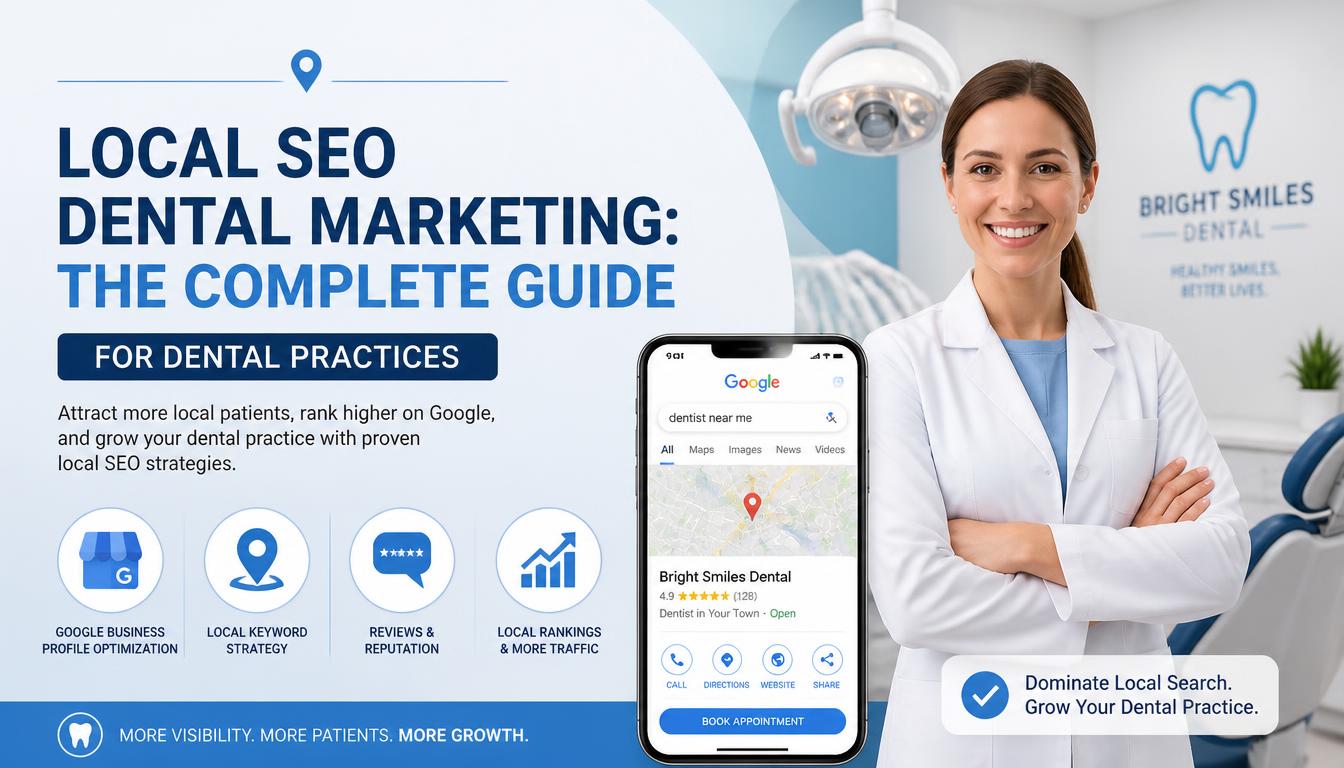
Local SEO dental marketing is the process of optimizing a dental practice’s online presence so it appears when nearby patients search for dental services on Google, Google Maps, and the Local Map Pack.
It brings together your Google Business Profile, online reviews, local citations, on-page SEO, technical SEO, and locally relevant content, so your clinic shows up for location-based searches like “dentist near me”, “emergency dentist near me”, or “dental implants in [city]”.
This guide explains how local SEO dental marketing works, why it matters for dental clinics in the USA, and the practical steps that help you outrank competitors. You will learn how to do local keyword research, optimize your Google Business Profile, build a policy-safe review strategy, keep your NAP consistent, improve your dental website, earn local backlinks, track local SEO performance, and plan a realistic marketing budget.
What Is Local SEO Dental Marketing?
Local SEO dental marketing focuses on local search engine results pages (SERPs) rather than national rankings. Its goal is simple: when potential patients in your area look for a dentist, your practice should be the one they find, trust, and book.
Search engine optimization (SEO) improves your website content and your overall online footprint so search engines rank you higher. Search engines like Google and Bing aim to deliver accurate answers and relevant answers that match search intent, and they avoid outdated information and unclear information. Your job is to show that your practice is the most helpful and trustworthy source for dental-related services in your community.
Rankings are earned by consistently providing value. Shortcuts, SEO scams, and attempts to game the system rarely last and can damage your authority and trustworthiness. Google also states that there is no way to request or pay for a better local ranking.
How Local SEO Differs From Traditional Dental SEO
Traditional SEO competes on a national scale against large industry players. Local SEO competes with local competitors for nearby patients in Google Maps and the Local Pack.
Both rely on the same core tactics:
- Keyword research
- On-page methods such as meta tags, headings, and helpful content
- Off-page methods such as citations and backlinks
- Technical tactics that help search engines crawl and understand your site
Dentistry is a health-related topic, and Google’s Search Quality Rater Guidelines treat health content as YMYL (Your Money or Your Life). That makes accurate content, trustworthy content, and strong E-E-A-T signals (experience, expertise, authoritativeness, and trustworthiness) especially important for dental websites.
How Google Ranks Dental Practices Locally (Relevance, Distance, Prominence)
Google says local results are mainly based on three factors:
| Ranking Factor | What Google Means |
| Relevance | How well your Business Profile matches what someone is searching for |
| Distance | How far your practice is from the person searching |
| Prominence | How well-known your practice is, including links to your business and the number of reviews and positive ratings |
Because these factors focus on relevance, location, and reputation, independent practices have a real opportunity to compete with larger practices and DSOs in their own neighborhoods.
Why Local SEO Dental Marketing Matters for Your Practice
Search habits have changed. Before choosing a provider, people look up everything from oral care tips to dental procedures, then compare dentists, read reviews, and book. Local SEO dental marketing helps you reach that right audience at the right moment and keep a steady flow of new patients.
If your clinic is missing from the top search results, it is effectively invisible to those searchers.
| Statistic | Data |
| Google’s share of worldwide search | About 89% (January 2026) |
| Click-through rate of the #1 organic result | 27.6% |
| Searchers who click a result on the second page | 0.63% |
| Average cost per click for dentists on Google Ads | $8.00 |
The local pack shows a small set of businesses, usually three, above the regular results, which makes those spots some of the most valuable real estate in dental marketing.
More Qualified Leads and Booked Appointments
Higher rankings put your practice in front of more prospective patients. Better visibility brings more qualified leads, more conversions, and more booked appointments without increasing your ad spend. Practices that stay off the first page leave that demand to competitors.
Higher Visibility in the Local Map Pack and “Near Me” Searches
Strong local SEO dental marketing can place your practice in three places at once: Google Maps, the Local Pack, and organic search results. That gives patients more chances to find you for local search queries like “dentist near me”, “family dentist [city]”, or “orthodontist near me”.
Lower Long-Term Costs Than Paid Ads
With Google Ads, you pay for every click. Recent industry benchmarks put the average dentist cost per click at about $8.00 and the average cost per lead at about $72.97. With organic visibility, you do not pay per click, and your long-term visibility keeps working after an ad campaign ends.
A Fair Chance to Compete With DSOs and Larger Practices
Local rankings depend on relevance, distance, and prominence, and Google states that local ranking cannot be bought. A well-optimized independent practice can outrank a larger group when its profile, reviews, and content are stronger in the local area.
Start With Local Keyword Research and Competitor Analysis
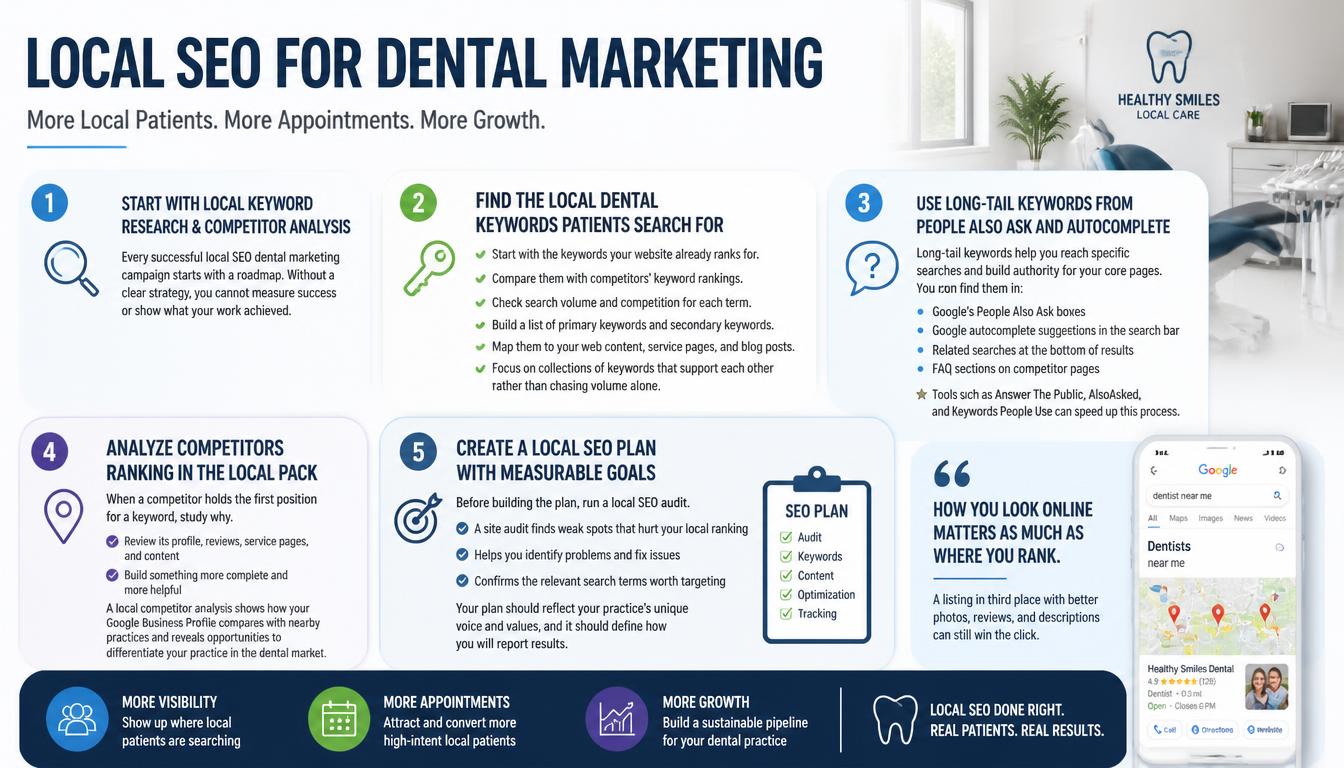
Every successful local SEO dental marketing campaign starts with a roadmap. Without a clear strategy, you cannot measure success or show what your work achieved.
Find the Local Dental Keywords Patients Search For
Keyword research is the foundation of your SEO strategy. It identifies the terms, phrases, and queries your target audience types into Google.
- Start with the keywords your website already ranks for.
- Compare them with competitors’ keyword rankings.
- Check search volume and competition for each term.
- Build a list of primary keywords and secondary keywords.
- Map them to your web content, service pages, and blog posts.
Focus on collections of keywords that support each other rather than chasing volume alone.
Use Long-Tail Keywords From People Also Ask and Autocomplete
Long-tail keywords help you reach specific searches and build authority for your core pages. You can find them in:
- Google’s People Also Ask boxes
- Google autocomplete suggestions in the search bar
- Related searches at the bottom of results
- FAQ sections on competitor pages
Tools such as Answer The Public, AlsoAsked, and Keywords People Use can speed up this process.
Analyze Competitors Ranking in the Local Pack
When a competitor holds the first position for a keyword, study why. Review its profile, reviews, service pages, and content, then build something more complete and more helpful.
A local competitor analysis shows how your Google Business Profile compares with nearby practices and reveals opportunities to differentiate your practice in the dental market.
Create a Local SEO Plan With Measurable Goals
Before building the plan, run a local SEO audit. A site audit finds weak spots that hurt your local ranking, helps you identify problems and fix issues, and confirms the relevant search terms worth targeting.
Your plan should reflect your practice’s unique voice and values, and it should define how you will report results. How you look online matters as much as where you rank. A listing in third place with better photos, reviews, and descriptions can still win the click.
Optimize Your Google Business Profile
Your Google Business Profile (GBP), formerly Google My Business (GMB), is often the first thing potential patients see, sometimes before your website. Google recommends verifying your business, keeping information accurate, responding to reviews, and adding photos to improve local ranking.
Claim and Verify Your Profile
Claim your profile, then verify it. Google offers several verification methods, including phone or text, email, live video call, video recording, and mail (postcard). Google selects the available options automatically based on your business, and postcard codes can take up to 14 days to arrive.
Complete Your Business Information
Fill out every section with accurate information:
- Practice name
- Address
- Phone number
- Website URL
- Regular hours and special hours
- Business category
- Services and attributes such as parking or accessibility
- Social media links
Write a clear business description that names your popular services and what sets your practice apart. Use relevant keywords, but keep it readable for humans. Consistency across these details helps Google trust your information.
Choose the Right Dental Categories
GBP categories help you appear for specific dental needs. Choose the most accurate primary category, such as “Dentist”, “Cosmetic dentist”, or “Pediatric dentist”, and add secondary categories only for services you actually provide.
Upload High-Quality Office, Team, and Before-and-After Photos
High-quality photos and videos of your office and team make your listing stand out and show a welcoming environment to nervous patients. If you share before-and-after photos, get written patient consent first. Outdated pictures or unprofessional images can cost you clicks, even when you rank well.
Post Regular Updates, Offers, and News
Use the posts feature to share updates, offers, and news. Regular posts and new images keep your profile active and up to date.
An optimized profile does not guarantee a top-three position, but it improves your chances of appearing in the local pack and builds customer trust and brand awareness.
Build a Strong Online Review and Reputation Strategy
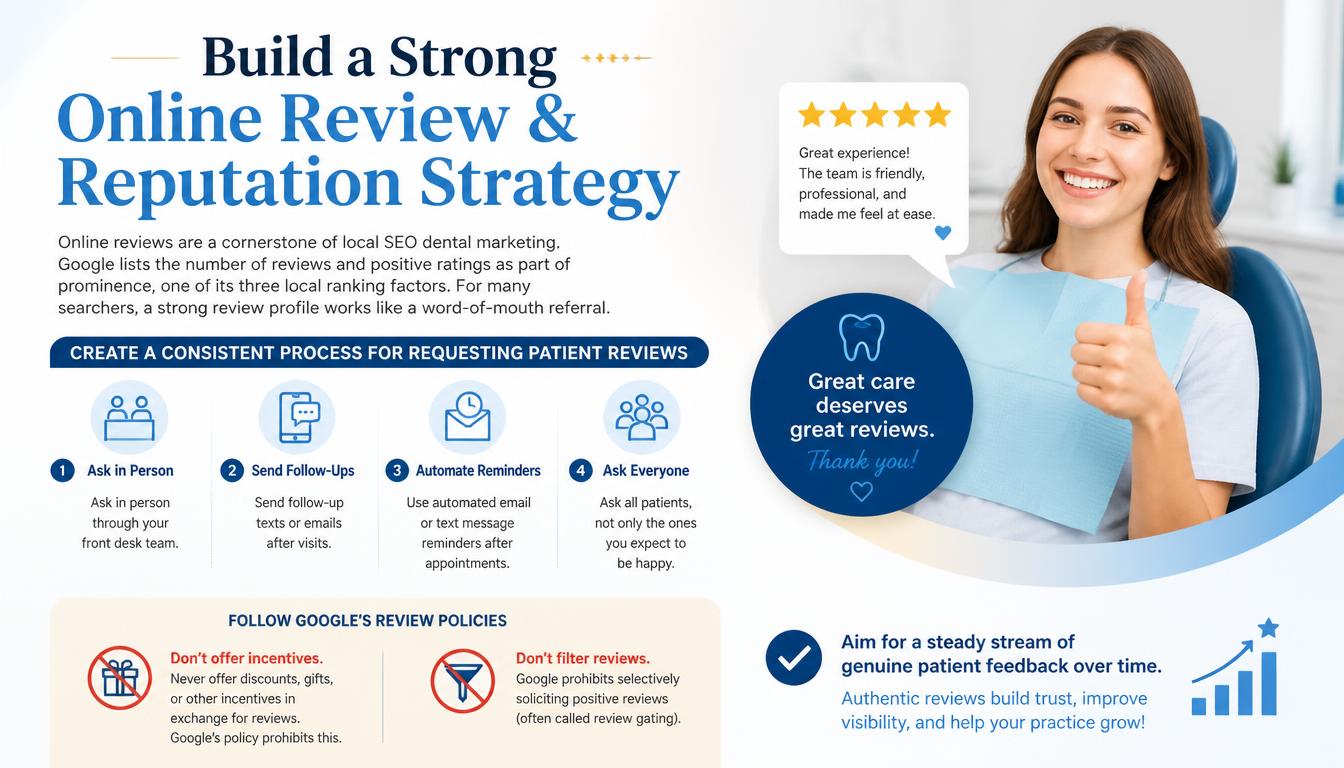
Online reviews are a cornerstone of local SEO dental marketing. Google lists the number of reviews and positive ratings as part of prominence, one of its three local ranking factors. For many searchers, a strong review profile works like a word-of-mouth referral.
Create a Consistent Process for Requesting Patient Reviews
Build a consistent process for asking patients to share feedback, and follow Google’s review policies:
- Ask in person through your front desk team.
- Send follow-up texts or emails after visits.
- Use automated email or text message reminders after appointments.
- Ask all patients, not only the ones you expect to be happy. Google prohibits selectively soliciting positive reviews (often called review gating).
- Never offer discounts, gifts, or other incentives in exchange for reviews. Google’s policy prohibits this as well.
Aim for a steady stream of genuine patient feedback over time.
Respond to Every Review Professionally and HIPAA-Safely
Responding to reviews shows you value feedback, and Google recommends it. For US dental practices, every reply must also protect patient privacy under HIPAA.
- Never confirm that the reviewer is a patient.
- Never mention names, treatments, insurance, or costs.
- Thank the reviewer in general terms and invite them to call the office.
This is not a minor detail. The HHS Office for Civil Rights has fined a dental practice $10,000 for disclosing a patient’s name, treatment plan, insurance, and costs in a Yelp review reply.
Showcase Patient Testimonials on Your Website
Feature positive testimonials on your home page and service pages, with patient permission. Patients who see consistent praise feel more confident booking. Monitor reviews regularly as part of your online reputation management.
Keep Your NAP Consistent and Build Local Citations
NAP stands for name, address, and phone number. Local citations are mentions of your NAP on online directories, healthcare directories, social profiles, and map apps.
Why NAP Consistency Builds Trust With Google
Imagine someone introducing themselves with a different name and phone number every time you met. You would soon doubt them. Incorrect business information across listings creates the same doubt for search engines and patients.
Consistent citations confirm that your practice is real, add credibility, and help local patients reach the right office.
Top Citation and Directory Sites for Dentists
| Directory Type | Examples |
| Search and map platforms | Google Business Profile, Bing Places, Apple Business Connect |
| General directories | Yelp, Yellowpages, Foursquare |
| Healthcare directories | Healthgrades, Zocdoc, Vitals |
| Dental and insurance directories | ADA Find-a-Dentist, insurance network directories such as Delta Dental |
Monitor and Update Your Listings Regularly
Claiming listings and submitting information is only the start. When your practice moves, changes its phone number, or updates its hours, update every listing so patients never find conflicting information. Monitoring citations for accuracy and consistency is an ongoing task.
On-Page SEO for Dental Websites
On-page SEO means optimizing individual web pages, both the content and the HTML, so search engines understand what you offer and where you offer it. Start with a professional website that is user-friendly, easy to navigate, and clear about your services.
Create Dedicated Service and Location Pages
You cannot rank well for a treatment by mentioning it once on your homepage. Each major service needs its own dedicated page, and each area you serve needs its own location page. Cover the treatments, the process, common questions, and insurance information patients look for.
Use Local Keywords Naturally in Titles, Headings, and Content
Instead of targeting a broad term like “dental implants”, target “dental implants in Chicago” on the relevant service page. Use location keywords naturally in page titles, headings, meta descriptions, and page content without forcing them into every paragraph.
Build Topical Authority With Pillar and Supporting Pages
Topical authority comes from high-quality content that answers the questions patients actually ask. Use written content, images, and videos to cover each topic fully.
Create a pillar page for each major service, then link to supporting pages built around long-tail keywords. For example, a veneers page can summarize the benefits of veneers and link to a detailed page on veneer care or costs. Internal links like this help visitors explore and help Google understand how your pages connect.
Avoid Keyword Cannibalization
Do not target the same keyword on multiple pages. That causes keyword cannibalization, where your own pages compete against each other. Give each page one clear topic and use keyword variations naturally.
Write Unique Title Tags and Meta Descriptions
Give each page a unique title tag and meta description that match its topic. Your title is your first impression in the SERPs, so make it clear and specific.
Strengthen E-E-A-T With Dentist-Led Content
Your dentists are your in-house experts. Involve them in Q&As, guides, and treatment pages, and show their names and credentials. This demonstrates real experience and expertise, which matters for health-related content.
Technical SEO for Dental Websites
Technical SEO makes your dental website easy for search engines to crawl and easy for patients to use. Without it, new pages may not get indexed, and slow pages lose visitors.
Improve Page Speed and Website Hosting
A slow website hurts user experience. Aim for fast load times and a secure connection through HTTPS.
- Test your pages with Google PageSpeed Insights or Lighthouse.
- Choose reliable website hosting.
- Compress large images and remove unused plugins.
- Use lazy loading for images below the fold.
Make Your Website Mobile-Friendly
Many patients search on smartphones. A mobile-friendly, responsive design adapts to every screen size, loads quickly, and makes it easy to call or book from a phone. Google has retired its Mobile-Friendly Test and the Mobile Usability report in Search Console, so use Lighthouse for mobile checks.
Add Dentist Schema Markup
Structured data helps search engines understand key details about your practice. Use schema markup with the Dentist type from schema.org, a subtype of LocalBusiness, to describe your name, address, phone number, hours, and services. Keep the markup consistent with your Google Business Profile.
Submit an XML Sitemap to Google
An XML sitemap lists your important pages so Google can find them. Submit it in Google Search Console and pair it with strong internal linking so Google can crawl your site efficiently.
Organize Your Site Architecture and Internal Links
Good site architecture helps search engines discover your pages and helps patients find answers fast. Most patients want to know who the dentist is, what treatment will cost, whether their insurance is accepted, and how to contact the office. Build your site structure, service pages, and internal links around those needs.
Use Short, Keyword-Focused URLs
Use short URLs that describe the page, such as /dental-implants/. Avoid generic URLs and unnecessary numbers.
Create Locally Relevant Dental Content
Quality content builds trust and positions your clinic as a reliable source of dental information. Blog posts, articles, and videos about common dental problems, from cavities to root canals, attract visitors and show your expertise. Informative content focused on educating patients helps readers make decisions and book with confidence.
Answer Local Patient Questions About Treatments and Insurance
Create locally relevant content around real patient questions, such as treatment FAQs, insurance information, and helpful dental resources. Use location keywords naturally and avoid repetitive content that copies the same page for every city you serve.
Promote Your Content Through Email and Social Media
Publishing is only half the work. Share each new dental blog post on social media, then send it to your mailing list through email marketing. This brings readers back to your site and keeps your practice top of mind.
Earn Local Backlinks to Build Authority
Backlinks from reputable websites signal that your practice is trustworthy, and Google counts links to your business as part of prominence. Relevant backlinks from local sources strengthen your local authority.
Local Link-Building Opportunities for Dentists
- Join your local Chamber of Commerce.
- Support community sponsorships and events.
- Partner with local organizations and schools.
- Get featured in local publications.
- Create useful, shareable content and use outreach to earn inbound links.
- Avoid buying links, which violates Google’s spam policies.
When Backlinks Matter Less for Local Dental SEO
Links still matter, but they are not everything. Google has said that links are no longer a top three ranking factor. In a smaller city or town with less competition, a strong Google Business Profile, local keywords, relevant content, citations, and reviews often move rankings more than heavy link building.
Local SEO for Multi-Location Dental Practices
Local SEO dental marketing works differently when you manage multiple locations. Because distance is a core ranking factor, Google tends to favor a practice close to the searcher, so every branch must prove it is the best option for its own community.
Create a Dedicated Page for Each Location
Each location needs its own dedicated page for its town or city. Simply listing other towns on one page is not enough. Location-specific pages should include local services, local keywords, staff, directions, and reviews from that office.
Set Up a Separate Google Business Profile for Each Location
Create a Google Business Profile for each location and link it to its matching location page. Manage each profile as a separate entity, because work on one branch does not help the others.
Build and Manage Citations for Every Location
Build citations for each location, not just your first office, and use listings management to keep every branch’s details accurate.
How to Tailor Local SEO to Your Dental Specialty
The fundamentals stay the same for every practice, but your keywords, content, reviews, and Google Business Profile should reflect your specialty and your patient priorities.
| Specialty | Patient Priorities | Content to Create | Keywords to Target |
| General / family dentist | Convenience, trust, comprehensive care | New-patient information, family dentistry FAQs | family dentist [city], dental clinic [city] |
| Pediatric dentist | Comfort, gentle care, patience | Parent FAQs, first-visit guides | kids dentist [city] |
| Orthodontist | Results, cost, treatment options | Braces and Invisalign pages, before-and-after cases | Invisalign [city], braces [city] |
| Emergency dentist | Speed, availability, pain relief | Emergency service page, urgent-care FAQs | same-day dentist [city] |
| Cosmetic dentist | Appearance, confidence | Smile gallery, financing information | veneers [city], teeth whitening [city] |
| Periodontist | Long-term gum health, expertise | Gum disease, gum grafting, and periodontal treatment pages | gum disease treatment [city] |
| Endodontist | Pain relief, availability | Root canal pages, recovery information | root canal specialist [city] |
| Oral surgeon | Safety, recovery | Surgical service pages, preparation guides | wisdom teeth removal [city] |
General and Family Dentists
Make it easy for families to book. Show family-friendly hours, accepted insurance, and services for every age on both your website and your profile.
Pediatric Dentists
Parents look for reassurance. Share kid-friendly office photos and a simple guide to what happens at a child’s first visit.
Orthodontists
Treatment is a long commitment, so explain timelines, options, and payment plans clearly, and use smile transformations (with consent) to show results.
Emergency Dentists
Urgent searchers decide fast. Put your phone number, same-day availability, and after-hours instructions at the top of the page.
Cosmetic Dentists
Results drive decisions here. A consent-approved smile gallery and clear financing information help patients move forward.
Periodontists, Endodontists, and Oral Surgeons
Specialists often receive referrals, so make each procedure page detailed. Include preparation steps, sedation options where offered, and recovery information that answers concerns before patients call.
How to Track Your Local SEO Performance
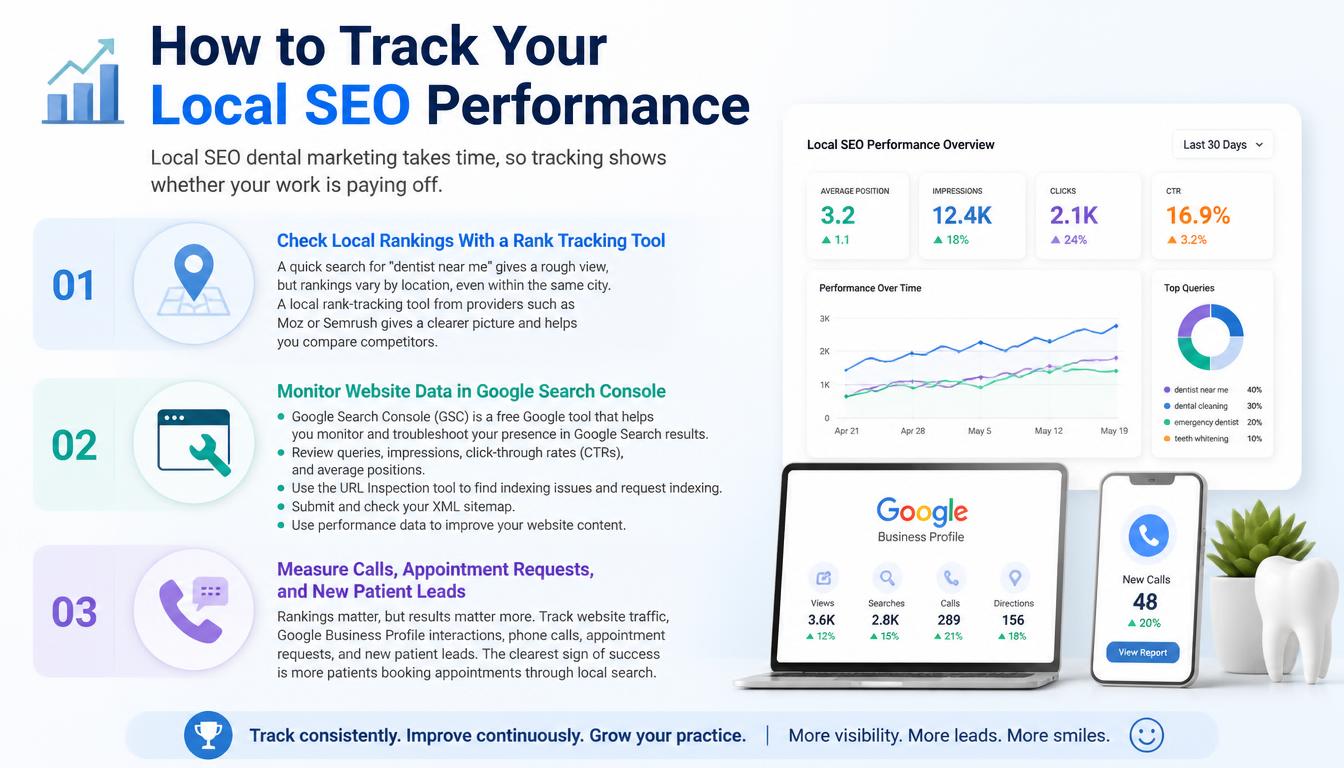
Local SEO dental marketing takes time, so tracking shows whether your work is paying off.
Check Local Rankings With a Rank Tracking Tool
A quick search for “dentist near me” gives a rough view, but rankings vary by location, even within the same city. A local rank-tracking tool from providers such as Moz or Semrush gives a clearer picture and helps you compare competitors.
Monitor Website Data in Google Search Console
Google Search Console (GSC) is a free Google tool that helps you monitor and troubleshoot your presence in Google Search results.
- Review queries, impressions, click-through rates (CTRs), and average positions.
- Use the URL Inspection tool to find indexing issues and request indexing.
- Submit and check your XML sitemap.
- Use performance data to improve your website content.
Measure Calls, Appointment Requests, and New Patient Leads
Rankings matter, but results matter more. Track website traffic, Google Business Profile interactions, phone calls, appointment requests, and new patient leads. The clearest sign of success is more patients booking appointments through local search.
Challenges of Local SEO Dental Marketing
Local SEO dental marketing is powerful, but it is a long-term investment. Knowing the challenges helps you set realistic expectations.
| Challenge | What It Means for Your Practice |
| Results take time | Google says SEO usually needs four months to a year to show improvements |
| Ongoing effort | Reviews, content, local listings, and website updates need continuous work |
| Multiple SEO areas | Technical SEO, on-page optimization, and local signals must work together |
| High competition | High-value treatments like implants or Invisalign in a major city are harder to rank for than in a smaller community |
| No guaranteed rankings | Google states no one can pay for or request a better local ranking |
Results Take Time
Some fixes, like correcting your Business Profile, can help quickly. Meaningful growth usually builds over several months, so consistency matters more than quick wins.
Ongoing Effort and SEO Expertise Are Required
Local SEO has many moving parts. Without SEO experience, coordinating technical fixes, content, citations, and reviews can be hard to manage alongside running a practice.
YMYL and E-E-A-T Standards for Dental Content
Because dental content is health-related, it should be accurate, reviewed by a dentist, and clear about who wrote it. Strong E-E-A-T signals help patients and search engines trust your pages.
How Much Does Local SEO Dental Marketing Cost?
There is no fixed price. Estimates for ongoing dental SEO commonly range from about $750 to $5,000 per month, depending on scope and market. Treat these as estimates, not quotes.
Factors That Affect Your Local SEO Budget
- Your location and how many dentists compete for the same searches
- The services you want to rank for
- How much work your website and local presence need
- The number of locations you manage
- Whether you target competitive treatments in a major city or a smaller local market
A practice in a smaller town may compete with a modest budget, while one targeting implants or Invisalign in a large metro area usually needs to invest more.
Local SEO vs. Google Ads for Dentists
Both channels can bring in patients, but they work differently.
| Factor | Local SEO | Google Ads |
| Speed | Builds over months | Can bring traffic immediately |
| Cost model | No per-click cost | Pay for every click (dentist average about $8.00) |
| Longevity | Long-term organic visibility | Traffic stops when you stop spending |
| Best for | A sustainable source of new patients | Short-term demand and promotions |
Many practices use paid search for quick wins while local SEO dental marketing builds organic rankings for steady, long-term growth.
Frequently Asked Questions
What Is Local SEO Dental Marketing?
Local SEO dental marketing is the process of improving your practice’s online presence so people nearby find you when they search for dental care. It targets location-based searches in Google Maps, the Local Map Pack, and organic results, then turns website visitors into patients.
How Long Does Local SEO Take for a Dental Practice?
There is no fixed timeline. Google says SEO usually needs four months to a year to show improvements. Your starting point, location, level of competition, and the current state of your website all affect the pace. Fixing basic problems, such as an incomplete Business Profile, can bring earlier gains.
Is Local SEO Worth It for Dentists?
For most practices, yes. It increases visibility, brings targeted traffic, and keeps generating leads long after the work is done, without a per-click cost. Results depend on your market, competition, and consistency.
Do I Still Need Local SEO If I Run Google Ads?
Yes. Google Ads can bring patients quickly, but you pay for each click and visibility ends when spending stops. Local SEO builds lasting visibility in Google Maps and organic search, so you are not fully dependent on paid ads.
Can I Do Local SEO for My Dental Practice Myself?
You can handle the basics: updating your Google Business Profile, asking for reviews, and keeping practice information accurate. Technical SEO, keyword research, competitor analysis, and link building usually need more expertise, especially in competitive markets.
Why Should Dentists Choose a Dental-Focused SEO Agency?
A dental-focused agency understands both search marketing and the dental industry. It knows which treatments bring the most value to your practice, how to write accurate health-related content, and how to stay within HIPAA rules when handling reviews, which a generic agency may overlook.
How Can I Tell If My Local SEO Is Working?
Track rankings for important local searches, plus Google Business Profile interactions, website traffic, phone calls, appointment requests, and new patient leads. If more patients are finding and booking through local search, your strategy is working.
Read More: https://linkneon.com/family-law-seo/
Conclusion
Local SEO dental marketing helps your practice show up at the exact moment nearby patients need care. Start with keyword research, then optimize your Google Business Profile, build reviews the policy-safe way, keep your NAP consistent, and strengthen your website with on-page SEO, technical SEO, and locally relevant content.
There is no set formula. Every practice has different needs, so test what works, track the impact, and adjust. Treat local SEO dental marketing as a long-term investment, and it can become one of the most reliable sources of new patients for your practice.