

Dedicated WordPress developers are programmers who work on your website on an ongoing basis, either full-time or for a fixed block of hours each month, instead of picking up one-off jobs. The same person learns your theme, plugins, hosting and goals, so fixes tend to get faster and new features are less likely to break old ones. According to W3Techs, WordPress runs 40.2% of all websites, which means a large pool of talent, but also a wide range in quality.
This article explains how dedicated WordPress developers compare with freelancers, agencies and in-house hires, what they do, and what they cost in the US. It also covers where to find them, a seven-step hiring process, the interview questions worth asking, and how to protect your code and site access once someone is on board.
How Dedicated WordPress Developers Work and How to Hire Them
Key Takeaways
- Dedicated WordPress developers set aside ongoing time for your site, which suits a steady backlog better than one-off fixes.
- Compared with freelancers and in-house hires, they balance continuity and cost.
- Published rates range from about $15 to $150 an hour, depending on platform, experience and location.
- A paid test project reveals more than an interview.
- Put code ownership, notice terms and site access rules in writing before work starts.
What Are Dedicated WordPress Developers?
Dedicated WordPress developers are assigned to your project for an agreed schedule and period, often months or longer. You direct their work much like a team member, while a vendor, platform or contract handles the employment side. That setup is sometimes called staff augmentation: adding outside people to your team without hiring them as employees.
The arrangement usually takes one of three forms:
- Through a vendor or agency that supplies a developer (or a dedicated development team) and handles payroll.
- Through a vetted talent platform, which screens developers and matches you with one.
- As a direct contractor you find and manage yourself.
The key difference from a one-off hire is commitment: you reserve someone’s time, so they’re available when your site needs work. Many businesses hire remote WordPress developers this way, since location matters less for web work.
What a Dedicated WordPress Developer Does
Typical work covers both building and keeping things running:
- Custom theme development and theme customization
- Custom plugin development for features no existing plugin covers
- Gutenberg block development for the WordPress block editor
- WooCommerce development, from checkout changes to payment and shipping integrations
- API integration with CRMs, email tools, ERPs and payment gateways
- WordPress migration from another platform or host
- Speed optimization and Core Web Vitals improvements
- Security hardening, updates, backups and malware cleanup
- Website maintenance, bug fixes and plugin conflict fixes
Few developers excel at all of this, so match skills to your actual backlog.
Dedicated Developer vs. Freelancer vs. Agency vs. In-House
Each option trades cost against control and continuity. This comparison reflects common patterns, not fixed rules:
| Factor | Dedicated developer | Freelancer | Agency | In-house employee |
| Best for | Ongoing work, steady backlog | One-off tasks | Full projects with design, dev and strategy | Large, constant workload |
| Continuity | High | Low to medium | Medium (staff may rotate) | High |
| Your control over daily work | High | Medium | Low to medium | Full |
| Cost structure | Monthly or hourly retainer | Per task or hour | Per project or retainer | Salary, benefits, taxes |
| Hiring effort | Medium | Low | Low | High |
| Main risk | Dependence on one person | Availability, disappearing mid-project | Higher cost, less flexibility | Cost when work slows |
Freelance WordPress developers suit a single, well-defined task. A WordPress development agency suits a redesign that needs designers, strategists and project managers. An in-house developer makes sense once you have enough work to keep someone busy year-round.
Dedicated WordPress developers sit in between: more commitment than a freelancer, less overhead than an employee. Agencies also use white label WordPress development, where an outside developer works under the agency’s brand.
When a Dedicated Developer Makes Sense (and When It Doesn’t)
Dedicated WordPress developers tend to fit when:
- Your site drives revenue or leads, so downtime and slow fixes cost money.
- You have a steady backlog of changes, not one isolated task.
- You’re planning a long-term project, such as a phased website redesign or WooCommerce build.
- You need ongoing maintenance but can’t justify a full-time salary.
It’s often the wrong choice when:
- You need one small fix. A vetted freelancer is usually cheaper and faster.
- Nobody on your side can give direction or review work. Dedicated WordPress developers still need someone to set priorities.
- You need strategy, branding and design as much as code. An agency covers more ground.
Skills to Look For
Beyond your project’s specific needs, check these basics whenever you screen dedicated WordPress developers:
| Skill | Why it matters |
| PHP | WordPress core, themes and plugins are written in it |
| JavaScript and React | Needed for Gutenberg blocks and modern front ends |
| HTML and CSS | Layout, responsiveness and accessibility |
| MySQL | WordPress stores content in a MySQL or MariaDB database |
| REST API | Connects WordPress to other software |
| WordPress coding standards | Signals clean, maintainable code others can take over |
| Version control (Git) | Tracks changes and allows safe rollbacks |
| WP-CLI and Advanced Custom Fields (ACF) | Command-line tool for faster routine tasks; popular custom-fields plugin |
| Security and performance | Prevents hacks and slow pages |
| Accessibility (WCAG) | Helps visitors with disabilities use your site; WCAG 2.2 is the current W3C standard |
Ask which PHP version they work with. WordPress.org recommends PHP 8.3 or greater, and says older versions have reached end of life. Current versions matter for security.
Engagement Models: Full-Time, Part-Time, and Hourly
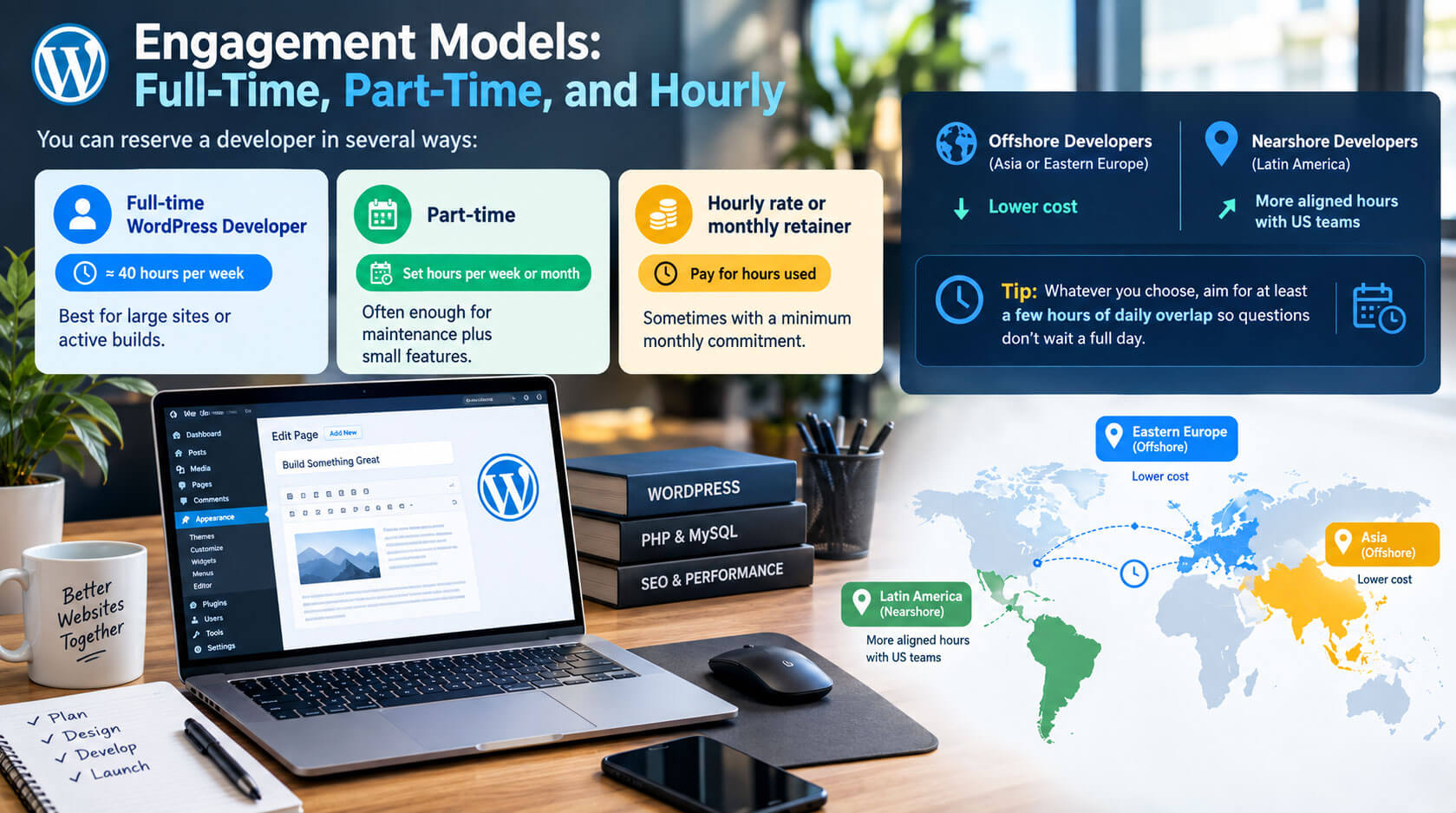
You can reserve a developer in several ways:
- Full-time WordPress developer: about 40 hours a week, suited to large sites or active builds.
- Part-time: a set number of hours per week or month, often enough for maintenance plus small features.
- Hourly rate or monthly retainer: you pay for hours used, sometimes with a minimum monthly commitment.
Offshore developers (for example, in Asia or Eastern Europe) can cost less, while nearshore developers in Latin America usually share more working hours with US teams. Whatever you choose, aim for at least a few hours of daily overlap so questions don’t wait a full day.
How Much Do Dedicated WordPress Developers Cost?
Rates vary widely by skill, location and platform. These are published figures, not quotes:
| Source | What it reports | Figure |
| US Bureau of Labor Statistics | Median annual wage, web developers (all, not WordPress-only) | $92,650 (May 2025) |
| Glassdoor (as cited by Toptal, secondhand) | US base pay range, WordPress developers | 116,000 (April 2025) |
| Codeable | Hourly rate used for estimates, plus a 17.5% service fee | 120/hour |
| WPBeginner, reporting on Toptal (Toptal doesn’t publish rates) | Reported hourly range | 150/hour |
| Upwork | Typical hourly range for WordPress developers (median $20) | 28/hour |
The gap between a $20 and a $120 hourly rate usually reflects vetting, experience, location and platform fees. A low rate isn’t automatically bad value, and a high one isn’t automatically good.
Pricing from vendors that place developers on monthly contracts isn’t published in any consistent, reliable way. Ask two or three providers to quote the same scope and compare what each price includes.
Budget beyond the WordPress developer hourly rate as well:
- Your own time for briefing, reviewing and testing work
- Onboarding hours before the developer is productive
- Tools such as staging hosting, project management software and premium plugins
- Rework if the first hire doesn’t work out
For comparison, an in-house hire adds benefits, payroll taxes and equipment on top of the WordPress developer salary, which is one reason some small businesses choose dedicated WordPress developers instead.
Where to Find Developers
Your main options for finding dedicated WordPress developers differ in vetting and price:
| Where | How it works | Good fit for |
| Codeable | WordPress-only platform; one estimate at a set hourly rate; escrow and a 28-day bug-fix warranty | Businesses wanting vetted WordPress specialists |
| Toptal | Screens freelancers and matches you with one; no-risk trial period | Larger budgets, longer engagements |
| Upwork | Open marketplace with a wide skill and price range | Buyers able to screen candidates themselves |
| WordPress agencies | Supply a developer or team under a contract | Teams wanting project management included |
| Job boards (e.g., WordPress Jobs) | You post a role and screen applicants | Direct contracts or employees |
Vetted WordPress developers cost more per hour because the platform does part of the screening. Open marketplaces cost less but put the screening work on you. Large enterprises sometimes also consider WordPress VIP, Automattic’s enterprise platform, which works with approved agency partners.
How to Hire a Dedicated WordPress Developer: 7 Steps
This process works whether you source dedicated WordPress developers from a platform, an agency or a job board.
- Write a scope of work. List your site’s stack (theme, key plugins, host), the backlog, and what “done” looks like.
- Set a budget and model. Pick hours per month and a rate range from the table above.
- Choose where to source. Options include a vetted platform, a marketplace, an agency or a job board.
- Review portfolios. Look for a developer portfolio with live sites or code samples similar to your work.
- Interview. Use the questions in the next section, and include someone technical if you can.
- Run a paid test project. Give a small, real task of a few hours. It reveals code quality and communication better than any interview.
- Sign a contract and onboard. Cover scope, rates, code ownership and access before work starts.
Interview Questions to Ask
Good WordPress developer interview questions check reasoning, not memorized answers:
- How do you add custom functionality without editing theme or core files? (Look for child themes, hooks or custom plugins.)
- How do you test changes before they go live? (Look for a staging site and Git.)
- How would you speed up a slow WooCommerce store?
- How do you handle plugin updates that break something?
- Can you show code you wrote and explain it? (Invite a code review.)
Watch for red flags too:
- They edit core WordPress files or the parent theme directly.
- They can’t explain their own past work.
- They want your main admin password instead of their own account.
- They quote a fixed price for complex work before seeing your site.
Contracts, Code Ownership, and Site Access
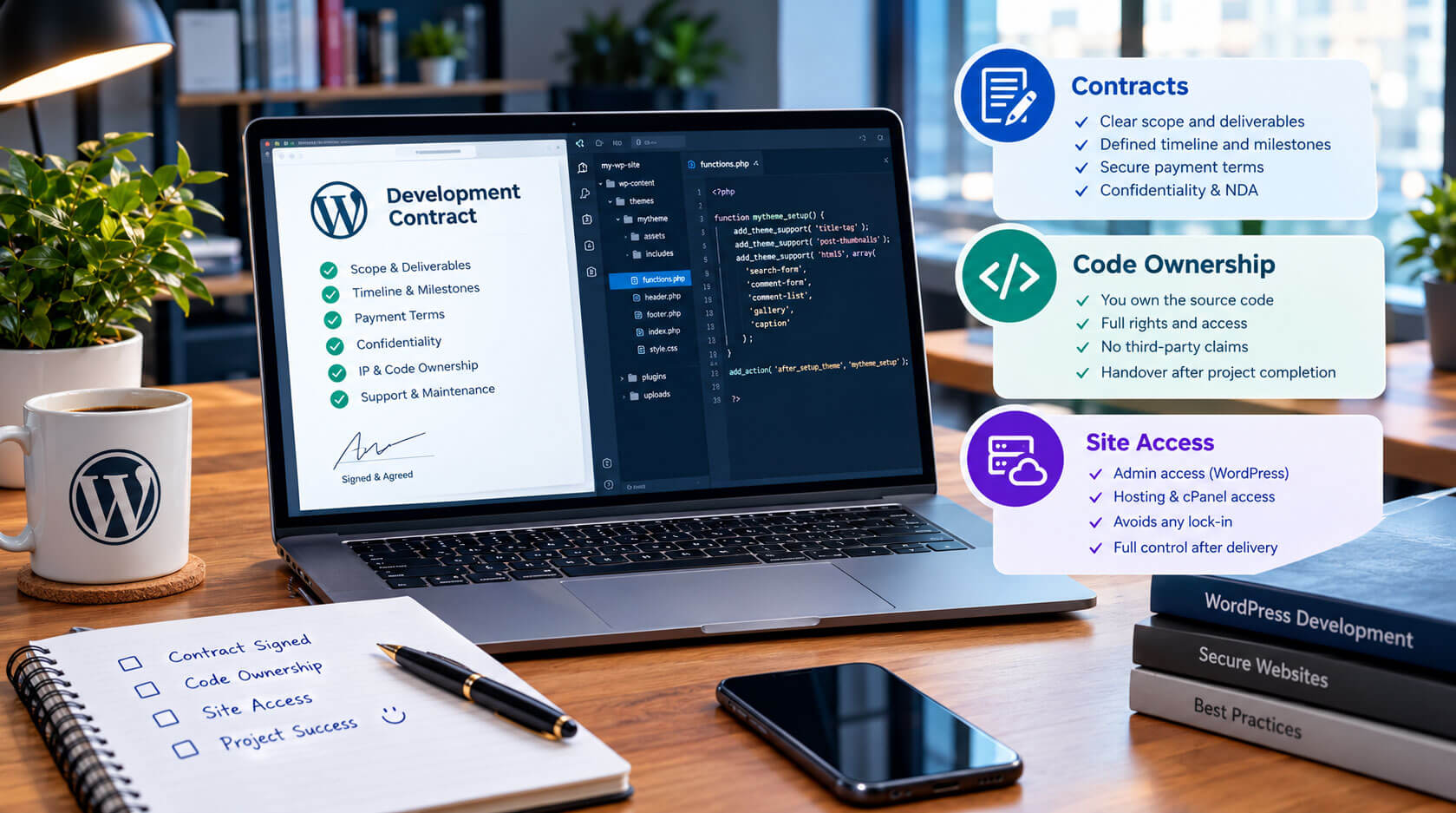
Before dedicated WordPress developers touch your live site, put these points in writing:
- IP ownership. For independent contractors, the US Copyright Office says work only counts as “made for hire” with a signed written agreement and if it fits one of nine specific categories. Otherwise, the contractor keeps the copyright by default. Custom code often doesn’t fit those categories neatly, so many contracts include an explicit assignment of rights. Have a lawyer review the wording.
- NDA if the developer will see customer data or unreleased plans.
- Commitment and notice: the minimum term and how much notice either side must give. Contracts with vendors that supply dedicated WordPress developers should state both.
- Replacement and rate terms: what happens if the developer leaves or isn’t a fit, and when rates can change.
- Worker classification. The IRS looks at behavioral control, financial control and the type of relationship to decide whether someone is a contractor or an employee. Hiring through a platform or vendor can simplify this. This isn’t legal advice, so check your situation with an accountant or lawyer.
For site safety:
- Give each developer their own account, never a shared password, and only the admin access they need.
- Have them work on a staging site (a private copy of your site, which managed hosts such as WP Engine and Kinsta offer) and push tested changes live.
- Keep automatic backups and store code in a Git repository you own.
- Remove access the day an engagement ends.
Onboarding and Managing a Remote Developer
Dedicated WordPress developers become productive faster with a simple onboarding checklist: site logins, hosting and repository access, a list of plugins and why they’re installed, brand guidelines, and the first three priorities.
After that, keep project management light but consistent. Use one ticket board, a weekly check-in and clear deadlines. Measure results by tickets closed on time, bugs reintroduced, site speed and uptime, not hours logged. Plan time zone overlap for live discussions.
Plan the exit from day one, too. Ask your developer to document custom code, plugins and deployment steps as they go, so another developer could take over within days if needed.
Benefits and Limitations
Benefits:
- Continuity: one person learns your site and moves faster over time.
- Predictable capacity and monthly cost.
- Lower total cost than a full-time employee for many small and mid-size businesses.
- Direct control over priorities.
Limitations:
- Dependence on one person. If they leave, knowledge leaves too unless it’s documented.
- You still need someone to manage and review work.
- Quality varies a lot by hiring channel, and a bad hire costs time as well as money.
- Offshore setups can bring communication and time-zone friction.
Frequently Asked Questions
What’s the difference between a dedicated WordPress developer and a freelancer?
A dedicated developer reserves ongoing time for your project. A freelancer usually takes individual tasks and splits time across many clients.
What does a dedicated developer cost per month?
It depends on hours and rate. As a rough guide, 40 hours a month at 120 an hour works out to 4,800 a month, based on the Upwork and Codeable figures above, before platform fees.
Should I hire a contractor (1099) or an employee (W-2)?
It depends on how much you control the work. The IRS weighs behavioral control, financial control and the relationship, so confirm with a tax professional.
Who owns the code a hired developer writes?
Your contract should say so. Without a signed written agreement, an independent contractor generally keeps the copyright, so include a clear IP assignment.
Is it safe to give a developer admin access?
Yes, with the safeguards above: separate accounts, limited permissions and a staging site.
How long does it take to hire one?
It varies. Toptal, for example, says it typically matches clients with WordPress developers in about 48 hours. Screening candidates yourself on an open marketplace usually takes longer.
Can one developer handle design, development and SEO?
Some can cover the basics of all three, but depth varies. A reasonable approach is to hire for code and bring in a designer or SEO specialist for bigger projects.
Are offshore developers worth it?
They can be. Check communication skills and working-hour overlap as carefully as technical skill.
Read More: https://linkneon.com/web-development/
Conclusion: Your Next Step
The main takeaway: dedicated WordPress developers fit businesses with a steady stream of website work and someone who can set priorities. Price matters, but a clear scope, a paid test project and a solid contract protect you more than any hourly rate.
Start this week. List your current backlog of site fixes and features, estimate the monthly hours it needs, and use that to decide whether a dedicated developer, a freelancer or an agency fits. If the backlog is steady, shortlist three dedicated WordPress developers and give each the same small paid test task.