

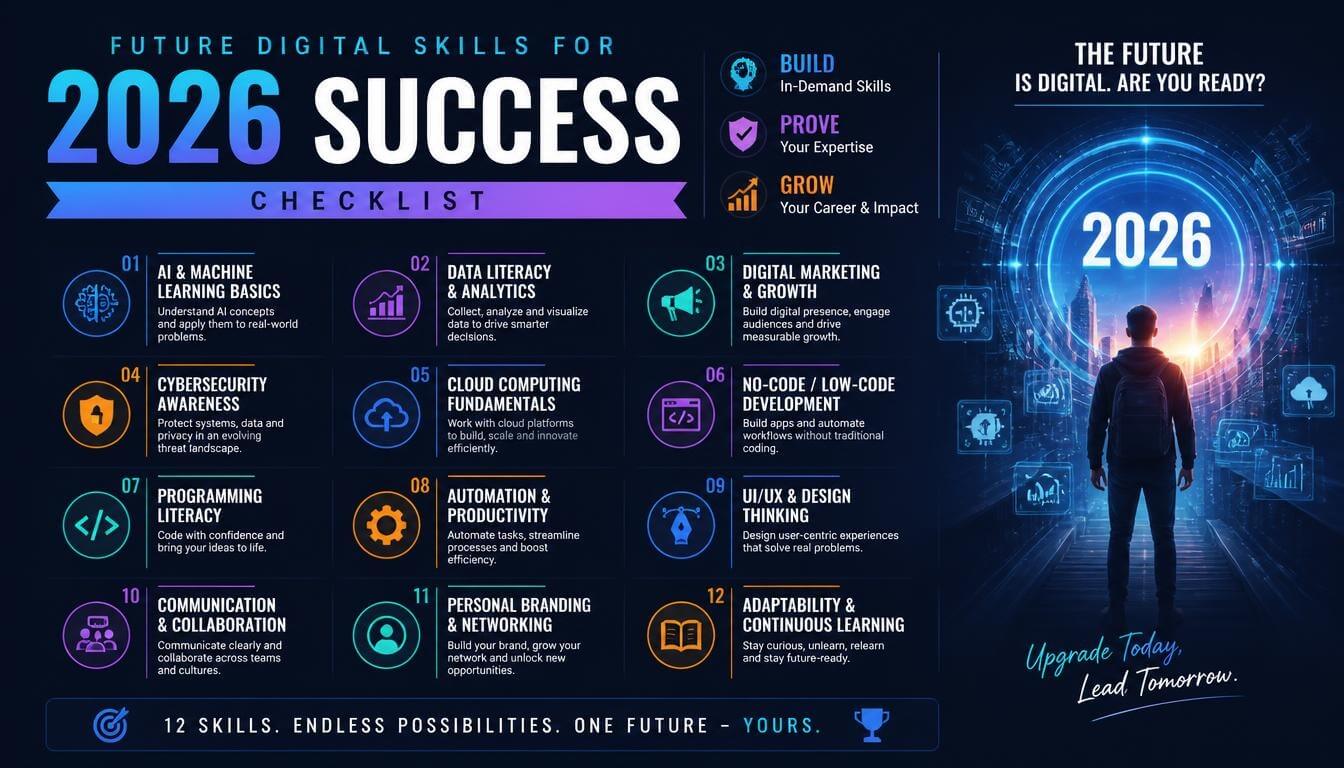
What if the biggest risk to your career isn’t AI itself, but someone who just knows how to use it better than you? The World Economic Forum expects 39% of workers’ core skills to change by 2030, and LinkedIn’s 2026 list of the fastest-growing skills in the United States is led by AI engineering, operational efficiency and AI business strategy. That’s why a future digital skills for 2026 success checklist matters so much right now. It gives you one clear list of the digital skills employers expect, so you can stop guessing and start building the abilities that actually move your career forward.
In this guide, I’ll walk you through the full future digital skills for 2026 success checklist, skill by skill. You’ll learn what each skill means, why employers value it and how to practice it at work. You’ll also see how these skills pay off in salary, plus a quick self-assessment, priorities for your career stage and job role, a 90-day plan, ways to prove your skills on a resume, the best places to learn and the mistakes to avoid. It all ends with a printable checklist you can come back to anytime.
What Are Future Digital Skills?
Let’s start simple. Digital skills are the practical abilities you need to use technology, data and digital tools to get work done, communicate and solve problems. “Future” digital skills are the ones growing fastest in demand, the abilities that will still matter in a few years, not just today.
It also helps to know the difference between a skill and a competency. A skill is the ability to use something, like building a pivot table. A digital competency goes further: it means knowing when to use that skill, how to read the results and how to make a sound decision with them. Employers increasingly hire for competency, which is why this future digital skills for 2026 success checklist focuses on applying each skill, not just knowing the tool’s name.
| Level | What It Means | Examples |
| Foundational | Everyday device and software use | Email, video calls, cloud file storage, online forms |
| Intermediate | Tool-based workflow skills | Spreadsheets, project boards, CRM systems, basic dashboards |
| Advanced | Specialized or strategic skills | Data analysis, automation, AI workflows, security practices |
Most people need a mix of all three levels, and the mix shifts as your role grows. Think of it as building a skills stack rather than collecting random tools. With that foundation in place, let’s look at why these skills carry so much weight this year.
Why Digital Skills Decide Career Success in 2026
Here’s the reality: digital skills are no longer just for “tech people.” The World Economic Forum names AI and big data as the fastest-growing skills, followed by networks and cybersecurity and technological literacy. It also lists analytical thinking as the top core skill employers want. The same report expects 170 million new jobs to be created and 92 million to be displaced by 2030, so the job market is being reshaped, not just shrunk.
The hiring side is shifting too. Employers are moving toward skills-based hiring, which means what you can do matters more than your degree or job title. LinkedIn reports that nearly half of recruiters searching on its platform now use skills data to help fill roles, so the skills you list carry serious weight.
And AI hasn’t made human judgment less important. It has made it more valuable. Microsoft surveyed 20,000 AI users across 10 countries, and 86% said they treat AI output as a starting point rather than a final answer. Respondents ranked quality control of AI output (50%) and critical thinking (46%) as the human skills that matter more as AI takes on execution. In other words, the winners in 2026 combine digital tools with clear thinking.
How Digital Skills Pay Off: Salary and Career Growth
You might be wondering whether all this effort actually shows up in your paycheck. The data says it can. Lightcast analyzed more than 1.3 billion job postings and found that postings listing AI skills offer about 28% higher salaries, roughly $18,000 more per year, than postings that don’t.
Even better, this isn’t limited to tech jobs. The same research found that 51% of job postings requiring AI skills in 2024 were outside IT and computer science roles. So whether you work in marketing, finance, HR or operations, adding the right digital skills can raise both your earning power and your chances of moving into a stronger role.
One thing to remember, though. These figures describe what job postings offer, not an automatic raise. The pay boost comes when you can show employers that you use these skills to get results, which is exactly what the checklist below helps you do.
The Future Digital Skills for 2026 Success Checklist: 12 Skills to Build
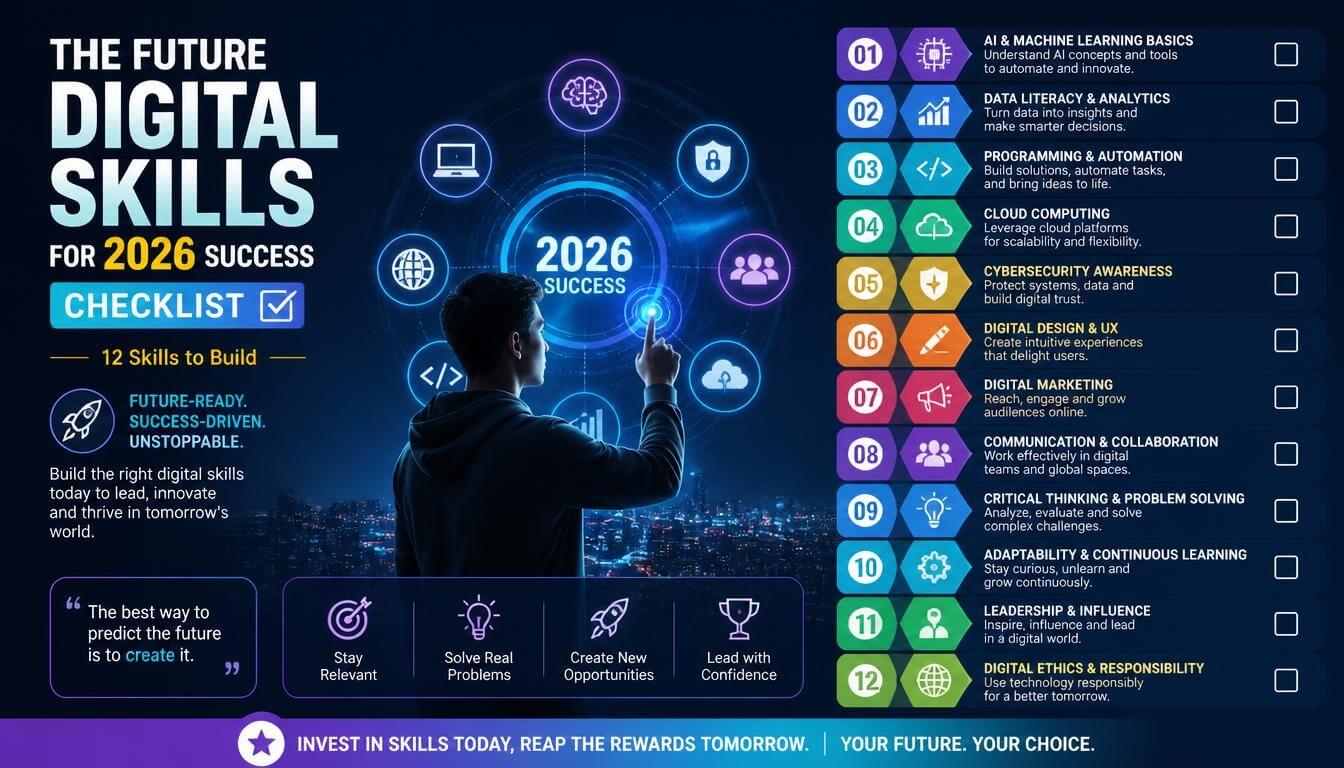
You don’t need expert-level depth in all 12. You need the right combination for your role, so read through each one and note which you already have and which you’re missing.
1. AI Literacy and Prompting
AI literacy means knowing how to use tools like ChatGPT, Claude, Copilot or Gemini to draft, research, summarize and analyze, and knowing their limits. Good prompt engineering means giving clear context, a defined task and the output format you need. Just as important, you check the result for errors and hallucinations before you use it.
Practice it on an actual work task. Take a weekly report, let AI create the first draft, then fact-check it, edit it and note what you changed. That turns casual AI use into a repeatable AI workflow you can explain in an interview.
The next step is learning to work alongside AI agents, tools that can complete multi-step tasks for you. The people who get the most from them plan deliberately. In Microsoft’s 2026 research, the most advanced AI users were far more likely to decide before starting a task what AI should handle and what they should do themselves (53% vs. 33%), and to do some work without AI on purpose to keep their own skills sharp (43% vs. 30%). Building that habit now prepares you for the way work is heading.
2. Data Literacy and Analytics
Data literacy is the ability to read a dashboard, question where the numbers came from and explain what they mean for a decision. You don’t need to be a data scientist. You need to be comfortable with Excel, pivot tables, KPIs and basic data visualization, and to know the difference between correlation and causation.
To build it, pick one business question, such as why sales dropped last month. Clean a small dataset, chart the key trend and write a short recommendation. Tools like Power BI and Tableau make the next step easy once the basics feel natural.
3. Cybersecurity Awareness
Cybersecurity is now everyone’s job, not just IT’s. Verizon’s 2025 Data Breach Investigations Report found that the human element was involved in about 60% of breaches, so your daily habits genuinely protect your company.
Learn to spot phishing and social engineering, use a password manager, and turn on multi-factor authentication everywhere. Understand least privilege, which means people only get the access they truly need, and know exactly how to report a suspicious email or incident.
An easy way to practice is a monthly security check of your own accounts. Review which apps have access to your work data, remove the ones you no longer use and confirm that multi-factor authentication is on. Small routines like this show employers you take data protection seriously.
4. Cloud and SaaS Fluency
Almost every business now runs on cloud computing and SaaS tools. Cloud fluency means understanding how services like AWS, Microsoft Azure and Google Cloud store and share data. It also covers how access controls work and why backups matter.
Start with the platforms you already use, Microsoft 365 or Google Workspace. Learn sharing permissions, version history and storage settings properly. Then map one everyday business need, like a shared client portal, to cloud services and explain the trade-offs around access, security and cost.
5. Automation and No-Code Workflows
Automation is really process thinking plus technology. Before you build anything, use process mapping to find repetitive, rules-based work. Then set up triggers and actions in a no-code or low-code tool like Zapier to handle it.
Pick one recurring chore, such as invoice reminders or weekly data exports. Automate the predictable steps, test the unusual cases and measure the time you saved. A before-and-after comparison is strong proof for any resume.
6. Digital Communication and Collaboration
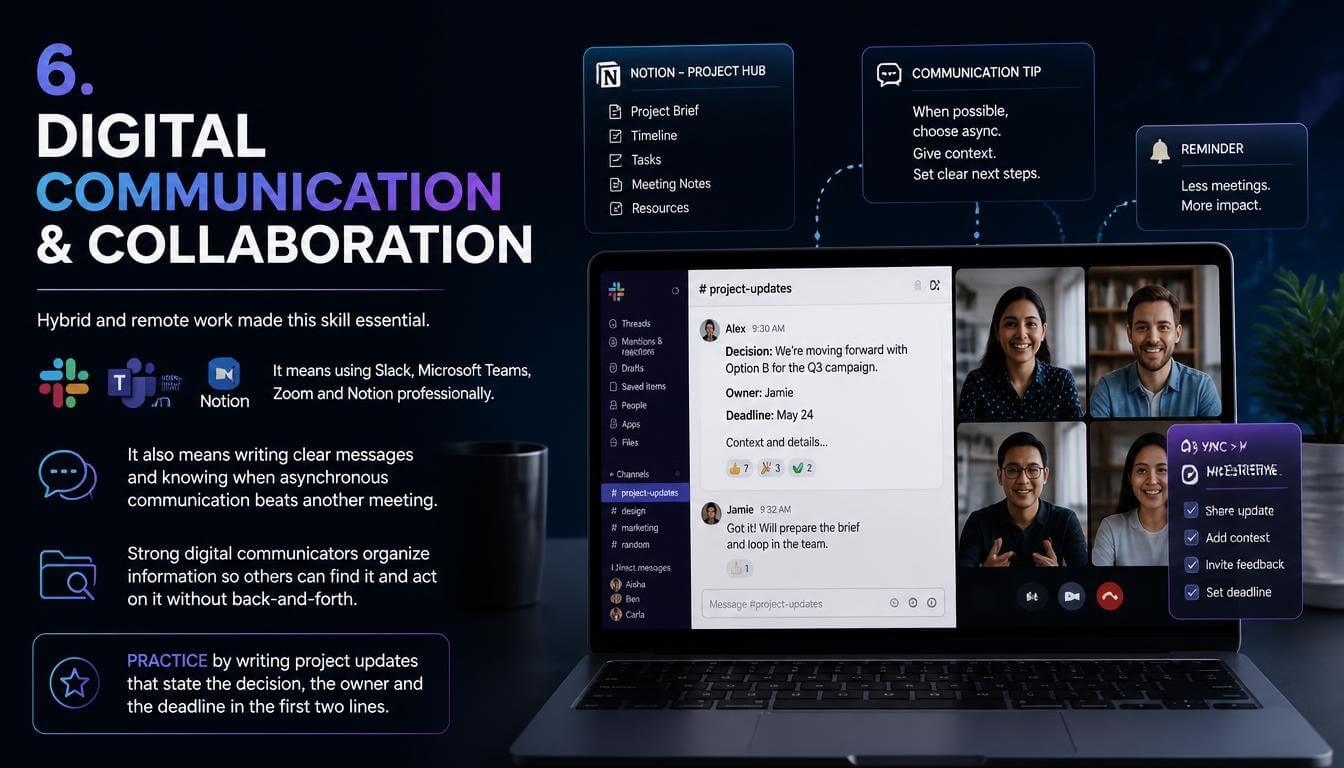
Hybrid and remote work made this skill essential. It means using Slack, Microsoft Teams, Zoom and Notion professionally. It also means writing clear messages and knowing when asynchronous communication beats another meeting.
Strong digital communicators organize information so others can find it and act on it without back-and-forth. Practice by writing project updates that state the decision, the owner and the deadline in the first two lines.
7. Digital Project Management
Digital projects often stall because of unclear ownership rather than bad technology. This skill means planning work in tools like Asana, Trello, Jira or Monday.com and tracking dependencies. It also means keeping stakeholders informed with steady, well-organized updates.
Learn the basics of Agile, Scrum and Kanban, then break one fuzzy goal into tasks, owners and milestones. Being able to show a working project plan sets you apart in almost any role.
8. Digital Marketing and Online Visibility
Digital marketing skills help anyone who needs attention for a product, a business or themselves. They cover SEO, content marketing, social media, Google Analytics 4 and CRM tools like HubSpot or Salesforce, and they connect each activity to measurable results like conversion.
Even outside marketing, personal branding pays off. A complete, keyword-rich LinkedIn profile and a few thoughtful posts can make recruiters notice you first.
To practice, choose one piece of content, like a blog post or product page, and track how it performs in Google Analytics 4 for a month. Note what brought visitors in and what made them leave. That loop of publishing, measuring and improving is the heart of every digital marketing role.
9. UX and Customer Experience Thinking
A product can work perfectly and still fail if people find it confusing. UX design and customer experience thinking teach you to view digital work through the user journey, spotting friction points, usability problems and accessibility gaps.
Try a quick audit. Walk through a website or internal form as a first-time user, note every confusing step and suggest fixes. Tools like Figma help later, but the core skill is empathy backed by evidence.
10. Basic Coding and Data Querying
You don’t have to become a software engineer, but reading and writing a little code is a clear advantage. Basic Python helps you automate and analyze data, and SQL lets you pull exactly the records you need from a database.
Aim for “useful,” not “expert.” Writing a short query to answer a business question, or a small script that saves an hour a week, is plenty to make this skill count.
11. Critical Thinking and AI Output Review
As AI produces more of our first drafts, judging that output becomes a skill in its own right. Critical thinking means checking sources, testing assumptions and separating facts from opinions before you share a conclusion.
Build the habit of asking three questions about every AI answer: Is it accurate? Is it complete? Is it right for this situation? Over time, this makes you the person your team trusts with important work.
12. Adaptability and Continuous Learning
Tools change faster than ever, so the ability to learn new ones quickly may be the most future-proof skill on this list. The World Economic Forum highlights resilience, flexibility and agility, along with curiosity and lifelong learning, among the skills rising fastest in importance.
Treat learning as a habit, not an event. Twenty focused minutes a few times a week with a new feature or tool keeps your skills current without overwhelming your schedule.
Employers notice adaptability through your stories. Keep a short note of each new tool you pick up, how long it took and what you did with it. In an interview, that record turns a vague claim like “I learn fast” into evidence.
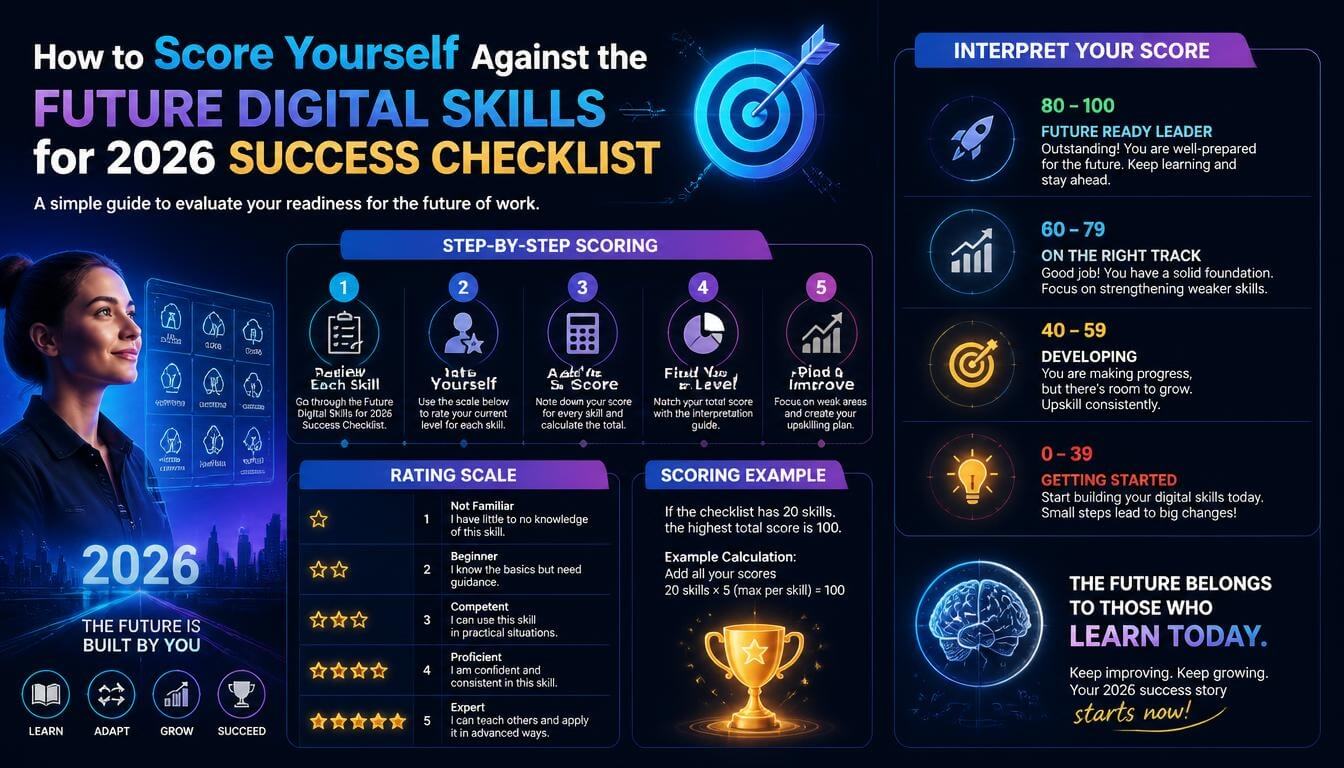
Now let’s turn the list into an honest self-assessment. For each skill, choose the level that describes what you can do today, not what you’ve only watched or read about.
| Skill | Level 1: Starting | Level 2: Working | Level 3: Strong |
| AI literacy | Casual use only | Uses AI for work tasks and checks output | Designs repeatable AI workflows with quality checks |
| Data literacy | Reads reports from others | Builds spreadsheets and basic dashboards | Cleans, analyzes and explains data for decisions |
| Cybersecurity | Sees security as IT’s job | Follows safe habits | Spots risks and recommends controls |
| Cloud and SaaS | Uses apps without understanding them | Manages sharing and permissions | Maps business needs to cloud services |
| Automation | Does repetitive tasks by hand | Builds basic rules or automations | Maps and automates full processes |
| Collaboration | Uses chat and meetings | Organizes shared work clearly | Designs a team’s digital workspace |
| Project management | Works from ad-hoc instructions | Tracks tasks and deadlines | Structures scope, risks and dependencies |
| Marketing and visibility | Has a basic online presence | Plans and measures basic campaigns | Connects content to measurable results |
| UX thinking | Focuses only on output | Notices obvious user problems | Maps friction and proposes evidence-based fixes |
| Coding and querying | No coding exposure | Reads short code or queries | Writes useful scripts or SQL |
| Critical thinking | Shares outputs without checking | Reviews and edits AI output | Challenges assumptions and explains reasoning |
| Adaptability | Avoids new tools | Learns new tools when required | Seeks out and masters new tools early |
Once you’ve scored yourself, run through these quick checks:
- Count how many skills you rated Level 1, because those are your biggest gaps
- Circle the 2–3 skills your target job mentions most often in postings
- Mark one skill you can improve this month inside your current job
- Note one skill where you’re already strong enough to show proof
- Write down one tool you need to learn first
Which Skills to Prioritize at Your Career Stage
Trying to master all 12 skills at once is the fastest way to burn out. A better approach is to pick the combination from this future digital skills for success checklist that fits where you are right now.
| Career Stage | Start With | Add Next | Your Goal |
| Students | AI literacy, collaboration, cybersecurity basics | One role-specific skill like marketing or data | Show one finished project, not just coursework |
| Career switchers | Data literacy and AI literacy | Automation or digital marketing | Add a digital layer to experience you already have |
| Working professionals | Two skills adjacent to your current role | Critical thinking and communication | Move from tool user to workflow owner |
| Managers | AI literacy and project management | Data literacy and security awareness | Set standards and model responsible AI use |
If you’re switching careers, don’t throw away your past experience. A finance professional who adds analytics and automation, or an HR professional who adds people data and AI-assisted workflows, becomes far more valuable than a beginner starting from zero.
Digital Skills by Job Role
Digital skills look different depending on your job. The table below shows what employers in common US roles typically expect.
| Job Role | Key Digital Skills | Common Tools |
| Marketing | SEO, analytics, content and AI writing | Google Analytics 4, HubSpot, social schedulers |
| Sales | CRM management, video selling, data tracking | Salesforce, HubSpot, Zoom |
| Customer service | Helpdesk systems, chat support, knowledge bases | Ticketing tools, live chat platforms |
| Finance and operations | Spreadsheet modeling, dashboards, automation | Excel, Power BI, ERP systems |
| HR | Applicant tracking, people analytics, e-learning | ATS platforms, learning management systems |
| Any role | Email, video calls, cloud documents, AI tools | Microsoft 365, Google Workspace, ChatGPT |
Use the row for your role as a shortcut through the future digital skills for success checklist. The skills listed there are the ones most worth proving first.
Your 90-Day Plan to Complete the Future Digital Skills for 2026 Success Checklist
A good plan is narrow enough to finish and practical enough to show. Pick 2–3 priority skills from your self-assessment and follow this three-phase roadmap.
| Phase | What to Do | What You’ll Have at the End |
| Days 1–30 | Map the skills your target role needs and learn the fundamentals | A skill map, a learning plan and 1–2 small practice outputs |
| Days 31–60 | Build one working project using your priority skills | A finished portfolio project with notes on your process |
| Days 61–90 | Update your resume, practice explaining your work and add a second proof point | A role-specific resume, a project story and interview-ready examples |
The secret is consistency. Short, regular practice beats a long weekend course followed by weeks of nothing. When you finish one round of this future digital skills for success checklist, start the next 90 days with a new skill or a deeper level of the same one.
How to Prove Your Digital Skills to Employers
Listing skills isn’t enough anymore. Recruiters want to see what you’ve done with them. Instead of writing “proficient in Excel,” write something like “built a dashboard that cut weekly reporting time by three hours.” Name the specific tool, then attach a result. Every item on your future digital skills for 2026 success checklist becomes far more valuable once you can show it in action.
A focused portfolio project is your strongest proof. Document the problem, what you did, the tools you used and what changed. A short case study like this works far better in an interview than a long list of software names.
Certifications still help, especially when they’re recognized in your field, such as Microsoft, Google or AWS certifications. Pair each certification with an applied example, though, so it supports a concrete story. Finally, many US employers screen resumes with an applicant tracking system, so mirror the exact tool names from the job posting and give your skills a clear section.
Where to Learn Digital Skills
The good news is that you can learn most of these skills online, often at low or no cost. The best choice depends on your goals and how you like to learn.
| Learning Option | Best For | Format |
| Coursera | Data, AI, cloud and certificate programs | Self-paced courses with certificates |
| LinkedIn Learning | Communication, analytics and business tools | Short modular videos |
| Udemy | Marketing, social media and specific software | On-demand courses |
| Free vendor training | Learning a specific platform you use at work | Tutorials and documentation |
| Mentorship and peer learning | Practical tips and accountability | One-on-one or group sessions |
Whichever option you choose, learn by doing. Building an actual dashboard or automation teaches you more than finishing ten videos you never apply.
Common Mistakes That Hold People Back
Even motivated learners fall into a few predictable traps. Watch out for these:
- Collecting tool names instead of building usable capability
- Trying to learn all 12 skills at the same time
- Trusting AI output without checking it
- Finishing courses without creating any proof of the skill
- Ignoring security habits because “IT handles that”
- Treating learning as a one-time event instead of an ongoing habit
Avoid these, and you’ll progress faster than most people who start at the same level as you.
Printable Future Digital Skills for 2026 Success Checklist
Save or print this future digital skills for 2026 success checklist and tick off each item as you go:
- I can use AI tools for work tasks and fact-check their output
- I can read a dashboard and explain what the data means
- I use multi-factor authentication and can spot phishing
- I understand sharing, permissions and backups in my cloud tools
- I have automated at least one repetitive task
- I communicate clearly in async messages and virtual meetings
- I can break a goal into tasks, owners and milestones
- My LinkedIn profile and online presence are up to date
- I can spot friction in a user journey and suggest fixes
- I can write a basic SQL query or simple script
- I review and question information before sharing conclusions
- I spend time learning a new tool or feature every month
FAQs
What is a future digital skills for 2026 success checklist?
It’s a practical list of the digital skills employers expect in 2026, from AI literacy and data literacy to cybersecurity and collaboration. You use it to score your current level, find your gaps and plan what to learn next.
How do I use a future digital skills for 2026 success checklist?
Score yourself on each skill, then pick the 2–3 that matter most for your target role. Follow a 90-day plan to learn them, build a small project for each, and add the results to your resume.
What is the most important digital skill for 2026?
For most people, it’s AI literacy. It topped LinkedIn’s 2025 list of the fastest-growing US skills, and LinkedIn’s 2026 list is led by AI engineering and AI business strategy, two skills that start with it. AI literacy works best when you pair it with critical thinking, because employers value people who can check and improve AI output.
Do I need to learn coding for digital skills success?
No. Basic SQL or Python is a helpful advantage, especially for data-heavy roles, but most digital skills, like collaboration, cybersecurity habits and AI literacy, need no coding at all.
How long does it take to build digital skills?
Basic AI and collaboration skills can improve in a few weeks of regular practice. Skills like advanced spreadsheets or dashboards usually take a few months of consistent use on real tasks.
Are digital skills only useful in tech jobs?
Not at all. Lightcast found that more than half of job postings requiring AI skills in 2024 were outside IT and computer science. Marketing, finance, HR, sales and operations roles all reward people who can work confidently with data, automation and AI tools.
How do I show digital skills on my resume?
Name the specific tools, attach a measurable result and mirror the wording in the job posting. A short portfolio project or case study makes your claims far more believable.
Read More: https://linkneon.com/mastering-parallel-programming/
Conclusion
Digital skills are no longer a bonus on your resume. They are the foundation of career success in 2026. Thankfully, you don’t need all of them at once. Use this future digital skills for 2026 success checklist to find your gaps, choose the 2–3 skills that matter most for your role, and turn them into visible proof through small, finished projects.
Start with one skill this week. Practice it on a live work task, document what changed and build from there. Small, steady progress compounds into a future-proof career. The people who thrive in 2026 won’t be the ones who know every tool. They’ll be the ones who keep learning, keep proving and keep moving.