


If a competitor’s website ranks above yours in Google, it’s already telling you something valuable: which search queries bring it traffic, and which keywords are worth chasing. Competitor keyword analysis is the process of finding those exact terms, evaluating whether they’re realistic to target, and turning them into a plan for your own content strategy. It works because it removes guesswork — if a keyword already drives organic traffic to a competing site, you know real people are searching for it, so you don’t have to rely on assumptions.
What Is Competitor Keyword Analysis?
Competitor keyword analysis means identifying the search terms your competitors already rank for, then studying those terms to understand which ones you should also target. It’s built on a simple idea: if a website ranks for a keyword and gets organic traffic from it, that keyword has already proven its value in the real world — you don’t have to guess whether people search for it.
For example, if you sell home coffee machines and a competitor ranks for “best espresso machine under $300,” that phrase tells you two things: people are searching for it, and someone is already capturing that demand. Your job is to figure out whether you can compete for it too, and if so, how.
The core benefits of doing this properly include:
- Uncovering keyword opportunities you might never have thought of on your own
- Understanding your audience’s language and needs more precisely
- Building a stronger, more complete content strategy
- Increasing organic traffic and, eventually, conversions
Step 1: Identify Your Real Competitors
Before you can analyze anyone’s keywords, you need to know who your competitors actually are — and this is where many people go wrong. There are two different types of competitors, and confusing them wastes time.
- Business competitors — companies that sell what you sell or serve the same market.
- SERP competitors — websites that rank for the same keywords as you, regardless of what they sell.
A blog, a marketplace, and a niche review site can all be SERP competitors for the same keyword without being business competitors at all — and for competitor keyword analysis, SERP competitors matter just as much as business competitors.
To find them, start with your seed keywords — the two or three core terms that describe what your business does. Search those terms and see which domains consistently appear on page one. Those are your starting list. If you already know your competitors by name, you can skip straight to researching their domains, but it’s still worth double-checking who ranks for your most important terms, since the SERP doesn’t always match your assumptions.
Step 2: Find Competitor Keywords (Tools & Manual Methods)

Once you have a list of competitor domains, it’s time to extract their keyword data — this is the data-gathering stage of competitor keyword analysis. There are three general approaches, and using more than one gives you a fuller picture.
Here’s a quick comparison to help you decide where to start:
| Method | Examples | Typical Cost | Best For |
| All-in-one SEO suites | Ahrefs, SEMrush, Moz | Paid subscription | Agencies and established sites needing deep competitor data |
| Keyword-focused tools | KWFinder, Ubersuggest | Free tier + paid upgrade | Small businesses and bloggers just getting started |
| Google’s native tools | Google Keyword Planner, Google Search Console | Free | Anyone with a Google Ads or Search Console account |
| Manual research | SERP analysis, People Also Ask | Free | Quick, low-cost validation of keyword ideas |
Paid Tools
Dedicated keyword research platforms (such as Ahrefs, SEMrush, Moz, and KWFinder) let you enter a competitor’s domain or URL and pull a list of the keywords they rank for, along with metrics like search volume, keyword difficulty, and estimated traffic. The general workflow across most of these tools is similar:
- Enter the competitor’s domain into the tool’s site/domain explorer.
- Navigate to the organic keywords or organic research section.
- Review the full list of ranking keywords, filtering by volume, position, or intent as needed.
- Export or save the keywords you want to investigate further.
These tools differ in their databases, update frequency, and pricing tiers, so it’s worth comparing a couple before settling on one, especially if budget is a concern.
Free Tools
You don’t need a paid subscription to start. Google Keyword Planner (inside Google Ads) lets you enter a competitor’s website and generates keyword ideas based on their content, along with rough volume ranges. Google Search Console — if you already rank for some overlapping terms — shows you impressions and average position, which can highlight where you’re close to outranking a competitor. Free trials or limited free tiers of tools like Ubersuggest can also give you a partial list of a competitor’s top keywords, which is often enough for a smaller site or a first pass.
Manual Research
Sometimes the simplest method is still effective. Search your seed keywords manually and study the pages that rank:
- Read competitor page titles and meta descriptions to see which terms they’ve optimized for.
- Check the People Also Ask boxes and related searches at the bottom of the results page — these often reveal long-tail keywords and sub-topics competitors haven’t fully covered.
- Skim the competitor’s own site structure (blog categories, navigation menus) to see which topics they’ve built entire content clusters around.
Manual research won’t give you exact volume numbers, but it’s free, fast, and often surfaces intent-based nuances that tools miss.
Step 3: Separate Organic vs Paid Keywords

Most people only look at organic rankings, but competitors are usually also bidding on keywords through PPC keywords in Google Ads — and that data tells a different story.
- Organic + Paid overlap — a keyword a competitor pays to rank for, even though they already rank organically, is a strong signal of high commercial intent and real revenue value.
- Organic-only keywords — tend to skew more informational and are often better suited for top-of-funnel content like guides and comparisons.
Reviewing both as part of your competitor keyword analysis gives you a clearer sense of priority, rather than judging every keyword by organic ranking data alone.
Step 4: Analyze the Keywords You’ve Found
Having a long list of competitor keywords isn’t useful on its own — the real work is in analysis. This is where you decide what’s actually worth pursuing.
Search Intent
Every keyword falls into one of four general categories: informational (someone looking to learn something), navigational (looking for a specific brand or site), transactional (ready to buy or take an action), and commercial investigation (comparing options before deciding). Matching your content format to the correct intent matters more than almost any other factor — a product page won’t rank for a purely informational query, and a blog post won’t rank for someone ready to check out.
Look at the pages currently ranking for a keyword. If they’re mostly comparison articles or reviews, that’s a strong hint the intent is commercial investigation, not transactional.
Keyword Difficulty
Keyword difficulty scores estimate how hard it will be to rank on page one for a given term, usually based on the authority and backlink strength of the pages already ranking. This number is only meaningful relative to your own site’s current authority — a “medium difficulty” keyword might be realistic for an established site and completely out of reach for a brand-new domain.
If your website is new, it generally makes sense to focus first on lower-difficulty, more specific terms where you can realistically compete, rather than chasing the same broad keywords as established competitors.
Search Volume & Trends
Search volume tells you the average number of monthly searches a keyword receives. Higher volume generally means a bigger potential audience, but it also usually means more competition. It’s worth pairing volume data with a trend tool to check whether interest in a keyword is rising, stable, or declining — targeting a keyword that’s losing search interest is rarely a good long-term investment, even if its current volume looks attractive.
Prioritize the Right Keywords
With intent, difficulty, and volume all in hand, prioritization comes down to weighing them together rather than fixating on any single metric. A keyword with high volume but poor intent match or very high difficulty may not be worth pursuing right away, while a lower-volume keyword with strong intent alignment and low difficulty can be a faster, more realistic win — particularly for newer or smaller sites still building authority. There’s no universal cutoff; the right choice depends on your site’s current strength and how directly the keyword connects to what you actually offer.
The chart below gives a simple visual way to think about this stage of competitor keyword analysis:
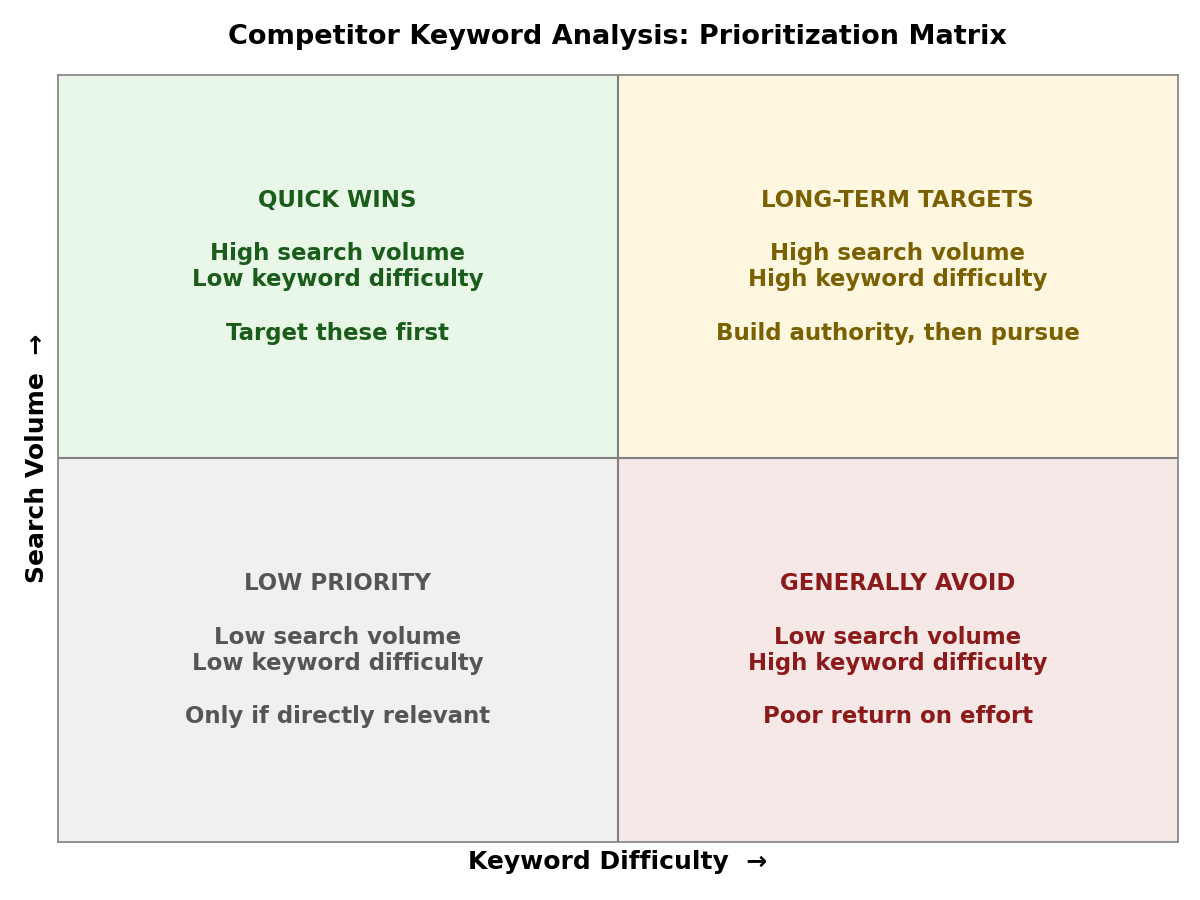
- Quick wins (high volume, low difficulty) — target these first.
- Long-term targets (high volume, high difficulty) — worth pursuing once your site has built more authority.
- Low priority (low volume, low difficulty) — only pursue if the topic is directly relevant to your business.
- Generally avoid (low volume, high difficulty) — rarely worth the effort.
Step 5: Perform Content Gap Analysis (Not Just Keyword Gap)
Finding a keyword gap — a term competitors rank for that you don’t — is only half the picture. The other half is a content gap analysis: actually opening the top-ranking pages and studying how they’re built.
Look at:
- Content depth — how thoroughly does the page cover the topic, and what subtopics does it include?
- Format — is it a listicle, a step-by-step guide, a comparison table, a video-supported article?
- Structure — how are headings organized, and does the page answer follow-up questions a reader might have?
- Media — does it use images, screenshots, charts, or embedded tools to support the text?
A keyword gap tells you what to write about. A content gap tells you how to write it better than what’s currently ranking — which is ultimately what determines whether your page can outrank theirs.
Step 6: Create and Optimize Content Around Keywords
Once you’ve chosen your target keywords, group related ones into clusters around a central topic rather than writing one page per keyword in isolation. This approach, often called keyword clustering, helps build topical authority — search engines tend to trust sites that cover a subject comprehensively across multiple interlinked pages more than sites with scattered, disconnected content.
From there, standard on-page SEO practices apply: use your focus keyword naturally in the title, early in the introduction, and in at least one subheading; write meta descriptions that reflect real search intent; and internally link between related articles so both users and search engines can navigate your topic cluster easily.
Step 7: Track Rankings and Iterate
Competitor keyword analysis isn’t a one-time task — it’s an ongoing cycle. Once your content is published, use a rank tracking tool to monitor how your pages perform for the target keywords over time, and keep an eye on whether competitors are gaining or losing positions on the same terms. Rankings shift as competitors update their content, new sites enter the space, and search intent evolves, so revisiting your keyword list every few months keeps your strategy current instead of stale.
Common Mistakes to Avoid
- Chasing high-volume keywords only. A big number looks appealing, but if the difficulty or intent doesn’t match your site, it’s not a realistic target.
- Ignoring search intent. Ranking well means matching what searchers actually want, not just including the right words.
- Treating it as a one-time project. Competitor rankings and search behavior change constantly; analysis needs to be revisited periodically.
- Copying competitor content instead of improving on it. A content gap analysis should reveal how to do better, not just what to replicate.
- Skipping paid keyword data. Ignoring PPC activity means missing a strong signal of commercial value.
FAQs
How often should I do competitor keyword analysis? There’s no fixed rule, but reviewing your core competitors’ keywords every few months helps you catch new opportunities and respond to shifts in the market before you fall behind.
Do I need paid tools to do this properly? No. Free tools and manual research can get you a solid starting list, especially for smaller sites. Paid tools simply make the process faster and give you more complete data.
Should I target every keyword gap I find? No. Not every gap is worth pursuing — check intent, difficulty relative to your site’s authority, and whether the topic genuinely fits your business before committing content resources to it.
What’s the difference between a keyword gap and a content gap? A keyword gap shows you which search terms a competitor ranks for that you don’t. A content gap analysis goes further, examining how their ranking content is structured, formatted, and how thoroughly it covers the topic — which shapes how you should write your own version.
Read This Blog: https://linkneon.com/how-to-get-seo-clients-without-cold-calling/
Conclusion
Competitor keyword analysis works because it replaces guessing with evidence — every keyword you find has already proven there’s demand for it. The real value, though, comes from what you do after finding the list: matching intent correctly, weighing difficulty against your own site’s authority, studying not just what competitors rank for but how they’ve built their content, and revisiting the process regularly as rankings shift. Approached this way, it becomes less of a one-time research task and more of an ongoing part of how your content strategy stays competitive.