

Most best practices I followed delivered nothing useful, while a few reckless SEO hypotheses moved rankings. That contradiction reshaped my mindset: Mad SEO begins where average SEOs stop, treating every ranking drop as raw material.
Picture mad SEO scientists without lab coats: practitioners blending coding, machine logic, and user psychology through trial and error. Each project demands three hats: Website Architect, Content Sorcerer, and Explosive Growth Strategist, all worn at once.
SEO education fails beginners and veterans, burying effective tactics under jargon. This guide covers testing, coding, content, AI search, local SEO and KPIs, built on an ethical hacker mindset, data analysis, and disciplined, calculated risk-taking.
What Is Mad SEO and Why Does It Work?
Most rankings I’ve rescued came from breaking best practices, not following them. That is mad SEO: treating search engines as a black box, forming SEO hypotheses, letting SEO testing decide which unconventional strategies outrank competitors.
Why does it work? Algorithms weigh hundreds of factors no SEO guides fully map. Forum debates settle nothing; data-backed insights do. Blending coding, technical optimization, on-page optimization and content creation exposes the signals competitors miss.
My track record proves ethics matter: white hat SEO builds durable visibility, grey hat SEO demands nerve, black hat SEO collapses quickly. Today this experimental lens extends to AI Overviews, AEO, GEO and AI platforms.
The Mad SEO Philosophy: Breaking Blindly Followed Best Practices
The fastest way to stall rankings is obeying every checklist. Average SEOs treat published guidelines as law, while mad SEO scientists without lab coats question them, swapping comfortable habits for calculated risk-taking and documented SEO hypotheses.
Years ago, I watched a client’s traffic flatline despite flawless audits. That failure became my manifesto: rigorous testing beats inherited advice. Through trial and error across guest-post sites and technical SEO experiments, effective tactics surfaced.
Breaking rules carelessly is not the point. An unconventional SEO mindset pairs curiosity with data analysis, keeping accessible SEO principles intact while chasing standout results using the latest strategies tested against top competitors before scaling.
Data-Driven SEO Testing and Expert Analysis
Most SEO reports I inherit are decoration, not evidence. Before trusting any recommendations, I rebuild the website analysis from raw crawl data, because SEO tools disagree, and client objectives deserve numbers that survived real testing.
Domain Rating misleads. Chasing DR-based backlinks from write for us pages feels productive, yet my off-page SEO experiments keep favoring relevance over raw metrics. One niche link earning Google News indexing can outweigh ten placements.
Programming earns its keep. I script ChatGPT versus Gemini comparisons, test every on-page setup change in isolation, then hand SEO experts reporting and analysis. That discipline turns consulting and strategy into measurable on-page SEO decisions.
The Fusion of Coding and SEO
The best ranking fix I ever shipped was not a keyword change; it was a few lines of coding that removed a render-blocking script. That moment taught me SEO rewards whoever reads machine logic fluently.
Yet a programmer often misses half the equation. Crawlers parse markup, but people decide clicks, and user psychology governs that decision. SEO writers who understand user behavior catch intent shifts before log files reveal them.
The fusion works when technical depth serves business strategy, not ego. I map market psychology and customer search behavior first, then decide which web development changes move revenue, because code nobody searches for earns nothing.
Three Key Roles of a Mad SEO: Architect, Content Sorcerer, Growth Strategist
My worst campaign failed because I hired one specialist and expected three jobs done. Splitting the work into three roles fixed it, and I have kept that separation since, across every client account I manage.
Think of them as three pillars sharing one ethical hacker mindset: the Website Architect probes how crawlers move, the Content Sorcerer probes audience trust, and the Explosive Growth Strategist probes where revenue leaks through funnels.
Contrarian take: rankings are a lagging symptom. Google rewards sites where structure, content, and conversion support each other, so I judge a team by whether its roles share data weekly, not by Monday keyword reports.
Architect
Before touching keywords, I spend a week breaking the site on purpose. Redirect chains, orphaned pages, and bloated templates surface fast, and fixing them strengthens technical foundations more than any audit tool’s color-coded score could.
Site structure decides which pages inherit authority. I map internal anchor text like plumbing, routing equity toward money pages, then use automation to flag broken links before real users or crawlers ever stumble into them.
Architects once worked entirely offline in clunky spreadsheets. Today the role includes on-page optimization at scale, schema decisions, and page speed budgets, because a slow, confusing build quietly sabotages every word the next role writes.
Content Sorcerer
The sorcery label misleads people; nothing here is mystical. Good unique content comes from studying search behavior in raw query logs, then answering the follow-up question searchers actually had but never typed into the box.
Lately my briefs demand information-gain optimized content, because AI Overviews summarize whatever is generic. Pages adding original data, tested numbers, or first-hand screenshots earn citations, while lightly rewritten competitor pages simply vanish from view entirely.
Keyword-optimized content still matters, but density obsession quietly died many years ago. I would rather publish engaging content that keeps readers scrolling, because return visits and scroll depth reveal quality faster than any on-page checklist.
Growth Strategist
Traffic charts flatter egos, yet invoices pay salaries. That tension defines growth engineering: tying every ranking gain to leads, then running conversion rate optimization so extra organic traffic becomes measurable revenue rather than vanity screenshots.
Hidden opportunities usually sit quietly in stubborn page-two positions. I treat them like an R&D team would, running controlled SEO tests on titles and internal links, and only scaling changes that move agreed KPIs upward.
Link acquisition belongs here too. Earned backlinks from respected niche publications compound slowly, so I pair them with digital PR outreach and press mentions, accepting slower curves for authority that algorithm updates rarely wipe out.
The Mad SEO Process: From Customer Research to Content Updates
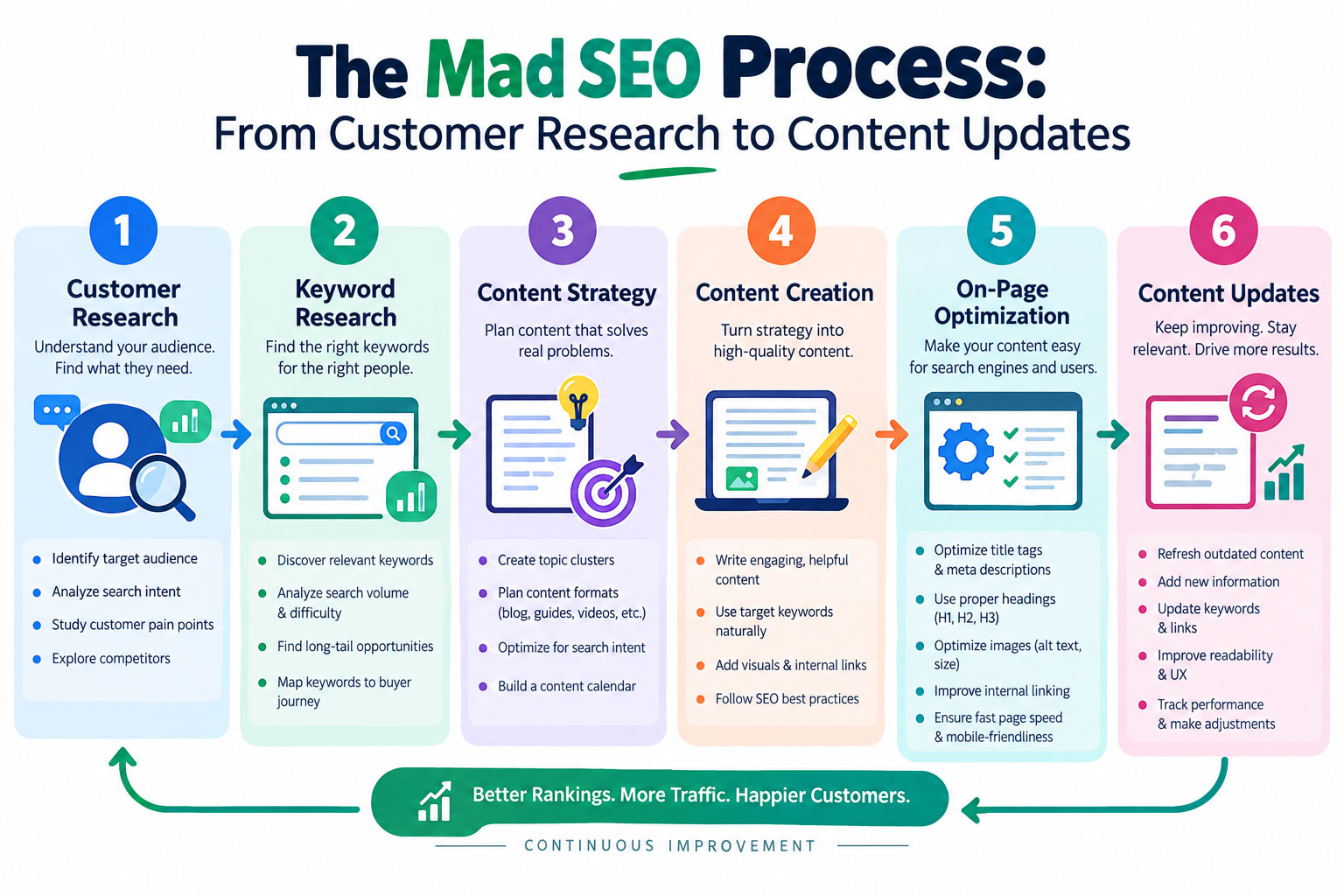
Most teams treat content updates as cleanup, yet I’ve watched stale ranking pages slip once competitor monitoring stops. The process truly starts there, because every refresh exposes what early customer research missed about client needs.
A free consultation rarely reveals the client vision; it surfaces assumptions. Pairing that conversation with competitor research viewed from multiple angles shapes a custom SEO strategy, then an SEO roadmap whose milestones reflect search demand.
Whether an agency frames it as three stages or four steps, content creation succeeds only when useful content becomes complete content. Honest progress updates then close the loop, feeding fresh ranking data back into research.
Client-Centric and Tailored SEO Strategies
Most agencies sell tailored solutions but deliver templates. I learned that real site-specific SEO begins before any audit, during the first consultation, where uncovering the client vision matters more than crawling pages for technical errors.
A client-centric approach rarely starts with rankings. Two brands in the same industry can attract a different target audience, so personalized solutions must connect every keyword to measurable client goals inside the wider marketing strategy.
Rankings fade; trustworthiness compounds. Clients stay when customer support answers questions in plain language and reports explain why a change mattered. That transparency turns SEO services into long-term relationships, starting when prospects book a call.
Technical, On-Page, and Off-Page SEO Scope
Most audits I run fail before anyone touches code, because teams split technical, on-page, and off-page SEO into separate silos. In practice, onsite fixes often stall quietly until branding gives Google a clearly recognizable entity.
A few years back, crawl budgets and schema felt like the whole job. Today, offsite credibility decides whether clean architecture matters, and earning Google News backlinks from publishers often outweighs another month of template tweaks.
The scope keeps widening beyond the website itself. A YouTube channel answering real customer questions, plus an accurate Google Maps listing, now carries signals that connect on-page relevance with technical trust and earned off-page authority.
SEO Content Creation That Outranks Competitors
Most ranking pages I audit aren’t winning because of length. They win because writers studied customer search behavior first, built useful content answering the question, and earned Google attention while bloated competitors chased word counts.
Early on, I confused in-depth content with complete content. A client’s sprawling guide skipped pricing. Once we rebuilt it from internal documents into accurate content, Google Search started favoring the leaner version over bulkier rivals.
Outranking competitors depends on structure. Optimized content fails when nobody finishes reading, so readable content matters equally. Grouping posts under a focused blog category and assigning in-house resources to refresh them keeps topical authority compounding.
AI Search Optimization: AEO, GEO, and Google AI Overviews
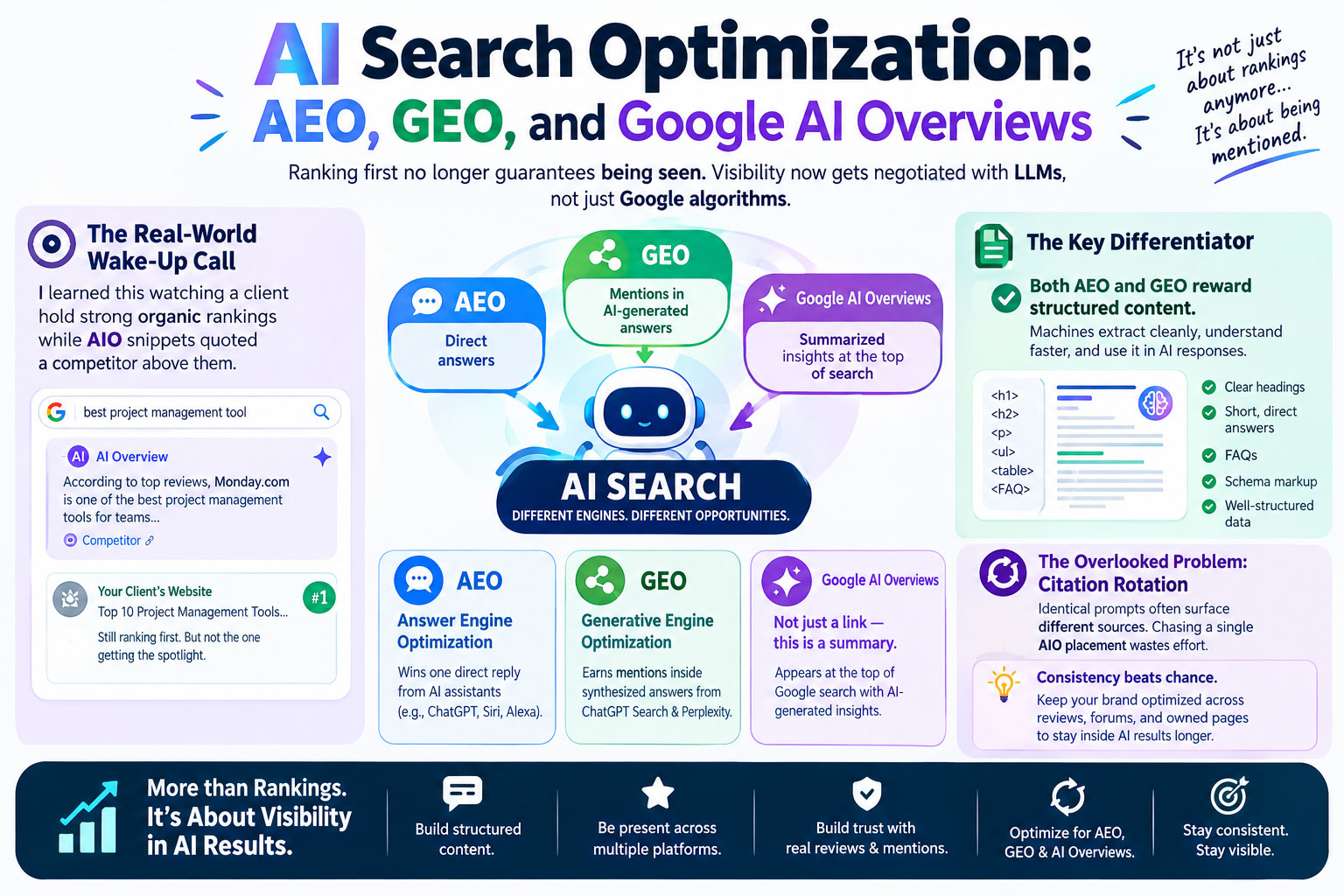
Ranking first no longer guarantees being seen. I learned this watching a client hold strong organic rankings while AIO snippets quoted a competitor above them. Visibility now gets negotiated with LLMs, not just Google algorithms.
Many call AEO and GEO rebranded SEO. Wrong. Answer engine optimization wins one direct reply; generative engine optimization earns mentions inside synthesized answers from ChatGPT Search and Perplexity. Both reward structured content machines extract cleanly.
The overlooked problem is citation rotation: identical prompts often surface different sources. Chasing a single AIO placement wastes effort. Consistent brand optimization across reviews, forums, and owned pages keeps your name inside AI results longer.
Local SEO and Google Maps Ranking Signals
Distance is the one factor you cannot optimize, yet many owners obsess over it. In my audits, Map Pack rankings shift more from prominence, built through genuine reviews, local partnership links, and consistent business details.
A complete Google Business Profile earns visibility, but steady GBP posting keeps it alive. I write every update as non-AI content, grounded in real jobs, then mirror those signals across YouTube clips and social profiles.
Contrarian truth: GBP rankings rarely hold without onsite signals backing them. Treat local SEO as one ecosystem where your website, citations, and Google Maps listing share facts, building a local presence that earns local results.
Page Speed and Its Role in SEO Performance
Shaving two seconds off load time rarely moves rankings alone; what it moves is conversions. On a retail audit I ran, the faster site recovered abandoned carts first, and organic visibility followed weeks later, reluctantly.
Google folded speed into its page experience signals because slow pages punish people, not crawlers. I now treat site performance as a user experience problem, testing mobile usability on throttled connections before touching compression settings.
Video-First Search: YouTube Shorts and Reels in Mobile SERPs
I have watched a ten-second Reels clip outrank a polished pillar guide on mobile SERPs. Google now pulls vertical clips into short-video shelves, where captions, spoken keywords, and fast hooks matter more than word count.
Honestly, video-first search is a format play, not a platform play. I cut one script into YouTube Shorts, add on-screen keyword text, track impressions across mobile search results, letting organic winners guide paid media spend.
Common SEO Mistakes That Hurt Rankings
Most rankings don’t collapse from penalties; they erode quietly. After auditing hundreds of sites, I’ve noticed experienced SEOs commit the costliest SEO mistakes, because untested assumptions about crawling, intent, and internal links rarely get challenged.
Chasing backlink building while pages load slowly, cannibalize each other, or bury answers under jargon wastes budget. My own recurring fixes start with indexation, then intent alignment, because sound SEO strategy repairs foundations before amplifying.
How to Measure Mad SEO Campaign Success with KPIs
After years of auditing campaigns, I’ve learned rankings lie when isolated. Real campaign success begins with defined goals, then traces awareness through engagement into sales, with CRM records confirming which organic sessions actually produced revenue.
Contrary to dashboard habits, fewer KPIs reveal more. I track impressions, click-through rate, qualified leads, and AI search citations, then adjust strategy when numbers stall, because measurement only matters if it changes your next move.
How to Choose the Right SEO Agency
Most hiring mistakes happen before the first call. I’ve watched owners chase the cheapest SEO company, then pay twice fixing thin work. Competitive rates mean nothing without quality work, so request case studies, not promises.
Ask who touches your site. A full-service digital agency may blend in-house teams with near-shore teams, which is fine when experts own strategy. The right SEO agency explains its services plainly and shares reporting access.
Frequently Asked Questions About Mad SEO
What Is Mad SEO?
Most people assume Mad SEO is just a quirky agency name, yet working alongside it showed me something sharper: testing-obsessed search strategy, backed by near-shore resources and a free book that teaches before it sells.
Is Mad SEO The Same As Black Hat SEO?
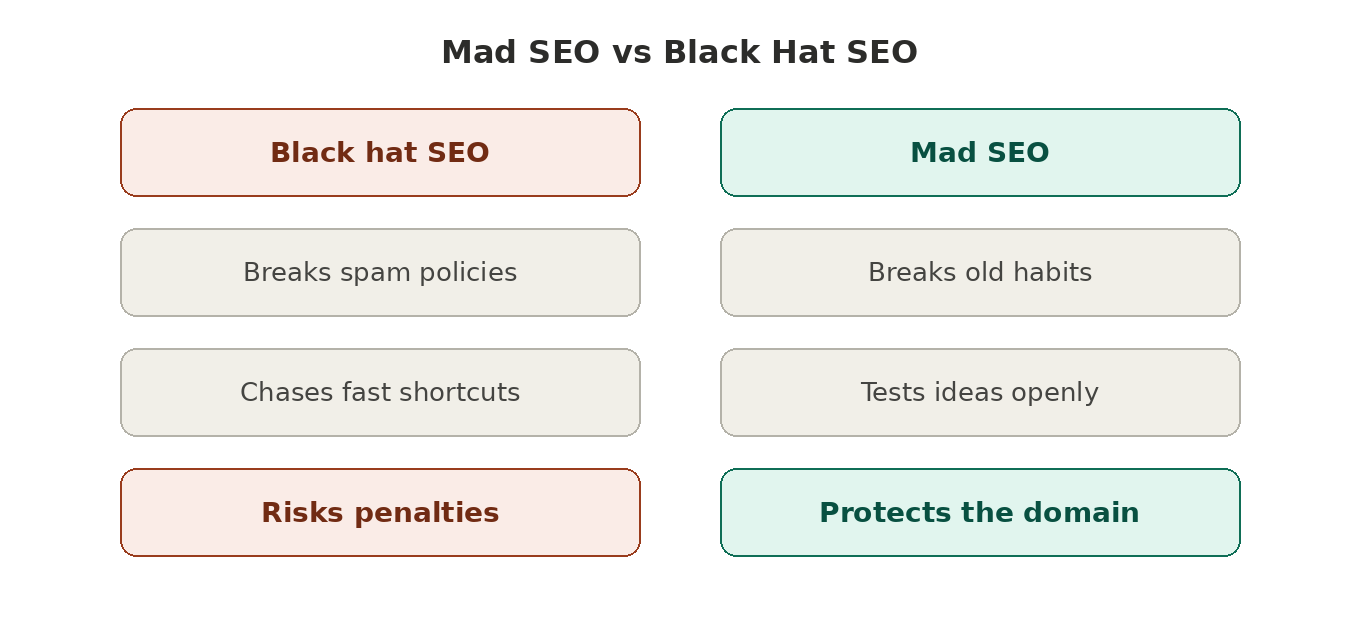
No, and that confusion annoys veterans like me. Black hat SEO breaks Google’s spam policies to win fast; Mad SEO breaks habits instead, testing unconventional ideas openly so beginners never gamble their domains on penalties.
How Does Mad SEO Help You Rank In AI Overviews And LLMs?
Language models quote pages that answer cleanly, so Mad SEO structures entities, definitions, and citations first. I treat advanced tactics like schema and passage formatting as step-by-step guidance, then test which pages AI Overviews surface.
How Long Does Mad SEO Take To Show Results?
Google itself notes SEO usually needs four months to a year, and Mad SEO doesn’t pretend otherwise. What changes is visibility: clients see ongoing test results in client-friendly presentations and slide decks, not vague promises.
Who Should Use A Mad SEO Approach?
Entrepreneurs tired of copy-paste tactics benefit most, but I’ve seen students grasp it quickly too. Agencies also adopt the approach, reselling tested strategies under a white label while keeping their own brand front and center.
Read More: https://linkneon.com/citation-cleanup-guide/
Final Thoughts On Mad SEO
Mad SEO earns its name by questioning basics everyone repeats. Its free book challenges knowledge monopolies in the SEO training market, treating accessibility as strategy and showing SEO education belongs in an open SEO guide.
After years of watching rankings swing, I trust process over prediction. Mad SEO asks one stubborn question before every change-what does the data actually say?- and that habit outlasts any algorithm update Google ships.
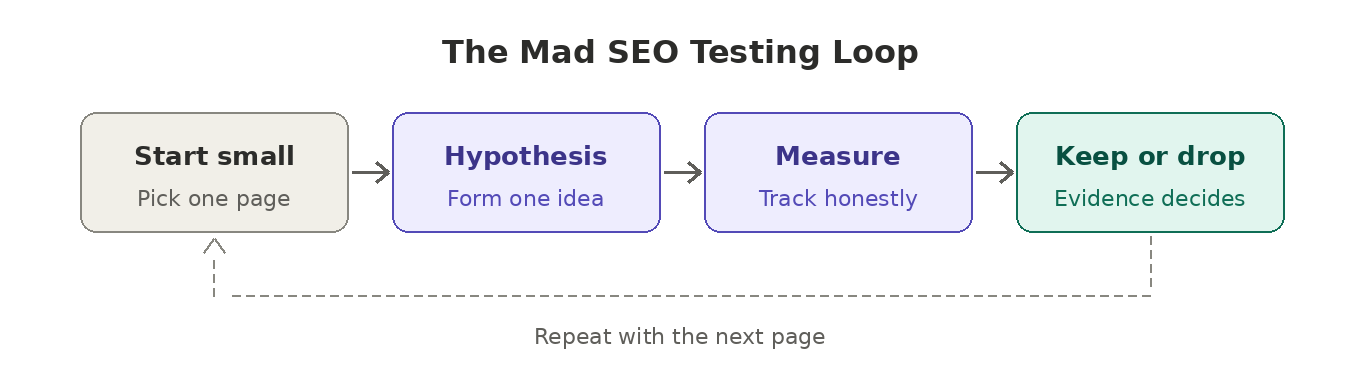
So start small. Pick one page, form a hypothesis, measure it honestly, and keep what works. That is the whole Mad SEO mindset: curious, skeptical, and patient enough to let evidence decide your next move.