

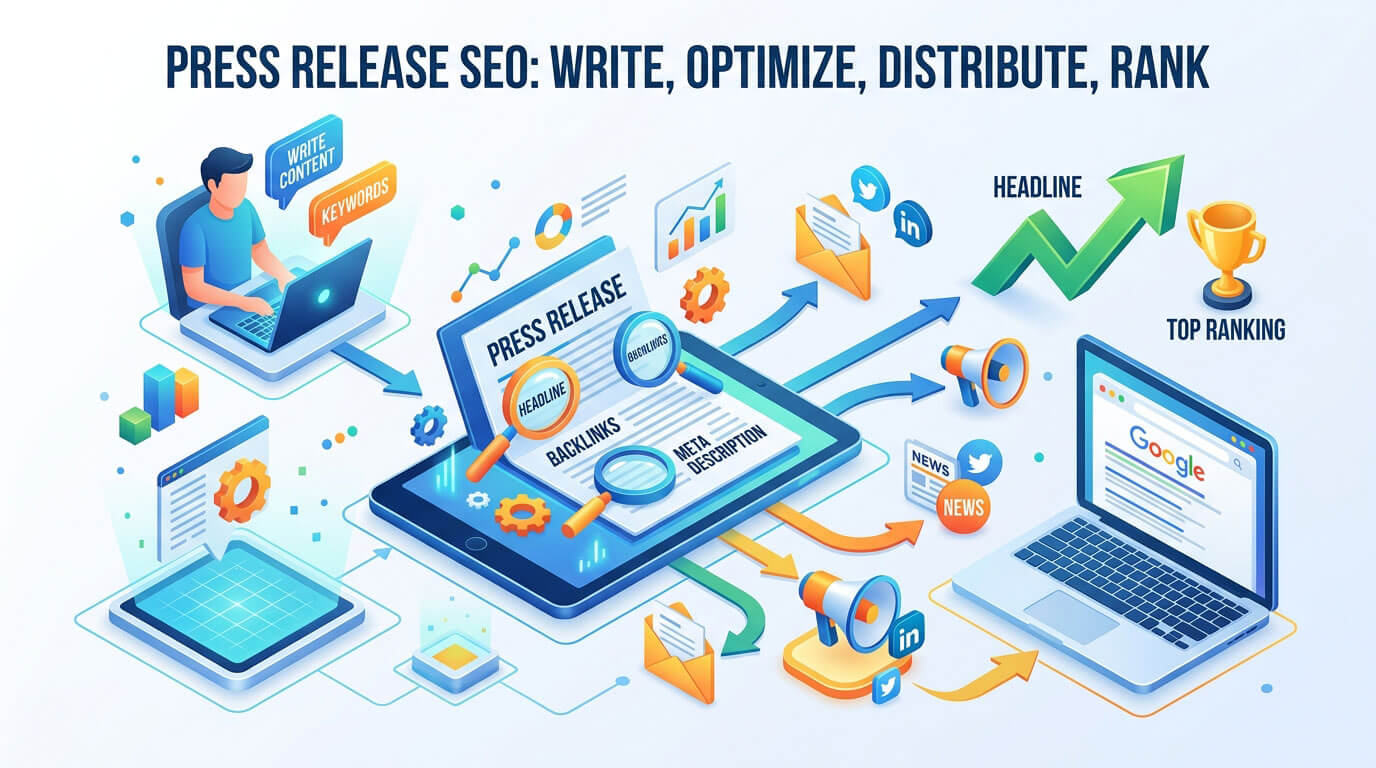
Press release SEO is the practice of writing, publishing, and distributing news announcements so that search engines, journalists, and readers can all find them.
It combines public relations with search engine optimization: a genuinely newsworthy announcement, the right keywords in the right places, a crawlable page on your own website, and links that follow search engine guidelines. Done well, a release earns media coverage, brand mentions, and referral traffic.
This article explains how press release SEO actually works today, without the hype. You’ll see whether press releases still help rankings, how to decide if your news deserves a release, and how to write a headline, lead, and boilerplate that serve both search engines and newsrooms.
It also covers on-page optimization, safe linking, distribution, common mistakes, and measurement, with a ready-to-use template and checklist.
What Is Press Release SEO?
A press release is an official announcement a company sends to the media and publishes for the public. Press release SEO adds a search layer on top: it makes sure the announcement is easy to find, easy to understand, and connected to the right page on your site.
The goal isn’t to turn news into a sales page. The goal is to make real news more discoverable. A good SEO-friendly press release still reads like journalism, follows the inverted pyramid (most important facts first), and answers questions a reporter would ask. The optimization is quiet: a clear headline, a sensible primary keyword, a clean URL, helpful images, and a few useful links.
Traditional Press Release vs. SEO Press Release
| Element | Traditional press release | SEO press release |
| Main audience | Journalists and editors | Journalists, searchers, and search engines |
| Headline | Newsy, sometimes vague | Newsy and specific, with a natural keyword |
| Home base | Sent by email or wire only | Also published on your own newsroom page |
| Links | Contact details only | A few useful, properly marked links |
| Success measure | Pickups and clippings | Coverage, branded search, referral traffic, conversions |
Do Press Releases Still Help SEO?
Yes, but mostly indirectly. The old idea was that every syndicated copy delivered a valuable backlink. That approach no longer holds up.
Direct Value: Your Owned Newsroom Page
The version of the release that lives on your own domain is the one you control. If it’s crawlable, internally linked, and well structured, it can rank for branded queries and announcement-specific searches: a product name, an event, an executive hire, a new location.
Indirect Value: Coverage, Mentions, and Branded Search
Most of the payoff comes from what the release sets in motion:
- A reporter or trade publication covers the story and links to you on its own, which is an editorial backlink.
- Your brand name appears next to your industry topics, which strengthens entity signals (how search systems connect your brand to a subject).
- Referral traffic brings in visitors who may return later through organic search.
- Credible coverage can make your brand easier for AI-driven search features to find and reference, although no one can guarantee that outcome.
What Press Releases Can’t Do
The leading search engine’s spam policies name keyword-optimized anchor text in press releases distributed on other sites as an example of link spam [1]. In practice, links in widely distributed releases shouldn’t be expected to pass ranking value, and keyword-heavy anchors can create risk. A press release also can’t rescue a weak story or hold rankings for broad, evergreen terms on its own. That job belongs to guides, product pages, and service pages.
Is Your News Worth a Press Release?
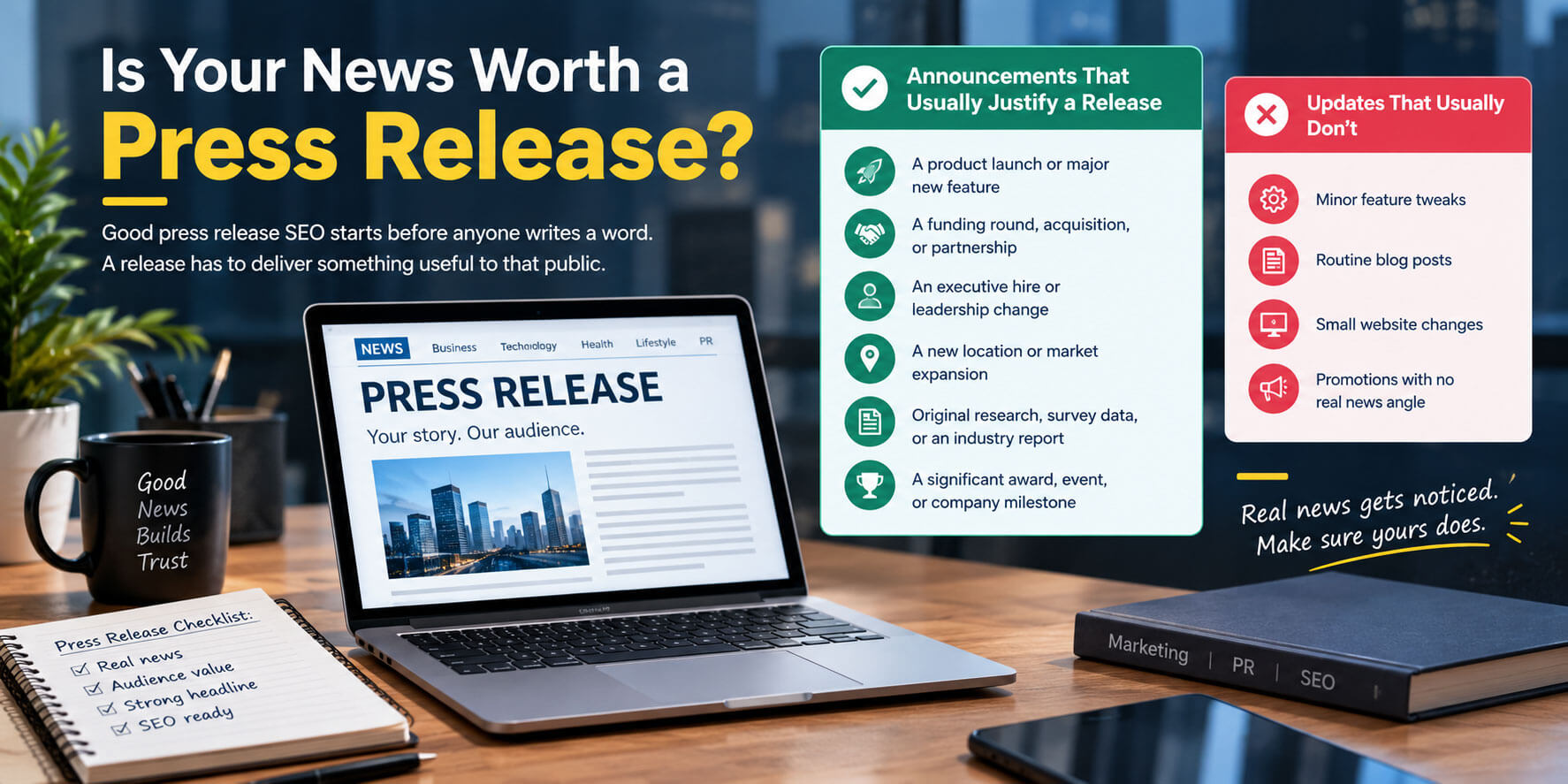
Good press release SEO starts before anyone writes a word. The leading US professional association for public relations describes PR as strategic communication that builds relationships benefiting both organizations and the people they serve [7]. A release has to deliver something useful to that public.
Announcements that usually justify a release:
- A product launch or major new feature
- A funding round, acquisition, or partnership
- An executive hire or leadership change
- A new location or market expansion
- Original research, survey data, or an industry report
- A significant award, event, or company milestone
Updates that usually don’t: minor feature tweaks, routine blog posts, small website changes, or promotions with no real news angle.
How to Write a Press Release for SEO
Writing for press release SEO means writing for two readers at once: a busy journalist who scans for the story and a search system that needs clear signals about the topic.
Research Keywords That Match the Announcement
Pick one primary keyword that describes the news itself, plus two or three secondary keywords or close variants. For a product launch, that might be the product category plus the problem it solves. Long-tail keywords (longer, more specific phrases) often fit announcements better than broad terms because they match what people actually search after hearing the news.
Check the live search results for each phrase. If the top results are buying guides or product pages, a news release probably won’t compete there.
Write a Clear, Searchable Headline
The press release headline should state what happened and who it matters to. Include the keyword only if it reads naturally. Keep it short enough to display fully in search results; many practitioners aim for roughly 60 to 70 characters.
| Weak headline | Stronger headline |
| Company Announces Exciting New Solution | [Company] Opens [Service] Location in [City] for [Audience] |
| Industry Leader Expands Offerings | [Company] Launches [Product] to [Solve Specific Problem] for [Audience] |
Answer the 5 Ws in the Lead
The lead paragraph should answer who, what, when, where, and why in the first two or three sentences. Place your primary keyword here if it fits. Skip background history and marketing claims; many reporters skim, so the key facts need to come first.
Build the Body with Facts and Real Quotes
Use the body to add specifics: numbers, dates, pricing, availability, and customer impact. Include one or two quotes from named people that add perspective instead of repeating the headline. Avoid keyword stuffing; repeating a phrase in every paragraph makes the release read like an ad and helps no one.
Close with a Consistent Boilerplate
The boilerplate is the standard “About the company” paragraph at the end. Keep it brief, factual, and identical across releases. Include your company name, what you do, where you’re based, and your website. For local businesses, consistent NAP details (name, address, phone) support local SEO and help search engines connect every mention to the same business.
Put It Together: A Simple Press Release Template
Use this skeleton and replace each placeholder with your own details:
[Company] Launches [Product] to [Solve Problem] for [Audience]
[Optional subheadline: the key benefit or number]
[CITY, State, Month Day, Year] — [Lead: who, what, when, where,
and why in two or three sentences, with the primary keyword if it fits.]
[Key details: features, pricing, availability, numbers.]
“[Quote that adds perspective],” said [Name], [Title] at [Company].
[Context: who benefits and what changes. One link to the page about the news.]
About [Company]
[Boilerplate: what you do, where you’re based, website.]
Media Contact
[Name, email, phone]
On-Page Optimization for Your Owned Release Page
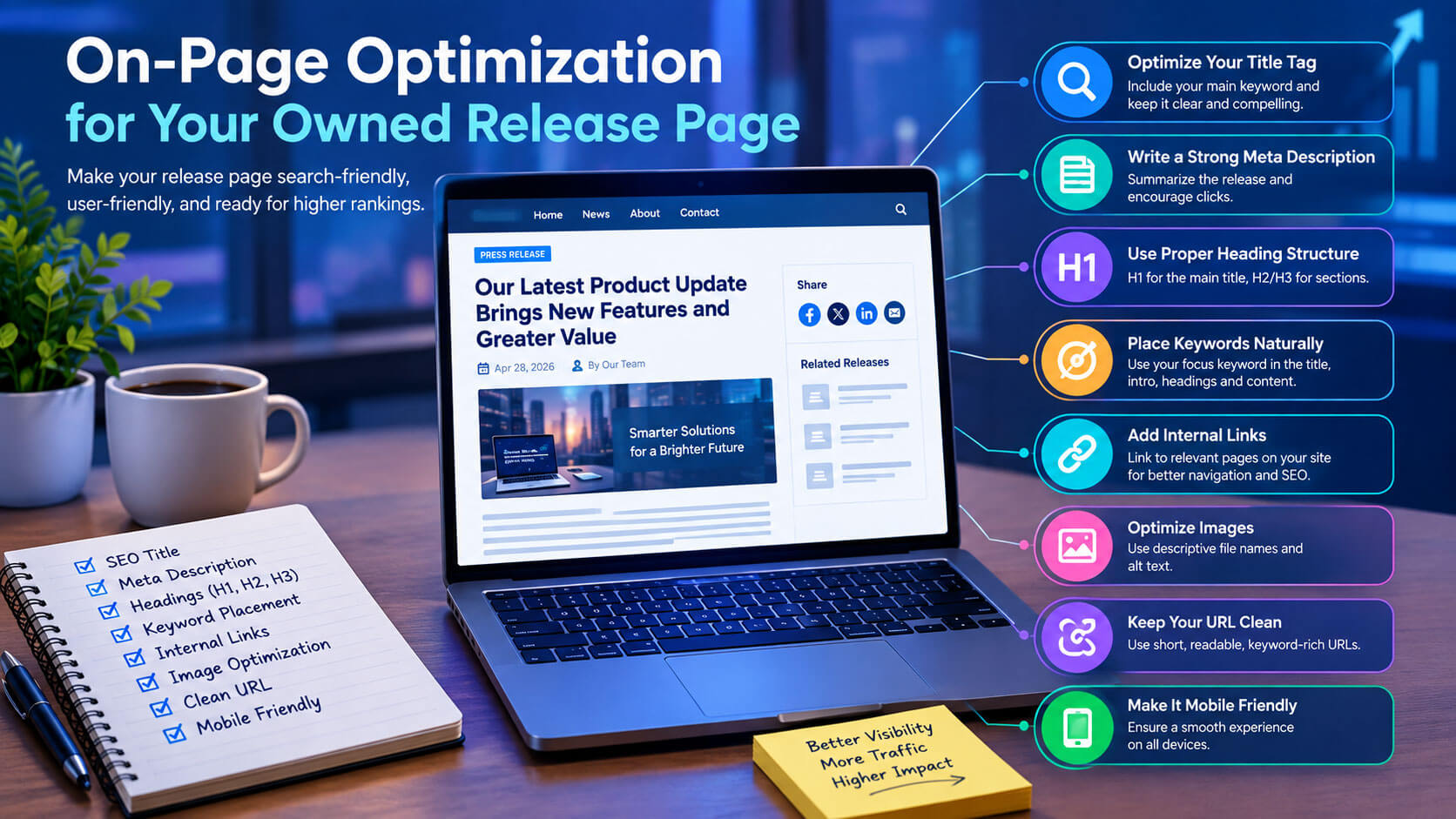
Your own newsroom copy is where press release SEO has the most direct control, so treat it like any other important page.
Title Tag, Meta Description, and URL Slug
- Title tag: match or closely mirror the headline, with the keyword near the front.
- Meta description: summarize the news in one or two sentences. Around 150 to 160 characters is a common guideline, though the leading search engine may show different text from your page instead [5].
- URL slug: keep it short and readable, such as /news/product-name-launch, rather than a string of numbers.
NewsArticle Structured Data
Structured data is code that labels your page’s content for search engines. Adding Article or NewsArticle markup helps search engines understand the page and show better title, image, and date information. The leading search engine’s documentation states that no markup is required to be eligible for news features such as top stories [3]. Treat it as a clarity aid, not a visibility guarantee.
Images, Alt Text, and Video Captions
Use real images, not stock photos. The leading search engine’s documentation calls alt text the most important attribute for giving it more information about an image, and notes that descriptive file names offer only light clues [4]. Add captions or transcripts to video so that every visitor, including people using assistive technology, can follow it.
Internal Linking
Link to the release from your newsroom index, related product or service pages, and relevant blog posts. Internal links help search engines find the page and understand how it relates to the rest of your site.
Links and Anchor Text in Press Releases
Links are where press release SEO most often goes wrong. Anchor text is the clickable text of a link, and in distributed releases it should describe the destination, not chase a ranking.
The leading search engine’s guidelines ask that links in advertisements or paid placements be marked with rel=”sponsored”. It still accepts rel=”nofollow” for these links, though sponsored is preferred [2]. Paid distribution falls into this category. Some services add these attributes automatically; if yours doesn’t, ask why before you publish.
| Safer practice | Riskier practice |
| One to three links in total | Ten or more links stuffed through the copy |
| Branded anchor text (your company or product name) | Exact-match anchors stuffed with commercial keywords |
| Links to the specific page about the news | Every link pointing to the homepage or unrelated pages |
| Sponsored or nofollow attributes on paid placements | Trying to pass ranking credit through paid syndication |
The link count is practitioner guidance, not an official search engine rule. The real test is simple: would the link still belong there if search engines didn’t exist?
Where to Distribute Your Press Release
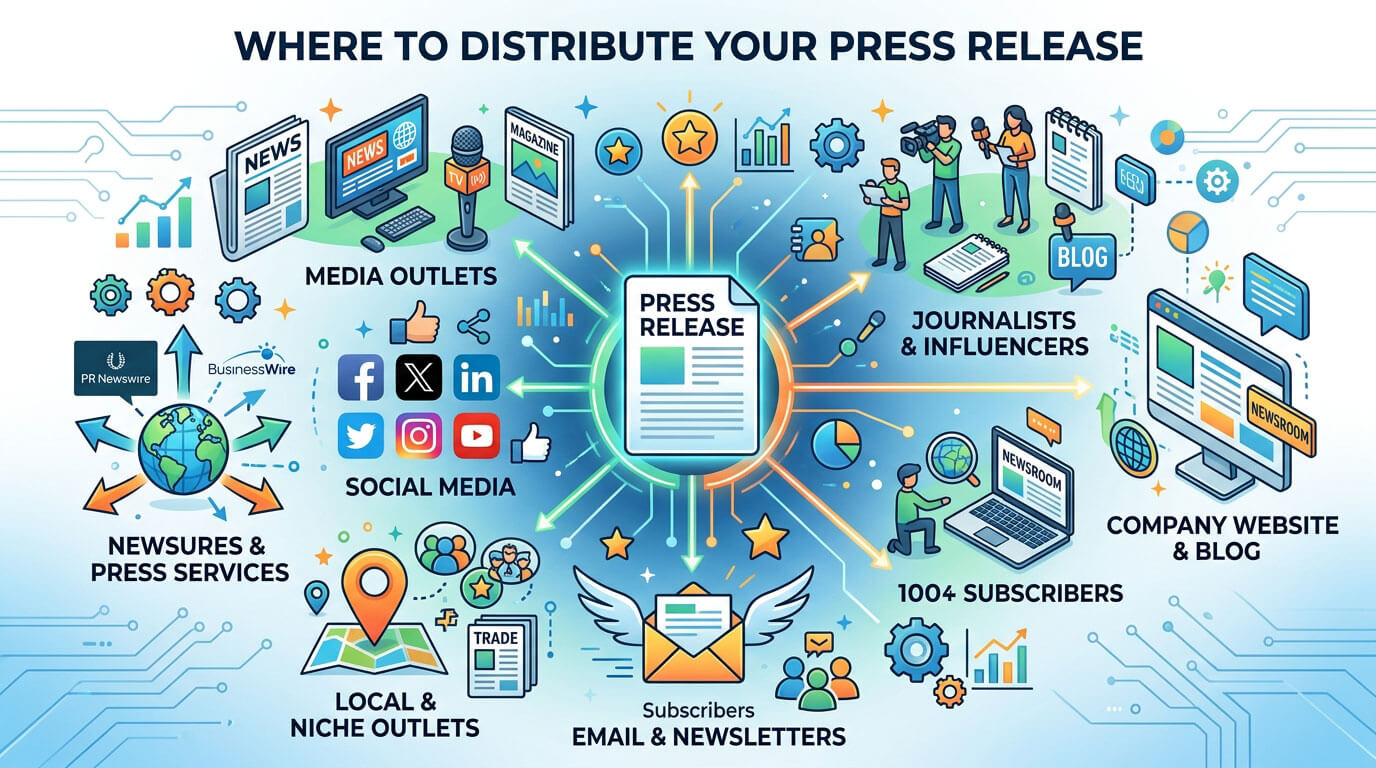
Press release distribution matters because it puts the news in front of people who might cover it. For press release SEO, relevance beats raw volume. Match the channel to the announcement:
- Local business news and community sites: openings, hiring, local partnerships, and charity work
- Trade publications: product, technology, manufacturing, or healthcare news
- Business and financial outlets: funding, acquisitions, and leadership changes
- Direct journalist outreach: data, research, or a strong expert angle, sent as a short personal pitch
- Your own channels: newsroom, email list, and social profiles
If you’re paying for a wire service, compare options on practical criteria rather than headline claims about huge outlet counts:
- Does it publish your release at a public, indexable URL?
- How does it handle links (nofollow or sponsored)?
- Does its report separate real editorial coverage from automated reposts?
Wide distribution also creates many identical copies of the same text on different sites. Those copies add reach, not extra rankings. When several versions of the same content exist, the leading search engine picks the one it judges best to show in results [6]. For press release SEO, publish on your own newsroom first and make that page the one you link to and promote.
Finally, be open about paid placements. The leading US public relations association’s code of ethics calls for honesty and accuracy in all communications, and for sharing the information people need to make responsible decisions [8].
Common Press Release SEO Mistakes
Most press release SEO problems come from treating the release as a link source instead of news. Watch for these:
- Keyword stuffing. Forced phrases make the copy unreadable. Fix: place the keyword in the headline and lead where it fits, then write naturally.
- Linking only to the homepage. Readers can’t find what the release promised. Fix: link to a dedicated landing page about the news.
- Publishing thin news on a schedule. A steady stream of minor releases erodes credibility with editors. Fix: publish when you have real news.
How to Measure Press Release SEO Results
Set one clear goal before the release goes live, such as demo requests, event registrations, report downloads, or coverage in three trade outlets. Then judge press release SEO by outcomes, not by how many sites reposted the text.
| Metric | Where to track it | What it tells you |
| Earned coverage | Media monitoring, manual search | Whether journalists found the story worth writing about |
| Referral traffic | Your web analytics tool | Which outlets sent real visitors |
| Branded search growth | Search engine webmaster tools | Whether more people searched for your brand after the news |
| Newsroom page rankings and impressions | Search engine webmaster tools | How the owned release performs in search |
| New editorial links | A backlink tool or manual checks | Which coverage produced independent links |
| Conversions and assisted conversions | Analytics goals with UTM parameters | Whether the release contributed to business results |
UTM parameters are short tags added to a link that show in analytics exactly where a visit came from.
Press Release SEO Checklist
Run through this before any release goes out:
- [ ] Would someone outside the company care about this news?
- [ ] One primary keyword chosen to match the announcement
- [ ] Headline states what happened; keyword only if it reads naturally
- [ ] Lead answers who, what, when, where, and why
- [ ] At least one real quote from a named person
- [ ] One to three links, pointing to the page about the news
- [ ] Paid placements marked sponsored or nofollow
- [ ] Release published on your own newsroom page first
- [ ] Title tag, meta description, and URL slug set
- [ ] Structured data, image alt text, and video captions added
- [ ] One measurable goal set, with UTM-tagged links
Frequently Asked Questions
Do press releases help SEO in 2026?
Yes, mostly indirectly. Press release SEO pays off through earned coverage, brand mentions, referral traffic, and a well-optimized page on your own site, not through syndicated links.
Are press release links dofollow or nofollow?
Links in paid or widely distributed releases should carry rel=”sponsored” or rel=”nofollow”. The leading search engine’s guidelines prefer sponsored for paid placements [2].
Can a press release rank in search results?
Yes, mainly for branded or announcement-specific searches such as a product name, event, or local opening.
How often should a business publish press releases for SEO?
Only when there’s real news. No publishing frequency is proven to improve press release SEO, and a run of thin releases can hurt credibility with editors.
Can press releases help local SEO?
They can. Local coverage, community-site mentions, and consistent NAP details in your boilerplate help search engines tie your business to its city and services.
Read More: https://linkneon.com/ben-stace-semantic-seo-writing-tool/
Conclusion
The key takeaway: press release SEO works when the news comes first and the optimization supports it. Your strongest assets are a crawlable release page on your own domain, a clear headline and lead, honest links marked the way search engine guidelines ask, and distribution aimed at people who might actually cover the story.
For a practical next step, run your next real announcement through the checklist above, publish it on your newsroom page first, and review your webmaster tools data and referral traffic after a few weeks. That single test will tell you more about press release SEO for your business than any distribution package can.