


Search engines used to work like matching machines. Type in “best running shoes,” and Google hunted for pages that repeated that exact phrase as many times as possible. That era is over. Modern search engines read for meaning — they connect your query to concepts, related topics, and real-world entities, then rank pages that demonstrate genuine understanding of a subject rather than pages that just repeat a phrase. This shift is what people mean when they talk about semantic SEO.
This guide walks through what semantic SEO actually is, how it differs from the old keyword-stuffing approach, and how Google’s language models interpret content today. It covers entity SEO, topic clusters, the short-tail versus long-tail keyword balance, local SEO’s role in semantic ranking, and the practical writing habits that make content read as knowledgeable rather than keyword-optimized. By the end, you’ll have a working framework you can apply to your own content, not just a definition to memorize.
What Is Semantic SEO?
Semantic SEO is the practice of creating content that search engines can understand in terms of meaning and context, not just matching text strings. Instead of asking “does this page contain the word ‘running shoes’ five times?”, a search engine now asks “does this page thoroughly address what someone means when they search for running shoes — cushioning, fit, durability, use cases?”
The word “semantic” refers to meaning. A semantic approach to SEO means writing about a topic the way a knowledgeable person would explain it to a friend: covering related ideas, answering follow-up questions before they’re asked, and using natural vocabulary instead of a single repeated phrase.
Practically, this means a page ranking for “running shoes” doesn’t need to say “running shoes” over and over. It needs to demonstrate real command of the subject — arch support, trail versus road use, breathability, sizing quirks, brand differences — because that breadth signals to the search engine that the page actually answers the query, in whatever words the reader used to ask it.
Semantic SEO vs. Traditional SEO
Traditional SEO treated keywords as the primary ranking signal. Writers picked a target phrase and worked it into the title, headers, and body as many times as they could without triggering a spam penalty. The strategy rewarded repetition over understanding.
Here’s a rough example of the old style:
“Best shoes for running. Our best running shoes are the best choice if you want the best running shoes online in 2026.”
That paragraph technically contains the keyword four times. It says almost nothing.
A semantic rewrite of the same idea:
“Runners logging more than 20 miles a week typically need more cushioning than casual joggers, and trail runners need different tread patterns than road runners entirely.”
The second version never repeats “running shoes” unnaturally, yet it’s more likely to satisfy both the reader and the algorithm, because it demonstrates specific, contextual knowledge. Traditional SEO optimized for the search engine’s old pattern-matching. Semantic SEO optimizes for the reader’s actual question — and search engines have gotten good enough at language that these two goals now largely overlap.
How Google Understands Meaning, Not Just Keywords
Google’s ranking systems rely on natural language processing (NLP) — a branch of AI that lets software interpret human language, including grammar, ambiguity, and context, rather than just matching keywords. Two models are commonly cited in this shift: BERT and MUM.
BERT (Bidirectional Encoder Representations from Transformers) reads a sentence in both directions at once, which lets it interpret words based on the words around them. That’s what allows Google to tell the difference between “flying to Paris” (a plan) and “planes flying to Paris” (a fact about air traffic) — same words, different meaning, different intent.
MUM (Multitask Unified Model) extends this further, handling more complex queries across multiple languages and formats at once. It’s worth noting that Google’s underlying models continue to evolve, and by 2026 the company may reference newer systems in official communication — the important takeaway for content creators isn’t the model name, it’s the direction: language understanding keeps improving, and content that reads naturally and covers a topic thoroughly benefits from that trend regardless of which specific model is doing the interpreting.
What Is Search Intent?
Search intent is the underlying goal behind a query — what the person actually wants to accomplish, not just the words they typed. Search intent generally falls into four categories:
- Informational — the reader wants to learn something (“what is semantic SEO”)
- Navigational — the reader wants a specific site or page (“Google Search Console login”)
- Commercial — the reader is comparing options before buying (“best SEO tools 2026”)
- Transactional — the reader is ready to act (“buy SEO course”)
Matching content to the right intent matters more than matching the exact phrase. A page written for someone in the “learning” stage but stuffed with buy-now language will frustrate readers and, over time, that mismatch signals poor relevance to search engines too.
Entity SEO and the Knowledge Graph

An entity, in SEO terms, is any distinct, identifiable thing — a person, place, organization, product, or concept — that a search engine can recognize and connect to other related entities. Google maintains a Knowledge Graph, a database of entities and the relationships between them, which it uses to understand how concepts connect.
For example, if your content mentions “schema markup,” a search engine that understands entities can connect that phrase to related concepts like Schema.org, structured data, and search result rich snippets, even if your page never explicitly states those connections. This is why writing that naturally references related concepts tends to perform better than writing that isolates a single keyword phrase — the surrounding context helps the search engine place your content correctly within its map of the topic.
Entity SEO isn’t something you “install” like a plugin. It’s a byproduct of writing thorough, accurate content that naturally touches on the concepts a real expert would mention.
Building Topical Authority with Topic Clusters
Topical authority is the degree to which a search engine trusts a website as a reliable source on a given subject, based on the breadth and depth of content that site publishes about it. A single well-written article can rank, but a site with multiple in-depth, interlinked articles on a topic tends to earn more consistent trust over time.
The most common structure for building this is the pillar-cluster model.
Pillar Pages vs. Cluster Content
A pillar page is a broad, comprehensive overview of a topic — in this case, something like “Semantic SEO: Beginner’s Guide 2026.” Cluster content consists of narrower articles that go deep on subtopics the pillar page only touches briefly — for example, “How to Avoid Keyword Stuffing” or “Local SEO Ranking Factors Explained.”
Cluster pages link back to the pillar page, and the pillar page links out to relevant clusters. This internal linking pattern helps search engines understand which pages belong together conceptually, and it helps readers navigate from a general overview into the specific detail they need.
How to Avoid Keyword Stuffing (With Examples)
Keyword stuffing is the practice of repeating a target phrase far more often than natural language would require, in an attempt to manipulate rankings. It’s a leftover habit from early SEO, and it tends to hurt more than it helps now — both because readers notice awkward repetition and because search engines are better at detecting it.
A practical test: read your paragraph out loud. If it sounds like something a person would actually say, it’s probably fine. If it sounds mechanical or repetitive, it needs a rewrite.
Stuffed version:
“Semantic SEO is important. If you want to rank, semantic SEO helps. Learning semantic SEO is the best way to improve your semantic SEO strategy.”
Natural version:
“Search engines now reward content that demonstrates real understanding of a topic, which is exactly what this approach is designed to do.”
Notice the natural version never uses the target phrase at all in that sentence — and that’s fine. A well-optimized page uses its primary keyword where it belongs (title, intro, a few headers) and otherwise relies on synonyms, related terms, and natural phrasing.
Short-Tail vs. Long-Tail Keywords: Finding the Balance
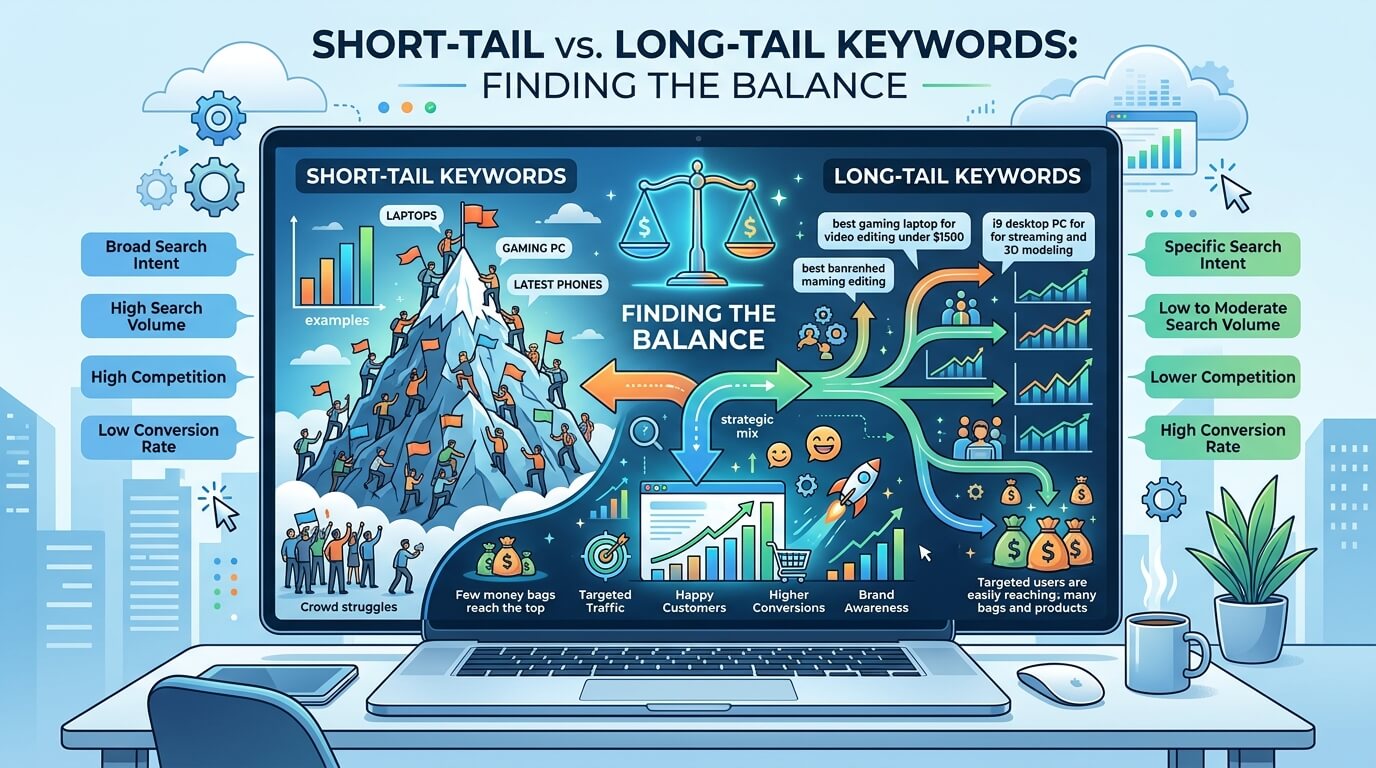
Short-tail keywords are broad, one- to two-word phrases with high search volume and high competition. Long-tail keywords are longer, more specific phrases with lower volume but often clearer intent and less competition.
| Type | Example | Best Use |
| Short-tail | “SEO guide” | Titles, H1s, broad topic framing |
| Long-tail | “how to avoid keyword stuffing in SEO” | Subheadings, FAQ sections, specific answers |
| Conversational | “how does semantic SEO work” | Voice search, FAQ formatting |
Short-tail keywords tend to bring in broader traffic but convert less predictably, since the searcher’s intent is less specific. Long-tail keywords bring fewer visitors but often more qualified ones, since the phrase itself reveals more about what the person wants. A reasonable approach for most beginner content is to anchor the page around one short-tail phrase and structure subheadings around a handful of long-tail variations that reflect real questions people ask.
Making Content “Knowledgeable” (E-E-A-T)
E-E-A-T stands for Experience, Expertise, Authoritativeness, and Trustworthiness — a framework Google’s quality raters use to evaluate content, particularly on topics where inaccurate information could cause harm (health, finance, safety). While E-E-A-T isn’t a direct ranking factor in the way a keyword is, it reflects the qualities Google’s systems are generally trying to reward.
In practice, this means:
- Writing with specific, concrete detail instead of vague generalizations
- Citing credible sources when making factual claims
- Keeping content updated as facts change
- Being upfront about limitations rather than overselling a claim
Content that reads as generic — the kind that could apply to any website on any topic — tends to underperform content that shows clear command of the specific subject.
Local Semantic SEO for Small Businesses
Local SEO and semantic SEO aren’t separate disciplines — they overlap. Search engines apply the same entity-recognition logic to local businesses that they apply to broader topics, connecting a business name, address, and category to a specific real-world entity.
A few practical pieces matter here:
- NAP consistency — keeping your business Name, Address, and Phone number identical across your website, directories, and Google Business Profile (the current name for what many still call by its older name, Google My Business — the product itself is unchanged, only the name and management interface have updated).
- Google Business Profile optimization — filling out categories, services, and descriptions completely, since this structured information feeds directly into how Google understands and displays your business for local, intent-based queries.
- Local schema markup — code that explicitly labels your business details for search engines, reducing ambiguity about what your business is and where it operates.
Local ranking factors include proximity, relevance, and prominence — and semantic clarity about what your business actually offers feeds directly into that “relevance” signal.
Structured Data and Schema Markup
Structured data is a standardized code format, most commonly following the Schema.org vocabulary, that labels specific elements of your content — a recipe’s cook time, an article’s author, a product’s price — in a way search engines can read directly, without inferring it from surrounding text.
Structured data doesn’t guarantee better rankings, but it removes ambiguity. It’s one of the more direct ways to hand a search engine confirmed facts about your content rather than asking it to infer those facts from context. For beginners, the most relevant schema types are usually Article, FAQPage, and LocalBusiness, depending on the content type.
Common Beginner Mistakes
A few patterns show up repeatedly among people new to this approach:
- Treating “semantic” as a synonym trick. Swapping in a thesaurus of related words isn’t the same as genuinely covering a topic in depth.
- Skipping structure. Comprehensive content without clear headings and logical flow is harder for both readers and search engines to parse.
- Expecting fast results. Semantic SEO tends to be a compounding strategy — topical authority builds over multiple pieces of content and time, not from a single optimized page.
- Ignoring local signals when the business is local, treating “SEO” and “local SEO” as unrelated tracks rather than overlapping ones.
Frequently Asked Questions
What is the difference between semantic SEO and traditional SEO?
Traditional SEO focused on matching exact keyword phrases as often as possible. Semantic SEO focuses on demonstrating genuine topical understanding, using natural language and related concepts rather than repetition.
Do I still need to use keywords if I’m doing semantic SEO?
Yes. Keywords still matter for signaling what a page is about, particularly in titles and headers. The difference is how they’re used — naturally and sparingly, alongside related terms, rather than repeated mechanically.
How long does semantic SEO take to show results?
There’s no fixed timeline, and it varies by site authority, competition, and content volume. It’s generally considered a longer-term, compounding strategy rather than something that produces overnight ranking changes.
Is semantic SEO only for large websites, or does it work for small and local businesses?
It applies to any size of website. For local businesses specifically, semantic SEO connects directly with local ranking signals like Google Business Profile accuracy and NAP consistency.
What tools help with semantic SEO and entity research?
Google Search Console shows which queries actually bring traffic to a page, which helps identify related terms and questions worth covering. Beyond that, general keyword research tools can surface related long-tail phrases.
How does voice search relate to semantic SEO?
Voice queries tend to be longer and more conversational than typed searches (“what is semantic SEO” instead of “semantic SEO definition”). Content written to answer natural-language questions directly tends to align well with both voice search and semantic ranking.
Can I do semantic SEO without technical or coding knowledge?
Largely, yes. The core of semantic SEO is writing thorough, well-organized content. Structured data and schema markup are more technical additions, but they’re optional enhancements, not a prerequisite.
What’s the biggest beginner mistake in semantic SEO?
Mistaking synonym substitution for genuine topical depth. Real semantic SEO requires actually understanding and explaining a subject, not just varying the vocabulary used to describe it.
Read This Blog: https://linkneon.com/local-seo-services-small-businesses/
Conclusion
Semantic SEO isn’t a separate technique bolted onto regular SEO — it’s what SEO has become as search engines have gotten better at understanding language. The practical shift for content creators is straightforward: stop optimizing for a phrase and start optimizing for a question. Cover a topic the way someone with real knowledge of it would explain it, structure that coverage clearly, and let related terms and concepts appear naturally rather than forcing a single keyword to carry the whole page.
As a next step, pick one piece of existing content on your site and run the “read it out loud” test from the keyword-stuffing section above. If it sounds like a person explaining something to another person, it’s already moving in the right direction. If it sounds like it’s talking to a search engine, that’s the paragraph to rewrite first.