

When people need a product or service, they often start by searching online, checking social media, reading reviews, or comparing different businesses. If your business is difficult to find during this process, potential customers may choose a competitor instead.
This is where SEO and SMM services can help.
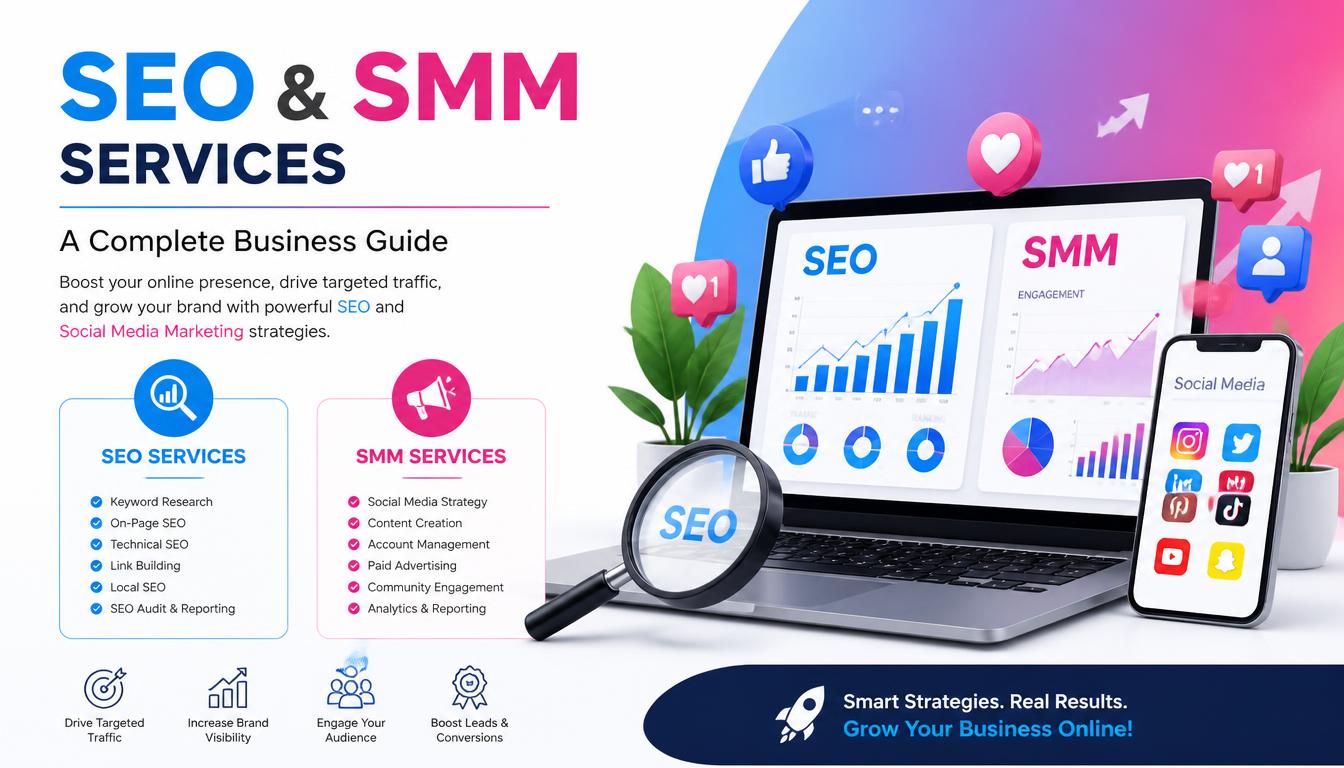
Search engine optimization (SEO) helps people discover your website through relevant search results. Social media marketing (SMM) helps you connect with your audience, share useful content, build brand awareness, and encourage people to take action.
Although both services support digital marketing, they work in different ways. SEO focuses on improving your visibility in search engines, while SMM focuses on reaching and engaging audiences through social platforms. When both are aligned with your business goals, they can support online visibility, lead generation, and long-term growth.
However, publishing blog posts or posting on social media is not enough on its own. You need to understand your audience, choose suitable channels, create relevant content, and measure whether your marketing activities produce meaningful results.
What Are SEO and SMM Services?
SEO and SMM services are digital marketing activities that help businesses reach relevant audiences online.
SEO focuses on making a website easier for search engines and visitors to understand. It can include keyword research, content optimization, technical improvements, website structure, local search optimization, and relevant link building.
SMM focuses on using social media platforms to communicate with potential customers. Depending on the business, this may include content planning, graphic design, short-form videos, community management, social media advertising, and performance reporting.
Consider a company that offers web development services. A potential customer might search Google for a suitable agency. SEO can help the company become visible for relevant searches. Later, the same person might see the agency’s project showcase on LinkedIn or Instagram, learn about its work, and decide to make contact.
The two channels serve different purposes, but they can help move the same potential customer closer to a decision.
SEO vs. SMM: Understanding the Difference
Before choosing a digital marketing strategy, it helps to understand what each service can achieve.
| Area | SEO services | SMM services |
| Main purpose | Improve visibility in organic search results | Reach and engage audiences on social platforms |
| Audience discovery | People searching for relevant topics, products, or services | People reached through posts, communities, recommendations, and ads |
| Common activities | Keyword research, on-page SEO, technical SEO, content optimization, link building | Content calendars, creative design, publishing, engagement, paid campaigns |
| Typical measurements | Search impressions, organic clicks, relevant traffic, conversions | Reach, engagement, clicks, leads, conversions |
| Time frame | Usually requires consistent work over time | Results depend on the platform, content, audience, and whether campaigns are paid |
| Long-term value | Useful pages may continue attracting relevant visitors | Consistent activity can build recognition and audience relationships |
Neither channel is automatically better than the other. The right choice depends on your audience, business model, competition, budget, and goals.
For example, a local plumbing company may benefit from local SEO because customers often search for nearby services. A fashion brand may place greater emphasis on visual content, influencer collaborations, and social media advertising.
Many businesses can benefit from both channels, but the balance should reflect how their customers discover and evaluate their services.
Keyword Research and Search Intent
Effective SEO starts with understanding what people are looking for. Keyword research helps you identify the words and phrases people use when searching for information, products, or services.
However, choosing keywords only because they have high search volume can lead to disappointing results. You also need to understand search intent, which means the purpose behind a search.
Consider these examples:
- Informational intent: “How does technical SEO work?”
- Commercial investigation: “Best SEO services for small businesses”
- Transactional intent: “Hire an SEO agency in London”
- Navigational intent: A person searching for a particular company by name.
Each search suggests a different need. Someone researching technical SEO may want an educational guide, while someone searching for an agency may be ready to compare providers.
Your content should match that need rather than pushing every visitor toward the same sales message.
How to Build a Keyword Strategy
Start by identifying your main services, the problems they solve, and the customers you want to reach. Then research relevant search terms and organize them into topic groups.
For an SEO agency, these groups might include:
- SEO services and packages
- Technical SEO audits
- On-page optimization
- Local SEO for businesses
- Link building and digital PR
- E-commerce SEO
- SEO reporting and performance measurement
Next, assign each topic to the most appropriate page. A service page should explain what you offer, who it helps, how the process works, and how a customer can get started. An educational article should answer the reader’s question thoroughly.
Avoid creating multiple pages that target nearly identical searches without a clear purpose. Instead, give each page a distinct role and connect related pages through useful internal links.
Tools such as Google Search Console, Google Trends, and keyword research platforms can help you investigate search demand and performance. Use their data to guide your decisions, not as a substitute for understanding your customers.
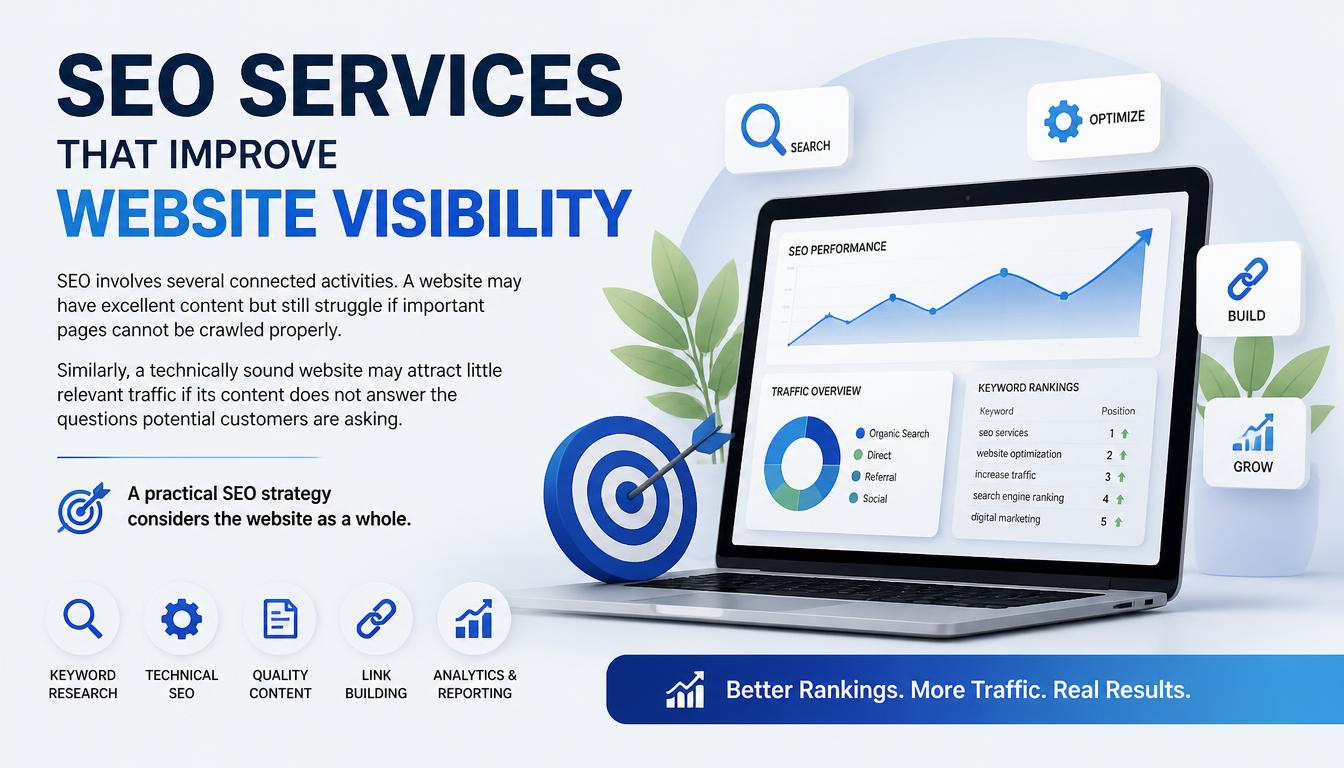
SEO involves several connected activities. A website may have excellent content but still struggle if important pages cannot be crawled properly. Similarly, a technically sound website may attract little relevant traffic if its content does not answer the questions potential customers are asking.
A practical SEO strategy considers the website as a whole.
On-Page SEO
On-page SEO improves individual pages so visitors and search engines can understand their purpose.
This includes writing descriptive page titles, creating clear headings, improving content, using descriptive URLs, adding useful image alt text, and linking to related pages where appropriate.
For example, a company offering local SEO services should explain what the service includes. Rather than repeating the same keyword throughout the page, it can describe Google Business Profile optimization, location-page improvements, local keyword research, review management, and performance tracking.
These details help readers understand what they are paying for.
Content should also address common customer concerns. If visitors want to know whether local SEO is suitable for a business with multiple locations, explain how the approach can differ between a single-location company and a multi-location organization.
The goal is to make the page useful, relevant, and easy to navigate, not to insert as many keywords as possible.
Technical SEO
Technical SEO addresses issues that can affect how search engines access, interpret, and index a website.
Common tasks include:
- Checking whether important pages can be crawled and indexed.
- Reviewing XML sitemaps and robots.txt rules.
- Fixing broken internal links and inappropriate redirects.
- Reviewing canonical tags and duplicate URL issues.
- Improving mobile usability and page performance.
- Checking HTTPS implementation and basic website security.
- Investigating problems reported in Google Search Console.
Imagine that a business redesigns its website and several important service pages stop appearing in search results. Publishing more articles may not solve the underlying problem. The team should first investigate whether those pages are accessible, indexable, and linked correctly.
Technical SEO should be based on evidence from the website rather than a generic checklist applied without investigation.
Local SEO
Local SEO helps businesses improve their visibility for relevant searches connected to a geographic area.
It is especially useful for businesses such as dentists, restaurants, repair companies, law firms, home service providers, and local agencies.
Typical activities include optimizing a Google Business Profile, maintaining accurate business information, creating useful location pages, managing customer reviews, and building relevant local citations.
For example, a dental clinic in Manchester may want to reach people searching for dental services in its service area. Its website should clearly explain its treatments, location, contact options, and relevant patient information. Its business profile should also contain accurate details.
Creating dozens of nearly identical location pages with only city names changed is not a strong strategy. Each page should provide meaningful information relevant to the location it serves.
Off-Page SEO and Link Building
Off-page SEO covers activities outside your website that can support its reputation, visibility, and authority.
Link building is one part of this work. Relevant backlinks may help search engines discover pages and understand relationships between websites. They can also send referral visitors when people click them.
Common approaches include digital PR, useful research, expert contributions, relationship-based outreach, and guest posting when it provides genuine value to the audience.
However, link quality matters more than simply collecting a large number of links. Buying links intended to manipulate search rankings, participating in link schemes, or publishing irrelevant guest posts at scale can create risks.
For paid placements, Google recommends qualifying sponsored links appropriately, such as by using rel=”sponsored” where applicable. A service provider should explain its link-building methods clearly rather than promising guaranteed rankings from a specific number of backlinks.
A sustainable approach focuses on relevance, editorial quality, transparency, and the value a link provides.
E-Commerce and Specialized SEO
Some websites require specialized SEO because of their structure and business goals.
An e-commerce website may need product-page optimization, category-page improvements, product image optimization, structured data, and solutions for duplicate URLs created by filters or sorting options.
A large enterprise website may need help managing complex site architecture, international targeting, crawlability, and coordination across multiple teams.
An international website may need properly planned language and regional versions, including appropriate hreflang implementation where relevant.
Your SEO strategy should match your website’s actual needs. A small local business does not necessarily need the same technical setup or reporting system as a large international retailer.
Content Marketing and Topical Authority
Content marketing helps a business answer customer questions, explain its expertise, and support people at different stages of the buying process.
Useful content may include educational blog posts, service pages, comparison guides, case studies, original research, tutorials, and practical resources.
For example, an agency offering web development could publish a guide explaining how to choose between WordPress and a custom-built website. A related article could discuss website maintenance costs, while a service page explains the agency’s development process.
These pages can link to one another when doing so helps readers explore the subject.
This approach can build topical depth, but topical authority is not a score that can be guaranteed by publishing a certain number of articles. The quality, relevance, accuracy, and usefulness of the content matter.
Before publishing an article, ask yourself:
- Does it answer a real question from the target audience?
- Does it offer useful information beyond a basic summary?
- Are the claims accurate and supported where necessary?
- Does it provide practical examples or clear next steps?
- Does it connect naturally to relevant pages on the website?
Avoid producing large numbers of similar articles just to cover keyword variations. A smaller collection of genuinely useful resources may serve readers better than a large library of repetitive content.
SMM Services: Building Relationships Through Social Media
SEO helps people discover your website through search. Social media marketing gives your business opportunities to communicate with audiences, demonstrate its work, and maintain relationships over time.
Effective SMM requires more than posting regularly. You need a clear objective, suitable platforms, a consistent brand voice, and content that gives people a reason to pay attention.
Social Media Strategy and Content Planning
A social media strategy should begin with your business goal.
Do you want to increase brand awareness, generate inquiries, drive website traffic, promote a product, or strengthen customer relationships? Different goals require different content and measurements.
Once the goal is clear, choose platforms based on where your target audience is active and how people use those platforms.
- LinkedIn may suit B2B companies, professional services, and industry insights.
- Instagram may suit visually presented products, portfolios, and behind-the-scenes content.
- Facebook may support local community engagement and particular customer groups.
- TikTok may be useful for short-form educational, entertaining, or product-focused videos, depending on the audience.
These are starting points, not fixed rules. Validate platform choices against your audience and actual results.
A content calendar can organize topics, formats, publishing dates, campaign priorities, and responsible team members. It helps maintain consistency without requiring every post to promote a service directly.
Creating Social Media Content People Want to See
Useful social content can educate, entertain, demonstrate expertise, answer questions, or help customers make decisions.
For a web development agency, a balanced content plan might include a website redesign example, a short explanation of a common website mistake, a client-approved project showcase, and a practical website maintenance tip.
A digital marketing agency might share SEO insights, explain common analytics mistakes, demonstrate a reporting dashboard, or discuss how it approaches a campaign.
Each post should have a clear purpose. Some content builds awareness, while other content encourages readers to visit a service page, download a resource, or request a consultation.
Use suitable formats for each platform, including short videos, carousels, graphics, articles, and educational posts. Make content accessible with readable text, captions where appropriate, and clear visual presentation.
Consistency matters, but quality should not be sacrificed just to meet a daily posting target.
Community Management and Customer Engagement
Social media is a two-way communication channel. Responding to questions, acknowledging feedback, and handling complaints professionally can help a business build stronger customer relationships.
Community management includes monitoring comments and messages, answering common questions, identifying recurring customer concerns, and directing people to the appropriate support channel.
For example, if several people ask about the same service requirement, the business could prepare a helpful post or update its website to explain the issue more clearly.
Customer feedback can also reveal gaps in product descriptions, website information, or the sales process.
Businesses should establish clear guidelines for response times, tone, complaint handling, and escalation. Sensitive customer details should not be requested or shared publicly.
Paid Social Media Advertising
Organic social media and paid social advertising serve related but different purposes.
Organic content helps a business maintain its presence and build relationships. Paid campaigns allow advertisers to reach selected audiences using the targeting options available on each platform.
Paid social campaigns can support product launches, lead generation, event registrations, and remarketing where permitted.
Before launching a campaign, define the objective, audience, creative, budget, landing page, and success metric. If the goal is lead generation, measure qualified inquiries rather than treating every click as a successful outcome.
For example, an agency could run a campaign promoting a website audit. The ad should explain the offer clearly, and the landing page should provide enough information for visitors to decide whether to submit an inquiry.
Track spending carefully and review lead quality. A campaign that generates many inexpensive leads may still be ineffective if those leads are unlikely to become customers.
Advertising platforms also have their own policies and privacy requirements, so targeting, tracking, and data collection should be handled appropriately.
How SEO and SMM Work Together
SEO and SMM can support one another when they share consistent messaging and business goals.
Consider a company that offers digital marketing services. Its team publishes a detailed guide about improving local search visibility. The article is optimized for relevant searches and linked to the company’s local SEO service page.
The team then shares useful insights from that guide on LinkedIn and Facebook. These posts introduce the topic to people who may not have found the article through search.
Some readers visit the website, explore other resources, and later contact the company. Meanwhile, questions and comments on social media reveal additional topics the audience wants to understand.
The team can use those insights to improve existing content or plan new resources.
This is a practical way for the two channels to complement each other. Social media distribution can help content reach more people, but social shares should not be treated as a guaranteed direct Google ranking boost.
A coordinated strategy can include:
- Researching customer needs and relevant search topics.
- Creating a useful website page or resource.
- Sharing selected insights through suitable social platforms.
- Directing interested users to a relevant page or next step.
- Reviewing search, social, and conversion data.
- Improving future content based on actual performance.
The aim is to create a connected customer journey rather than managing SEO and social media as completely separate activities.
Conversion Rate Optimization and Lead Generation
Getting visitors to a website is only part of the job. You also need to help relevant visitors understand your offer and take the next appropriate step.
Conversion rate optimization (CRO) focuses on improving the experience that leads to an action, such as submitting a form, requesting a quote, booking a consultation, or completing a purchase.
Start by examining the page a visitor sees after clicking a search result or social post.
Does the headline match the message that brought them there? Is the offer clear? Can they find pricing information or understand how the process works? Is the contact form easy to complete? Does the page work properly on mobile devices?
For example, a visitor who clicks an advertisement for local SEO services should land on a page explaining those services, not a generic homepage that leaves them searching for the information again.
You can test improvements to headlines, page layouts, calls to action, and form design. Use reliable data and change elements with a clear hypothesis rather than making random adjustments.
Lead generation also depends on lead quality. Track whether inquiries match your target audience, whether your sales team can contact them successfully, and whether those inquiries eventually become customers.
Analytics, Reporting, and Measuring ROI
SEO and SMM performance should be measured against business objectives, not just activity levels.
Publishing more content, gaining followers, and receiving clicks can be useful indicators, but they do not automatically demonstrate business growth.
A useful report connects marketing activities to measurable outcomes.
| Goal | Useful metrics |
| Improve organic visibility | Search impressions, clicks, relevant query performance |
| Attract relevant visitors | Organic sessions, landing-page engagement, qualified traffic |
| Generate leads | Form submissions, calls, qualified inquiries |
| Improve social engagement | Reach, engagement, meaningful comments, link clicks |
| Evaluate paid campaigns | Spend, conversions, cost per lead, lead quality |
| Understand business results | Sales, revenue, customer acquisition cost, return on investment |
Google Search Console can help you understand how your website performs in Google Search. Website analytics tools can help measure visitor behavior and conversions, while social platforms provide their own reporting data.
Make sure tracking is configured correctly before drawing conclusions. Differences in attribution methods, reporting windows, consent settings, and conversion definitions can affect comparisons between platforms.
Return on investment should also account for costs. A campaign may produce revenue but still be unprofitable once advertising spend, labor, software, content production, and other expenses are considered.
SEO often requires time before its impact becomes clear, while paid campaigns may generate data more quickly. Neither guarantees a particular result. Report progress honestly and use the findings to decide what should happen next.
Choosing the Right SEO and SMM Strategy for Your Business
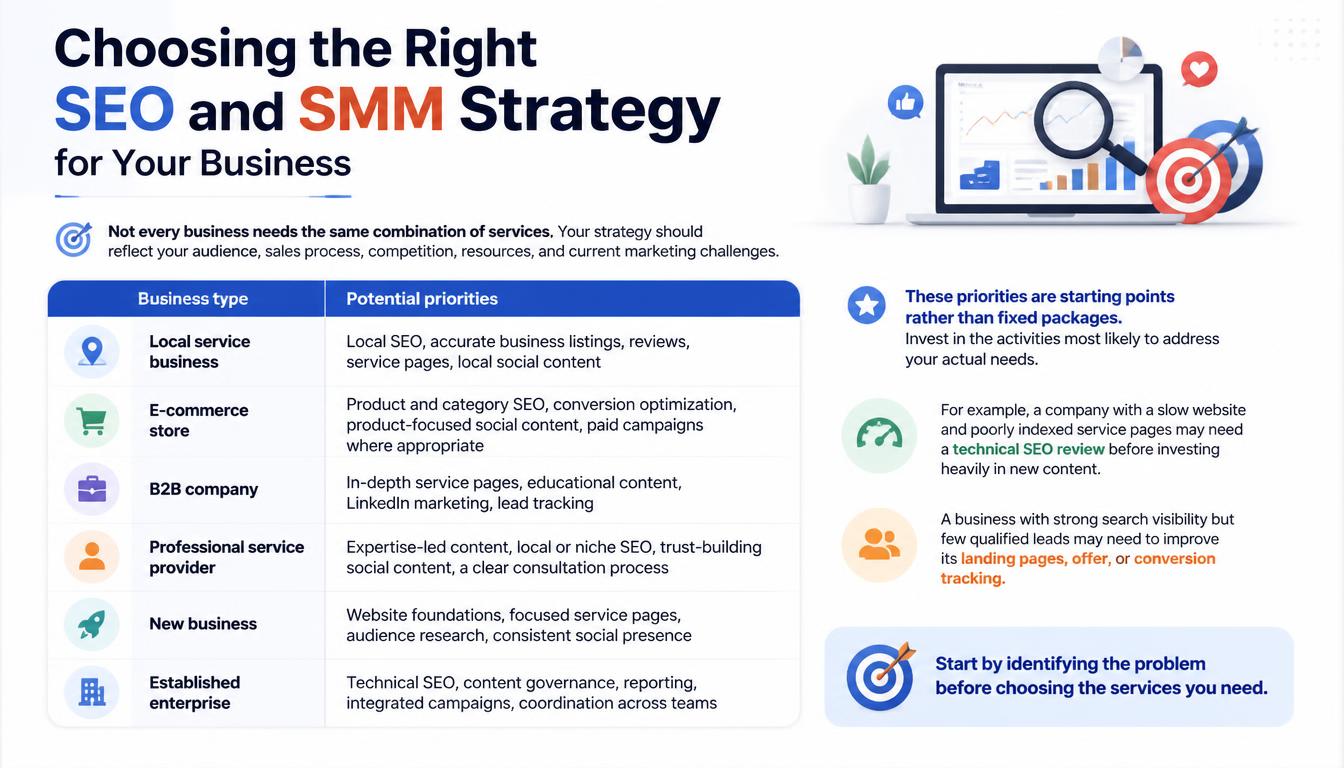
Not every business needs the same combination of services. Your strategy should reflect your audience, sales process, competition, resources, and current marketing challenges.
| Business type | Potential priorities |
| Local service business | Local SEO, accurate business listings, reviews, service pages, local social content |
| E-commerce store | Product and category SEO, conversion optimization, product-focused social content, paid campaigns where appropriate |
| B2B company | In-depth service pages, educational content, LinkedIn marketing, lead tracking |
| Professional service provider | Expertise-led content, local or niche SEO, trust-building social content, a clear consultation process |
| New business | Website foundations, focused service pages, audience research, consistent social presence |
| Established enterprise | Technical SEO, content governance, reporting, integrated campaigns, coordination across teams |
These priorities are starting points rather than fixed packages. Invest in the activities most likely to address your actual needs.
For example, a company with a slow website and poorly indexed service pages may need a technical SEO review before investing heavily in new content. A business with strong search visibility but few qualified leads may need to improve its landing pages, offer, or conversion tracking.
Start by identifying the problem before choosing the services you need.
SEO and SMM Packages, Pricing, and Deliverables
SEO and SMM pricing varies according to the scope of work, competition, website complexity, target market, content requirements, advertising budget, and reporting needs.
A basic package might cover a defined set of SEO tasks or a limited social media publishing schedule. A broader package may include technical audits, ongoing content optimization, outreach, creative production, community management, paid campaign management, and detailed reporting.
Before agreeing to a package, ask for a clear breakdown of what is included.
For SEO, this could cover the pages being optimized, technical issues being addressed, the content plan, the approach to link acquisition, and the reporting schedule.
For SMM, it could specify the platforms managed, the number and type of posts, creative production, community management, advertising management, and performance reporting.
Also clarify which costs are separate. Social advertising spend, premium software, photography, video production, and extensive content writing may not be included in the management fee.
Be cautious of offers that promise guaranteed rankings, a fixed number of leads without explaining the assumptions, or large quantities of backlinks without discussing relevance and quality.
A transparent provider should explain the work, deliverables, success metrics, and factors that remain outside its control.
How to Choose an SEO and SMM Agency
Choosing an agency is not just about comparing prices. You need a provider that understands your goals, communicates clearly, and can explain how its work supports those goals.
Start by reviewing relevant experience, case studies, service descriptions, and reporting processes. Look for specific examples that demonstrate the work performed and the results measured. Make sure claimed results are supported by credible evidence and that the agency has permission to share the information.
Ask how the agency approaches keyword research, technical SEO, content planning, social media strategy, and conversion tracking. The answers should be relevant to your business rather than identical for every client.
It is also worth discussing communication and ownership. You should understand who manages the project, how often updates are provided, who approves content, and who owns your website, accounts, and creative assets.
A reliable provider will explain limitations as well as opportunities. Search competition, customer demand, website condition, budget, and the quality of the offer can all influence performance. No agency can responsibly guarantee a specific Google ranking or a particular level of sales from SEO alone.
Finally, make sure you can evaluate the work being delivered. Reports should explain what was completed, what changed, what the data indicates, and what the team recommends next.
Frequently Asked Questions About SEO and SMM Services
What Do SEO Services Include?
SEO services may include keyword research, on-page optimization, technical SEO, content marketing, local SEO, link building, website audits, and performance reporting. The exact scope depends on the website’s needs and the agreed objectives.
What Is the Difference Between SEO and SMM?
SEO focuses on improving a website’s visibility in search engine results. SMM focuses on reaching and engaging audiences through social media platforms. SEO can help attract people who are searching for relevant information or services, while social media can support awareness, interaction, and content distribution.
How Long Does SEO Take to Show Results?
There is no fixed timeline. Some improvements may become visible relatively quickly, while meaningful organic growth can take several months or longer. Results depend on competition, website condition, content quality, technical issues, and the work being implemented.
How Much Do SEO and Social Media Marketing Services Cost?
Pricing varies according to scope, complexity, competition, content requirements, number of platforms, and advertising needs. Request a clear proposal that lists the deliverables, fees, reporting arrangements, and any additional costs.
Can SEO and SMM Generate Leads Together?
Yes. SEO can help potential customers discover relevant website pages, while social media can increase awareness, distribute content, and support audience engagement. When both channels lead people toward clear, useful landing pages, they can contribute to a more coordinated lead-generation strategy.
Which Digital Marketing Services Does a Small Business Need?
A small business might begin with a functional website, keyword research, essential on-page SEO, local SEO where relevant, consistent social media content, and basic conversion tracking. The right starting point depends on whether the main goal is local visibility, online sales, brand awareness, or qualified leads.
Should I Invest in SEO or Social Media Marketing First?
Start by considering how customers typically find and choose your type of business. If people actively search for your services, SEO may be a strong priority. If your product benefits from visual discovery, community interaction, or rapid audience testing, social media may deserve more attention. Many businesses can benefit from a gradual combination of both.
Read More: https://linkneon.com/seo-st-ives/
Conclusion: Build a Digital Marketing Strategy Around Your Business Goals
SEO and SMM services help businesses reach people through two important digital channels. SEO improves the opportunity for customers to discover relevant website content through search, while SMM helps businesses communicate, build recognition, and engage audiences through social platforms.
Their value comes from using them with a clear purpose. Research your audience, build useful website pages, maintain a sound technical foundation, create relevant social content, and make it easy for interested visitors to take the next step.
Measure outcomes rather than relying only on rankings, followers, or traffic. Use the results to improve your strategy, and invest in the activities that best support your business goals.
There is no single plan that works for every company. A focused strategy based on customer needs, reliable data, and consistent improvement is a more practical foundation for sustainable digital growth.