


A firm with a stunning, award-winning portfolio can still be invisible on Google — and that’s usually not a design problem, it’s an SEO for architects problem. Most architecture firms grow almost entirely through referrals and word-of-mouth, which works well until a firm needs to expand beyond its existing network. When a prospective client searches “residential architect in [city]” or “modern renovation architect near me,” a firm relying solely on personal connections simply doesn’t exist to that person, no matter how strong its actual work is.
This guide covers SEO for architects specifically — not generic small-business SEO advice, but the parts that are genuinely different for this industry: image-heavy portfolios that fight against page speed, project pages that need to work as both visual showcases and searchable content, and a client decision cycle that’s slower and more trust-driven than most industries SEO guides are written for. It also covers realistic cost and timeline expectations, so a firm knows what it’s actually signing up for.
What Is SEO for Architects?
SEO for architects means optimizing an architecture firm’s own website so it ranks in Google’s organic search results for the terms prospective clients actually search — location-based terms, style-specific terms, and project-type terms like “kitchen renovation architect” or “sustainable home design firm.” It’s distinct from being featured on architecture publications like ArchDaily or Dezeen, and distinct from running paid ads, both of which provide visibility that isn’t tied to the firm’s own site earning search rankings.
For architecture firms specifically, SEO covers three overlapping areas: the project portfolio itself (each project’s page), local search presence (showing up for location-based searches), and broader website content that isn’t tied to any single project. Most firms, if they think about SEO at all, focus only on having a portfolio online — but a portfolio that isn’t structured or written for search rarely ranks, no matter how visually impressive it is.
Why Architecture Firm SEO Is Different
A typical local business SEO guide assumes short, straightforward content and a fast purchase decision. Architecture breaks both assumptions. Firm websites are built around photography — often large, high-resolution images that showcase finished work — which creates a genuine tension: the industry’s core value proposition (visual quality) works against one of SEO’s core technical requirements (page speed). A portfolio site that loads slowly because of unoptimized images can lose search visibility it would otherwise earn on content quality alone.
The client decision cycle is also structurally different. Someone hiring an architect for a home renovation or a commercial build is making a decision worth tens of thousands of dollars or more, researched over weeks or months, not a same-day purchase. That changes what “SEO success” should even look like — a spike in traffic that doesn’t convert for months isn’t a failure, it’s often just how long this industry’s buying cycle actually runs. And because referrals remain the dominant client-acquisition channel for many firms, SEO isn’t replacing that channel — it’s building a second one for the inquiries that wouldn’t have found the firm through word-of-mouth alone.
SEO vs. Referrals and Paid Ads

| Channel | Speed | Cost Structure | Best For |
| Referrals | Ongoing, unpredictable timing | Free (relationship-based) | Repeat clients, word-of-mouth network |
| Google Ads | Immediate | Pay-per-click | Short-term visibility, specific campaigns |
| SEO (Organic) | Months to build | No per-click cost | Long-term, compounding visibility |
None of these channels needs to replace the others. A firm that’s built its business on referrals doesn’t need to abandon that strategy — SEO simply captures the prospective clients who never would have heard about the firm through existing relationships, particularly people who are new to an area or don’t have a personal connection to anyone who’s used an architect before.
Optimizing Project and Portfolio Pages
A project page is the individual showcase for one completed (or in-progress) piece of work — photos, a description of the design approach, materials, scope, and often the client’s goals. Optimizing these pages means writing genuine, specific text about the project rather than a photo gallery with a one-line caption, since search engines still rely heavily on text content to understand what a page is actually about, no matter how strong the visual content is.
A well-optimized project page includes a clear, descriptive title (not just “Project 14”), a few paragraphs describing the design challenge and solution in the firm’s own words, and internal links to related projects (similar style, similar project type, similar location) so that a visitor exploring one project naturally discovers others. This also gives search engines a clearer sense of the firm’s overall body of work, not just one isolated page.
Image SEO for Architecture Photography
Image SEO matters more for architecture firms than almost any other industry, because photography isn’t a secondary element of the content — it’s often the primary reason a visitor is on the page at all. Every image should have a descriptive filename (not “IMG_4021.jpg”) and meaningful alt text that describes what’s actually shown, which serves both accessibility and search purposes simultaneously.
The harder problem is file size. High-resolution architectural photography can easily run several megabytes per image, and a project page with a dozen such images can become slow enough to hurt both search rankings and the visitor’s actual experience. Compressing images without visibly degrading quality, using modern formats like WebP, and loading images progressively as a visitor scrolls (rather than all at once) are practical ways to keep visual quality high without the page speed penalty.
Structured Data for Architecture Firms
Structured data is a standardized code format that labels specific page elements so search engines can read them directly rather than inferring them from surrounding text. Here it’s worth correcting a common assumption: ProfessionalService, which used to be the default Schema.org type recommended for firms like architecture practices, has been deprecated by Schema.org in favor of the more general Service type or a more specific subtype [SchemaApp]. Firms currently using ProfessionalService markup aren’t broken, but new implementations should use Service instead [Aubrey Yung].
| Old Approach | Current Recommendation | Why It Changed |
| ProfessionalService | Service (or a specific subtype) | Deprecated due to overlap/confusion with Service [Schemantra] |
Service schema isn’t tied to a specific Google rich result the way product listings are, but it still contributes to how both search engines and AI-driven answer tools understand what a firm does and where it operates [Aubrey Yung]. This deprecation is confirmed directly on Schema.org’s own type documentation as well [Schemantra]. For most firms, this markup belongs on the homepage and a dedicated services page, describing the firm as the provider and specifying the geographic area served.
Local SEO for Architects
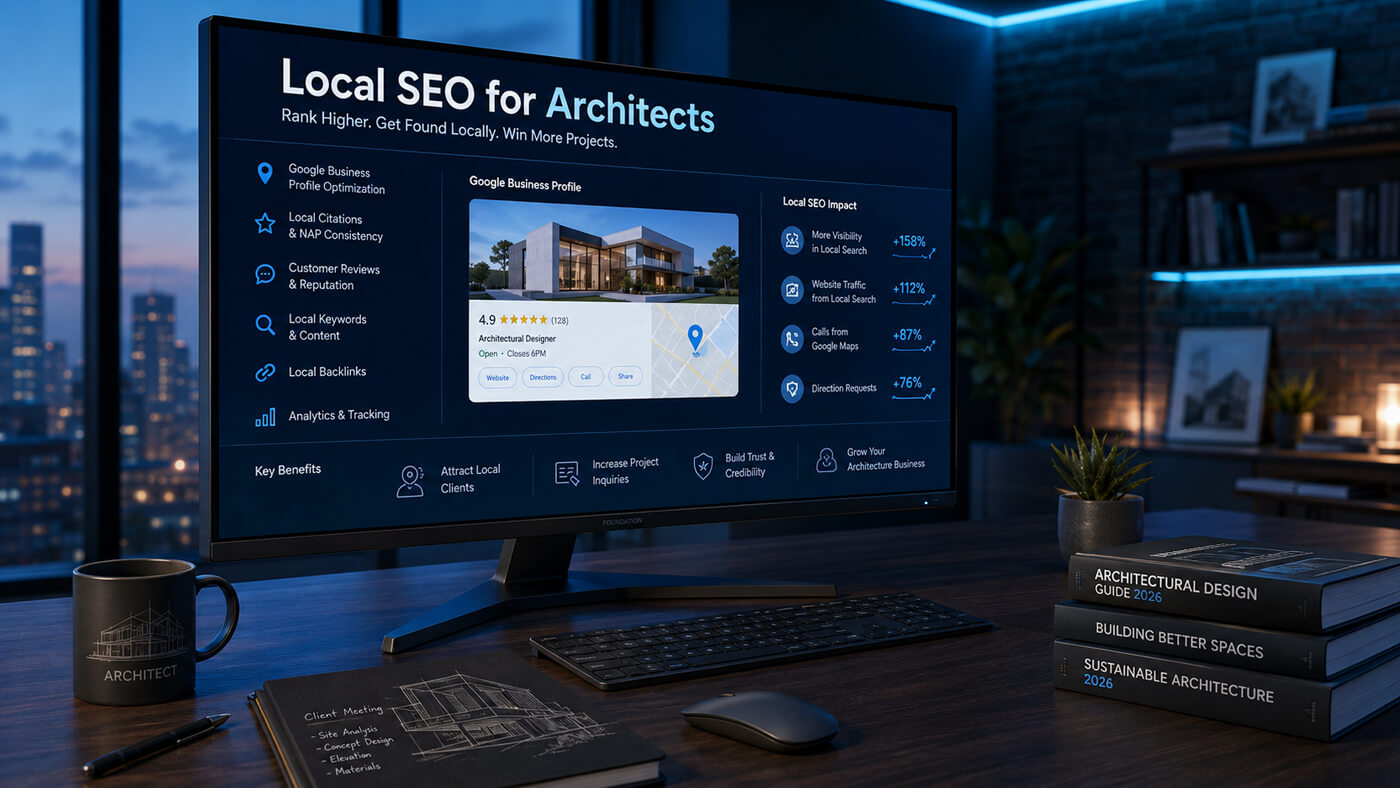
Local SEO determines whether a firm shows up in the Google Map Pack — the map-based block of results for searches like “architect near me” or “[city] architecture firm.” A complete, accurate Google Business Profile — correct categories, service area, photos, and hours — directly affects whether Google surfaces the firm for these location-based searches.
NAP consistency — keeping the firm’s Name, Address, and Phone number identical across the website, Google Business Profile, and any directory listings (including architecture-specific directories) — matters because inconsistencies make it harder for search engines to confirm a business’s identity with confidence. This is a low-cost, foundational fix that many firms overlook simply because it’s not visually interesting work compared to updating a portfolio.
Reviews, Awards, and Credentials as Trust Signals
Client testimonials and reviews function as both a conversion signal for prospective clients and a trust signal that search engines weigh alongside a firm’s overall credibility. For architecture specifically, credentials carry real weight too — American Institute of Architects (AIA) membership and industry awards function as trust signals a prospective client can verify, even though they aren’t a direct, documented ranking factor in the way a technical SEO element is. Displaying them prominently supports the kind of credibility that matters for a high-consideration purchase decision like hiring an architect.
Content Strategy Beyond Project Pages
Because project pages showcase specific completed work, they don’t answer the broader questions a prospective client has before they’re ready to commit to a specific firm. Evergreen content — pages not tied to one project — fills that gap: explainers on the design process, “what to expect when working with an architect,” budget-range guidance, or style-specific content (“what defines mid-century modern renovation”).
This kind of content also tends to attract earlier-stage research traffic — someone exploring whether to hire an architect at all, before they’ve chosen one — which builds familiarity with a firm well ahead of the eventual inquiry. A handful of well-written process and philosophy pages, done once, keep generating that early-stage visibility long after a specific project’s relevance fades.
Technical SEO Basics for Architecture Websites
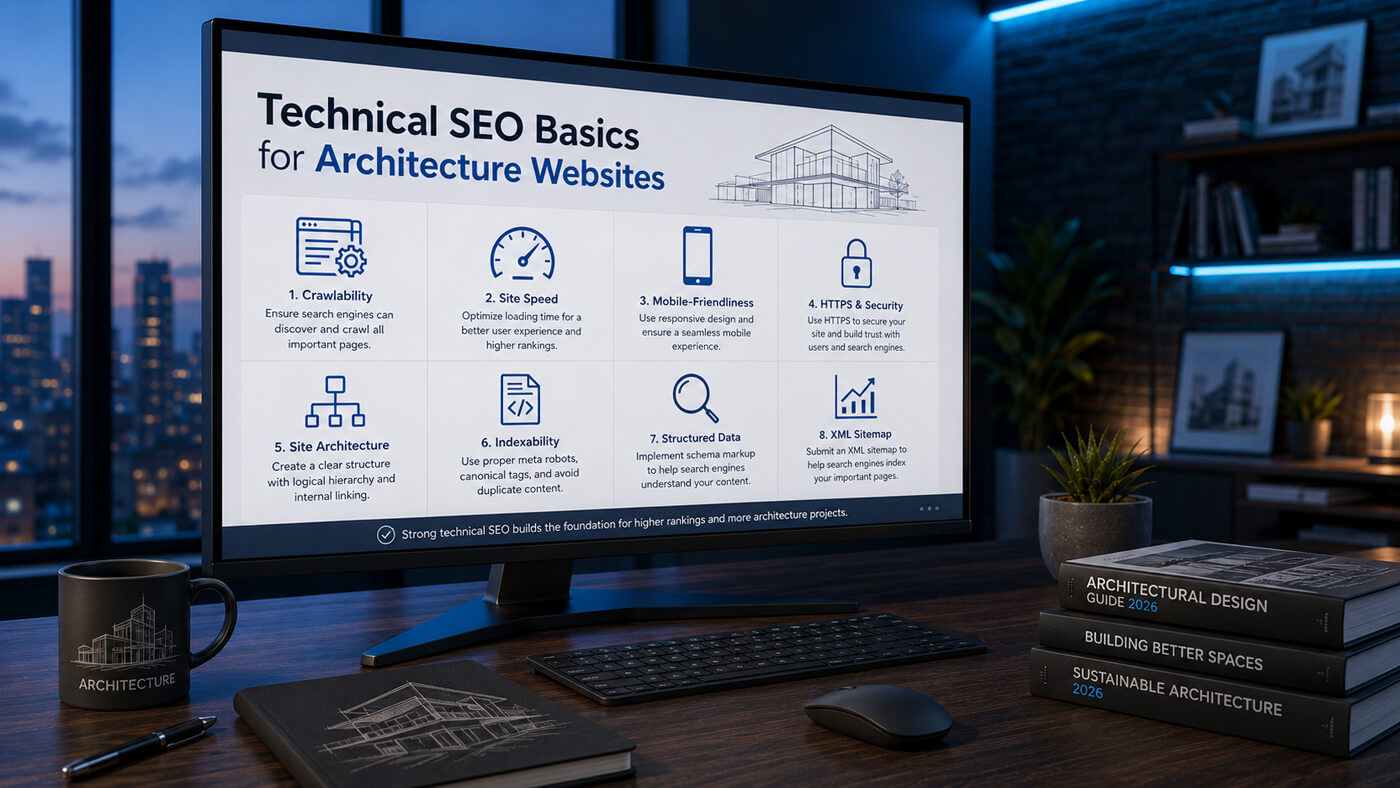
Given the image-weight problem already discussed, site speed deserves particular attention for architecture firm websites specifically — more so than for a typical local-business site with lighter content. Mobile responsiveness matters too, since prospective clients frequently browse portfolios on phones before deciding whether to reach out, and a site that displays awkwardly or loads slowly on mobile risks losing that visitor before they’ve seen enough work to be convinced.
On-page basics — clear page titles, descriptive meta descriptions, and a logical site structure that makes it easy for both visitors and search engines to move between the homepage, portfolio, services, and about pages — round out the technical foundation most firms are missing, often because the site was built primarily as a visual showcase without much thought given to how it’s structured for search.
Keyword Research for Architects
Keyword research for an architecture firm generally falls into a few practical buckets: location-based terms (“architect in [city],” “[neighborhood] home renovation architect”), project-type terms (“kitchen renovation architect,” “commercial office design firm”), and style-specific terms (“modern farmhouse architect,” “sustainable home design”). Combining project type and location tends to produce the clearest match between what a prospective client is searching and what a specific service or project page addresses.
Google Search Console — a free tool showing which search terms already bring traffic to a site — is worth checking regularly, since it often reveals which project types or styles are already gaining organic traction and where content gaps exist relative to what the firm actually offers. Pairing Search Console with Google Analytics closes the loop: Search Console shows which search terms bring visitors to the site, while Analytics shows what those visitors actually do once they arrive — whether they browse multiple projects, visit the contact page, or leave after one image. Looking at both together makes it easier to tell whether a keyword is attracting genuinely interested prospects or just casual browsers.
Residential vs. Commercial SEO Considerations
Residential and commercial architecture clients search and decide differently, and treating them as one undifferentiated audience is a common gap in generic advice. Residential prospects tend to search more locally and emotionally (“dream home architect near me”), often browsing portfolios extensively before reaching out, and responding well to style-specific and philosophy-driven content that helps them picture working with a specific firm.
Commercial clients — developers, business owners, institutional buyers — tend to search more specifically around project type and scale (“multi-family residential architect,” “retail space design firm”) and weigh a firm’s relevant project experience and track record more heavily than aesthetic browsing alone. They’re also more likely to search for a firm’s licensing, insurance, and past project scale directly, since those factors often matter for procurement decisions in a way they don’t for a homeowner. A firm serving both audiences benefits from separating this content clearly — distinct landing pages or portfolio sections for residential and commercial work — rather than blending both into one undifferentiated portfolio that under-serves either audience’s actual search behavior.
Cost, Timeline, and Getting Started
SEO costs for architecture firms vary significantly based on firm size, number of active markets, and whether work is done in-house or through an agency, and any specific dollar figure should be treated as a rough industry range rather than a guarantee. Realistically, meaningful ranking improvements take several months to materialize — architecture’s long client decision cycle means SEO’s slower timeline is actually a reasonable fit for the industry, rather than a mismatch the way it might be for a business expecting fast transactional conversions.
This timeline also means SEO isn’t a good fit for a firm that needs immediate visibility for a specific opening or event — that’s a case where paid ads or direct outreach still make more sense. SEO earns its value as a compounding, background channel that keeps working while a firm focuses on client work, not as a quick-turnaround tactic.
A practical starting point for a small or mid-size firm: audit current image file sizes and page load speed first, since this is both foundational and directly tied to the industry’s core content challenge. From there, confirming Google Business Profile accuracy and fixing any NAP inconsistencies typically costs little beyond time, before investing in new content or link-building efforts that take longer to show results. Firms working with an outside SEO provider should ask specifically how that provider plans to handle image-heavy portfolio pages — this is genuinely industry-specific work, and a provider without architecture or design-industry experience may default to generic advice that doesn’t account for the page-speed tension already discussed.
Frequently Asked Questions
Is SEO worth it for a small architecture firm?
Generally yes, particularly for capturing prospective clients outside an existing referral network. It won’t replace word-of-mouth entirely, but it builds a second, ongoing source of inquiries that doesn’t depend on personal relationships.
How much does SEO cost for an architecture firm?
It varies widely by firm size, market competitiveness, and whether the work is done in-house or through an agency. There’s no single reliable industry-wide figure, so it’s worth getting quotes specific to your market rather than relying on a general benchmark.
How long does it take to see SEO results for an architecture firm?
Typically several months for meaningful ranking movement, which aligns reasonably well with architecture’s naturally long client decision cycle. Foundational fixes like image optimization and Google Business Profile accuracy can show improvements sooner than competitive keyword rankings do.
Can a small firm compete in SEO against larger, multi-office architecture practices?
For broad, highly competitive terms, it’s difficult. Smaller firms tend to have better luck focusing on specific locations, project types, or design styles rather than trying to outrank larger practices on generic terms like “architect.”
What’s the difference between SEO and just being featured on ArchDaily or Houzz?
Being featured on architecture publications can drive visibility and sometimes a valuable backlink, but it doesn’t build the firm’s own website’s search authority the way owned SEO does. The two can complement each other rather than substitute for one another.
How do I optimize project photos without slowing down my website?
Compress images without visibly degrading quality, use modern formats like WebP, and load images progressively as a visitor scrolls rather than all at once. This preserves visual impact while addressing the page speed problem that image-heavy portfolios commonly face.
Does SEO work differently for residential vs. commercial architecture firms?
Yes. Residential clients tend to search more locally and browse portfolios extensively before contacting a firm, while commercial clients search more specifically around project type and scale, and weigh relevant project experience more heavily.
Will SEO reduce my need for referrals, or does it work alongside them?
For most firms, it works alongside referrals rather than replacing them. SEO tends to reach the prospective clients who wouldn’t have found the firm through an existing network at all.
Read This Blog: https://linkneon.com/seo-for-car-dealers/
Conclusion
SEO for architects isn’t generic local-business SEO applied to a design firm — the visual-heavy content, the long trust-driven decision cycle, and the tension between showcasing photography and maintaining page speed make it its own discipline. The firms that get real value from it treat project pages, image optimization, and evergreen content as three connected pieces, rather than assuming a beautiful portfolio alone is enough to be found.
A practical next step: run your current portfolio site through a page speed test and see how your largest project pages perform. If image weight is dragging load times down, that’s the most foundational, highest-leverage fix available before investing further in content or local SEO work.