


Topical authority SEO means building your website into the go-to source on one subject, instead of writing scattered posts around single keywords. Google notices when a site covers a topic from every angle, and it tends to trust that site more than one with a handful of thin, disconnected pages.
This article breaks down what topical authority SEO actually involves, walks through the practices commonly associated with consultant Ben Stace, and gives you a step-by-step way to apply the approach to your own site. We’ll also cover where the method falls short and what’s worth verifying before you take any claims about it at face value.
What Is Topical Authority SEO?
Topical authority is the degree to which search engines treat your website as a credible, complete source on a given subject. It’s not a number Google publishes anywhere — there’s no dashboard that shows your “topical authority score.” Instead, it’s inferred from patterns: how many angles of a topic you cover, how those pages link to each other, and whether your content answers the follow-up questions a real reader would have.
The shift toward this way of thinking has been building for years, but two things have accelerated it. First, Google’s language models got much better at understanding meaning rather than matching exact words, so keyword stuffing stopped working the way it once did. Second, AI-generated search results — like Google’s AI Overviews — pull from sources that demonstrate depth, not just sources that rank for one phrase. A single article optimized for “best running shoes” has a harder time getting cited by an AI summary than a site with twenty interlinked pages covering running shoe fit, materials, injury prevention, and brand comparisons.
For site owners, the practical takeaway is this: ranking well now depends less on finding one perfect keyword and more on proving, through your content structure, that you understand the whole topic.
Who Is Ben Stace?
Ben Stace’s name shows up across a cluster of SEO agency blogs describing him as a consultant focused on semantic SEO and topical mapping. Several of these posts describe him as UK-based and credit him with refining topical authority into a repeatable process for clients.
It’s worth being upfront here: independent verification is thin. There’s no personal website, LinkedIn profile, or press coverage turning up alongside these agency posts, and the articles themselves disagree on some details — one explicitly states he didn’t invent topical authority, while others imply he originated the approach. What’s consistent across sources is the method attributed to him: semantic content, entity optimization, structured topic clusters, and intent-matched pages. Whether that method is uniquely his or a synthesis of established SEO practice, it’s a legitimate framework worth understanding either way — and it lines up closely with what SEO tools like Clearscope and Surfer SEO have taught for years.
Topical Authority vs. Traditional Keyword SEO

Older SEO practice treated each page as a bid for one keyword. You’d research search volume, write a page targeting that phrase, add the keyword a certain number of times, and hope to rank. It worked reasonably well when search engines were less sophisticated at understanding context.
Topical authority SEO flips the unit of work from the page to the topic. Instead of asking “what’s my keyword for this page,” you ask “what does someone need to fully understand this subject, and what pages does that require?” A single pillar page might target a broad term like “home espresso brewing,” while a dozen supporting pages answer specific questions — grind size, water temperature, machine comparisons, troubleshooting.
| Aspect | Traditional Keyword SEO | Topical Authority SEO |
| Unit of optimization | Single page, single keyword | Entire topic cluster |
| Content planning | Keyword-by-keyword research | Full topical map before writing |
| Structure | Standalone pages | Pillar page + linked cluster pages |
| Ranking signal | Keyword match, backlinks | Depth, entity coverage, internal linking |
| AI/generative search fit | Weaker — narrow scope | Stronger — demonstrates comprehensive coverage |
| Time to results | Can be faster per page | Slower, but more durable over time |
The two approaches aren’t mutually exclusive. Keyword research still matters inside a topical strategy; it just operates at the level of a cluster rather than a single article. The difference is architecture, not the absence of keywords.
The Core Building Blocks of Topical Authority
A few concepts show up repeatedly in how topical authority gets built in practice. Understanding each one on its own makes the step-by-step process easier to follow.
Semantic SEO & NLP
Semantic SEO means writing for meaning and context rather than exact-match phrases. Search engines use natural language processing (NLP) — technology that parses text for intent and relationships between words — to figure out what a page is actually about, even when it doesn’t repeat a target phrase word-for-word. Practically, this means you can (and should) use synonyms, related phrases, and natural variation instead of repeating “topical authority SEO” in every sentence. Google’s systems are generally good at recognizing that “topic clusters,” “content silos,” and “topical mapping” all relate to the same underlying concept.
Entity-Based SEO
An entity, in SEO terms, is a distinct thing — a person, place, product, or concept — that search engines recognize and can connect to other entities. Google maintains something called the Knowledge Graph, a database of entities and how they relate to one another. When your content consistently mentions the right entities in context (say, specific ingredients, tools, or industry terms relevant to your topic), it helps search engines place your site correctly within that web of relationships. Structured data — code added to a page’s HTML, often called schema markup — can reinforce this by explicitly telling search engines which entities appear on the page and how they relate to each other.
Entity optimization isn’t about keyword density. It’s closer to making sure your content mentions the things a genuine expert would naturally reference, in the way they’d naturally reference them.
Topical Maps & Content Clusters
A topical map is a plan that lays out every subtopic, question, and related concept within your chosen subject before you write anything. From that map, you build a pillar-and-cluster structure: one broad pillar page that overviews the topic, and multiple narrower cluster pages that each go deep on one piece of it. The cluster pages link back to the pillar, and the pillar links out to each cluster, creating a web search engines can crawl and understand as a unit.
This is the part of Ben Stace’s described approach that gets the most attention, and for good reason — it’s the structural backbone everything else sits on.
Search Intent Alignment
Every piece of content in a cluster should match a specific stage of what the reader is trying to do: learn something, compare options, or take action. A page written for someone just starting to research a topic shouldn’t read the same as a page written for someone ready to buy. Mismatched intent is a common reason otherwise well-optimized content underperforms — the page might be accurate and thorough, but it’s answering a question the reader wasn’t actually asking.
Step-by-Step: How to Build Topical Authority
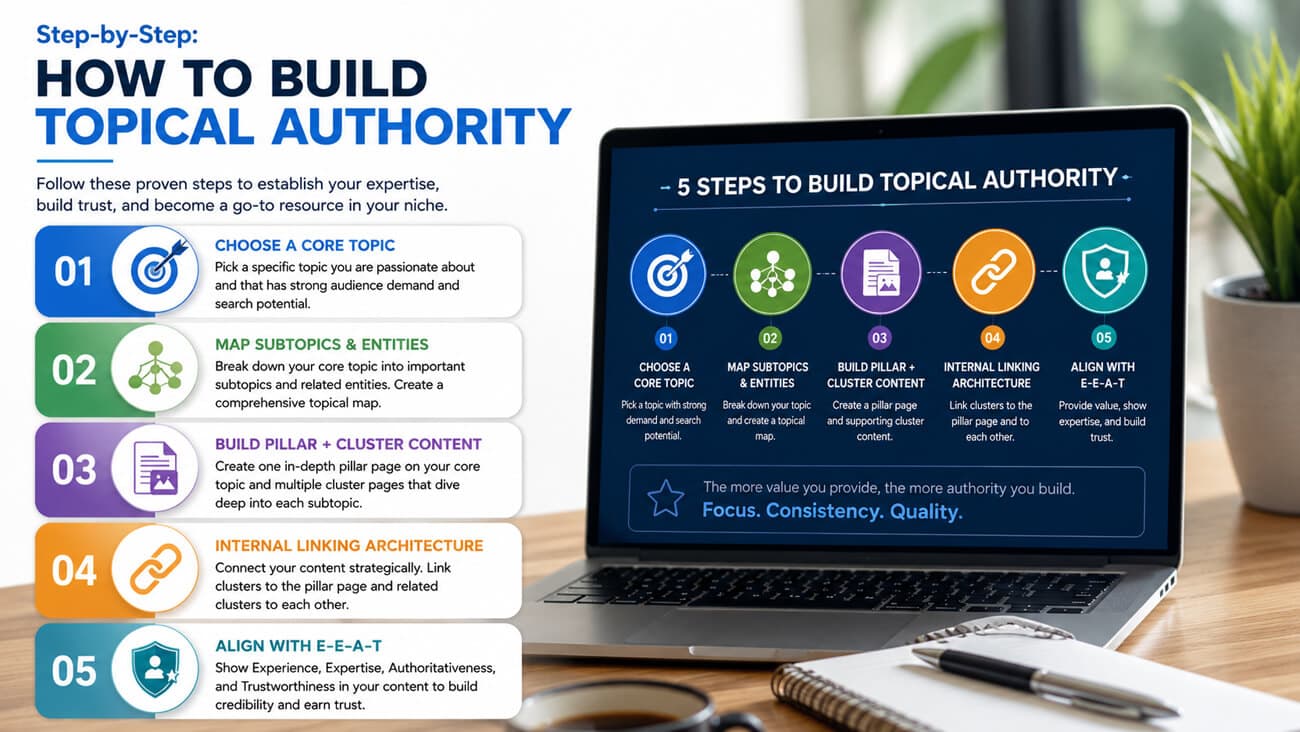
Step 1 – Choose a Core Topic
Pick something specific enough that you can realistically cover it in full, but broad enough to support dozens of subtopics. “SEO” is too broad for almost anyone to own. “Local SEO for dental practices” is a topic a small agency could plausibly dominate. The topic should also connect to your actual business goals — building authority on a subject unrelated to what you sell won’t convert, even if it ranks.
Step 2 – Map Subtopics & Entities
Search your core topic and see what Google already surfaces — the “People also ask” boxes, related searches, and top-ranking competitor pages all reveal what search engines expect a comprehensive resource to cover. List every recurring subtopic and question. This becomes your topical map. At this stage, also note the entities (tools, terms, names, standards) that legitimately belong in the conversation.
Step 3 – Build Pillar + Cluster Content
Write one pillar page that overviews the whole topic at a reasonable depth, then build cluster pages for each subtopic identified in Step 2. Each cluster page should be genuinely useful on its own, not just a placeholder for a keyword.
Step 4 – Internal Linking Architecture
Link every cluster page back to the pillar, and link the pillar out to every cluster. Where it makes sense, link cluster pages to each other too — if your “grind size” article naturally references water temperature, link to that article instead of just mentioning it in passing. This linking pattern is what turns a pile of articles into a structure search engines can read as a coherent topic.
Step 5 – Align with E-E-A-T
E-E-A-T stands for Experience, Expertise, Authoritativeness, and Trustworthiness — the framework Google’s quality guidelines use to evaluate content, particularly for topics that affect someone’s health, finances, or safety. Author bios, citations to credible sources, accurate and current information, and transparency about who’s behind the content all support this. Topical authority and E-E-A-T reinforce each other: a site that demonstrably knows a subject deeply is also more likely to read as trustworthy.
Tools to Support Topical Authority SEO
A few categories of tools show up consistently in topical authority workflows:
- Content optimization platforms (Clearscope, Surfer SEO) analyze top-ranking pages for a topic and suggest related terms and entities your content should cover.
- Keyword clustering tools (Keyword Insights and similar) group large keyword lists into semantically related clusters, which speeds up the topical mapping step.
- Site audit tools help identify gaps in your existing content — subtopics you haven’t covered yet, or old pages that need updating to stay current.
None of these tools build topical authority on their own. They speed up research and identify gaps; the actual work of writing useful, accurate content still falls on you.
Common Mistakes & Limitations
Topical authority SEO isn’t a shortcut, and it’s worth naming where it tends to fall short:
- It’s slow. Building out a full topical map and cluster can take months, not days. Sites expecting quick ranking jumps from this approach are usually disappointed.
- It demands niche focus. A site trying to be authoritative on ten unrelated topics dilutes the effect. This approach works best for businesses willing to specialize, at least within a given content area.
- It’s hard to measure precisely. Because Google doesn’t publish a topical authority metric, most measurement is indirect — ranking improvements across a cluster, increased organic traffic to the topic as a whole, or more frequent appearances in AI-generated answers.
- Depth can tip into padding. Some sites interpret “cover every angle” as an excuse to publish low-value filler content just to round out a cluster. A cluster of ten genuinely useful pages beats twenty thin ones.
- Attribution to any single consultant should be read skeptically. As covered above, the practices linked to Ben Stace overlap heavily with established SEO methodology taught by multiple tools and practitioners. Treat any framework, including this one, as a codification of good practice rather than a proprietary secret.
How to Measure Topical Authority
Since there’s no official score, most practitioners track a combination of signals:
- Aggregate ranking position across all pages in a cluster, not just the pillar
- Organic traffic growth to the topic as a whole over time
- Featured snippet and AI Overview appearances, which tend to favor sites Google already treats as authoritative on a subject
- Internal link coverage — auditing whether every cluster page is properly linked to the pillar and to related clusters
- Content gap analysis — periodically checking whether new subtopics or questions have emerged that your cluster doesn’t yet cover
None of these numbers isolate “topical authority” cleanly from other ranking factors like backlinks or site speed. They’re best read as a trend over months, not a single data point.
Frequently Asked Questions
What is the difference between topical authority and domain authority?
Domain authority is a third-party metric (popularized by Moz) that estimates a site’s overall ranking strength based largely on backlinks. Topical authority is specific to one subject and is based on content depth and structure, not links alone. A site can have high domain authority overall but weak topical authority in a niche it rarely covers.
How long does it take to build topical authority?
There’s no fixed timeline, and be wary of anyone promising one. Most practitioners describe a process measured in months — building out a full cluster, letting Google crawl and index it, and seeing ranking movement across the topic rather than a single page.
Do I need to cover every subtopic to rank well?
Not every single one, but the more genuine gaps you leave, the weaker the signal. Prioritize subtopics with real search demand or that your competitors already cover, and treat obscure edge cases as lower priority.
Is topical authority SEO the same as semantic SEO?
They overlap but aren’t identical. Semantic SEO refers to writing for meaning and context at the page level. Topical authority is the broader site-level outcome that semantic SEO, entity optimization, and content clustering all contribute to.
What tools help measure or build topical authority?
Content optimization tools like Clearscope and Surfer SEO help identify related terms and entities. Keyword clustering tools group large keyword sets into topics. Standard analytics tools (Google Search Console, GA4) help track traffic and ranking trends across a cluster over time.
Does topical authority matter for AI Overviews and AI search?
Current evidence suggests it does — AI-generated summaries tend to draw from sources that demonstrate depth on a subject rather than single-keyword-optimized pages. This is an evolving area, though, and specific mechanics of how AI search selects sources aren’t fully public.
Can a small website realistically build topical authority?
Yes, provided the topic is narrow enough. A small site trying to own “marketing” will struggle. A small site trying to own “email marketing for independent bakeries” has a realistic shot, because the competition is thinner and the scope is manageable.
Who is Ben Stace and what does his approach add to standard topical authority practice?
Based on available sources, Ben Stace is described as a consultant specializing in semantic and topical SEO, though independent verification of his background is limited. His described method — pillar-and-cluster structure, entity optimization, and intent alignment — matches widely taught topical authority practice rather than introducing a fundamentally different technique.
Read This Blog:https://linkneon.com/semantic-seo-topical-authority-guide/
Conclusion
Topical authority SEO comes down to a simple shift: stop optimizing pages one keyword at a time, and start building topics one cluster at a time. The mechanics — mapping subtopics, writing pillar and cluster content, linking it together, and aligning with E-E-A-T — aren’t exclusive to any one consultant, whatever a given framework is named after. What matters is whether you actually do the work of covering a subject in full, rather than skimming it for search volume.
If you’re starting from scratch, don’t try to build an entire topical map in one sitting. Pick one narrow, business-relevant topic, list ten to fifteen real subtopics a reader would need answered, and write those pages before expanding further. A small, genuinely complete cluster will do more for your rankings than a sprawling, half-finished one.