

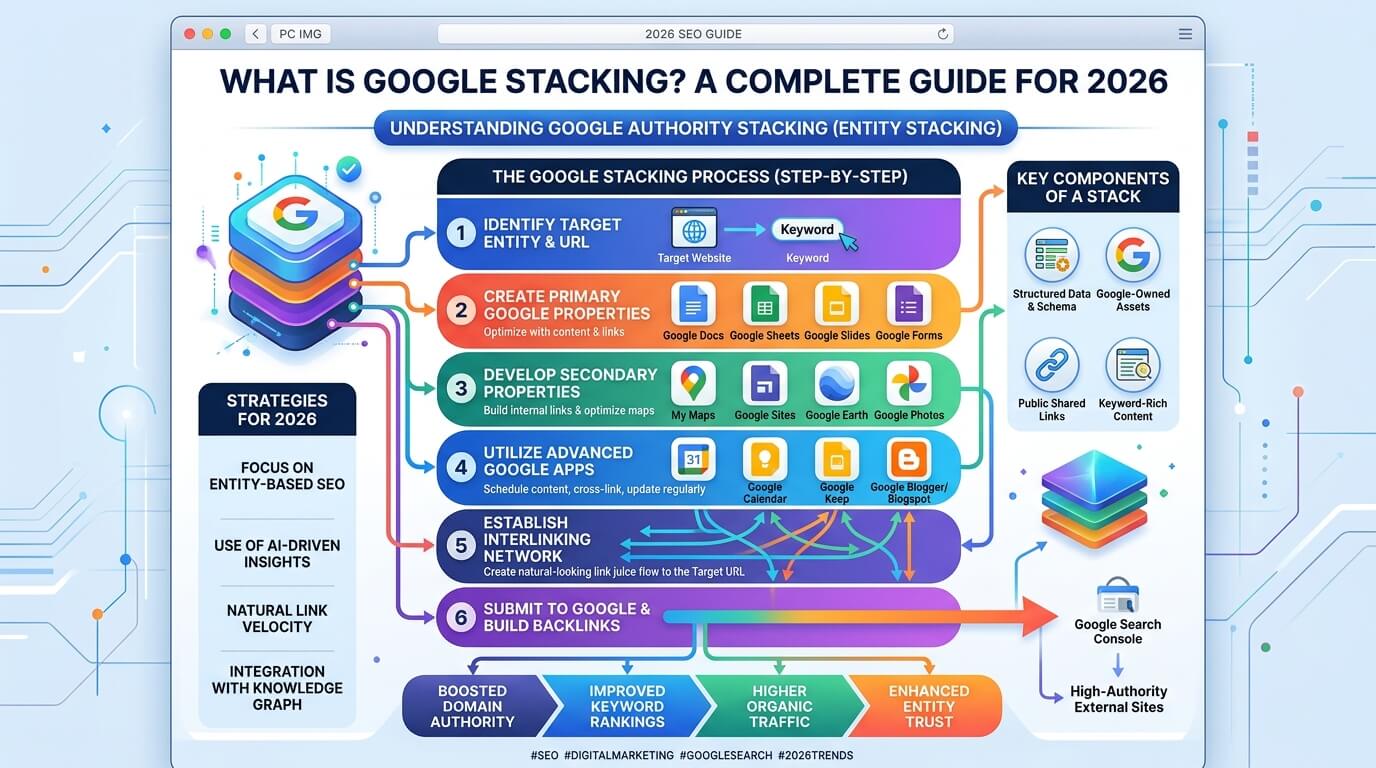
Google stacking (also called Google entity stacking or Google Drive stacking) is a link building technique where someone creates a network of Google’s own properties, things like Docs, Sheets, Slides, Photos, and Sites, and links them together and back to a website.
The idea behind Google stacking is that because these properties sit on Google’s own trusted domains, they carry authority that can pass through to the linked site.
This guide walks through what Google stacking actually involves, how it’s built step by step, and whether it’s worth doing at all. That last part matters: most articles on Google stacking are written by companies selling it as a paid service, so their take on safety and effectiveness isn’t neutral. This one tries to be.
What Is Google Stacking?
Google stacking, sometimes called Google Drive stacking or Google entity stacking, is a link building method built around Google’s own ecosystem instead of external websites.
Rather than getting links from blogs or directories, you build content directly on Google Docs, Sheets, Slides, Photos, Maps, and Sites, then interlink those properties and point them back to your main website [Source: Rank Math].
The reasoning behind Google stacking is straightforward: Google trusts its own domains. A link from docs.google.com or sites.google.com theoretically sits in a more trusted environment than a link from a random third-party blog, so the assumption is that these links carry stronger authority signals [Source: RankIt.UK].
Whether that assumption holds up in practice is a separate question, covered later in this article. It’s also worth being clear upfront about what Google stacking is not: it isn’t paid links, it isn’t a private blog network, and it isn’t a guaranteed ranking method, it’s a specific, documented technique with a specific, contested history.
Key Takeaways
- Google stacking evolved from “Web 2.0” link-building approaches, which used free platforms like Blogger and Wix to build link wheels, a technique Google’s John Mueller has directly called a link scheme that violates spam policies, so it sits in a gray area rather than being confirmed safe [Source: Search Engine Roundtable, LockedownSEO].
- Even neutral, non-commercial sources note some SEOs now consider Google stacking outdated as it’s become more common among spammers [Source: Rank Math].
- The strongest documented use case is local SEO, mainly through NAP (name, address, phone number) consistency, though this benefit likely overlaps with standard local SEO practices that don’t require stacking at all.
- No reliable data exists on how long results take or how much ranking impact stacking actually produces; treat confident timelines or guarantees from anyone selling the service with skepticism.
- If you try it, avoid keyword-stuffing every property and never let the stack be its only value, each property should be useful on its own, not just a link vehicle.
A Short History: From Link Wheels to Google Stacking
Google stacking didn’t appear out of nowhere. It’s connected to an older technique called a “link wheel,” where SEOs built several small websites, often on free platforms like Blogger, Wix, or HubPages, and linked them to each other in a circular pattern to funnel authority toward one main site [Source: RankIt.UK, SitePoint].
Google’s own John Mueller addressed link wheels directly in 2022, stating plainly that “those are essentially link schemes, so they would be against our spam policies,” and noting that the tactic is “super old” and doesn’t work [Source: Search Engine Roundtable].
Google stacking is often described as an evolution of the earlier “Web 2.0” link-building approach, which used those same free platforms to build link wheels; Google stacking follows a similar logic but consolidates the properties entirely within Google’s own ecosystem instead of scattering them across various free platforms [Source: LockedownSEO].
That lineage is the single most important piece of context in this whole article. It doesn’t mean Google stacking is automatically penalized, Google hasn’t issued a statement naming the technique directly, but it does mean the underlying mechanism, building a network of properties primarily to pass authority rather than to inform readers, is close enough to something Google has already flagged that caution is warranted. That context shapes most of the guidance further down.
How Google Stacking Works
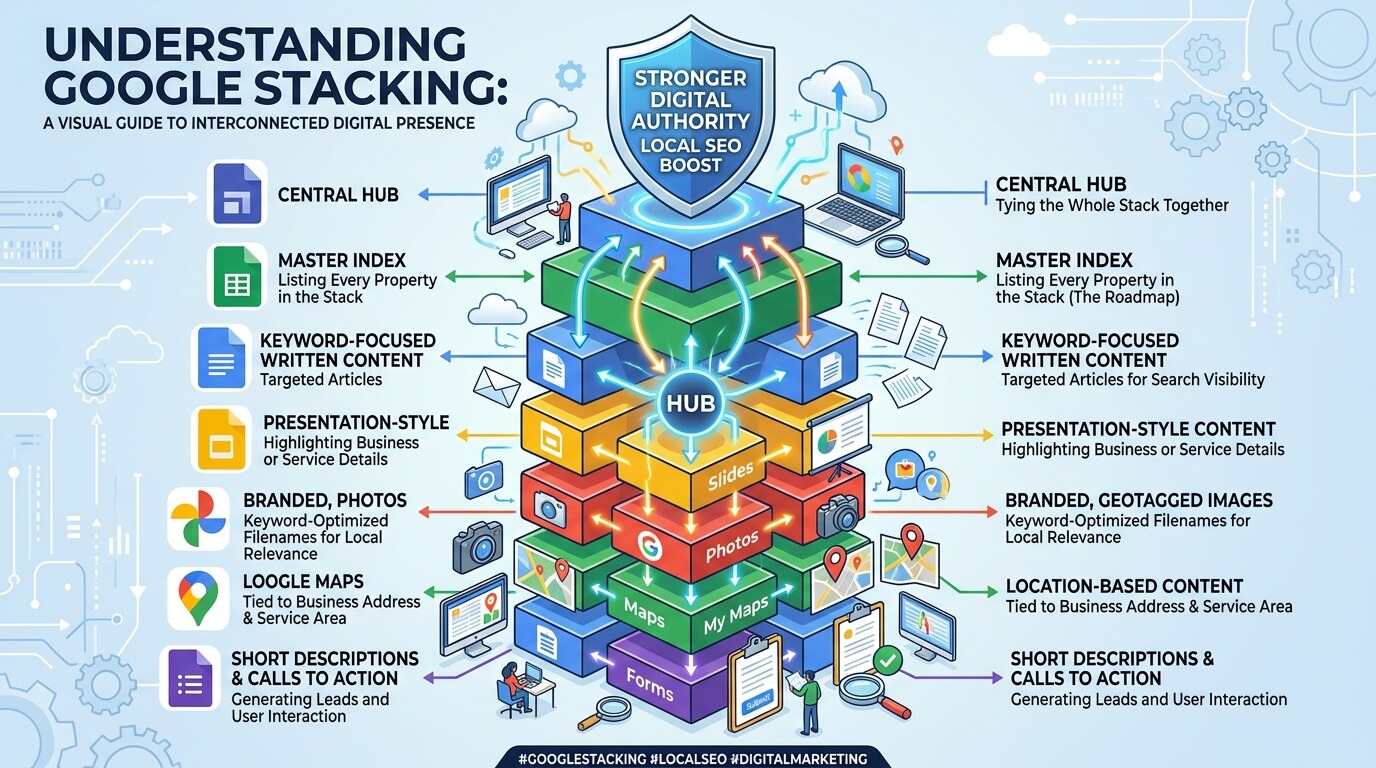
The Google Properties Involved
A typical Google stack draws from several free, publicly available Google tools:
- Google Docs, used to publish keyword-focused written content
- Google Sheets, often built as a master index listing every property in the stack
- Google Slides, used for presentation-style content about a business or service
- Google Photos, for branded, geotagged images with keyword-optimized file names
- Google Maps (My Maps), for location-based content tied to a business address
- Google Sites, which usually functions as the central hub tying the whole stack together
- Google Forms, sometimes used for short descriptions and calls to action
[Source: Rank Math, CitationBuilderPro]
Interlinking and Linking Back to Your Site
The properties in a stack aren’t meant to sit in isolation. Each one is typically linked to at least one other property in the stack, plus the central Google Site, plus the target website. This interlinking is what turns a handful of disconnected documents into a “stack” in the first place [Source: RankIt.UK].
Publishing and Indexing
For any of this to matter for SEO, the properties need to be publicly accessible and indexable. In Google Docs, for example, this means going to File, then Share, then Publish to Web, which makes the document behave like a regular, crawlable webpage rather than a private file [Source: Rank Math].
How to Build a Google Stack, Step by Step
- Research your target keywords. Before creating anything, identify the keywords and topics the stack should support. These should tie directly to what the target website already covers [Source: Rank Math].
- Create a dedicated Google account for the project. Keeping the stack separate from a personal account helps with organization and avoids mixing business and personal data [Source: Rank Math].
- Build a Google Drive folder as the base. Name it around a primary keyword and business name, and populate it with basic business details: name, address, phone number, website, and target keywords [Source: CitationBuilderPro].
- Create the individual Google properties. Populate each Doc, Sheet, Slide deck, Photos album, and Map with genuinely useful, relevant content, not just keyword-stuffed filler [Source: Rank Math, CitationBuilderPro].
- Build a Google Site as the central hub. This site typically embeds the other properties and links out to the main website, functioning as the anchor point of the entire stack [Source: CitationBuilderPro].
- Publish everything to the web. Each property needs its sharing settings changed to public so it can actually be crawled and indexed [Source: Rank Math].
- Interlink the properties and monitor the stack over time. A stack that’s built once and abandoned tends to look neglected; ongoing updates are part of most recommended approaches [Source: Rank Math].
Types of Google Stacks
Not every Google stack looks the same. Sources describe a few recurring variations:
| Stack Type | What It Includes | Typical Use Case | Source Confidence |
| Google Drive Stack | A structured Drive folder containing Docs, Sheets, Slides, and Photos | General authority building | Multiple sources |
| Google Entity Stack | Content optimized around semantic and entity keywords tied to a brand | Reinforcing what a business is and does | Multiple sources |
| Google Authority Stack | A broader mix that may include Sites, Maps, Calendar, and YouTube | Larger, more comprehensive campaigns | Multiple sources |
| Cloud Stack | Similar structure hosted across cloud platforms rather than only Google properties | An advanced, less-documented variant | Single source only |
[Source: CitationBuilderPro]
The first three stack types show up consistently across the sources reviewed for this guide. The “Cloud Stack” row is included for completeness but comes from a single source with no independent corroboration, so it’s worth treating as a niche offshoot rather than a standard part of Google stacking.
Google Stacking for Local SEO
Local SEO is where Google stacking gets cited most often, and it’s arguably the strongest use case for the technique. The logic is that consistent name, address, and phone number (NAP) details spread across multiple Google properties, plus a well-optimized Google Business Profile, reinforce a business’s location and relevance for city- or neighborhood-specific searches [Source: RankIt.UK, CitationBuilderPro].
For a local business, this typically means including a full address, phone number, and service area consistently across every property in the stack, and linking properties to the business’s Google Business Profile where relevant. The stated goal is stronger visibility in Google Maps results and local map pack rankings [Source: CitationBuilderPro].
It’s worth noting that this local benefit likely overlaps with standard NAP consistency practices, which are already a recognized local SEO best practice independent of Google stacking specifically; none of the sources reviewed isolate how much of the benefit, if any, comes from the stacking mechanism itself versus the NAP consistency alone.
Is Google Stacking Safe? A Balanced Look
This is where most articles on the topic get one-sided, and it’s worth being direct about why. Two of the most detailed guides on Google stacking are published by companies that sell it as a paid service, so their framing of it as safe and effective carries an obvious incentive.
The case for it being reasonably safe: Google stacking uses Google’s own free, publicly available tools in the way they’re designed to be used, publishing a document, sharing a folder, creating a site. Nobody is buying links or hacking anything. RankIt.UK describes it as “considered a legitimate white hat SEO tactic” when done properly.
The case for caution: that same source immediately qualifies it, warning that “over-optimization could be viewed as manipulative, veering towards black hat techniques” [Source: RankIt.UK].
Even Rank Math’s own glossary entry, a neutral third party with no stacking service to sell, notes that “some bloggers believe Google stacking has become less effective over time, particularly as it has become common with spammers,” and that some consider it “an outdated SEO technique”.
There’s also the lineage problem covered earlier: Google’s John Mueller has explicitly called the related link-wheel technique a link scheme that violates Google’s spam policies [Source: Search Engine Roundtable].
Google has not issued a direct statement specifically addressing “Google stacking” by name, so there’s no confirmed official verdict either way, but the resemblance is close enough that this is best treated as a gray-area tactic rather than a confirmed-safe one.
Google Stacking vs. Other Link-Building Methods
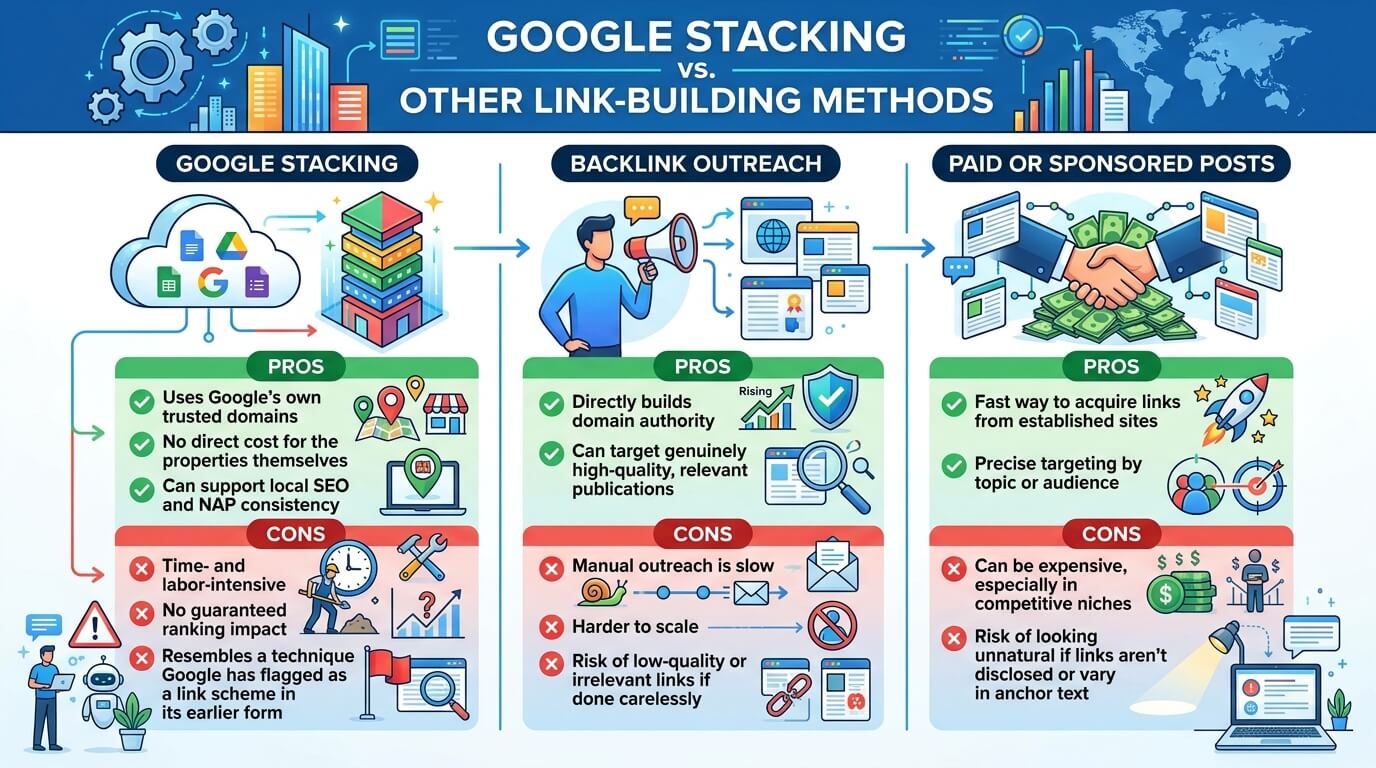
| Method | Pros | Cons |
| Google Stacking | Uses Google’s own trusted domains; no direct cost for the properties themselves; can support local SEO and NAP consistency | Time- and labor-intensive; no guaranteed ranking impact; resembles a technique Google has flagged as a link scheme in its earlier form |
| Backlink Outreach | Directly builds domain authority; can target genuinely high-quality, relevant publications | Manual outreach is slow; harder to scale; risk of low-quality or irrelevant links if done carelessly |
| Paid or Sponsored Posts | Fast way to acquire links from established sites; precise targeting by topic or audience | Can be expensive, especially in competitive niches; risk of looking unnatural if links aren’t disclosed or vary in anchor text |
[Source: RankIt.UK]
No single method here is objectively best. The right mix depends on budget, timeline, and how much ongoing maintenance a business can realistically commit to.
Common Mistakes to Avoid
- Treating the stack as a one-time project. An abandoned, outdated stack is a weaker signal than an actively maintained one.
- Keyword-stuffing every property. Cramming the same exact-match phrase into every Doc and Sheet is exactly the kind of over-optimization that risks looking manipulative.
- Duplicating identical content across properties. Each property should add something distinct rather than repeating the same paragraph with minor tweaks.
- Skipping Google’s actual spam policies. Since Google stacking sits in a gray area, it’s worth reading Google’s published spam policies directly rather than relying only on SEO blog summaries.
- Relying on stacking as the only SEO strategy. Every source reviewed, including the ones selling the service, agrees this works best as one part of a broader approach, not a replacement for genuine content and legitimate outreach [Source: RankIt.UK].
- Building the stack around only the main business site. A stack with no independent value of its own, no property that would be useful even without the backlink, is the version most likely to read as manipulative rather than informative.
Frequently Asked Questions
Is Google stacking considered white hat or black hat SEO?
It’s genuinely contested. Google stacking doesn’t involve buying links or hacking anything, which puts it closer to white hat in mechanism, but its resemblance to link wheels, a technique Google has directly called a link scheme, means it sits in a gray area rather than being clearly safe [Source: Search Engine Roundtable, RankIt.UK].
Does Google stacking actually help local SEO rankings?
Sources that specialize in local SEO argue it can support local visibility, mainly through consistent NAP details and Google Business Profile integration [Source: CitationBuilderPro]. There isn’t independent, non-commercial data confirming the size of that effect, and the benefit likely overlaps heavily with standard NAP consistency practices that don’t require Google stacking specifically.
Is Google stacking still effective in 2026, or is it outdated?
Opinions differ even among SEO sources. Rank Math’s glossary notes some practitioners now consider Google stacking outdated as it became more common among spammers [Source: Rank Math], while services that sell stacking continue to market it as effective. Treat any confident claim about current effectiveness, in either direction, with some skepticism.
Can Google stacking get my site penalized?
There’s no confirmed case tied specifically to “Google stacking” by name in the sources reviewed, but the technique’s similarity to link wheels, which Google has explicitly classified as a link scheme, means the risk isn’t zero, especially if properties are keyword-stuffed or clearly built only to manipulate rankings rather than inform readers.
How long does it take to see results from a Google stack?
None of the sources reviewed provide verifiable data on this, and no reliable timeline can be stated here without speculating. Given that it involves creating and indexing multiple properties before any potential signal would register, results, if any, would not be immediate, but a specific number of weeks or months isn’t something this guide can responsibly claim.
Do I need to hire an agency, or can I build a Google stack myself?
The process itself, creating Docs, Sheets, a Google Site, and setting sharing permissions to the public, doesn’t require specialized tools or technical skill. Agencies mainly offer time savings and experience with structuring the interlinking, not access to anything a business owner couldn’t do independently.
Read More: https://linkneon.com/ahrefs-vs-semrush-vs-moz/
Conclusion
Google stacking is a real, documented technique: build content across Google’s own properties, interlink them, and point them at a website. Whether it’s worth doing depends on how much weight you put on its unclear standing with Google.
It isn’t confirmed to violate any specific policy, but it’s connected to a tactic, link wheels, that Google has directly called a link scheme, and even neutral sources acknowledge Google stacking may be losing effectiveness as it becomes more common.
A reasonable approach is to treat it as a minor, low-cost supplement to genuine local SEO work like NAP consistency and Google Business Profile optimization, not as a primary or guaranteed ranking strategy.