


A shopper searching “2023 Honda Civic under 15k near me” is close to a purchase decision, and whichever dealership shows up first — organically or through a listing site — has a real shot at that sale. Most dealerships pour budget into paid ads and third-party listing platforms like Cars.com or AutoTrader, while SEO for car dealers — optimizing their own website’s organic visibility — gets left as an afterthought. That’s a missed opportunity, because organic search keeps working long after an ad budget runs out.
This guide covers what SEO for car dealers actually means specifically — not generic small-business SEO advice, but the parts that are genuinely different: vehicle detail pages that disappear when cars sell, local search competition, structured data for inventory, and the reputation signals that influence whether a shopper clicks your listing over a competitor’s. It also covers realistic cost and timeline expectations, so you know what you’re signing up for before committing budget to it.
What Is SEO for Car Dealers?
SEO for car dealers means optimizing a dealership’s own website so it ranks in Google’s organic (unpaid) search results for the terms shoppers actually use — model names, “near me” searches, price ranges, and comparison queries. It’s distinct from paying to appear on Cars.com or AutoTrader, and distinct from running Google Ads, both of which stop producing visibility the moment you stop paying.
For a dealership specifically, SEO covers three overlapping areas: the vehicle inventory itself (each car’s listing page), local search presence (showing up for shoppers nearby), and the broader website content that isn’t tied to any single car. Most beginners think of SEO as only the first of these — optimizing listings — but the other two matter just as much, arguably more, because they’re not tied to inventory that constantly changes.
Why Dealership SEO Is Different From Typical Local SEO
A restaurant’s SEO strategy centers on a handful of stable pages — menu, hours, location — that rarely change. A dealership’s SEO strategy has to deal with something most local businesses never face: its most important pages, the vehicle detail pages (VDPs), are temporary by design. A car sells, its listing gets removed, and any search ranking or backlinks that page had earned disappear with it.
This creates a structural challenge that generic SEO advice doesn’t address. If a dealership’s entire SEO effort is built around individual VDPs, that effort resets every time inventory turns over. The other structural difference is competition: a local bakery mostly competes with other local bakeries, but a dealership competes not just with nearby dealerships but with large, well-funded listing platforms — Cars.com, AutoTrader, CarGurus — that already dominate many automotive search results by default. That’s a real limitation worth naming honestly rather than glossing over: outranking these platforms for competitive, high-volume terms is difficult for most independent dealerships, and a realistic strategy usually focuses on where a dealership’s own site can actually win — branded searches, local “near me” terms, and specific inventory combinations the big platforms don’t target as precisely.
SEO vs. Google Ads for Dealerships
Google Ads produces immediate visibility — a new campaign can put a dealership at the top of search results the same day it launches, which matters when inventory needs to move quickly. SEO takes longer to build, often months, but doesn’t stop working the moment you stop spending, and organic clicks don’t cost anything per click.
| Factor | SEO (Organic) | Google Ads (Paid) |
| Time to visibility | Months | Immediate |
| Cost structure | No per-click cost | Pay-per-click |
| Longevity | Persists after work stops | Stops when budget stops |
| Best for | Brand authority, local presence | Fast inventory turnover, urgent sales |
A reasonable approach is running both, using ad performance data to inform which organic keywords are actually worth prioritizing — if a paid keyword consistently converts well, it’s a strong candidate for dedicated organic content too, rather than staying dependent on ad spend indefinitely.
Optimizing Vehicle Detail Pages (VDPs)
A vehicle detail page is the individual listing for one car — year, make, model, trim, mileage, price, photos, and description. Optimizing these pages means writing unique, specific descriptions rather than relying on manufacturer boilerplate that every dealership selling the same model uses, since duplicate content across dozens of dealership sites gives search engines nothing to differentiate on.
A well-optimized VDP includes the vehicle’s specific details in both the visible text and the page’s title and meta description, clear high-quality photos, and internal links to related inventory (similar models, similar price ranges) so that when one car sells, the page’s SEO value isn’t entirely lost — some of it transfers through those internal links to the pages still active.
Structured Data for Vehicle Listings
Structured data is a standardized code format that labels specific page elements — price, mileage, make, model — so search engines can read them directly rather than inferring them from surrounding text. For dealerships, this comes from two related Schema.org types:
| Schema Type | Applied To | What It Communicates |
| AutoDealer | Homepage, location pages | Business identity, hours, location, brand affiliation [Schema.org] |
| Vehicle + Product | Individual VDPs | Year, make, model, trim, mileage, price, condition [A3 Brands] |
It’s worth noting that Google’s dedicated Vehicle Listing rich-result feature, introduced in October 2023, was deprecated in June 2025 [DemandLocal] — so structured data on VDPs no longer guarantees a specific rich search result the way it once did. That doesn’t make Vehicle schema pointless, though: it still makes vehicle data machine-readable for AI systems and answer engines beyond traditional search [iLoveSchema], which matters as more automotive research happens through AI-driven tools. Adoption of this markup among dealerships is also inconsistent — audits of dealership sites commonly find incomplete or missing Vehicle schema [Unalike Marketing], which means implementing it properly is one of the more accessible ways a smaller dealership can differentiate technically from competitors who haven’t bothered.
Local SEO for Dealerships

Local SEO determines whether a dealership shows up in the Google Map Pack — the map-based block of results for searches like “car dealership near me” or “[brand] dealer in [city].” A dealership’s Google Business Profile is the foundation of this: complete, accurate hours, categories, photos, and services directly affect whether Google surfaces the business for relevant local searches.
NAP consistency — keeping the dealership’s Name, Address, and Phone number identical across the website, Google Business Profile, and every directory listing — matters more than it sounds like it should, because inconsistencies quietly erode the local search signals search engines use to confirm a business’s identity [CFM Growth]. AutoDealer schema markup on the homepage reinforces this same signal at the code level, and works alongside — not instead of — a well-maintained Google Business Profile.
Reviews and Reputation Management
Star ratings and review counts show up directly next to search results and Google Business Profile listings, which means reputation isn’t separate from SEO performance — it directly affects whether a shopper clicks a dealership’s listing when several appear for the same search. A dealership with strong pricing and inventory but a thin or outdated review profile can still lose the click to a less competitive dealer with better visible trust signals.
Responding to reviews, both positive and negative, and actively encouraging satisfied customers to leave them, is a low-cost habit that compounds over time in a way paid advertising doesn’t.
Content Strategy Beyond Inventory Pages
Because VDPs are inherently temporary, relying on them as the sole SEO strategy means constantly starting over. Evergreen content — pages that aren’t tied to a specific car in stock — gives a dealership something stable to build authority around. Examples include buying guides (“what to look for in a used SUV”), comparison content (“Model A vs. Model B: which fits your budget”), financing explainers, and service department content that has nothing to do with current inventory at all.
This kind of content also tends to attract the kind of search traffic that’s earlier in the buying journey — someone researching before they’re ready to buy — which builds brand familiarity ahead of the eventual purchase-intent search. A dealership’s service department is a particularly underused source of evergreen content: pages covering common maintenance questions, seasonal service reminders, or “how often should I…” topics rarely compete with third-party listing platforms at all, since those platforms are built around inventory, not ownership and upkeep. That makes service content one of the more realistic areas for a smaller dealership to build genuine topical authority without going head-to-head with larger competitors.
Technical SEO Basics for Dealership Websites
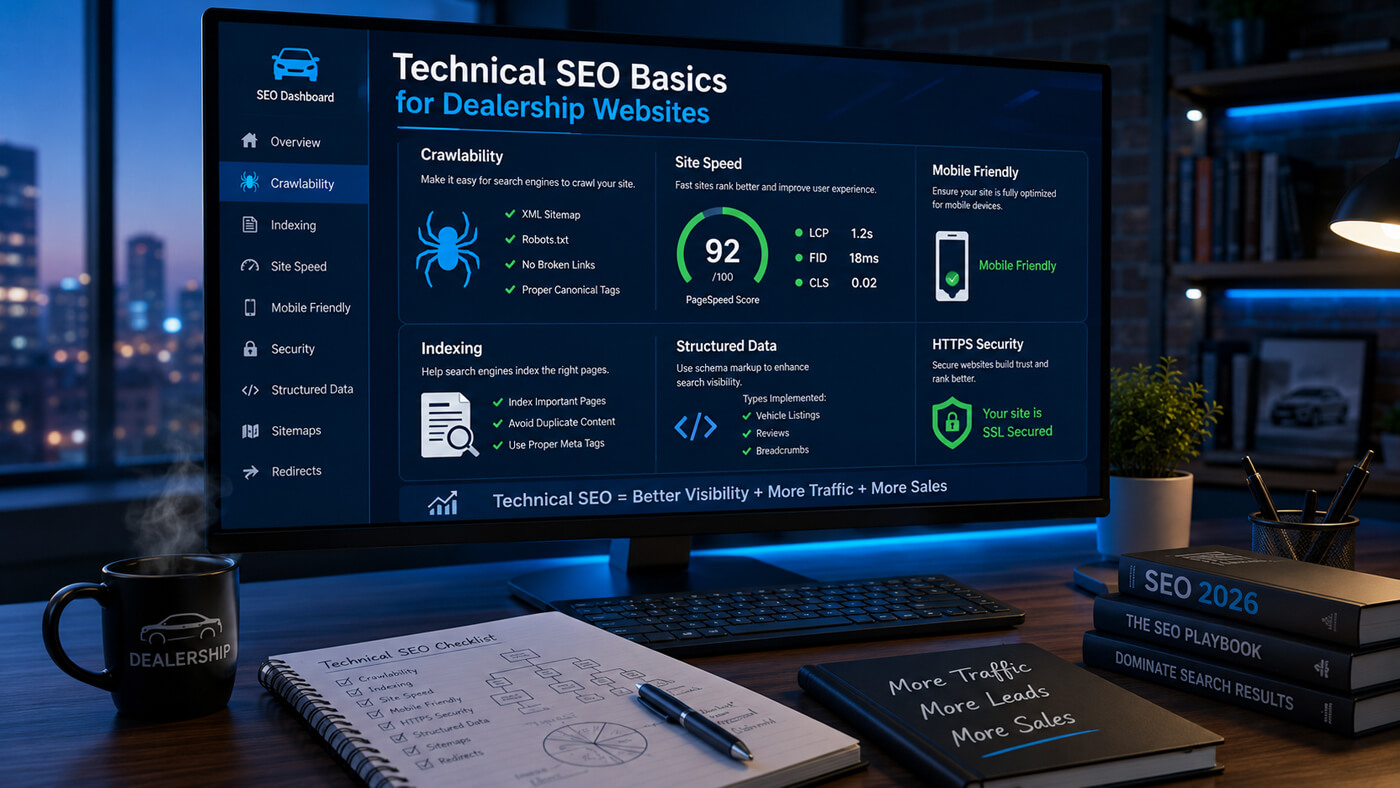
Dealership websites tend to be large, with hundreds or thousands of inventory pages, which makes technical SEO fundamentals matter more than they would for a smaller local business site. Site speed and Core Web Vitals — Google’s metrics for loading speed, interactivity, and visual stability — affect both rankings and how likely a shopper is to stay on a slow-loading page instead of bouncing to a competitor.
Mobile optimization matters particularly here: mobile devices account for roughly 68.5% of all automotive website traffic as of 2026, compared to around 28% for desktop [Click-Vision]. A dealership site that loads slowly or displays awkwardly on mobile loses shoppers to competitors before SEO rankings even become the deciding factor. It’s also worth noting that mobile conversion rates on automotive sites tend to lag behind desktop [Click-Vision] — which suggests mobile traffic and mobile conversion are different problems, and a fast-loading, easy-to-navigate mobile VDP matters as much for turning visits into leads as it does for ranking in the first place.
Keyword Research for Car Dealers
Keyword research for a dealership generally falls into a few practical buckets: model-specific terms (“2024 Toyota Camry for sale”), local-intent terms (“car dealership near me,” “[brand] dealer in [city]”), condition-and-price terms (“used trucks under $20k”), and comparison or research terms (“best family SUVs 2026”). Combining model and location tends to produce the clearest match between what a shopper is searching and what a specific VDP or category page offers.
Google Search Console — a free tool showing which search terms already bring traffic to a site — is worth checking regularly, since it often reveals which model or category pages are already gaining traction organically and where content gaps exist. Pairing it with Google Analytics helps close the loop: Search Console shows which keywords bring people to the site, while Analytics shows what those visitors actually do once they arrive — whether they view multiple vehicle pages, fill out a contact form, or leave quickly. Looking at both together makes it easier to tell whether a keyword is bringing in genuinely interested shoppers or just traffic that doesn’t convert.
SEO for Multi-Location Dealership Groups
A dealership group with several locations faces added complexity that single-location guides usually skip over entirely. Each location typically needs its own local landing page, its own Google Business Profile, and consistent NAP information specific to that address, rather than one generic “contact us” page trying to represent multiple physical locations. Getting this structure wrong — for example, using one page to represent several locations, or letting one location’s Google Business Profile list an incorrect address inherited from a template — tends to dilute local search visibility for all of them rather than strengthening any single one.
Inventory presents an added wrinkle for groups: if the same vehicle model is listed across multiple location pages with near-identical descriptions, that’s a smaller-scale version of the duplicate-content problem covered earlier, just happening within one dealership group’s own site instead of across competitors. Distinct, location-specific inventory pages, and location-specific content around each dealership’s community and staff, help each location build its own local relevance rather than competing against sibling locations for the same rankings.
Cost, Timeline, and Getting Started
SEO costs for dealerships vary significantly depending on inventory size, number of locations, and how competitive the local market is, and any specific dollar figure should be treated as a rough industry range rather than a guarantee, since pricing structures differ widely between agencies and in-house approaches. Realistically, meaningful organic ranking improvements take several months to materialize, not weeks — SEO compounds over time rather than producing an immediate spike the way a paid ad campaign does.
A practical starting point for a small or mid-size dealership: audit whether AutoDealer schema and Google Business Profile are set up correctly first, since these are foundational and relatively low-cost to fix, before investing heavily in content or link-building efforts that take longer to pay off.
Frequently Asked Questions
Is SEO worth it for a small car dealership?
Generally yes, particularly for local and branded searches where large listing platforms don’t have as strong a foothold. It won’t replace paid advertising or third-party listings entirely, but it builds visibility that doesn’t disappear when ad spend stops.
How much does SEO cost for a car dealership?
It varies widely by dealership size, location competitiveness, and whether the work is done in-house or through an agency. There’s no single reliable industry-wide figure, so it’s worth getting quotes specific to your market rather than relying on a general benchmark.
How long does it take to see SEO results for a dealership?
Typically several months for meaningful ranking movement, since organic search authority builds gradually rather than instantly. Foundational fixes like schema markup and Google Business Profile accuracy can show local visibility improvements sooner than competitive keyword rankings do.
Can a small dealership realistically compete with Cars.com or AutoTrader in search results?
For broad, highly competitive terms, it’s difficult. Small dealerships tend to have better luck focusing on local “near me” searches, branded terms, and specific inventory combinations rather than trying to outrank listing platforms on generic model searches.
What’s the difference between SEO and Google Ads for a dealership?
Google Ads buys immediate visibility that stops when spending stops. SEO builds organic visibility over time at no per-click cost, but takes longer to show results. Most dealerships benefit from using both together.
What happens to my SEO when a vehicle listing gets sold and removed?
The individual page’s ranking value is largely lost, which is why relying solely on VDPs for SEO is risky. Internal linking to similar in-stock vehicles and building evergreen content that isn’t tied to specific inventory helps offset this turnover.
Does having listings on third-party sites hurt or help my own website’s SEO?
This is genuinely debated in the industry rather than settled — third-party listings can help overall visibility and lead generation, but they don’t build authority for your own website, and there’s no clear consensus on whether syndicated listings have any direct effect on your site’s own rankings.
Read This Blog: https://linkneon.com/semantic-seo-beginners-guide-2026/
Conclusion
Dealership SEO isn’t generic local-business SEO with a car theme — the constant inventory turnover, the competition from major listing platforms, and the reputation-driven click decisions make it its own discipline. The dealerships that get real value from it tend to treat their vehicle listings, local search presence, and evergreen content as three connected pieces rather than relying entirely on inventory pages that vanish the moment a car sells.
A practical next step: start with a technical audit of your current Google Business Profile accuracy and whether AutoDealer schema exists on your homepage at all. Both are foundational, relatively inexpensive to fix, and give you a clear, honest baseline before deciding how much further to invest in ongoing SEO work.