


Marketers increasingly get asked to justify SEO the same way they justify a paid ad campaign, with numbers, attribution, and a clear cost-per-result. That is where SEO performance marketing comes in, treating organic search not as a separate, hard-to-measure discipline, but as a channel held to the same accountability standards as paid media. The catch is that SEO and traditional performance marketing do not actually work the same way underneath, and pretending they do leads to bad expectations and worse strategy decisions.
This guide covers the topic from two angles that usually get treated separately but should not be: how to measure and report on SEO the way a performance marketer would, and how to actually blend SEO with paid channels into one coordinated strategy. It also addresses something most guides gloss over — whether SEO technically qualifies as performance marketing at all.
What Is SEO Performance Marketing?
Performance marketing, in its strict original sense, refers to advertising where you pay only for a specific measurable outcome — a click, a lead, a sale — rather than paying for exposure regardless of result [YoungUrbanProject]. By that strict definition, SEO does not technically qualify: you cannot pay Google for a specific ranking position, and there is no direct pay-per-outcome mechanism the way there is with a paid campaign [EMB Global]. This is exactly why the phrase sparks genuine debate among practitioners.
That said, a growing number of marketers argue that SEO belongs inside the performance marketing conversation anyway, because its data-driven approach matches the accountability mindset performance marketing expects [TheVibrantBranding]. In practice, SEO performance marketing usually means one of two things: applying performance marketing measurement discipline to SEO work, or running SEO and paid performance channels together as one coordinated strategy. This guide treats both as legitimate parts of SEO performance marketing and covers each in turn.
SEO vs. Performance Marketing: The Core Differences
Before blending the two, it helps to be clear on what actually separates them, since conflating them is where a lot of strategy mistakes start.
| Factor | SEO | Performance Marketing |
| Payment model | No direct pay-per-result | Pay per click, lead, or conversion |
| Time to results | Months, gradual | Hours to days, immediate |
| Control over placement | Indirect, ranking is earned | Direct, bid-based placement |
| Cost trajectory | Front-loaded effort, low marginal cost later | Ongoing cost tied to volume |
| Typical channels | Organic search, content | Google Ads, Meta Ads, SEM, affiliate |
SEO is a long-term strategy that aims to improve a website’s organic visibility, while performance marketing is a more immediate approach built around paid, trackable actions [LinkedIn/Mahika Arora]. Neither is inherently better — they solve different problems on different timelines. A business launching a time-sensitive promotion needs the immediacy of paid; a business building durable, compounding visibility over years needs SEO’s patience. Most mature marketing organizations eventually need both.
Applying Performance Marketing Discipline to SEO
The core of performance marketing thinking is treating every marketing dollar as accountable to a measurable outcome. Applying that discipline means moving past vanity metrics — rankings and raw traffic — toward the metrics that actually connect to business results.
SEO KPIs That Actually Matter
A performance-minded approach to SEO tracks metrics that mirror how a paid campaign would be evaluated:
- Organic conversion rate — leads or sales attributed to organic search, not just sessions.
- Cost per acquisition — once SEO labor and content costs are factored in.
- Attributed revenue or leads — tied to organic search, not just raw traffic.
- Ranking position — still matters, but only as a leading indicator, not the goal itself.
A page ranking first for a keyword nobody converts on is not a performance win, it is a vanity metric dressed up as one. Cost per acquisition for SEO is genuinely harder to calculate than for paid media, since content and technical work are sunk costs that pay off over an extended period, but that difficulty is not a reason to skip the calculation entirely.
Attribution: SEO Performance Marketing’s Hardest Problem
Attribution is where SEO performance marketing gets genuinely difficult, because organic search rarely closes a sale on the first visit the way a well-targeted ad sometimes can. A common buyer path involves an organic search visit, a return via direct traffic days later, and a conversion that a last-click attribution model would credit entirely to that final direct visit, erasing SEO’s actual contribution to the sale. Multi-touch attribution models, which distribute credit across every touchpoint in a customer’s journey, give a more honest picture of SEO’s real contribution, though they are more complex to configure and interpret.
Google Analytics and Google Search Console together form the practical measurement foundation here: Search Console shows which queries and pages are driving organic visibility, while Analytics shows what happens after that visit — whether it converts, on what timeline, and through what path. Neither tool alone tells the full story.
Blending SEO and Paid Search Strategy
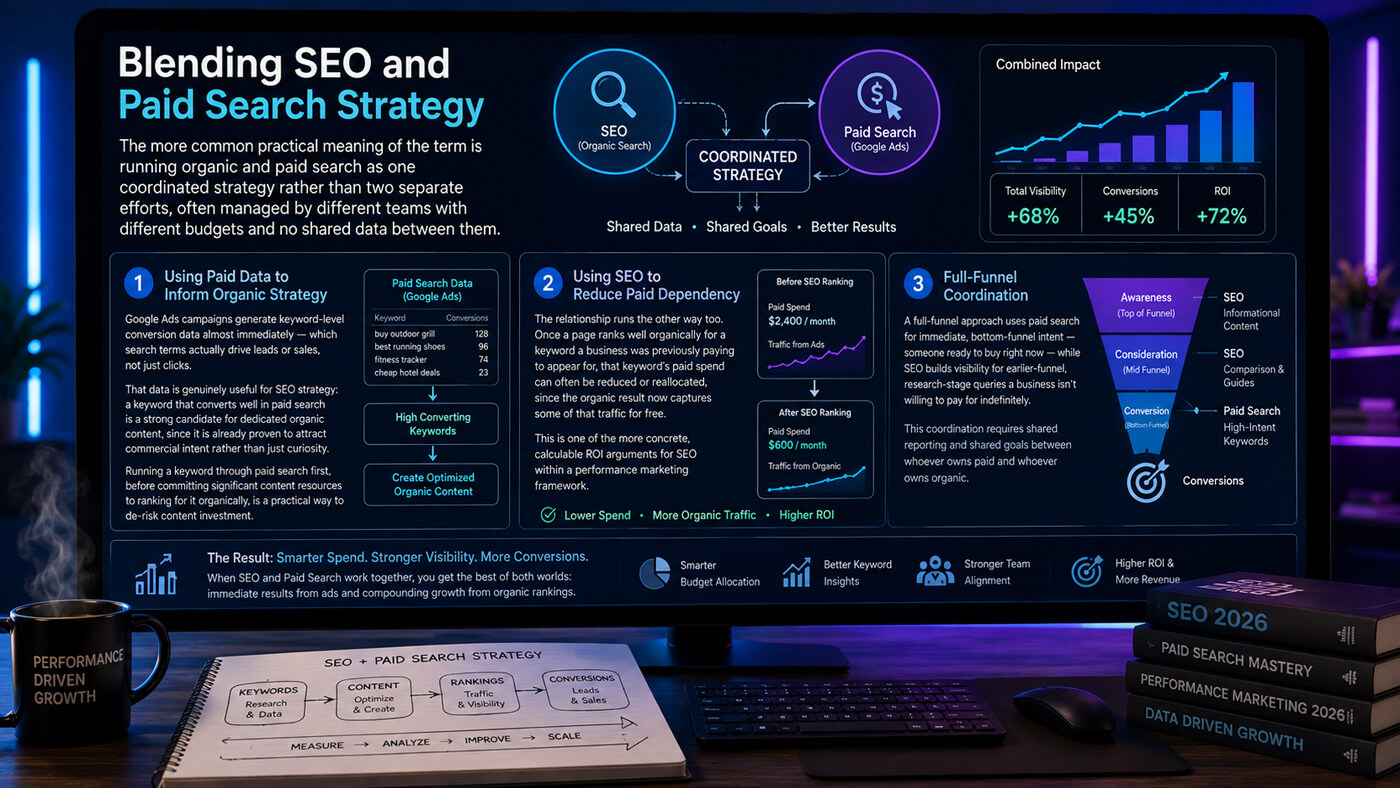
The more common practical meaning of the term is running organic and paid search as one coordinated strategy rather than two separate efforts, often managed by different teams with different budgets and no shared data between them.
Using Paid Data to Inform Organic Strategy
Google Ads campaigns generate keyword-level conversion data almost immediately — which search terms actually drive leads or sales, not just clicks. That data is genuinely useful for SEO strategy: a keyword that converts well in paid search is a strong candidate for dedicated organic content, since it is already proven to attract commercial intent rather than just curiosity. Running a keyword through paid search first, before committing significant content resources to ranking for it organically, is a practical way to de-risk content investment.
Using SEO to Reduce Paid Dependency
The relationship runs the other way too. Once a page ranks well organically for a keyword a business was previously paying to appear for, that keyword’s paid spend can often be reduced or reallocated, since the organic result now captures some of that traffic for free. This is one of the more concrete, calculable ROI arguments for SEO within a performance marketing framework.
Full-Funnel Coordination
A full-funnel approach uses paid search for immediate, bottom-funnel intent — someone ready to buy right now — while SEO builds visibility for earlier-funnel, research-stage queries a business isn’t willing to pay for indefinitely. This coordination requires shared reporting and shared goals between whoever owns paid and whoever owns organic.
Technical SEO’s Role in Performance Marketing
Core Web Vitals and page speed matter to this discipline for a very direct reason: a slow-loading landing page hurts conversion rate regardless of whether the traffic arriving on it is organic or paid. A performance marketer optimizing a paid landing page for conversion rate and an SEO specialist optimizing the same page for Core Web Vitals are often solving overlapping problems, even if they don’t coordinate their work.
On-page SEO — clear titles, structured content, fast load times — also benefits paid campaigns indirectly through Google Ads’ Quality Score, which factors in landing page relevance and experience. A well-optimized page can lower paid cost-per-click at the same time it improves organic ranking potential.
Content Strategy for SEO Performance Marketing
Content built with this mindset starts from conversion rate optimization principles rather than purely from keyword volume. A page can rank well and still underperform if it doesn’t guide the visitor toward a clear action — the same scrutiny a performance marketer applies to an ad landing page should apply to a high-traffic organic page.
This also means prioritizing content around keywords with demonstrated commercial intent, informed by paid search data, over purely high-volume, low-intent terms that generate traffic without generating results.
Reporting SEO Like a Performance Channel
Performance marketing culture expects regular, clear reporting tied to business outcomes — something SEO has historically been weaker at, partly because of the attribution difficulty already discussed. Building an SEO reporting cadence that mirrors paid reporting makes it far easier for SEO to hold its place in budget conversations.
Tools like Google Looker Studio can pull data from both Search Console and paid platforms into a single dashboard, which supports the kind of side-by-side, channel-agnostic reporting this discipline needs.
Common SEO Performance Marketing Mistakes
A team new to this approach commonly makes a few avoidable mistakes:
- Treating ranking position as the only success metric.
- Applying last-click attribution and concluding SEO doesn’t work.
- Running SEO and paid as fully separate budgets with no data sharing between them.
Each of these undermines the case for treating this as a coherent strategy.
Tools for SEO Performance Marketing
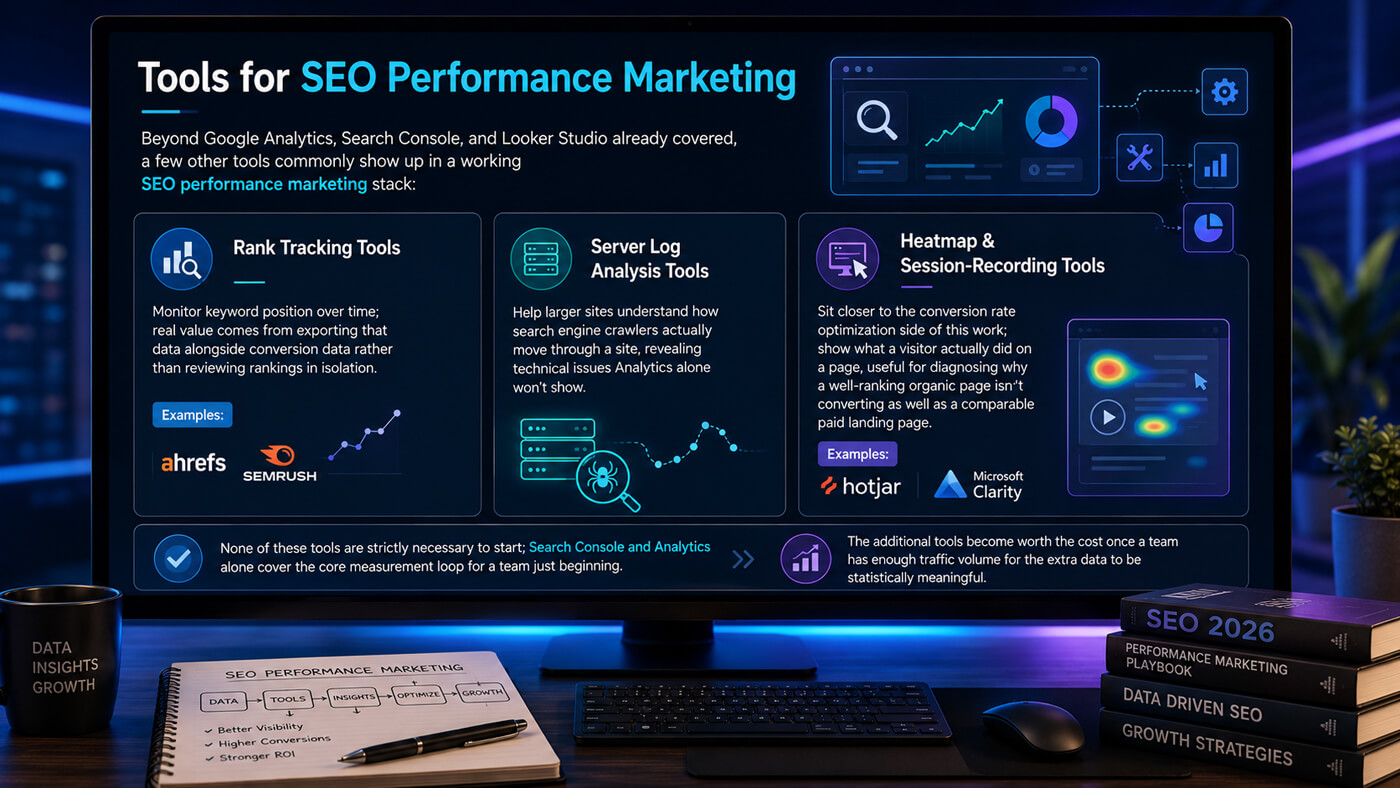
Beyond Google Analytics, Search Console, and Looker Studio already covered, a few other tools commonly show up in a working SEO performance marketing stack:
- Rank tracking tools — monitor keyword position over time; real value comes from exporting that data alongside conversion data rather than reviewing rankings in isolation.
◦ Examples: Ahrefs, SEMrush
- Server log analysis tools — help larger sites understand how search engine crawlers actually move through a site, revealing technical issues Analytics alone won’t show.
- Heatmap and session-recording tools — sit closer to the conversion rate optimization side of this work; show what a visitor actually did on a page, useful for diagnosing why a well-ranking organic page isn’t converting as well as a comparable paid landing page.
◦ Examples: Hotjar, Microsoft Clarity
None of these tools are strictly necessary to start; Search Console and Analytics alone cover the core measurement loop for a team just beginning. The additional tools become worth the cost once a team has enough traffic volume for the extra data to be statistically meaningful.
Building the Business Case for Leadership
SEO’s slower timeline and harder attribution make it a genuinely difficult sell in a budget conversation dominated by channels that report same-day results. The strongest business case usually isn’t “SEO will outperform paid” — for many businesses it won’t, on a pure short-term ROI basis — but rather that SEO’s marginal cost drops over time in a way paid spend never does. A paid campaign generating 1,000 clicks costs roughly the same per click on day one and day one thousand. An organic page that took real effort to build and rank continues generating traffic at close to zero marginal cost once it’s ranking, which changes the long-run economics even if the short-run economics favor paid.
Presenting this honestly to leadership means being upfront about the timeline mismatch: a paid campaign can be evaluated and adjusted within days, while an SEO investment often needs a full quarter or more before there’s enough data to judge whether it’s working. Framing SEO spend as a longer-duration investment with a different risk profile tends to hold up better than overselling early results.
Frequently Asked Questions
Is SEO actually considered performance marketing?
Strictly, no — traditional performance marketing is defined by pay-per-outcome pricing, which SEO doesn’t have. In practice, many marketers use the term more loosely, to mean applying performance marketing’s measurement rigor to SEO.
How do you measure SEO performance the way you’d measure a paid campaign?
By tracking conversion rate, cost per acquisition, and attributed revenue or leads — not just rankings and raw traffic. Multi-touch attribution gives a more accurate picture than last-click models within an SEO performance marketing setup.
Should SEO and paid search be managed by the same team?
Not necessarily the same team, but they should share data and goals. Paid search keyword-level conversion data is genuinely useful for prioritizing SEO content, and strong organic rankings can reduce paid spend on the same keywords.
How much does SEO performance marketing cost?
It varies by scope — SEO content and technical work, paid campaign spend, and any reporting or attribution tooling all factor in differently by business size and market.
How long does it take to see performance results from SEO?
SEO itself typically takes months to show meaningful ranking movement, even when measured with performance marketing rigor. Using paid search to validate keyword intent first can shorten the feedback loop.
Can SEO’s ROI really be measured with confidence?
With the right attribution setup, SEO’s contribution can be measured with reasonable confidence, though rarely with the same precision as a single-click paid conversion. This is a genuine limitation of SEO performance marketing measurement, not a solved problem.
Read This Blog: https://linkneon.com/seo-company-oxford-guide/
Conclusion
SEO performance marketing is not really one discipline — it is the intersection of two things that don’t naturally overlap: SEO’s slow, indirect, hard-to-attribute nature, and performance marketing’s demand for immediate, measurable accountability. The realistic path forward is not forcing SEO into performance marketing’s strict definition, but borrowing its measurement discipline and its willingness to share data across channels.
A practical next step for any team pursuing SEO performance marketing: pull last quarter’s Google Ads keyword-level conversion data and cross-reference it against the current SEO content plan.