


Every SEO company in Oxford sounds the same on a sales call. They all promise results, all show impressive case studies, and all describe themselves as different from the agencies that give this industry a bad name. This guide covers what actually separates a legitimate SEO company in Oxford from one that will waste your budget: how to evaluate a provider, what questions genuinely reveal expertise versus sales talk, and the red flags that should end a conversation immediately.
Choosing an SEO company is harder than choosing most other vendors because the buyer usually can’t judge the work directly. You wouldn’t know good technical SEO from mediocre technical SEO by looking at it, which is exactly why some agencies get away with charging real money for very little actual work.
What Does an SEO Company Actually Do?
An SEO company in Oxford, like any SEO provider, optimizes a website so it ranks higher in unpaid, organic search results, typically through some combination of technical fixes (site speed, crawlability, structured data), content strategy, and off-page work like earning backlinks from other credible websites. A legitimate provider, in Oxford or any market, should be able to explain each of these pillars clearly without hiding behind jargon.
The confusion for most buyers starts because “SEO” gets used as a catch-all term covering very different scopes of work. One SEO company might mean a comprehensive strategy touching technical infrastructure, content, and links. Another might mean a narrow monthly service that only submits your site to a few directories. Both get sold under the same three-letter label, which is part of why evaluating one requires more than reading their homepage or trusting their self-description.
Why Choosing the Wrong SEO Company Is Costly
The cost of picking the wrong provider isn’t just wasted monthly fees, though that adds up quickly over a multi-month engagement. Low-quality providers sometimes use tactics — spammy backlinks, keyword stuffing, cloaking — that violate Google’s Search Essentials guidelines and can trigger manual penalties, which are considerably harder and slower to recover from than simply not ranking well in the first place [Ggeeks.org].
There’s also an opportunity cost. Every month spent with an SEO company that isn’t producing real progress is a month a business could have spent building genuine visibility instead. Because SEO results compound slowly, a bad six-month engagement doesn’t just fail to help, it actively delays when real results could have started.
SEO Company in Oxford vs. Freelancer vs. In-House
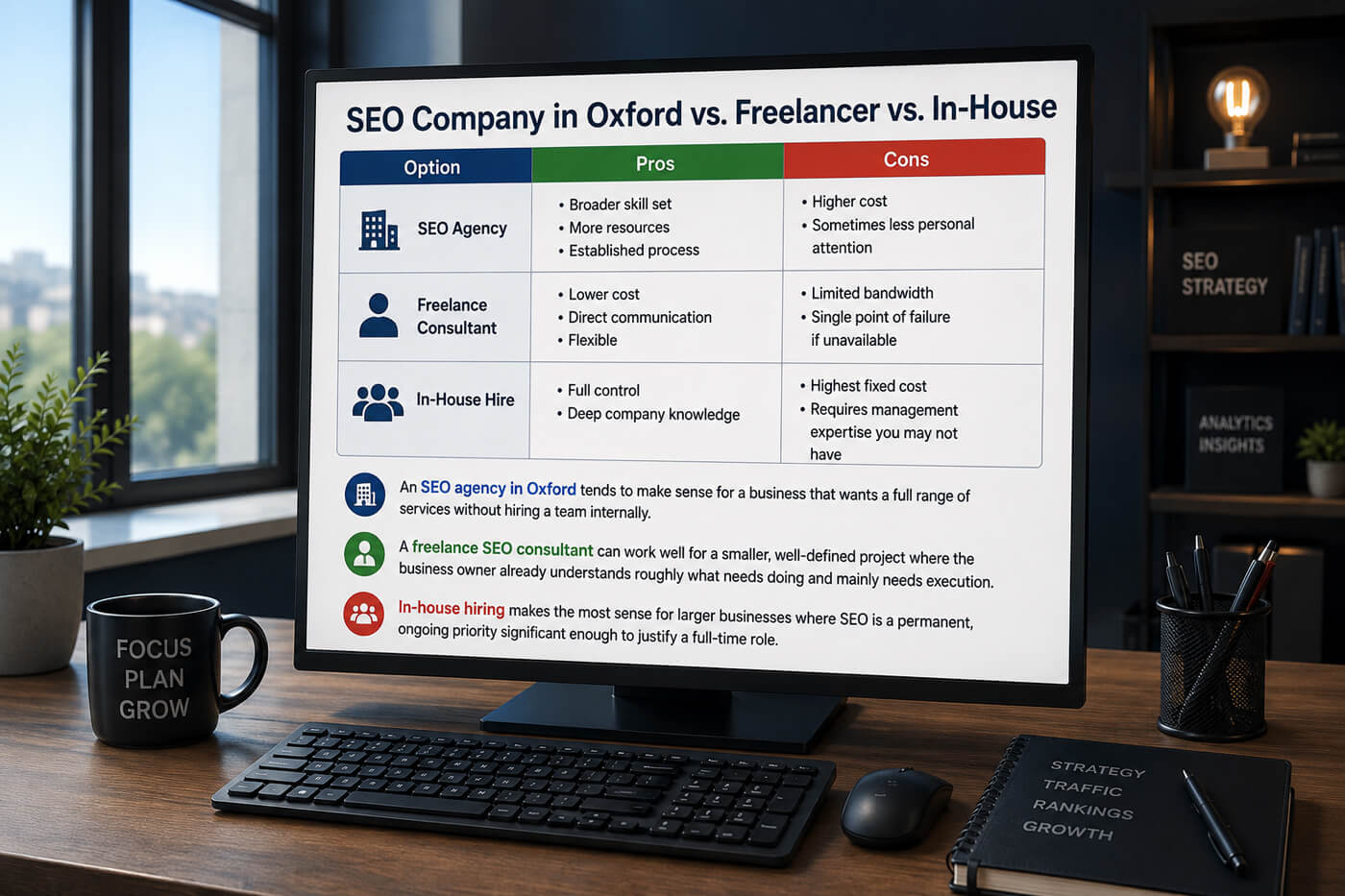
| Option | Pros | Cons |
| SEO Agency | Broader skill set, more resources, established process | Higher cost, sometimes less personal attention |
| Freelance Consultant | Lower cost, direct communication, flexible | Limited bandwidth, single point of failure if unavailable |
| In-House Hire | Full control, deep company knowledge | Highest fixed cost, requires management expertise you may not have |
An SEO agency in Oxford tends to make sense for a business that wants a full range of services without hiring a team internally. A freelance SEO consultant can work well for a smaller, well-defined project where the business owner already understands roughly what needs doing and mainly needs execution. In-house hiring makes the most sense for larger businesses where SEO is a permanent, ongoing priority significant enough to justify a full-time role.
Questions to Ask Before Hiring an SEO Company
A short list of direct questions filters out a surprising number of unqualified providers quickly:
- What specific deliverables will I receive each month, and on what schedule?
- Can you walk me through a past project in detail, including what didn’t work?
- Will I have direct access to my own Google Search Console and Analytics data?
- What’s your process when an update from Google affects my rankings?
- Who on your team will actually be doing the work, versus overseeing it?
A legitimate provider should answer all of these without hesitation or vague deflection. Agencies that get evasive about who does the actual work, or that can’t describe a past project’s specifics beyond “we got great results,” are signaling something worth taking seriously.
Red Flags to Watch For
Some warning signs are close to universal red flags in this industry, not just cautionary notes.
Guaranteed rankings. This is the clearest, most reliable disqualifier available to a buyer. Google’s own guidance on hiring an SEO explicitly states that no one can guarantee a #1 ranking on Google, and specifically warns businesses to be wary of SEOs that claim to guarantee rankings or allege a special relationship with the company [OuterBox Design]. When a sales pitch directly contradicts what Google itself publishes, that’s not a minor inconsistency, it’s a structural warning sign.
Rankings for meaningless keywords. A related tactic: an agency delivers a “guaranteed” top ranking, but for a keyword phrase so obscure or low-volume that ranking for it generates essentially no traffic or business value [DASH-SEO]. Technically the promise gets fulfilled; practically, nothing changes for the business.
Locked-out reporting. If an agency won’t give you direct access to your own Search Console and Analytics data, and instead only shares curated screenshots or a branded dashboard they control, that’s worth questioning. Legitimate agencies generally have no reason to keep a client locked out of their own performance data.
Vague or missing process explanations. An agency that can’t explain, in plain language, what it’s actually doing to your website each month, is either inexperienced or deliberately obscuring low-effort work behind SEO terminology.
How SEO Pricing Works

SEO companies generally price their services one of three ways, and each model shapes incentives differently.
| Pricing Model | How It Works | What It Incentivizes |
| Monthly Retainer | Fixed fee for ongoing work | Consistent, long-term effort; least tied to short-term wins |
| Project-Based | One-time fee for defined scope | Efficient completion of a specific task, less ongoing relationship |
| Performance-Based | Payment tied to rankings/traffic milestones | Can incentivize chasing easy, low-value keywords over meaningful ones |
What Pricing Model Incentivizes
Performance-based pricing sounds appealing on the surface, since payment is tied to results. In practice, it can push an agency toward the same meaningless-keyword problem described in the red flags section, since hitting an easy ranking target technically satisfies the payment trigger without necessarily helping the business. A monthly retainer, while it requires more trust upfront, tends to align incentives toward sustained, genuine improvement rather than gaming a specific metric.
There’s no reliable single industry figure for what this kind of work should cost, since pricing varies enormously by market competitiveness, business size, and scope of work — a business should treat any quoted range as a starting point for comparison shopping rather than a fixed benchmark.
Realistic Timeline Expectations
For most websites hiring an SEO company in Oxford or elsewhere, meaningful ranking improvements typically appear within four to twelve months of consistent, quality-focused SEO work [Ggeeks.org]. This is one of the most important expectations to set before hiring, because it’s also one of the most commonly violated promises in the industry — any agency promising significant results within days or a couple of weeks is very likely relying on the same red-flag tactics already discussed.
Evaluating Case Studies and Past Results
A case study showing a traffic graph trending upward, on its own, proves very little. Traffic and rankings can rise for reasons unrelated to an agency’s work, and a graph alone doesn’t show whether that traffic translated into actual leads or revenue for the business. A stronger case study explains the starting situation, the specific changes made, and connects those changes to a business outcome, not just a vanity metric.
Asking a prospective provider to walk through the reasoning behind a past project, not just the results, reveals far more about their actual expertise than reviewing a polished results screenshot ever will, and any serious agency should welcome that level of scrutiny.
Local vs. National SEO Services
Local SEO focuses on visibility for geographically specific searches, optimizing a Google Business Profile, building local citations, and targeting “near me” or city-specific search terms. National SEO focuses on broader visibility across a wider market without the geographic narrowing.
A business serving customers primarily in one area benefits more from an SEO company that genuinely understands local SEO tactics, rather than a generalist agency treating every client identically regardless of whether the business serves a single neighborhood or an entire country.
Reporting and Transparency: What You Should Get Access To

At minimum, a legitimate SEO company should provide regular reporting that explains what was done, why, and what changed as a result, not just a dashboard of numbers with no narrative. Direct access to Google Search Console and Google Analytics, rather than agency-controlled summaries alone, lets a business verify progress independently instead of relying entirely on the agency’s own reporting.
Common Mistakes When Hiring an SEO Company in Oxford
A few patterns show up repeatedly among buyers who end up disappointed with their choice of provider. The first is choosing based on price alone, without weighing what a suspiciously low quote likely means about the depth of work being done. The second is skipping the reference-check step entirely, taking case studies at face value rather than asking a past or current client directly about their actual experience.
A third common mistake is failing to clarify ownership of assets and access before signing. If a business doesn’t retain control of its own Google Search Console property, its content, or its backlink profile documentation, switching away from an underperforming provider later becomes far harder than it needs to be. Clarifying this upfront, before any work begins, protects a business regardless of how the relationship eventually unfolds.
A fourth mistake is treating the first month’s results as a verdict on the entire engagement. Because SEO compounds slowly, judging any provider after only a few weeks tends to produce misleading conclusions in either direction — too early to see genuine wins, but also too early to fairly conclude the work isn’t going anywhere.
Starting the Relationship With an SEO Company in Oxford
Many businesses find it useful to structure an initial engagement with a new provider as a short, defined trial or audit period rather than jumping straight into a long-term contract. A one-to-two-month initial audit, with clearly defined deliverables and a written summary of findings, lets both sides evaluate fit before committing to a longer retainer.
During this period, a reasonable expectation from any provider includes a full technical audit of the existing site, a competitive analysis showing where the business currently stands relative to competitors, and a documented strategy for the following months, not yet the ranking results themselves, which take longer to materialize. A provider that resists this structure, insisting instead on an immediate long-term commitment with no defined early checkpoint, is worth questioning on that basis alone.
What “Good SEO” Actually Looks Like Day to Day
It helps to have a concrete picture of what legitimate ongoing work looks like, since the term “SEO” covers such a wide range of actual activity. In a typical month, a competent provider might fix technical issues flagged in a site audit — broken internal links, slow-loading pages, missing structured data — while also publishing or updating content targeting specific, researched keywords, and pursuing a handful of genuine backlink opportunities from relevant, credible sites rather than bulk-purchased links from low-quality directories.
None of this looks dramatic from the outside. There’s no single moment where rankings jump overnight, which is precisely why the earlier point about guaranteed rankings matters so much — the actual mechanics of durable SEO work are gradual and somewhat unglamorous, which is also why sales pitches promising fast, dramatic results are worth treating with suspicion rather than excitement. A business owner evaluating monthly reports should expect to see specific, itemized activity — which pages were touched, which technical issues were resolved, which content was published — rather than a summary paragraph and a chart with no explanation behind it.
Frequently Asked Questions
How much should I expect to pay for SEO services?
It varies significantly by market competitiveness, business size, and scope of work. There’s no single reliable industry-wide figure, so it’s worth comparing multiple quotes specific to your situation rather than anchoring to a general benchmark.
How long does it take to see results from SEO?
Meaningful ranking improvements for competitive keywords typically take four to twelve months of consistent work. Any agency promising significant results within days or weeks should be treated with real skepticism.
Is it better to hire an SEO agency or a freelancer?
It depends on scope. An agency suits businesses wanting a full range of services without building an internal team; a freelancer can work well for a smaller, well-defined project where budget is tighter.
Can an SEO company guarantee first-page rankings?
No legitimate company can. Google’s own guidance explicitly warns against agencies that make this claim, since no third party controls Google’s ranking algorithm.
What’s the difference between local and national SEO services?
Local SEO targets geographically specific searches and Google Business Profile visibility; national SEO targets broader visibility without geographic narrowing. The right choice depends on whether your customer base is local or widespread.
What should be included in an SEO contract?
Clear deliverables, reporting cadence, who retains access to your Search Console and Analytics data, and what happens if the relationship ends — including whether any work product or access transfers back to you.
How do I know if an SEO company is using bad practices?
Ask directly about their link-building and content methods. Vague answers, or reluctance to explain specifics, is itself a warning sign, even before you can verify the tactics technically.
Should I ask for references or case studies before hiring?
Yes, and push past the surface numbers — ask what specifically was done and why, not just what the outcome was. This applies whether you’re comparing local providers or national ones side by side.
Read This Blog: https://linkneon.com/seo-for-architects/
Conclusion
Choosing the right provider, in Oxford or anywhere, comes down to the same core test: can this provider explain what they do, why it works, and show their reasoning, not just their results. Guaranteed rankings, locked reporting, and vague process explanations are the clearest signals something is wrong, while transparency, realistic timelines, and specific answers to direct questions are the clearest signals something is right.
A practical next step: before signing with any SEO company in Oxford, ask for direct access to your own Search Console during any trial or initial audit period. An agency’s willingness to grant that access, before you’ve committed to anything long-term, tells you more about their legitimacy than almost anything else on this list.