


Blockchain technology is a way of recording data in a shared distributed ledger that many computers hold at the same time. Each new batch of records, called a block, is sealed with cryptography and linked to the block before it, so quietly rewriting old data becomes extremely hard. No single bank or company has to run the system for it to work, hence the term decentralized.
This article explains blockchain technology from the ground up for readers who know Bitcoin’s name but not what sits underneath it. You’ll see how a transaction moves through the network, how consensus mechanisms keep everyone in agreement, the four network types, real uses, limits, and where US rules stand in 2026, plus a checklist to decide whether you need a blockchain at all.
What Is Blockchain Technology and Where Did It Come From?
Picture a notebook shared by thousands of people, where each page carries a fingerprint of the page before it. Rewrite page 40, and its fingerprint no longer matches what page 41 expects, so every other copy exposes the change.
Blockchain technology is one form of distributed ledger technology (DLT): a database copied and kept in sync across many independent computers instead of one company’s server.
The idea is older than crypto:
- 1991: Stuart Haber and W. Scott Stornetta described a cryptographically linked chain of timestamps for digital documents.
- 1993: Dave Bayer joined them on a paper that added Merkle trees to make the system more efficient.
- 2008: Satoshi Nakamoto published the Bitcoin whitepaper, combining those ideas with a peer-to-peer network to create digital cash.
- 2009: The Bitcoin network went live with its first block, the genesis block.
- 2015: Ethereum launched and made the chain programmable through smart contracts.
The Core Building Blocks: Blocks, Hashes, Nodes, and the Ledger
Every blockchain shares the same core parts:
| Component | What it is | Why it matters |
| Block | A bundle of transactions plus a header | Groups records in a fixed order |
| Cryptographic hash | A fixed-length “fingerprint” of data, produced by functions such as SHA-256 | Change one character and the whole hash changes |
| Previous-block hash | Each header stores the hash of the block before it | Links blocks into a chain, so tampering breaks the link |
| Timestamp | Records when the block was created | Shows the order of events |
| Merkle root | One hash that summarizes every transaction in the block | Lets nodes check a single transaction quickly |
| Nodes | Computers that keep a copy of the ledger and check the rules | Removes the single point of failure |
| Public and private keys | A key pair: the private key signs, the public key lets others verify | Proves ownership without a central login |
The word “immutable” is a little misleading. A blockchain is better described as tamper-evident: changing history would require redoing the work (or controlling the stake) behind every later block, and honest nodes would see the mismatch. In practice, blockchain technology makes cheating expensive and visible rather than physically impossible.
How a Transaction Gets Added to the Chain, Step by Step
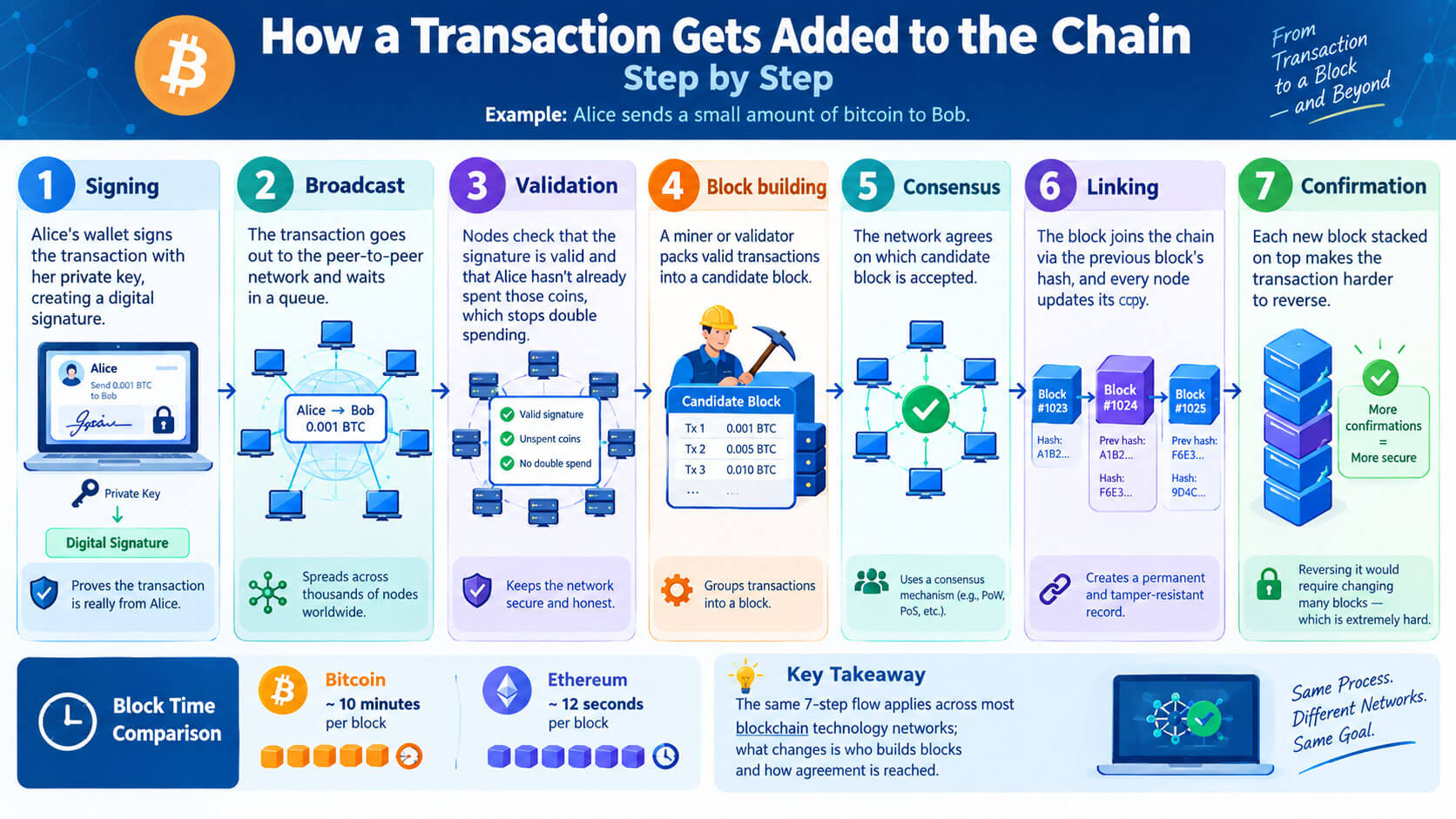
Example: Alice sends a small amount of bitcoin to Bob.
- Signing: Alice’s wallet signs the transaction with her private key, creating a digital signature.
- Broadcast: The transaction goes out to the peer-to-peer network and waits in a queue.
- Validation: Nodes check that the signature is valid and that Alice hasn’t already spent those coins, which stops double spending.
- Block building: A miner or validator packs valid transactions into a candidate block.
- Consensus: The network agrees on which candidate block is accepted.
- Linking: The block joins the chain via the previous block’s hash, and every node updates its copy.
- Confirmation: Each new block stacked on top makes the transaction harder to reverse.
Bitcoin’s design assumes a new block roughly every 10 minutes, while Ethereum produces blocks in 12-second slots. The same seven-step flow applies across most blockchain technology networks; what changes is who builds blocks and how agreement is reached.
Consensus Mechanisms: Proof of Work, Proof of Stake, and Others
A consensus mechanism answers a hard question: how do thousands of strangers agree on one version of the truth when some might lie? Computer scientists call this the Byzantine Generals Problem.
| Mechanism | How the next block is chosen | Energy use | Known example |
| Proof of Work (PoW) | Miners race to solve a puzzle using computing power | High | Bitcoin |
| Proof of Stake (PoS) | Validators lock up coins as collateral; cheaters can lose part of it (“slashing”) | Low | Ethereum since 2022 |
| Delegated Proof of Stake | Token holders vote for a small set of block producers | Low | Some public networks |
| Proof of Authority / Byzantine Fault Tolerance (BFT) | A known group of approved validators signs blocks | Low | Mostly private chains and test networks |
On September 15, 2022, Ethereum moved from PoW to PoS in an upgrade called “the Merge,” which the Ethereum Foundation estimates cut its energy use by about 99.95%.
PoW and PoS networks can both face a 51% attack, where one party controls most of the computing power or stake. On large networks, that attack is extremely costly; smaller chains are more exposed. Put simply, the larger and more spread out a blockchain technology network is, the harder it is to attack.
Four Types of Blockchain Networks
Not every blockchain is public. The right type depends on who reads, writes, and validates data.
| Type | Who can join | Who validates | Typical use | Example |
| Public blockchain | Anyone | Anyone (permissionless) | Cryptocurrency, DeFi, NFTs | Bitcoin, Ethereum |
| Private blockchain | Invited users only | One organization | Internal records, audit logs | A single company’s Hyperledger Fabric deployment |
| Consortium blockchain | Approved members | A group of organizations | Banking, trade finance, industry data sharing | Industry networks built on R3 Corda |
| Hybrid blockchain | Mixed | Private network, public verification | Keeping data private while proving it hasn’t changed | Private ledgers that post fingerprints (hashes) of their data to a public chain |
Private and consortium chains are also called permissioned blockchains. They trade some decentralization for speed, privacy, and control, which suits many enterprise blockchain projects. Hyperledger Fabric is now maintained under LF Decentralized Trust, the Linux Foundation group that took over the Hyperledger projects in 2024.
Blockchain vs. Traditional Database vs. Bitcoin
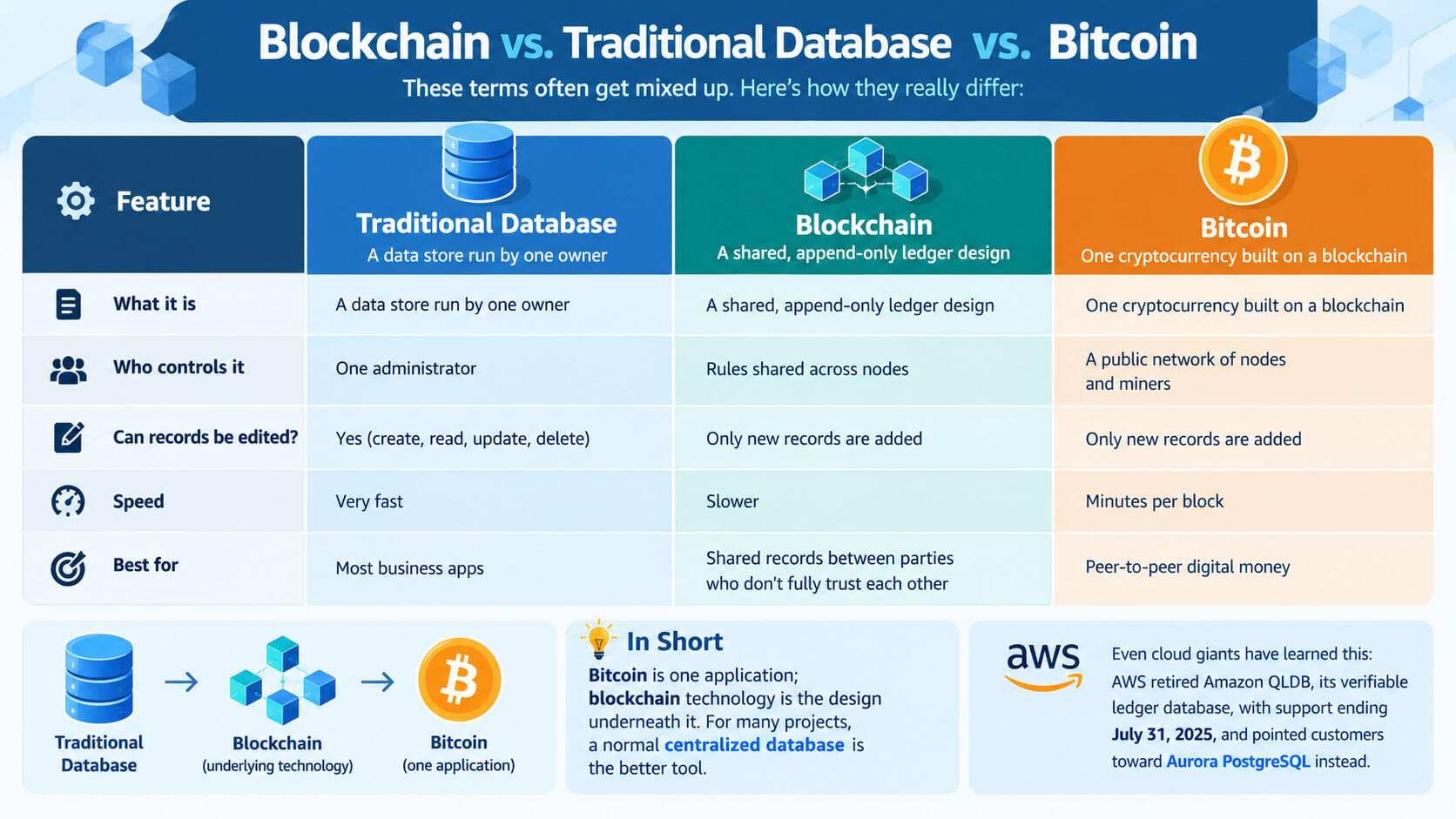
Even cloud giants have learned this: AWS retired Amazon QLDB, its verifiable ledger database, with support ending July 31, 2025, and pointed customers toward Aurora PostgreSQL instead.
These terms often get mixed up:
| Feature | Traditional database | Blockchain | Bitcoin |
| What it is | A data store run by one owner | A shared, append-only ledger design | One cryptocurrency built on a blockchain |
| Who controls it | One administrator | Rules shared across nodes | A public network of nodes and miners |
| Can records be edited? | Yes (create, read, update, delete) | Only new records are added | Only new records are added |
| Speed | Very fast | Slower | Minutes per block |
| Best for | Most business apps | Shared records between parties who don’t fully trust each other | Peer-to-peer digital money |
In short, Bitcoin is one application; blockchain technology is the design underneath it. For many projects, a normal centralized database is the better tool.
Even cloud giants have learned this: AWS retired Amazon QLDB, its verifiable ledger database, with support ending July 31, 2025, and pointed customers toward Aurora PostgreSQL instead.
Smart Contracts, Tokens, and Tokenization
A smart contract is a program stored on a blockchain that runs automatically when set conditions are met, such as “release payment when delivery is confirmed.” Ethereum developers typically write smart contracts in Solidity, a language with a large developer community, and apps built from them are called decentralized applications (dApps).
Smart contracts also create tokens, digital units that live on a chain:
- Fungible tokens: interchangeable units, like points or currency (the ERC-20 standard on Ethereum).
- Non-fungible tokens (NFTs): unique items, such as a ticket or a digital collectible (ERC-721).
- Stablecoins: tokens designed to hold a steady value, usually one US dollar.
- Tokenized real-world assets: bonds, fund shares, or property rights represented as tokens.
Deployed code is hard to change, so one bug can lock or expose funds, which is why smart contract audits are standard before launch.
Real-World Uses of Blockchain Technology by Industry
The strongest cases share a pattern: several parties need the same records, and none wants a rival in control.
| Industry | How it’s used | Example or status |
| Food supply chain | Tracing where a product came from | Walmart’s Hyperledger Fabric test cut mango trace-back time from about 7 days to 2.2 seconds |
| Banking and payments | Cross-border payments and asset tokenization | J.P. Morgan’s Kinexys reported $2B+ average daily volume in 2024 |
| Stablecoin payments | Dollar-backed tokens for fast transfers | Regulated at the federal level under the GENIUS Act |
| Decentralized finance (DeFi) | Lending and trading via smart contracts, not brokers | Ethereum-based protocols |
| Digital identity | Credentials a person controls and shares selectively | Reusable digital IDs |
| Healthcare | Securing patient records and automating insurance claims | Secure data sharing between providers |
| Real estate | Recording ownership rights and transaction histories | Property records kept on Ethereum |
| Energy | Peer-to-peer energy trading between producers and consumers | Pilot projects |
Not every pilot reaches production, so when you evaluate a blockchain technology vendor, ask for live deployments, not press releases.
Benefits That Hold Up in Practice
Where blockchain technology fits the problem, these benefits are real:
- Data integrity: Altered records stand out immediately, which suits audits and compliance.
- One shared source of truth: Partners stop reconciling separate records.
- Built-in audit trail: Every change is timestamped and traceable.
- Fewer intermediaries: Some settlement and transfer steps can skip middlemen.
- Round-the-clock operation: Public networks don’t keep business hours.
- Automation: Smart contracts execute agreed rules automatically.
Limitations and Risks You Should Know
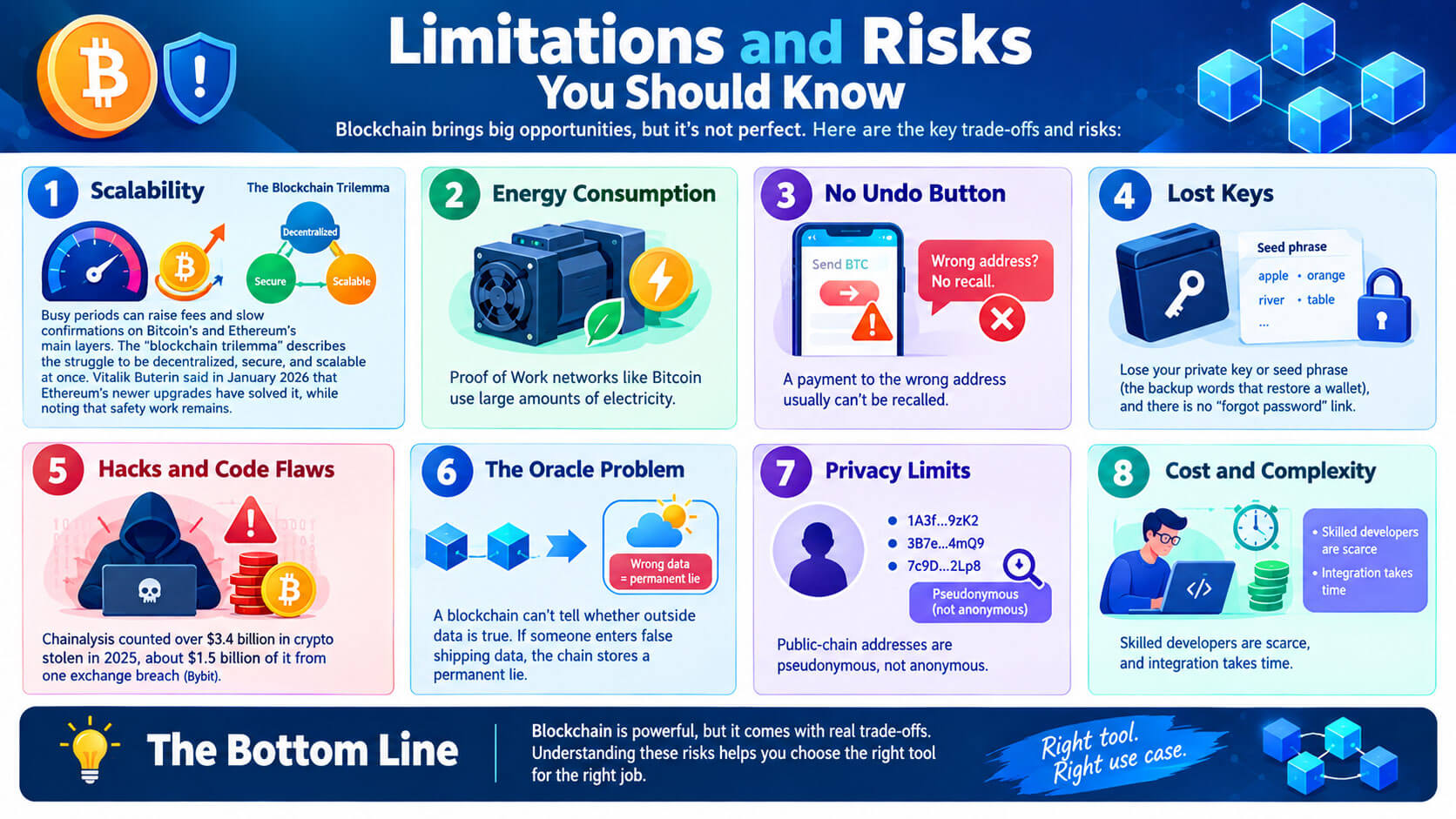
Every blockchain technology project also carries real trade-offs:
- Scalability: Busy periods can raise fees and slow confirmations on Bitcoin’s and Ethereum’s main layers. The “blockchain trilemma” describes the struggle to be decentralized, secure, and scalable at once; Vitalik Buterin said in January 2026 that Ethereum’s newer upgrades have solved it, while noting that safety work remains.
- Energy consumption: Proof of Work networks like Bitcoin use large amounts of electricity.
- No undo button: A payment to the wrong address usually can’t be recalled.
- Lost keys: Lose your private key or seed phrase (the backup words that restore a wallet), and there is no “forgot password” link.
- Hacks and code flaws: Chainalysis counted over $3.4 billion in crypto stolen in 2025, about $1.5 billion of it from one exchange breach (Bybit).
- The oracle problem: A blockchain can’t tell whether outside data is true. If someone enters false shipping data, the chain stores a permanent lie.
- Privacy limits: Public-chain addresses are pseudonymous, not anonymous.
- Cost and complexity: Skilled developers are scarce, and integration takes time.
Blockchain Regulation in the United States
Using blockchain technology is legal in the US; the rules target the assets and activities built on it. Here is where things stand as of late September 2026:
- GENIUS Act: Signed on July 18, 2025, it sets federal rules for payment stablecoins, including one-to-one backing with US dollars or other low-risk assets. Treasury, the Office of the Comptroller of the Currency (OCC), and the Federal Deposit Insurance Corporation (FDIC) have issued proposed rules to put it into practice.
- CLARITY Act (H.R. 3633): This market-structure bill would divide crypto oversight between the SEC and the CFTC. It passed the House 294–134 on July 17, 2025, but a Senate cloture vote (a procedural vote that needs 60 votes to move a bill forward) failed 49–50 on September 15, 2026, so it is not law.
- IRS reporting: Brokers must report digital asset sales to taxpayers and the IRS on the new Form 1099-DA, starting with 2025 transactions.
Rules are moving quickly, so confirm details with a qualified attorney or tax professional before acting.
Do You Actually Need a Blockchain? A Quick Checklist
A blockchain is worth considering when most of these are true:
- Several organizations need to write to the same records.
- They don’t fully trust each other or one central operator.
- A tamper-evident history has clear value (audits, provenance).
- Removing an intermediary would save real time or money.
A regular database is likely the better choice when:
- One organization owns and controls the data.
- You need to edit or delete records often, such as for privacy requests.
- Speed and cost matter more than shared trust.
If you land in the second list, Blockchain-as-a-Service (BaaS) won’t change that. Services such as Amazon Managed Blockchain, which supports Ethereum, Bitcoin, Polygon, and Hyperledger Fabric, make blockchain technology easier to run, not more necessary.
Where Blockchain Technology Is Heading
These trends are worth watching, though none guarantees an outcome:
- Layer 2 networks and rollups: They process transactions off the main chain and post results back, cutting fees.
- Zero-knowledge proofs: They prove a statement is true without revealing the underlying data.
- Stablecoins and tokenized assets: Banks and fund managers are testing on-chain settlement.
- Blockchain and AI: Proposals include tracking where AI training data came from.
- Post-quantum security: NIST finalized its first post-quantum encryption standards in August 2024, and blockchain developers are studying how to adopt them.
Frequently Asked Questions
Is blockchain the same as Bitcoin?
No. Bitcoin is a cryptocurrency and the first major use of a blockchain. Blockchain technology is the underlying record-keeping design, which also powers Ethereum, enterprise ledgers, and supply chain systems.
Can a blockchain be hacked?
Large public chains are very hard to rewrite, but exchanges, wallets, bridges (tools that move tokens between chains), and buggy smart contracts get hacked often. Most losses tied to blockchain technology come from those surrounding layers, not the chain itself.
Can data on a blockchain be changed or deleted?
Not in the normal sense. New entries can correct old ones, but the original stays, so storing personal data directly on a public chain is usually a bad idea.
Who controls a blockchain?
On public networks, no single party does; nodes, miners, or validators enforce the rules. On private and consortium chains, the owner or member group does.
Is blockchain legal in the United States?
Yes. US regulation targets activities built on blockchain technology, such as issuing stablecoins, trading crypto assets, and reporting taxes, not the technology itself.
How long does a blockchain transaction take?
It depends on the network. Bitcoin blocks take minutes, Ethereum blocks take seconds, and Layer 2 networks are often faster still.
Is blockchain bad for the environment?
It depends on the consensus mechanism. Proof of Work uses a lot of energy, while Proof of Stake uses far less, which is why Ethereum’s 2022 switch cut its footprint so sharply.
Read More: https://linkneon.com/latest-tech-trends/
Conclusion and Key Takeaways
Blockchain technology is best understood as a shared, tamper-evident record book: powerful when many parties need the same trusted history, and needless overhead when one organization controls the data.
- It links blocks with cryptographic hashes and keeps copies across many nodes.
- Consensus mechanisms such as Proof of Work and Proof of Stake replace a central referee.
- Documented wins exist in supply chains and bank settlement, but some projects never move past testing.
- US rules now cover stablecoins, while broader crypto market legislation is still unsettled.
Your next step: Run one multi-party process from your work through the checklist above, and only then compare platforms such as Ethereum, Hyperledger Fabric, or R3 Corda.