

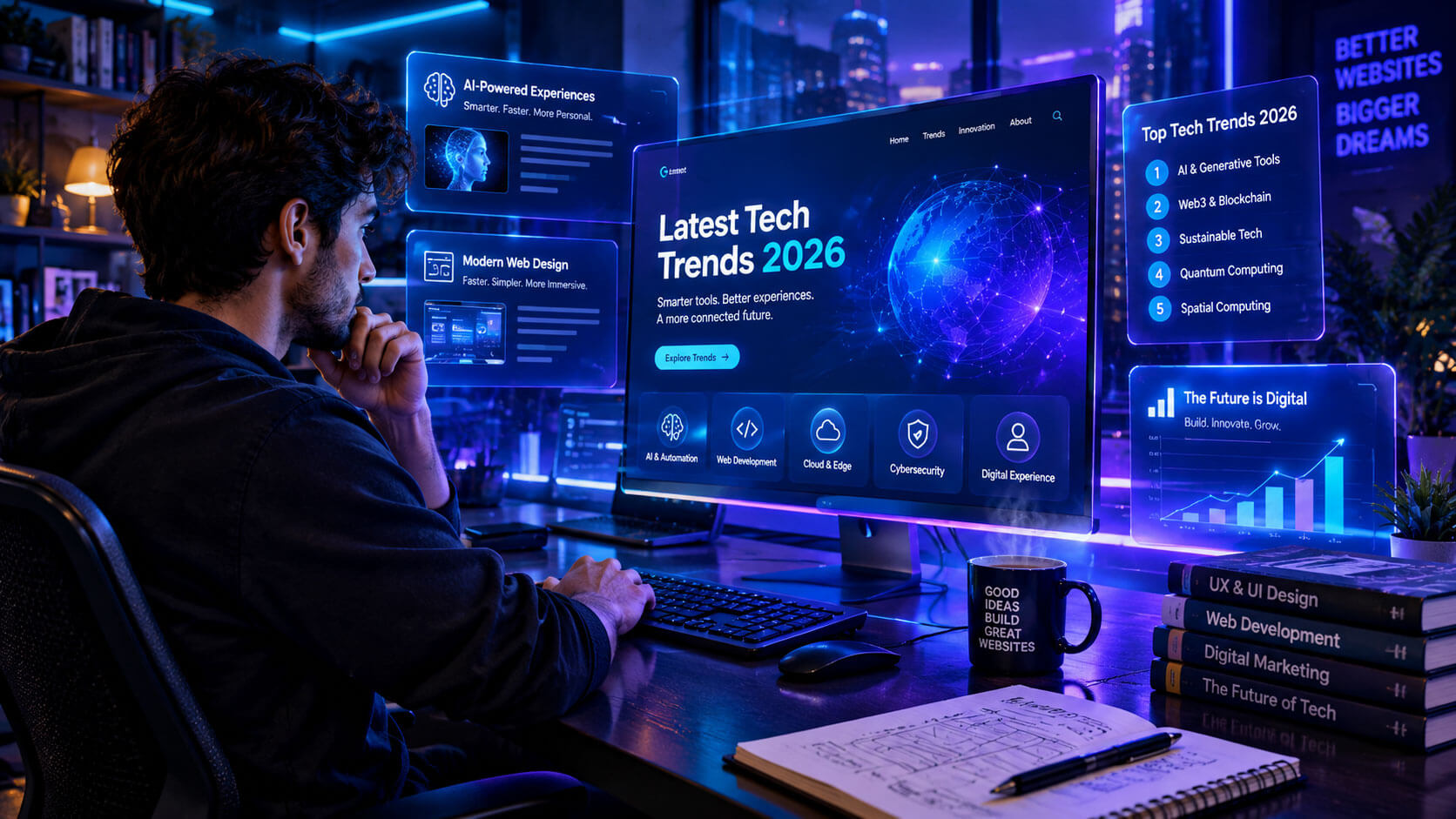
The latest tech trends are the technologies moving from labs and pilot projects into real products, budgets and regulations. In 2026, that shift is easy to see. AI is no longer just answering questions; it’s starting to take actions. Tech giants are signing nuclear power deals for their data centers. Robotaxis carry paying passengers in US cities, and standards bodies have already published encryption designed to resist future quantum computers.
This Gamrawtek guide covers ten of the latest tech trends worth your attention in 2026, with a plain explanation, concrete examples and an honest view of how far along each one is. You’ll also find a quick summary table, a hype-versus-reality check, and clear advice on what these trends mean for your business, your career and the devices you buy.
The Latest Tech Trends Worth Watching in 2026
Key Takeaways
- AI is shifting from answering questions to taking actions, through agents that complete multi-step tasks.
- Some trends are ready now: on-device AI, passkeys, Wi-Fi 7 and robotaxis in select US cities.
- AI’s growth is driving a surge in data center power demand, pushing tech giants toward nuclear and cleaner energy.
- Post-quantum encryption needs attention today, even though useful quantum computers are still years away.
- The smartest approach is small pilots and security basics, not chasing every headline.
How We Chose These Trends
To make this list of the latest tech trends, a technology had to show at least two of these signals:
- Real adoption: people or companies are using it today, not just testing it.
- Serious investment: major companies or governments are spending on it.
- Standards or regulation: rules or official standards exist, which usually means the technology is maturing.
- Independent recognition: it appears in respected reviews such as Gartner’s strategic trends or MIT Technology Review’s breakthrough list.
That filter keeps the latest tech trends here grounded in evidence rather than press releases. Each one below also gets a rough time horizon, so you can tell what’s ready now from what’s still years away.
Latest Tech Trends at a Glance
Here’s a quick overview of the latest tech trends covered below, with where each one stands today:
| # | Trend | What it is, simply | Where it stands |
| 1 | Agentic AI | AI that completes multi-step tasks, not just answers | Early adoption now |
| 2 | On-device AI | Smaller AI models running on phones and laptops | Shipping now |
| 3 | AI data centers and energy | The power and chips behind AI | Rapid build-out now |
| 4 | Quantum and post-quantum security | New computers, and encryption that resists them | Security: now; computing: 5+ years |
| 5 | Spatial computing | Digital content blended with the physical world | Early, niche |
| 6 | Physical AI and robotaxis | AI that controls robots and vehicles | Robotaxis live; humanoids in pilots |
| 7 | AI-era cybersecurity | Defending against deepfakes and AI-driven attacks | Urgent now |
| 8 | Next-gen connectivity | Wi-Fi 7, satellite-to-phone, 6G research | Wi-Fi 7 and satellite now; 6G around 2030 |
| 9 | Green and energy tech | Cheaper batteries and cleaner power | Growing now |
| 10 | Biotech and health tech | Gene editing and AI-assisted medicine | Early clinical use |
1. Agentic AI: From Chatbots to AI Agents
Agentic AI describes systems that plan and carry out tasks on their own, such as researching suppliers, filling in forms or updating records, instead of only generating text. Where generative AI writes a draft, an AI agent can also send it, file it and follow up.
Gartner lists multi-agent systems, groups of AI agents working together toward a goal, among its top strategic technology trends for 2026.
Useful early examples include:
- Customer service agents that resolve simple requests end to end
- Coding agents that write, test and fix software
- Research agents that gather and summarize information from many sources
Major AI providers, including OpenAI, Google, Microsoft and Anthropic, now build agent features into their products, so many office workers are likely to meet this trend before the others.
The limits matter. Agents still make mistakes, and a mistake that takes an action costs more than one that only produces a wrong sentence. For most teams, a sensible approach is to start with low-risk tasks and keep a human approving anything important.
2. Smaller, Smarter AI on Your Devices
Not every AI task needs a giant cloud model. Small language models and on-device AI run directly on phones and laptops, which can mean faster responses, lower costs and better privacy, because your data doesn’t always leave the device.
AI PCs are the clearest example. Microsoft’s Copilot+ PCs, for instance, require a neural processing unit (NPU), a chip built for AI tasks, capable of more than 40 trillion operations per second. Gartner also expects businesses to shift toward domain-specific models trained for particular industries or tasks.
For buyers, the key question is whether the AI features solve an actual need. An NPU won’t help much if you never use the tools that rely on it.
3. The Power Problem: AI Data Centers and Energy
Every AI answer runs on hardware somewhere, and that hardware needs electricity. The International Energy Agency (IEA) estimates that data centers used about 415 terawatt-hours in 2024, around 1.5% of global electricity, and projects that figure to more than double to about 945 TWh by 2030. The US accounts for a large share of that growth.
Tech companies are responding in three ways: more efficient AI chips (from NVIDIA’s GPUs to cloud providers’ custom chips), liquid cooling and long-term power deals. In 2024, Microsoft signed a 20-year agreement to buy power from a restarted reactor at Pennsylvania’s Three Mile Island plant. MIT Technology Review named hyperscale AI data centers and next-gen nuclear among its 2026 breakthrough technologies.
This trend affects everyone indirectly, through electricity demand, local grid planning and the environmental cost of AI.
4. Quantum Computing and Post-Quantum Security
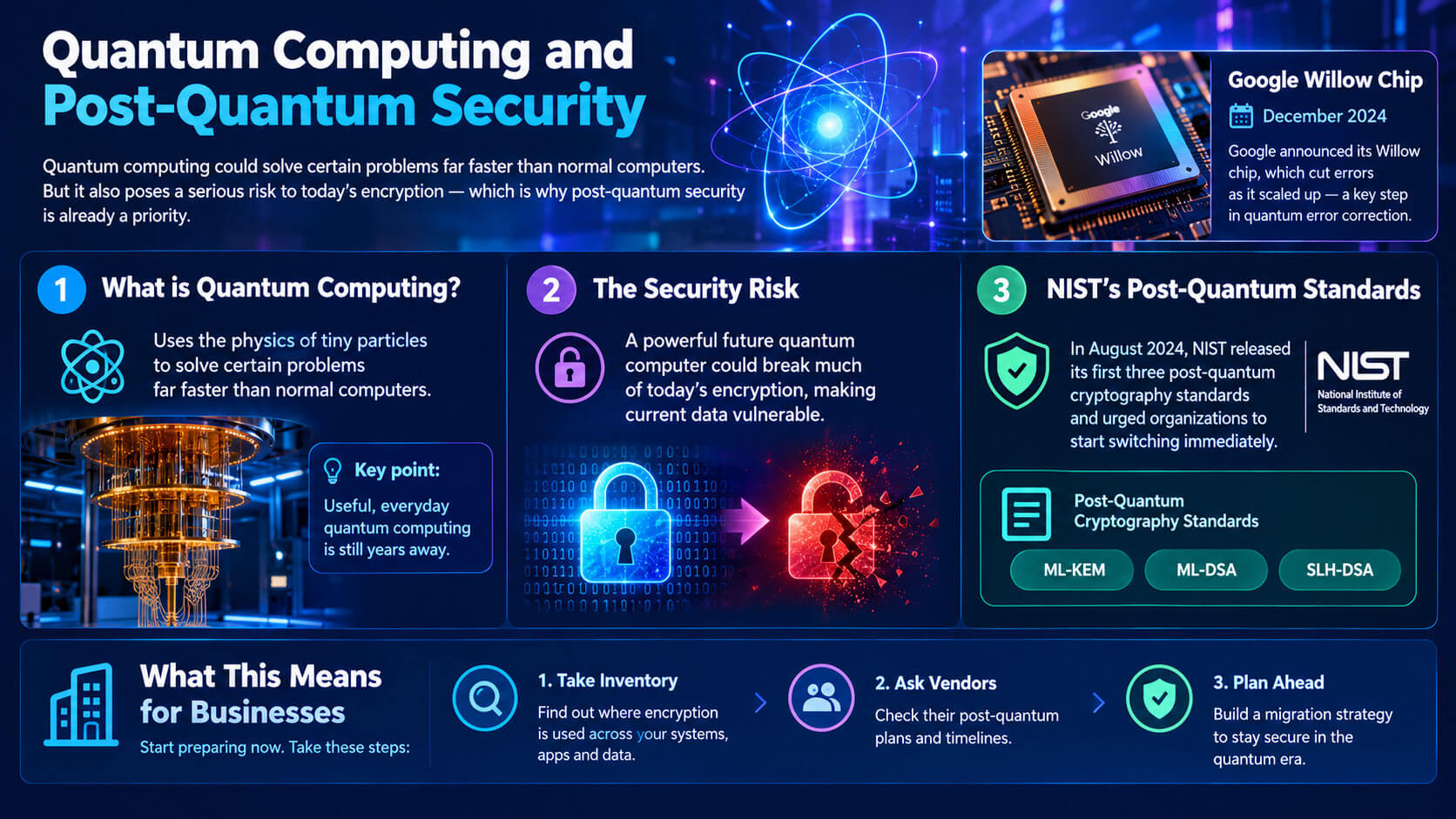
Quantum computing uses the physics of tiny particles to solve certain problems far faster than normal computers. In December 2024, Google announced its Willow chip, which cut errors as it scaled up, a key step in quantum error correction.
Useful, everyday quantum computing is still years away. The security side, however, is urgent now. A powerful future quantum computer could break much of today’s encryption, so NIST released its first three post-quantum cryptography standards in August 2024 and urged organizations to start switching immediately.
For businesses, that means taking stock of where encryption is used and asking vendors about their post-quantum plans.
5. Spatial Computing and Smart Glasses
Spatial computing blends digital content with the physical world. It includes augmented reality (digital layers over what you see), virtual reality (fully digital environments) and mixed reality, which combines both.
Here, hardware sets the pace. Apple’s Vision Pro headset showed what’s possible, but its $3,499 launch price put it out of reach for most buyers. The more likely path to everyday use is lightweight smart glasses with cameras, audio and AI assistants built in. Early uses are strongest in training, design, remote support and hands-free work.
The trend has substance, but mass adoption depends on devices getting lighter, cheaper and more useful day to day.
6. Robots, Physical AI, and Robotaxis
Physical AI brings intelligence to machines that sense and act in the real world: robots, drones and vehicles. Gartner includes it among its 2026 strategic trends.
Robotaxis are the most visible example in the US. Waymo reported about 500,000 paid rides a week across 10 US cities in March 2026, up from 50,000 a week in May 2024. It has continued adding cities since.
Humanoid robots attract heavy investment and attention, but public deployments so far look like limited trials in warehouses and factories. Treat bold predictions about robots in every home with caution. The nearer-term gains are in logistics, manufacturing and inspection.
7. Cybersecurity in the Age of Deepfakes
AI now works on both sides of security. AI-powered cyberattacks include more convincing phishing emails and deepfakes: fake audio or video that imitates real people, sometimes used to trick staff into sending money.
Defenses are shifting in response:
- Passkeys replace passwords with a login tied to your device. The FIDO Alliance, the industry group behind passkeys, describes them as phishing-resistant.
- Zero trust security checks every user and device every time, instead of trusting anyone inside the network.
- Gartner predicts that preemptive cybersecurity, which aims to stop attacks before they happen, will account for half of all security spending by 2030.
A simple habit helps too: verify unusual requests, especially about payments, through a second channel.
8. Faster, Wider Connectivity
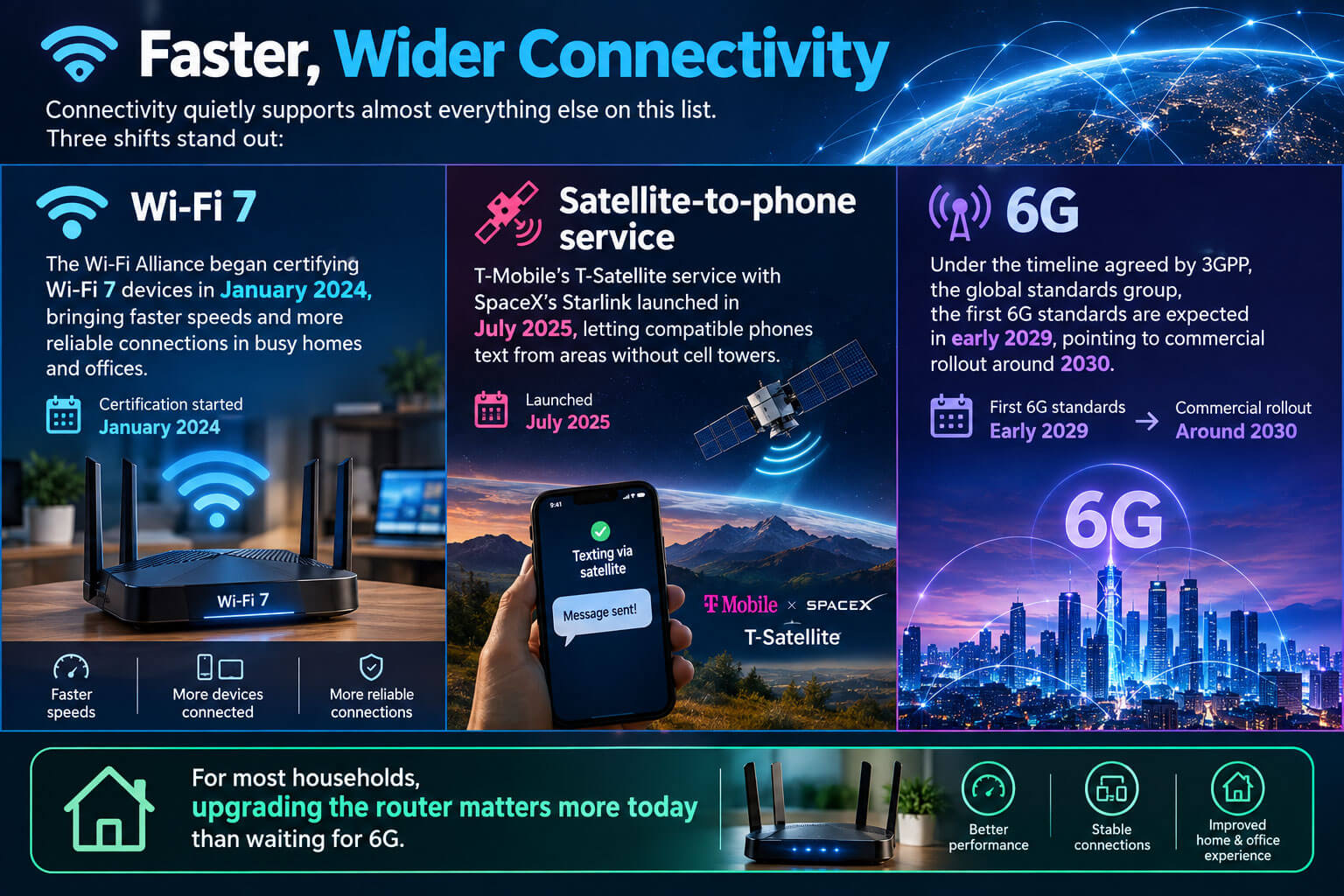
Connectivity quietly supports almost everything else on this list. Three shifts stand out:
- Wi-Fi 7: the Wi-Fi Alliance began certifying Wi-Fi 7 devices in January 2024, bringing faster speeds and more reliable connections in busy homes and offices.
- Satellite-to-phone service: T-Mobile’s T-Satellite service with SpaceX’s Starlink launched in July 2025, letting compatible phones text from areas without cell towers.
- 6G: under the timeline agreed by 3GPP, the global standards group, the first 6G standards are expected in early 2029, pointing to commercial rollout around 2030.
For most households, upgrading the router matters more today than waiting for 6G.
9. Green Tech and Sustainable Computing
Climate tech is becoming cheaper and more practical, with a direct effect on household and business costs. MIT Technology Review named sodium-ion batteries, a cheaper alternative made from abundant materials, among its 2026 breakthroughs, along with next-generation nuclear power.
Better energy storage supports electric vehicles and a grid that relies more on solar and wind. In computing, sustainable technology means more efficient chips, smarter cooling and measuring the carbon cost of software and AI workloads. The pressure on this trend grows as AI’s energy use rises.
10. Biotech and Health Tech
Gene editing has crossed an important line. In December 2023, Casgevy became the first FDA-approved therapy using CRISPR gene editing. It’s approved to treat sickle cell disease in patients 12 and older.
Other growing areas include AI drug discovery, where models help identify promising compounds faster, and health wearables that track sleep, heart rhythm and activity. These tools are promising but not replacements for medical care, and treatments like gene therapy remain expensive and limited to specific conditions.
Other Trends Worth a Look
A few more of the latest tech trends didn’t make the top ten but deserve a mention:
- Generative coding: AI tools that write, test and fix code. MIT Technology Review named it a 2026 breakthrough.
- Confidential computing: protecting data while it’s being processed, not just when it’s stored or sent.
- Digital provenance: proving where software, data and media came from, which matters more as deepfakes spread. Gartner lists both of these among its 2026 trends.
- AI-native development platforms: tools that let smaller teams build software faster with AI help.
- Stablecoins: digital tokens designed to hold a steady value, usually pegged to the US dollar. The GENIUS Act, signed in July 2025, set the first federal US rules for them.
Hype vs. Reality: What’s Overrated
Separating hype from substance is the hardest part of following the latest tech trends. This table offers a working view, not a forecast:
| Status | Examples | What it means for you |
| Real today | On-device AI, passkeys, Wi-Fi 7, robotaxis in select cities | Worth using or planning for now |
| Promising, early | AI agents, smart glasses, sodium-ion batteries, humanoid robots | Pilot carefully; expect fast change |
| Longer term | Useful quantum computing, 6G | Watch, but don’t plan budgets around it yet |
| Faded from headlines | The consumer metaverse | Attention has largely moved to useful spatial computing |
Tools like the Gartner Hype Cycle exist because excitement often runs ahead of results. A useful test for any of the latest tech trends: who pays for it today, and what problem does it solve?
What These Trends Mean for Businesses
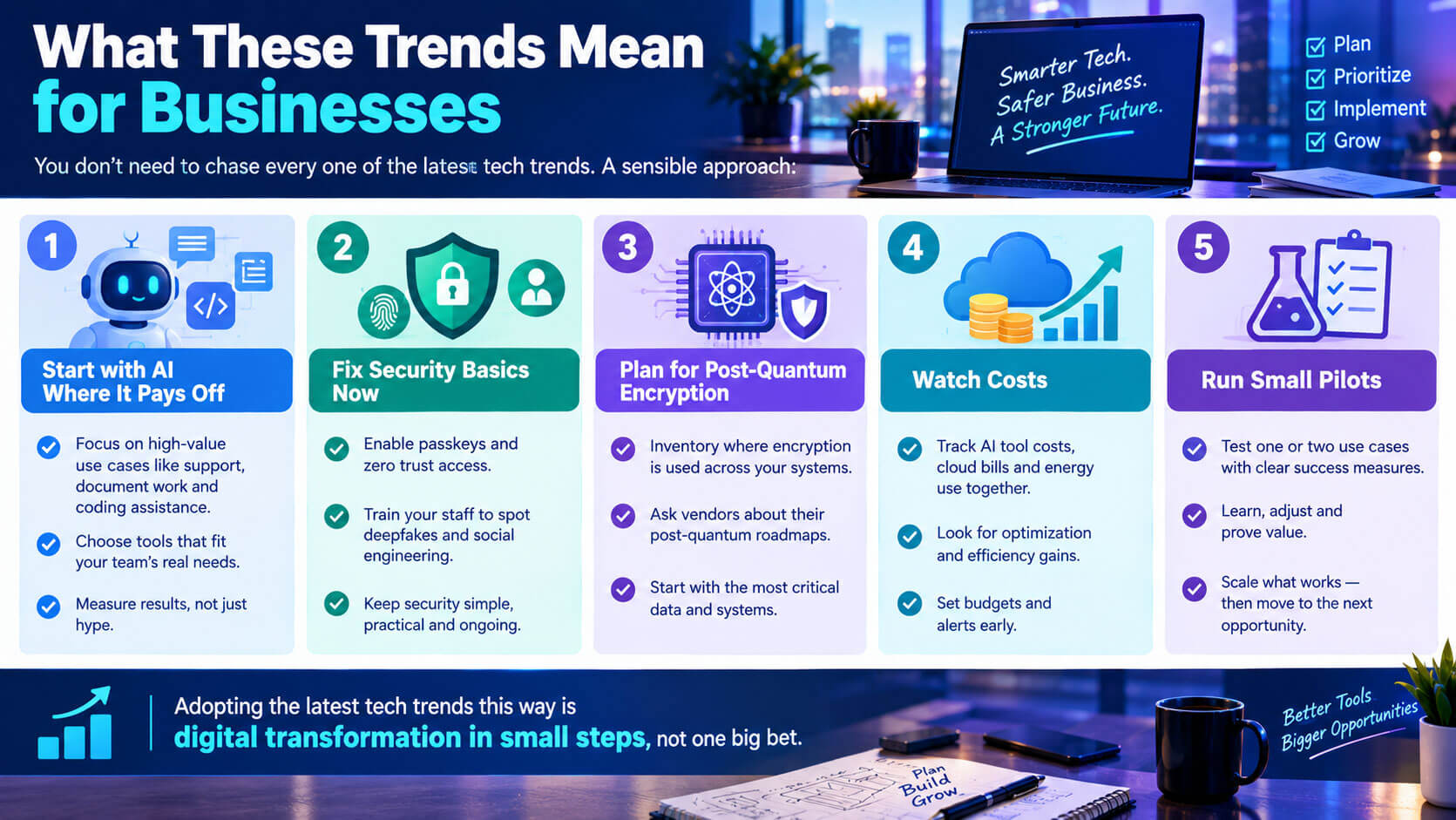
You don’t need to chase every one of the latest tech trends. A sensible approach:
- Start with AI where the payoff is clear: support, document work and coding assistance.
- Fix security basics now: passkeys, zero trust and staff training against deepfakes.
- Plan for post-quantum encryption: inventory your systems and ask vendors about their roadmaps.
- Watch costs: AI tools, cloud bills and energy use can climb together.
- Run small pilots with clear success measures before scaling anything.
Adopting the latest tech trends this way is digital transformation in small steps, not one big bet.
What They Mean for Your Career and Daily Life
The latest tech trends reward people who learn to work with AI rather than avoid it. Tech skills in demand include using AI tools well, data literacy, cybersecurity awareness and, for technical roles, cloud and AI engineering.
As a consumer, you’ll feel the latest tech trends mostly through your devices: more AI features in phones and laptops, better home Wi-Fi, satellite texting in remote areas and more health data from wearables. Before paying extra for any AI feature, ask whether you’ll actually use it.
Risks and Limitations
The latest tech trends also bring trade-offs:
- Energy and environment: AI’s growth increases electricity demand.
- Jobs: automation is likely to change many roles, and some may shrink.
- Privacy: more sensors and AI mean more personal data collected.
- Misinformation: deepfakes make it harder to trust what you see and hear.
- Regulation: rules are still forming. The EU AI Act, for example, phases in obligations through 2027 and beyond.
Frequently Asked Questions
Which tech trends matter most in 2026?
Start with the ones already affecting daily life: AI assistants and agents, on-device AI, stronger logins like passkeys, and faster connectivity. The rest matter more over the next few years.
What’s the difference between agentic AI and generative AI?
Generative AI creates content such as text or images. Agentic AI goes further, planning steps and taking actions to complete a task.
Is the metaverse still a trend?
It gets far less attention than it did a few years ago. Much of the activity has shifted toward practical spatial computing, such as smart glasses and AR for training.
When will quantum computing affect everyday life?
Not soon for most people. The immediate effect is on security, because organizations are already moving to post-quantum encryption.
Do these trends matter for small businesses?
Yes. Several of the latest tech trends, such as passkeys and AI assistants, can be low-cost to adopt and quick to show value.
What tech skills should I learn in 2026?
Practical AI tool use, data literacy and cybersecurity basics help in almost any job. Technical roles benefit from cloud, AI and security engineering skills.
How can I keep up without feeling overwhelmed?
Follow a few reliable sources on the latest tech trends, focus on the trends that affect your work, and test ideas with small experiments instead of chasing every headline.
Read More: https://linkneon.com/quotes-about-ai/
Conclusion: How to Keep Up
The main takeaway: the latest tech trends of 2026 center on AI moving from talk to action, backed by new chips, new power sources and new security needs. Some trends, such as passkeys, on-device AI and Wi-Fi 7, are ready now. Others, such as useful quantum computing and 6G, are further out.
Your next step: pick the two trends from the table that most affect your work or home, and take one small action on each this month, whether that’s a pilot, a security upgrade or learning a new tool. To keep tracking the latest tech trends as they develop, subscribe to the Gamrawtek newsletter for regular updates.