

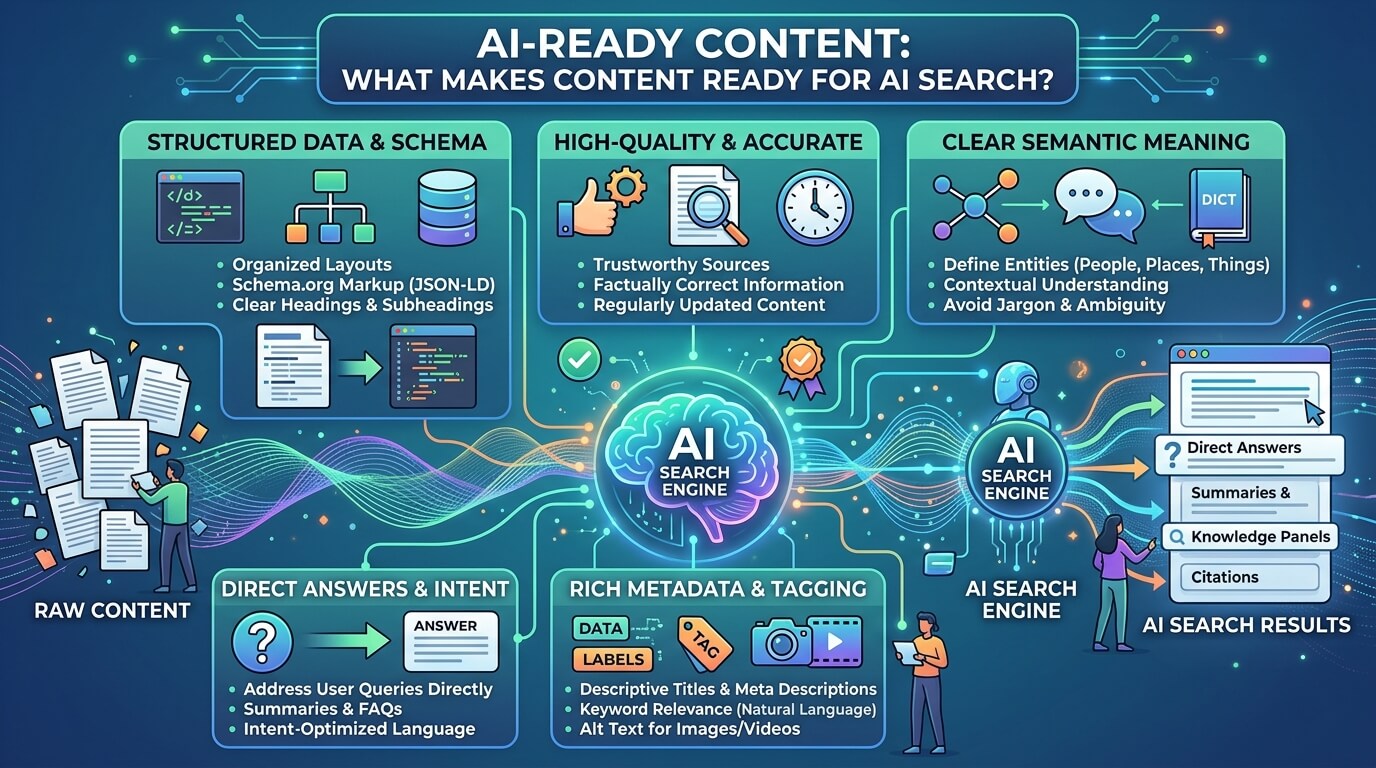
Here is the uncomfortable truth I keep repeating to clients: a page-one result no longer guarantees visibility. AI systems now synthesize a single response, and pages that fail AI filtering vanish from the conversation entirely.
Readiness rarely starts with keywords. It starts with meaning. When an LLM scans a page, it hunts for a clean answer, evidence-based claims, and clear headings to extract without misrepresentation of what the author said.
Playbooks treated traditional search like a librarian stacking books. Today’s engines behave more like a research assistant, pulling knowledge fragments from live sources, weighing credibility, and stitching an assembled reply before anyone clicks a link.
The contrarian point most teams miss is that more content rarely helps. AI-generated slop dilutes trust. What earns citation preference is originality, visible expertise, and structured data that lets machines verify facts confidently and quickly.
This guide carefully unpacks what genuinely makes AI-ready content work: crawlable foundations, self-contained chunks, answer-first structure, E-E-A-T signals, schema, freshness, and brand mentions beyond your site, plus how zero-click searches now reshape measuring real success.
What Is AI-Ready Content?
Most definitions describe it as content written for robots. That framing is backwards. It is material AI systems can retrieve, summarize, and cite without guessing, because the meaning was never buried in the first place.
During audits, I ask one question per page: could a stranger lift any paragraph-level passage and still trust it? If the answers survive without surrounding context, that page earns AI inclusion and steady citations.
Historically, readiness meant indexable pages and a tidy meta title. Those SEO basics still matter, yet AI answer engines layer something new on top, rewarding entity clarity, explicit definitions, and data-backed assertions over keyword stuffing.
I break the definition into three tests. Can bots reach it through clean HTML? Can models parse its self-contained sections and direct answer? Can they judge it credible through named sources, credentials, and third-party mentions?
Teams resist this: readiness is not a format, a plugin, or schema markup. It is a trusted source habit, publishing original insight and accurate facts, so AI search treats your brand as the relevant answer.
Why AI-Ready Content Matters Now
Here is the uncomfortable truth I tell clients: losing organic clicks hurts less than never becoming the selected answer. When AI Overviews and AI chatbots respond, the quoted page wins attention, while ignored pages vanish.
For two decades, traditional SEO meant chasing those ten blue links. Gartner predicted search engine volume would drop 25% by 2026 (Gartner, 2024), as conversational queries shift toward AI-generated answers built from multiple sources simultaneously.
Visibility now starts before anyone reads a word. In my audits, crawlable pages with clean technical structure and valid structured data support extraction better, because systems lift self-contained chunks, not entire articles, into conversational answers.
Not every format earns citations equally. Detailed guides, comparison pages, FAQs, and high-density summaries tend to be reused, yet only when they carry authoritative information. Thin content formats padded for length rarely become recommended answers.
Ironically, machines reward what they cannot fake. Original research, expert explanations, and human creativity give people-first content its edge over recycled comprehensive content. So Content GEO treats original content as the engine of content discovery.
How AI Systems Select and Use Content
After auditing dozens of pages, my blunt conclusion is that LLMs rarely reward the keyword-stuffed article; they reward extractable source material that answers precisely. Keyword matches still matter, but context decides whether systems cite you.
Selection works in stages. Crawlers must find pages, which is where Technical GEO keeps content accessible; models then understand passages, favoring clearly structured, on-topic sections whose claims stay consistent and unambiguous across the whole domain.
Consider a repair guide. Once it carries an author bio naming a certified technician and that person’s qualification, it becomes a far stronger reliable answer candidate, because authoritative expertise signals trustworthy answers to retrieval systems.
Freshness shapes accuracy checks too. Pages carrying up-to-date stats and updated facts are likelier to be recommended in AI Overviews, whereas stale pages get mentioned less. Comprehensive answers help most when the answer comes first.
I treat AI search optimization as four pillars working together: technical access comes first, Content GEO shapes passages, Entity GEO clarifies identity, and Brand Authority GEO earns outside trust, compounding into lasting AI search visibility.
Traditional SEO vs. AI Search
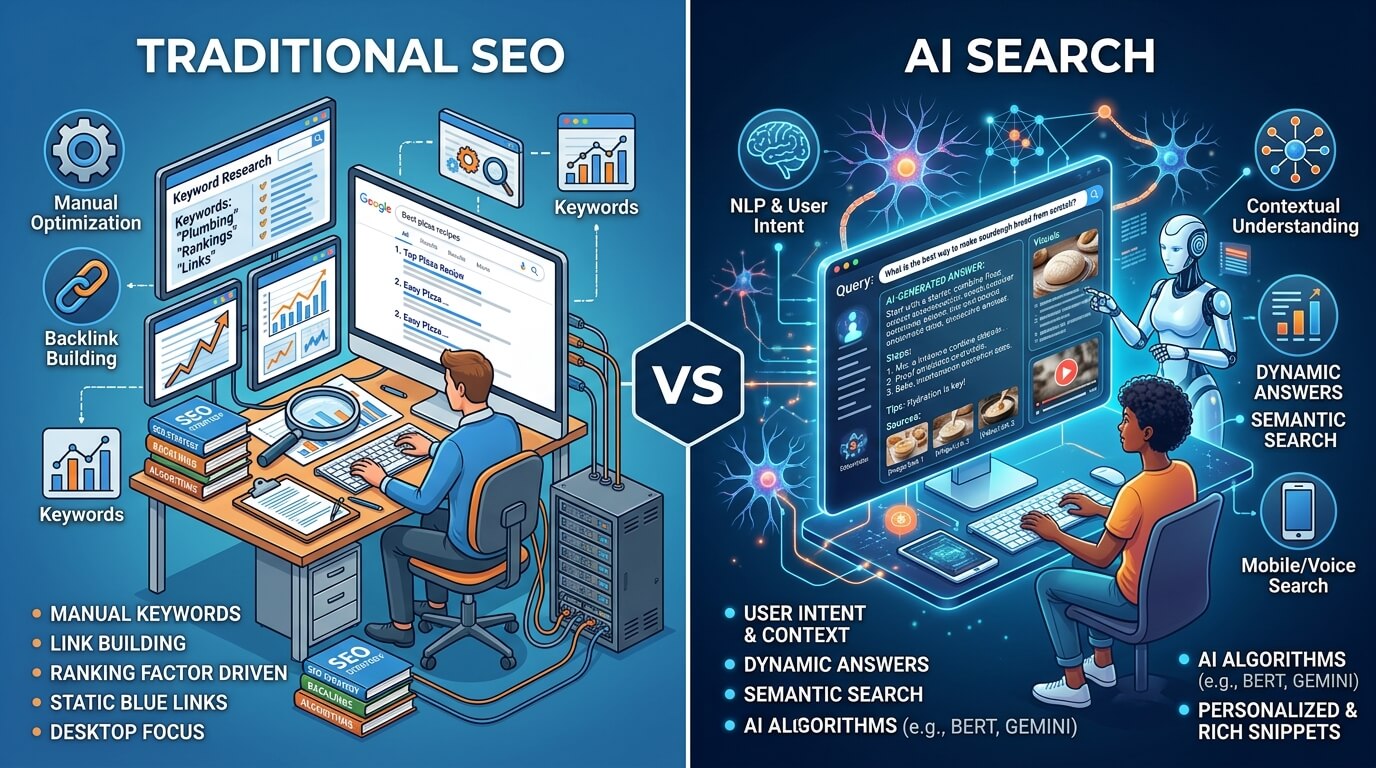
Top placement no longer guarantees anything; I have watched page-one articles become uncited content inside generated answers. Traditional SEO pushed whole pages up a list, while answer engines quietly pull modular pieces through retrieval instead.
Keywords are not obsolete, despite panels insisting otherwise. What changed is tolerance for exact-match repetition. Early keyword articles repeated phrases mechanically; today, natural-language queries reward sites mapping concepts, so systems understand meaning, not string matches.
Being selected differs from being listed. A page can rank fifth and still get referenced because one section answers precisely. Engines extract dense paragraphs poorly, so concise language and people-first signals decide which passage wins.
My dashboards changed before my tactics did. Impressions matter, yet citation frequency became my leading indicator, alongside unlinked brand mentions and SERP features. Lower website traffic stopped scaring me once high-intent visits converted into transactions.
AI search optimization still needs crawlability and earned backlinks; that foundation never moved. The divergence sits in delivery: search experiences offer conversational answers with source links, handling complex questions that once required three separate queries.
Technical Foundation: Can AI Access Your Content?
I once audited a brilliant guide that AI platforms never cited. The writing wasn’t the problem. Its answers lived inside interactive elements that loaded after clicks, so bots saw an empty shell and moved on.
That audit reshaped how I view Technical GEO. Discovery comes before Understanding, and no model can interpret what it cannot crawl. Uncrawlable pages blocked by login walls, robots rules, or broken links never enter conversations.
Many crawlers skip client-side rendering, so I push HTML-first builds. Text delivered in the initial response stays indexable. Tabs loading extra content on click create hidden data, leaving fragmented answers rather than clean retrievable chunks.
Clean heading hierarchy in raw HTML helps machines map sections. During live retrieval, assistants fetch pages in seconds, so slow servers lose. I test technical speed like I test on-site search: through a stranger’s eyes.
JSON-LD markup works as a translation layer, but only when it mirrors user-visible content. I also add ARIA labels and convert media into structured text assets, reviewing every auto-generated caption because machines repeat errors confidently.
Clear Structure, Headings and Self-Contained “Chunks”
Most pages I audit fail before any writing quality matters. When bots crawl a site and hit uncrawlable pages or fragmented layouts, discovery stalls, so brilliant paragraphs never become retrievable chunks that AI platforms trust.
A clean heading hierarchy guides machine understanding of a page. Each subheading should announce one claim, and the text beneath must stand alone, because live retrieval lifts sections without their neighbors before anything gets cited.
I learned this rebuilding a client’s pricing section. Tabs and other interactive elements buried key facts as hidden data. Switching to an HTML-first approach made every answer indexable and turned user-visible content into the source.
Technical GEO gets oversold. JSON-LD markup acts as a translation layer, confirming what visible text already says, not replacing it. ARIA labels help assistive tools and parsers, yet no technical fix rescues a vague paragraph.
Treat every section as one of your structured text assets. Write a direct answer, add supporting detail, then stop. Auto-generated summaries and on-site search snippets pull from these blocks, so tight chunks pay off everywhere.
Write for Real Questions and User Intent
Underperforming pages I audit share one flaw: they answer what the writer wanted to say, not the specific question readers typed. AI systems reward intent matching, so I begin every brief with real user questions.
Mapping the customer journey exposes how one type of user asks differently from another. Beginners want simple questions resolved; evaluators raise objections about cost or fit. Every user’s need then deserves its own standalone passage.
Once, writers padded drafts with introductory fluff to hit word targets. Conversational search ended that habit. People now phrase queries in natural language, and buried answers get skipped; a concise answer placed first consistently wins.
Support tickets and sales calls hold the richest customer insights. I mine them for the main question, then cluster related questions, sub-questions, and long-tail objections beneath it. That grouping builds semantic relevance without stuffing phrases.
Some fear zero-click answers waste effort. I disagree. When direct answers carry nuance and firsthand examples, readers return with follow-up questions. Studying human behavior, not volume metrics, reveals which usable answer keeps pages in rotation.
Answer First: Front-Loaded Answers and Summaries
After auditing many pages, I noticed the posts AI tools quoted rarely had the best writing; they had the main answer sitting in the opening lines. Burying the core question response under backstory kills extractability.
My rule: open each section with a one-line definition, then a summary carrying one idea. Name the key entities instead of leaning on pronouns, because models lift fragments out of context, and skimmers do too.
Front-loading doesn’t mean shallow content. The ready-made answer earns trust, then detail arrives in tight chunks that handle likely follow-ups. Readers who stop early still leave with the main idea, while patient ones get depth.
Lists, Tables and Formatting
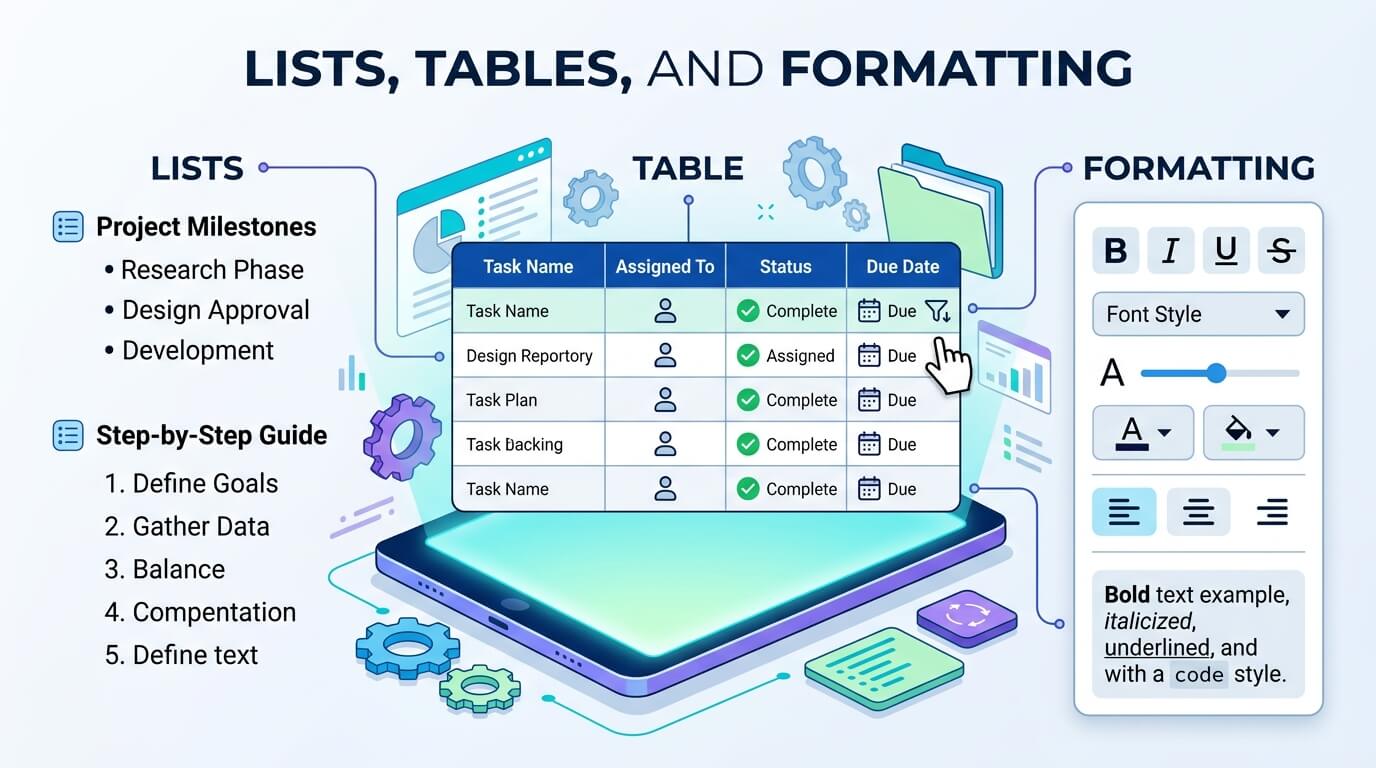
Auditing hundreds of pages, I stopped treating tables as decoration. Models lift chunks, not essays, so a pros-and-cons grid with clear criteria beats complete paragraphs for extractability, when every row carries one fact.
Old templates stacked generic headings like Features or 5 Benefits of This Product under one H1. Retrieval quietly punishes that. Descriptive headings, ordered H3 subtopics and dividers framing short paragraphs enforce one idea per section.
My working rule: open each H2 with a TL;DR, convert procedures into numbered lists, close with Key Takeaways, and never publish out-of-order sequences. That structural discipline raised snippability across every topic I’ve managed.
Clear, Plain, Unambiguous Language
Plain language gets mistaken for dumbed-down writing, yet my audits keep proving otherwise. Pages that win citations replace vague claims with explicit terminology, open every first sentence with substance, and place definitions where confusion begins.
Early client drafts buried meaning under long intros, filler and fluff. Rebuilding them as an inverted pyramid, with a tight Answer Block of two sentences up top, gave machines a simple explanation to lift cleanly.
Ambiguity hides in drifting vocabulary. Name one concept with one term, keep that consistency across related terms, and anchor abstractions with examples. That specificity turns factual content into conversational answers for full questions people type.
Optimize for Entities, Not Just Keywords
Keywords got my pages found; entities got them understood. After auditing dozens of sites, I noticed NLP systems rarely struggle with vocabulary. They struggle with ambiguity, when one brand entity shares names with unrelated concepts.
The fix is unglamorous: explicit language, consistency, and unambiguous product categories. State what you sell, who you serve, and your differentiators in plain language. Then reinforce identity through Organization schema and a trustworthy brand description.
Single pages rarely establish meaning alone. Machines infer topical association from how a core topic connects with related subtopics across your site. Build content pillars, define each concept once, and extraction improves while misinterpretation disappears.
Demonstrate Expertise and Authorship (E-E-A-T)
An author page rarely persuades LLMs of anything. During audits, I notice models trust consistency across entities: matching identities, bios, and aligned signals. Isolated self-declared credentials read like claims, not proof, until mentions confirm them.
Experience, E-E-A-T’s newest letter, surfaces through usage experience, not adjectives. Real examples, proprietary data, and expert opinions give reputable sources reasons to cite you. Expert bylines with a publish date and author metadata reinforce reliability.
Here’s the uncomfortable part: expertise proven elsewhere outweighs anything claimed on-site. Coverage in trusted media, industry publications, and genuine thought leadership builds credibility signals and brand recognition. Stay honest about limits; cited authority rewards restraint.
Schema Markup and Structured Data
Schema rarely moves rankings on its own, and I learned that after watching a client’s schema stuffing backfire. Markup only earns trust when it mirrors visible content, giving machines clean labels for what readers see.
Where structured data helps is entity alignment. When a clinic’s business markup, author page, and publication dates connect a licensed physician to her articles, expert authorship becomes machine-readable, letting answer engines verify each claim’s origin.
Treat markup as a promise, not a shortcut. FAQ pages with question-style headings, honest reviews, and time-stamped facts deserve schema; mismatches are detectable, and answer snippets favor accuracy over decoration in the audits I’ve run.
Back Claims with Evidence and Original Data
Most pages I audit fail not from weak writing but unsupported assertions. Generative engines often skip claims without primary sources, yet reward data-backed opinions carrying original data, because Trustworthiness grows when readers can verify everything.
I treat evidence as incomplete until ownership becomes visible. Expert bylines, author bios, and a publish date with matching date metadata let transparent sourcing connect every statistic to a recognized expert whose Experience is checkable.
Proprietary numbers carry the most weight. Original research, case studies showing before/after metrics, and citations to analyst reports turn a thin page into a well-cited guide, while removing unverified details protects hard-won Authority and Expertise.
Build Topical Authority, Not Isolated Pages
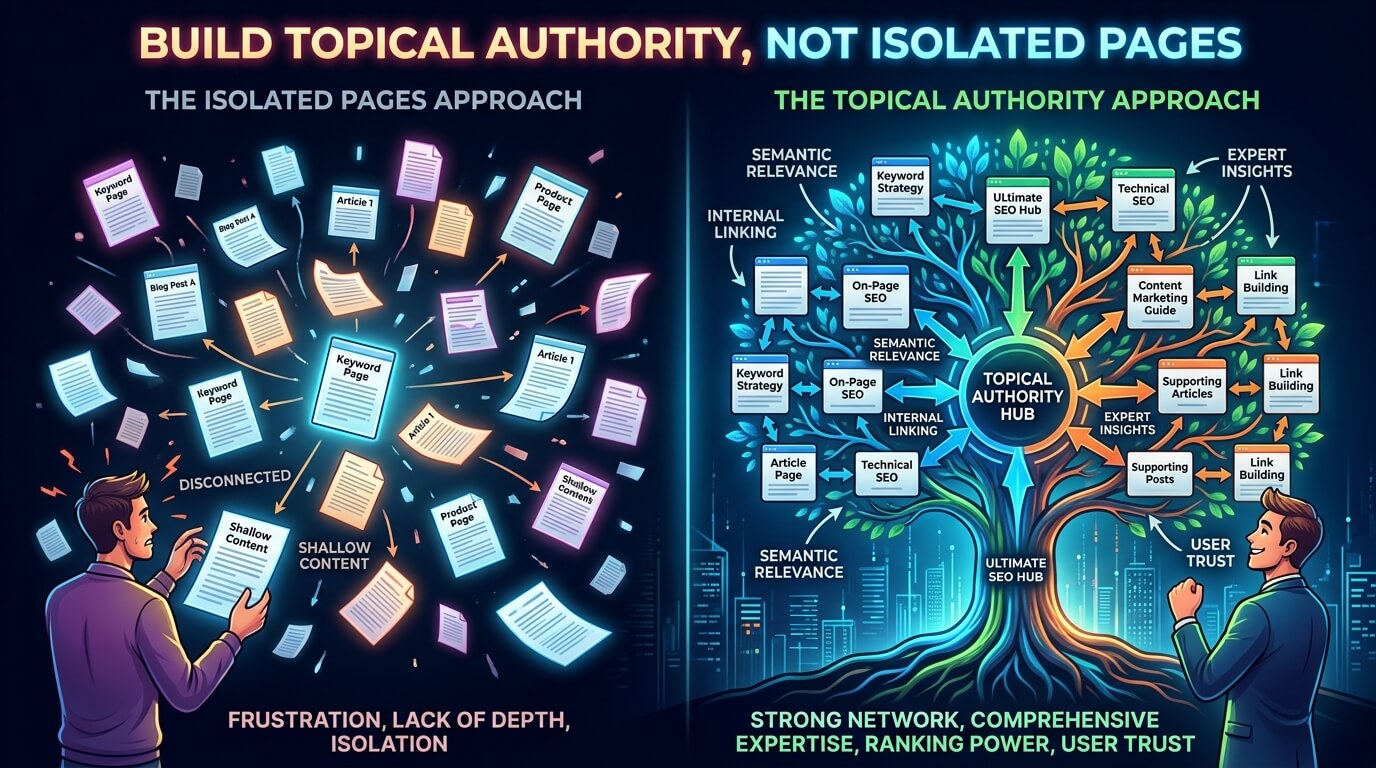
Most sites I audit have plenty of pages and no authority. Each post chases one keyword, then sits alone. LLMs read differently; they reward semantic coverage across core topics, judging whether your library understands them.
Picture a site about electric cars. One pillar page names the main topic; supporting pieces cover batteries, charging stations, and dashboard software. Internal links bind them into a topic cluster, so Entity GEO signals compound.
Breadth alone fails, though. I map related terms first, then fill gaps with glossary pages, comparisons, and how-to guides sharing a consistent structure. That topic alignment proves depth and completeness, which isolated articles never demonstrate.
Content Formats That Perform Best in AI Search
After auditing cited pages, I stopped believing essays win. AI engines lift how-tos, definitions, and Best vs comparisons because each holds a self-contained answer. Formats that open with 1–2 sentences of verdict get quoted first.
Proof matters equally. A client’s case studies gained citations only after we added Key findings summaries, statistics from original research, and charts described in plain prose. Machines skim bullets and logical headings before dense paragraphs.
Q&A content built on What is and How to phrasing earns placements, yet video is undervalued. Publishing short videos with transcripts, captions, and text equivalents for infographics turns media into extractable sections supporting answer-first writing.
Can you appear in AI Overviews without ranking #1?
Yes. AI Overviews do not simply copy the page in the #1 position. Google’s systems draw from several sources that answer the query well, so a page lower in the organic ranking can still be cited if it offers a clear explanation, clear definitions and accurate details. A strong ranking helps because it signals relevance. However, extractable answers backed by reliable sources often decide which page earns the citation.
Can AI-generated content perform well?
It can, if a person adds real value. Google does not penalize AI-generated content just because AI was used. Its spam policies target scaled content abuse, which means pages mass-produced mainly to manipulate rankings. Use AI for drafting, then add original research, first-hand examples and expert review. Be open about AI involvement where readers would expect it, because transparency builds trust. Unedited low-value content that repeats what already ranks rarely earns visibility in search or AI answers.
How often should content be updated?
There is no fixed rule. The right timeframe depends on how quickly the facts change. A practical schedule:
- Review fast-moving topics such as AI, software or regulations every 1–3 months.
- Review data-driven topics with statistics, prices or benchmarks every 3–6 months.
- Check evergreen guides less often, but fix errors as soon as you find them.
Meaningful content updates correct outdated facts, add new examples and refresh sources. Changing only the publish date does not count.
Does long-form content perform better?
Not by default. Google has said that word count is not a ranking factor, so length alone does not help. Long-form content works when the topic’s scope needs it, and it fails when it is padded with fluff. The goal is a complete answer: match the depth to the question, cover the subtopics a reader expects, and stop there. Completeness matters more than word count, and AI systems favor passages that answer clearly over pages that are simply long.
Are FAQs good for AI search?
Yes, when they are helpful. FAQs follow the question-and-answer format that AI systems use, so a well-written answer can be lifted directly into a response. Build them from genuine questions found in support tickets, sales calls and People Also Ask results instead of invented filler. Keep each answer short and direct. Treat FAQs as one part of a broader strategy, not a shortcut. They support strong pages but cannot replace them.
Is AI search reducing website traffic, and how do you measure success without clicks?
For many informational searches, yes. Users often get their answer on the results page and never click. That makes clicks only one of several success indicators. You can also track:
- How often AI tools cite or mention your brand
- Growth in branded searches and direct traffic
- The quality and conversion rate of the visits that do arrive
The real goal is influence: being present throughout the buying journey, so your brand becomes the natural choice when purchase decisions are made.
What is AI search?
AI search uses large language models to answer questions directly instead of only listing links. Tools such as Google AI Overviews, ChatGPT search, Perplexity and Gemini read prompts written as full questions. They then gather information from multiple web pages and present a summarized answer, often with cited sources. AI search is most common for informational queries, where users want an explanation rather than a list of websites.
Final Thoughts
AI-ready content is not a trick or a single tactic. It is a complete strategy built on strong content, which remains the foundation of Content GEO. Pages that earn inclusion in AI Overviews and other AI tools combine helpfulness, relevance and quality with evidence-based content and user-friendly content that both search engines and LLMs can trust. They match the reader’s intent, offer clearer explanations, and support every claim with stronger evidence and current facts.
Start with how you write. Use active voice and defined ideas, and cut the jargon, abstract styles, clever puns, complex metaphors and convoluted sentences that confuse customers and machines alike. Then strengthen the structure behind your words:
- Build topical authority with a hub page linked to supporting pages and related pages through clear internal links.
- Add Article schema, FAQ schema or Product schema where it genuinely fits the page.
- Give every image descriptive alt text and meaningful file names.
- Publish multimodal content such as videos, images and accurate transcripts instead of relying on a single format.
Stand out from the crowd. Beige content and generic articles give AI systems no reason to cite you. Distinctive content with a real brand personality, in-depth analysis, unique content and visible expertise gives them a reason to choose you over a competitor. Use automation where it helps, but avoid over-automating the work that needs human judgment.
Your website is only part of the picture. Earned media, trade press, industry sites and community platforms build authority in your niche and create mental availability beyond your own domain. A consistent author bio across platforms also supports personal branding and trust.
Finally, judge performance by more than clicks:
| What to track | Why it matters |
| Mentions and references | Show how often AI answers include your brand |
| Sentiment | Shows whether those mentions are positive or negative |
| AI Overview visibility | Shows how present you are in Google’s AI answers |
Pair this tracking with a regular review of existing content to fix outdated details. The brands that achieve lasting AI visibility and durable visibility will treat valuable content as an ongoing process, not a one-time project.
Read More: https://linkneon.com/latest-tech-trends/
Key Takeaways
- Open each section with a one-sentence definition, then add expert explanations, clear steps and a real example. Use the title, every major heading and the meta description to state the core idea, and treat the opening paragraph as a high-density seed that sums up the whole page.
- Mix formats on purpose. Definitions, glossaries, how-tos, buyer’s guides, Q&A content and service pages each serve a different use case, problem and solution, and no single format is the winner for every query. Add honest commercial-intent content that compares options and alternatives, so your brand can be recommended at the decision stage.
- Organize pages into a library of connected topics and solutions, guided by a clear content roadmap. Add WebSite schema to the home page, Service schema to service pages, and mark up prices, ratings, reviews and materials to support rich results and AI shopping results. HowTo schema no longer triggers Google rich results, but it still describes steps clearly.
- Support every claim with data and credible sources, because evidence-backed, data-rich pages outperform thin traffic-driven content. Replace the anonymous post with expert blog posts that carry a clear author bio, and use a marketing byline only when the writer has real experience.
- Update fast-moving topics every 1–3 months and other topics every 3–6 months, and refresh any trends guide to protect its relevance. Make media readable for AI vision with alt text, clear titles, helpful descriptions and text versions of audio and videos.
- Length never equals value. Useful content and good content are judged by quality, and AI-generated content always needs human review. Follow the 3 Hs by staying helpful, honest and harmless, and use a structured guide format that gives AI a reason to choose you over a competitor.