

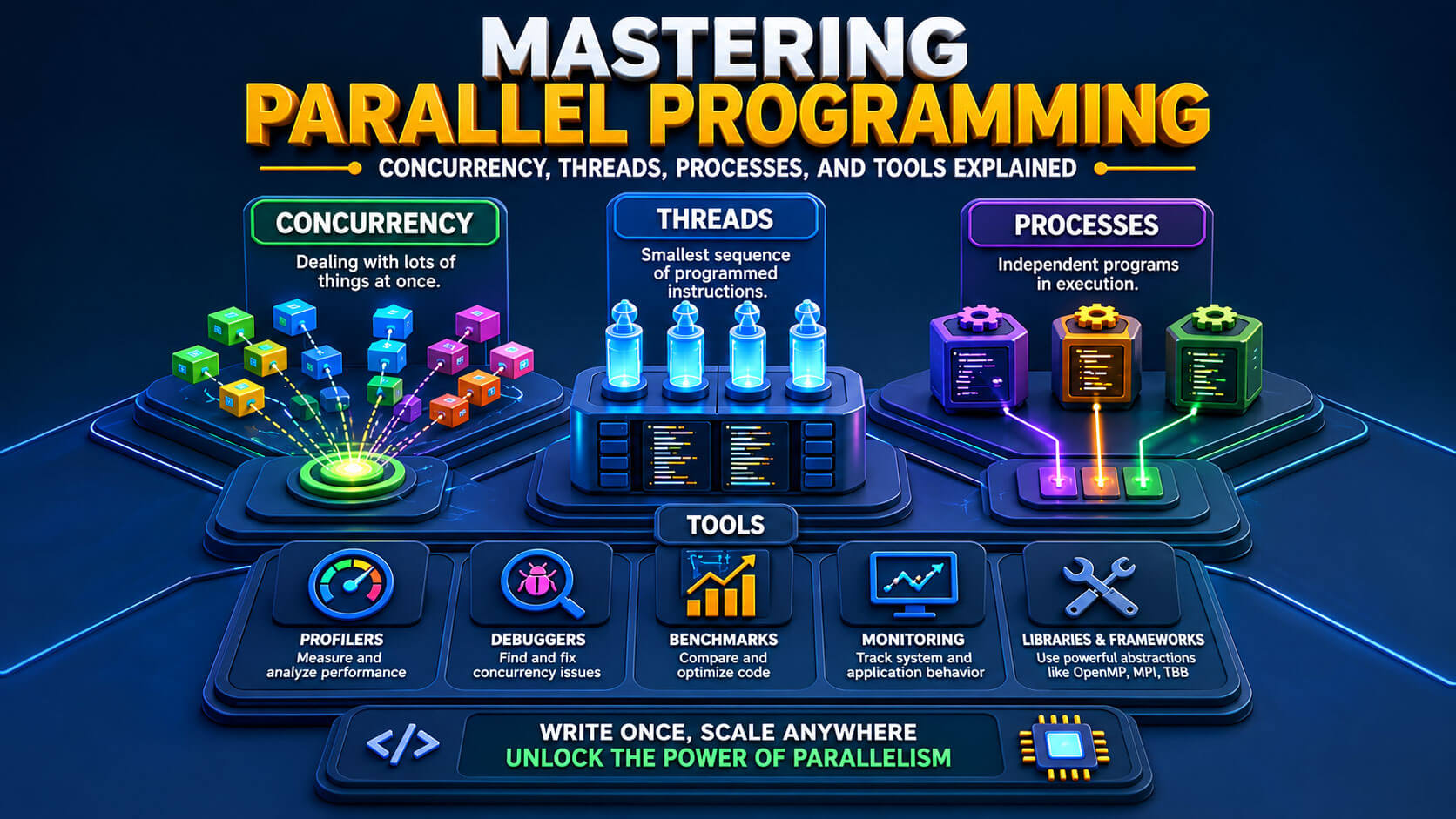
Mastering parallel programming means splitting heavy work into independent subtasks that run on several CPU cores, GPUs, or distributed clusters at the same instant, while keeping every result correct. Done well, it gives you true parallelism and real scalability without race conditions or deadlocks.
In this guide, I’ll walk you through mastering parallel programming: how threads differ from processes, how mutexes and semaphores protect shared data, which bugs to watch for, and which design patterns and libraries to use in Python, Java, Go, and C#.
Key Takeaways
- Concurrency manages overlapping tasks; parallelism runs them at the same moment on separate cores.
- Use threads or async code for waiting-heavy work and processes for computation-heavy work.
- Protect shared data with the lightest tool that works.
- Measure before and after every change; overhead can cancel any gain.
- Serial sections limit speedup, so redesign them first.
What Is the Difference Between Concurrency and Parallelism?
Concurrency means managing tasks whose lifetimes overlap, even if only one runs at a time. Parallelism means running tasks at exactly the same moment on separate hardware. Concurrency is about structure; parallelism is about simultaneous execution.
Parallel programming splits work into task groups that run on multicore processors for faster execution. Concurrent programming coordinates concurrent operations that share CPU time, so an app stays responsive while it waits on disks or networks. Both are paradigms, and most real systems mix them.
One chef switching between pots is multitasking; three chefs cooking at once is simultaneous code execution. Concurrent processes, in other words, aren’t always parallel, and these fundamentals shape every later decision.
| Aspect | Concurrency | Parallelism |
| Core idea | Tasks overlap in time | Tasks run at the same moment |
| Hardware needed | Works on one core | Needs several cores, GPUs, or machines |
| Main goal | Staying responsive | Raw speed |
| Typical mechanism | Context switches, async/await | Multi-core execution, SIMD instructions |
| Best fit | I/O-bound work | CPU-bound work |
| Example | A collaborative editor pushing live updates | Gaming engines rendering frames on many cores |
Why Mastering Parallel Programming Matters Today
Since the mid-2000s, chipmakers have added cores instead of clock speed. Today’s multi-core hardware rewards scalable software; single-core code leaves performance gains untouched.
That shift made concurrency, parallelism, and multithreading essential wherever workloads are heavy:
- High-performance computing (HPC) for scientific simulation and weather forecasting
- Financial modeling under tight deadlines
- Machine learning workloads that rely on GPU acceleration
- Web servers and microservices that handle many simultaneous requests
- Database management systems that combine concurrency control, locking, isolation levels, and optimistic concurrency
- Games and multimedia apps that run rendering threads, physics, and AI side by side
For developers, this makes mastering parallel programming a strong career skill. It leads to responsive apps built on thread-based concurrency, higher throughput, and better robustness under load.
How Hardware Shapes Parallel Code
Mastering parallel programming includes basic hardware understanding of the CPU. Cache hierarchies decide how fast data reaches each core, cache coherence keeps those copies in sync, and out-of-order execution and speculative execution reorder work behind the scenes. That’s why multi-core architectures and many-core architectures reward careful memory use.
CPU vs Core
A CPU is the physical chip, and each core inside it is an independent execution unit. Multi-core CPUs are true parallel hardware: a quad-core chip allows simultaneous execution of four instruction streams, which is the central idea of modern CPU architecture.
On a machine with one core, the operating system scheduler gives each task short time slices, creating an illusion of simultaneity. Extra threads won’t speed up CPU-bound loops there; they only add activation cost and force resource sharing, while spinlocks simply burn cycles.
Compiled vs Interpreted Programs
C, Go, and Rust compile to machine code, while Python, PHP, and JavaScript usually rely on an interpreter. Either way, launching a program creates a program instance with its own address space.
C/C++ code maps closely to the hardware, while the standard CPython build uses a GIL (global interpreter lock) that lets only one thread run Python bytecode at a time.
Caches, Memory Models, and Resilience
When two cores update different variables on the same cache line, they keep invalidating each other’s copy. This hidden slowdown can rival lock contention, so place each busy shared variable carefully.
Since CPUs reorder instructions, atomic operations restore the ordering that protects data integrity.
Resilient design isolates faults and shuts down cleanly, separating reliable applications and fault-tolerant systems from fragile ones.
Threads vs Processes: Choosing the Right Unit of Work
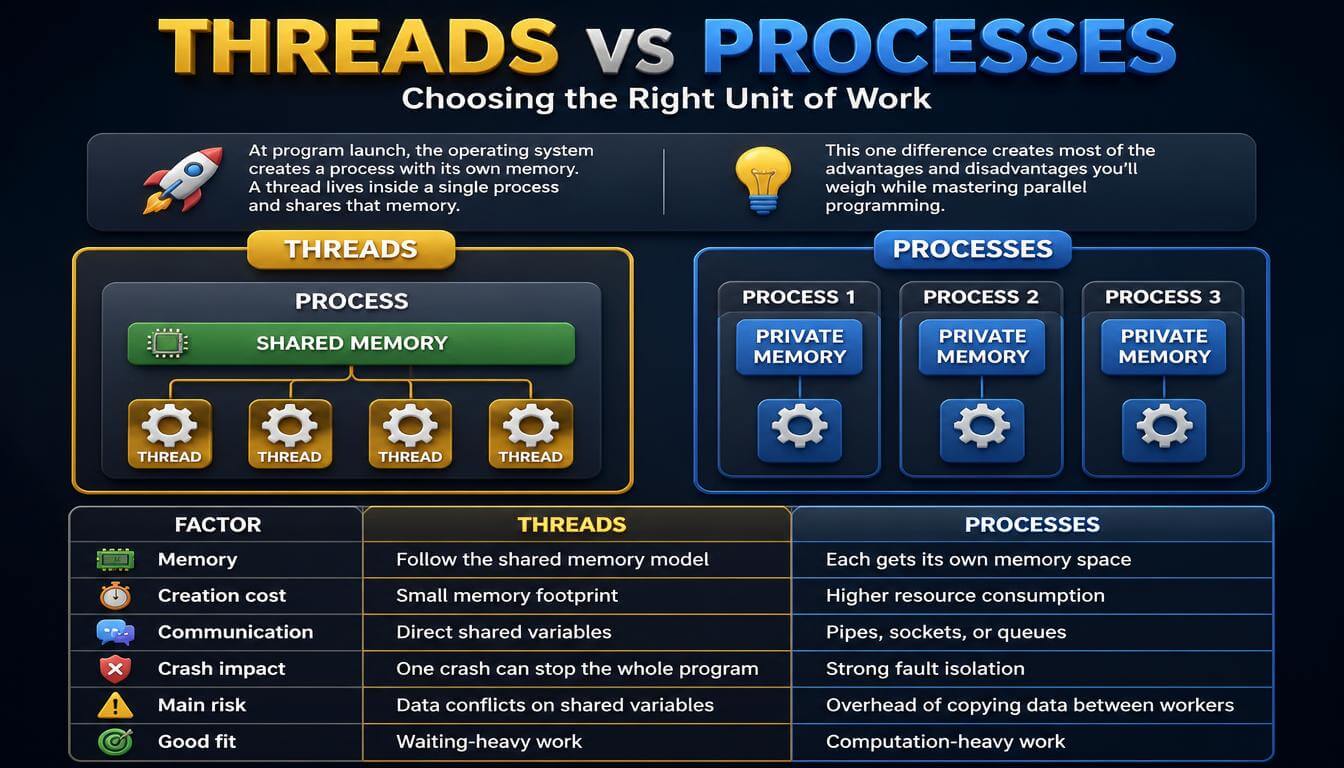
At program launch, the operating system creates a process with its own memory. A thread lives inside a single process and shares that memory. This one difference creates most of the advantages and disadvantages you’ll weigh while mastering parallel programming.
| Factor | Threads | Processes |
| Memory | Follow the shared memory model | Each gets its own memory space |
| Creation cost | Small memory footprint | Higher resource consumption |
| Communication | Direct shared variables | Pipes, sockets, or queues |
| Crash impact | One crash can stop the whole program | Strong fault isolation |
| Main risk | Data conflicts on shared variables | Overhead of copying data between workers |
| Good fit | Waiting-heavy work | Computation-heavy work |
Multithreading for Waiting-Heavy Work
Threads shine when work waits on disks or networks: while one waits, another runs. In GUIs, a dedicated UI thread handles clicks while helper threads fetch data, keeping the user experience smooth.
Because each thread mostly waits, the global lock rarely gets in the way. Go handles this with lightweight goroutines that pass results over channels, and Python’s coroutines offer another route to non-blocking I/O.
Multiprocessing for Computation-Heavy Work
For CPU-heavy tasks, separate processes let every core run at full speed, so you get genuinely parallel execution. Python’s multiprocessing module gives each worker its own interpreter:
from multiprocessing import Pool
def square_sum(n):
return sum(i * i for i in range(n))
if __name__ == “__main__”:
with Pool() as pool:
results = pool.map(square_sum, [5_000_000] * 4)
print(results)
Python 3.14 made the free-threaded build officially supported, but the default build still has the global lock, so check your runtime first.
Native Threads vs Green Threads
Native threads are created and scheduled by the operating system kernel, which manages their thread lifecycle. Green threads are lightweight execution units handled by a language runtime’s own scheduler, so context switching between them is cheap.
Classic green threads froze on one blocking call and couldn’t use a multi-core CPU. Go fixes this by multiplexing goroutines onto several OS threads. On Linux, C programs use POSIX Threads (pthreads), and both fork() and pthread_create() use the clone() system call, so threads share the PIDs numbering pool.
Synchronization Primitives That Protect Shared Data
When threads touch shared state, primitives keep data consistency and stop race conditions. Choosing the lightest primitive that still works is a key part of mastering parallel programming.
| Primitive | What it does | Typical use |
| Mutex | Lets one thread at a time into protected code | Updating a shared cache |
| Semaphore | Lets up to N threads in at once | Capping open database connections |
| Condition variable | Lets threads sleep until a condition becomes true | Producer-consumer handoffs: waking consumers when producers fill a thread-safe queue |
| Barrier | Holds threads until all of them reach one point | Phases of a simulation |
| Spinlock | Busy-waits instead of sleeping | Very short sections in kernel code |
| Atomic variable | Updates one value without a lock | Counters and std::atomic flags |
Each language wraps these tools differently:
- Python: threading.Lock and queue.Queue cover most needs.
- Java: synchronized methods, volatile fields for visibility, and the java.util.concurrent package, all governed by Java’s happens-before rules.
- C#: the Thread class offers Start, Sleep, and Join (Abort is unsupported in modern .NET), plus the lock keyword and the Interlocked class.
- C++: std::mutex with std::lock_guard, plus atomics whose memory ordering you can relax with std::memory_order_relaxed when speed matters.
Lock-free structures use atomic retry loops; adopt them only after profilers show heavy lock contention. Consistent lock ordering, resource ordering, and careful design prevent a circular wait, while deadlock detection catches the rest.
Common Concurrency Bugs and How to Fix Them
Concurrency bugs often vanish when you add a print statement because they depend on thread interleavings. Knowing the four classic failures is a big step toward mastering parallel programming, and it saves hours of debugging:
- Race condition: two threads make simultaneous writes to the same variable and lose updates. Fix it with mutexes, a Mutex object, compare-and-swap, or atomic operations for reliable race prevention.
- Deadlock: two threads each hold one lock and wait for the other’s. Fix it by always acquiring each lock in the same global order.
- Livelock: threads keep yielding to each other. Fix it with randomized retry delays.
- Starvation: one thread never gets into the critical section. Fix it with fair locks or queue-based scheduling.
A deadlock needs four conditions: mutual exclusion, hold and wait, no preemption, and a circular wait. Break one, and you get deadlock-free applications. Avoid anti-patterns like per-task threads or an oversized thread pool, and add runtime monitors.
Try a multithreaded counter: let two threads each increment or decrement a shared counter one million times. Without protection, the total falls short; with a lock or an atomic counter, it’s always correct.
Concurrency Models: Shared Memory vs Message Passing

Beyond individual locks, mastering parallel programming means planning how tasks communicate. Two models dominate, from desktop apps to large distributed systems, and both rest on memory models that define what each task can see.
With shared memory, threads share variables and guard them with locks, which is fast but harder to reason about at scale.
Message passing gives each task separate memory and moves data between tasks instead, much like inter-process communication between child processes created by forking, which talk through file descriptors. Go’s channels grew out of Tony Hoare’s CSP model, while Erlang is built around the actor model.
At cluster scale, MPI handles distributed-memory message passing and barriers, and MapReduce frameworks spread big data jobs across many machines for distributed computing.
Design Patterns: Thread Pool and Producer-Consumer
A thread pool keeps workers alive and hands them tasks and background jobs. Java’s ExecutorService, Python’s ThreadPoolExecutor, and C#’s Task.Run() all draw on pools like this.
Producer-consumer links pipeline stages through bounded queues. Python’s queue.Queue and C#’s BlockingCollection handle the waiting, coordination, and synchronization, so you don’t have to write condition variables by hand. A C# Semaphore can also cap a shared database connection pool.
Bounded queues also create backpressure. When consumers lag, producers pause instead of flooding memory. That keeps log analysis and data processing pipelines stable and eases a graceful shutdown, improving resilience. Producer-consumer is really a small message passing model, and it also works across processes through IPC.
Languages and Tools for Parallel Work
Your toolkit depends on whether the bottleneck is I/O-bound waiting or CPU-bound computing. That’s a decision you’ll make again and again while mastering parallel programming, whether you choose threads, processes, or asynchronous programming.
| Language | Waiting-heavy work | Computation-heavy work |
| Python | asyncio, threading | Multiprocessing library, ProcessPoolExecutor |
| Java | Virtual threads (Java 21+), CompletableFuture | ExecutorService, Fork/Join, parallel streams |
| Go | Goroutines with a WaitGroup | Goroutines spread across all cores |
| C# / .NET | async/await | Parallel.For, PLINQ |
| C / C++ | Event loops, std::async | std::thread, OpenMP, MPI |
| Rust | Async runtimes such as Tokio | std::thread, Rayon |
Java 21’s virtual threads let servers run huge numbers of lightweight threads for blocking I/O, while classic pools reuse a few heavy ones.
Compiled languages like C build binaries ahead of time and control SIMD instructions, while interpreted languages like JavaScript and PHP trade raw performance for faster development. Modern languages usually map their concurrency tools onto native threads. Go’s channels follow Communicating Sequential Processes (CSP), and Akka brings the actor model to the JVM.
In .NET, async methods support exception handling, Task.Delay(), and ConfigureAwait(false); PLINQ’s AsParallel() adds data parallelism; and Monitor, AutoResetEvent, and ManualResetEvent handle signaling.
Async/Await for Waiting-Heavy Work
Async/await lets one thread start a network call and resume when the result arrives, so tasks run in overlapping intervals, which preserves responsiveness and keeps a non-blocking UI.
In Python, asyncio runs many coroutines on one thread; in C#, await client.GetStringAsync(url) frees the thread during the wait, giving readable non-blocking I/O through Task-based Asynchronous Programming. This style suits a web scraper, event-driven services, or a high-performance API with many simultaneous connections. TAP supports task chaining with ContinueWith() and Task.WaitAll. Unlike old green threads in user space, async code doesn’t stall on a blocking system call.
Data Parallelism with Parallel Loops
Parallel.ForEach in C#, Java’s parallel streams, and Rust’s Rayon split large collections across CPU cores automatically. Under the hood, the library breaks the input into subtasks and balances them across workers; .NET’s Task Parallel Library (TPL) also offers Parallel.Invoke.
Always measure first. On small jobs, coordination overhead can wipe out any speedup.
When Not to Parallelize
Part of mastering parallel programming is knowing when to stop. Parallel code adds complexity and harder testing, so skip it when:
- The task finishes in milliseconds and runs rarely
- Each step depends on the previous one
- A better algorithm or a simple cache already solves the problem
Testing, Debugging, and Measuring Speedup
Concurrency bugs depend on thread timing, so a test can pass ten times and then fail. These habits, essential for mastering parallel programming, catch most of them:
- Run race detectors like Go’s -race flag or ThreadSanitizer for C/C++.
- Stress-test with many iterations and a varied thread count to expose rare interleaving orders, livelocks, and starvation.
- When progress stalls into perpetual waiting, use backoff strategies with randomization, a capped backoff, and fair scheduling by priorities; starvation is resource denial.
- Give lock-free data structures and wait-free data structures extra stress tests, and watch queue processing latency.
- Profile before you optimize, then track execution time, throughput, and resource utilization as your success metrics and milestones.
Amdahl’s law caps multi-core speedup: if 10% of a program is serial, no core count makes it more than ten times faster. Gustafson’s law adds hope: when the problem grows with the core count, bigger workloads keep scaling.
Real-World Applications of Parallel Programming
Mastering parallel programming pays off in practical applications you use every day, often with advanced concurrency across distributed computing environments and cloud environments:
- A web server such as Nginx uses event-driven programming to juggle many connections.
- Databases protect data consistency and transaction isolation with locks and versioning.
- Climate and other scientific workloads run simulations with MPI across nodes and OpenMP within them.
- Hadoop popularized running MapReduce over large datasets on distributed machines.
- Game engines spread rendering work across worker threads.
- Model training for AI/ML runs massive data-parallel math on GPUs.
- Fintech trading platforms, including high-frequency trading systems, process market data concurrently, and robotics relies on real-time systems with strict deadlines.
Future Trends in Parallel Programming
One of the clearest future trends is that accelerators like GPUs and FPGAs now take on work that once ran only on CPUs, so mastering parallel programming increasingly means targeting mixed parallel hardware, not just classic shared-memory multiprocessing (SMP) machines.
Cloud computing and microservices push message-passing concurrency across distributed clusters. Rust’s compiler rejects data races in safe code.
A Practical Path to Mastering Parallel Programming
Skills for real-world applications stick when you build things. Treat the steps below as hands-on exercises in a phased plan, where each step adds one new idea on top of the foundations of concurrency and parallelism.
Milestones to Track Your Progress
- Build a shared counter, break it, then fix it with a lock and an atomic type.
- Build a pipeline with producer/consumer queues, using Python’s queue.Queue or C#’s BlockingCollection.
- Write a concurrent web scraper and an async file read with asyncio or C# async/await.
- Speed up parallel image processing, then filter the even numbers from a range of 100,000 values in parallel.
- Recreate a deadlock with a reversed lock order, then fix it with a deadlock-free design.
- Compare your speedup with Amdahl’s prediction, then try practice projects like a distributed task queue, treating each step as a learning milestone.
How to Keep Learning
Two books stand out: Concurrency in Go by Katherine Cox-Buday, with clear code examples, and Seven Concurrency Models in Seven Weeks by Paul Butcher, which compares key techniques across languages. Java Concurrency in Practice by Brian Goetz suits Java developers.
For structured courses, try Coursera, edX, or Udemy. Contributing to open-source projects then turns that knowledge into real experience.
Read More: https://linkneon.com/dedicated-wordpress-developers/
Frequently Asked Questions
Is parallel programming the same as concurrent programming?
No. Concurrent programming structures overlapping tasks; parallelism runs work at the same moment on several cores. In short, concurrent ≠ parallel: a single core can run concurrent code, but parallelism needs more than one processing unit.
Should I use threads or processes in Python?
Use threading or asyncio for waiting-heavy work like an async HTTP request, and multiprocessing for heavy computation, since the default CPython build still has the GIL.
What is the hardest part of mastering parallel programming?
Reasoning about shared state in concurrent code. Race conditions and deadlocks rarely show up in simple unit tests, so limit shared data and use thread analyzers.
How many threads should I create?
For heavy computation, start near one thread per core. For waiting-heavy work, more threads or async tasks help. Measure throughput instead of guessing.
Which language is best for mastering parallel programming?
No single language wins. Go makes goroutines easy, C# and Java offer mature frameworks, and C++ exposes hardware detail.
Does adding more cores always make code faster?
No. Serial sections, lock contention, and false sharing limit gains, and extra cores can even slow a concurrent application down.
Final Thoughts
Mastering parallel programming comes down to two decisions: whether your work mostly waits or computes, and how your tasks share data. Get those right, and scaling concurrency in any language makes sense.
Next step: measure one slow job, parallelize it with the matching tool, and measure again. That experiment teaches mastering parallel programming better than a week of reading.
No one gets this right on the first try. Start small, break things on purpose, and read your measurements honestly. Each bug you fix shows how threads really behave, and that understanding is what turns fast code into reliable code.