

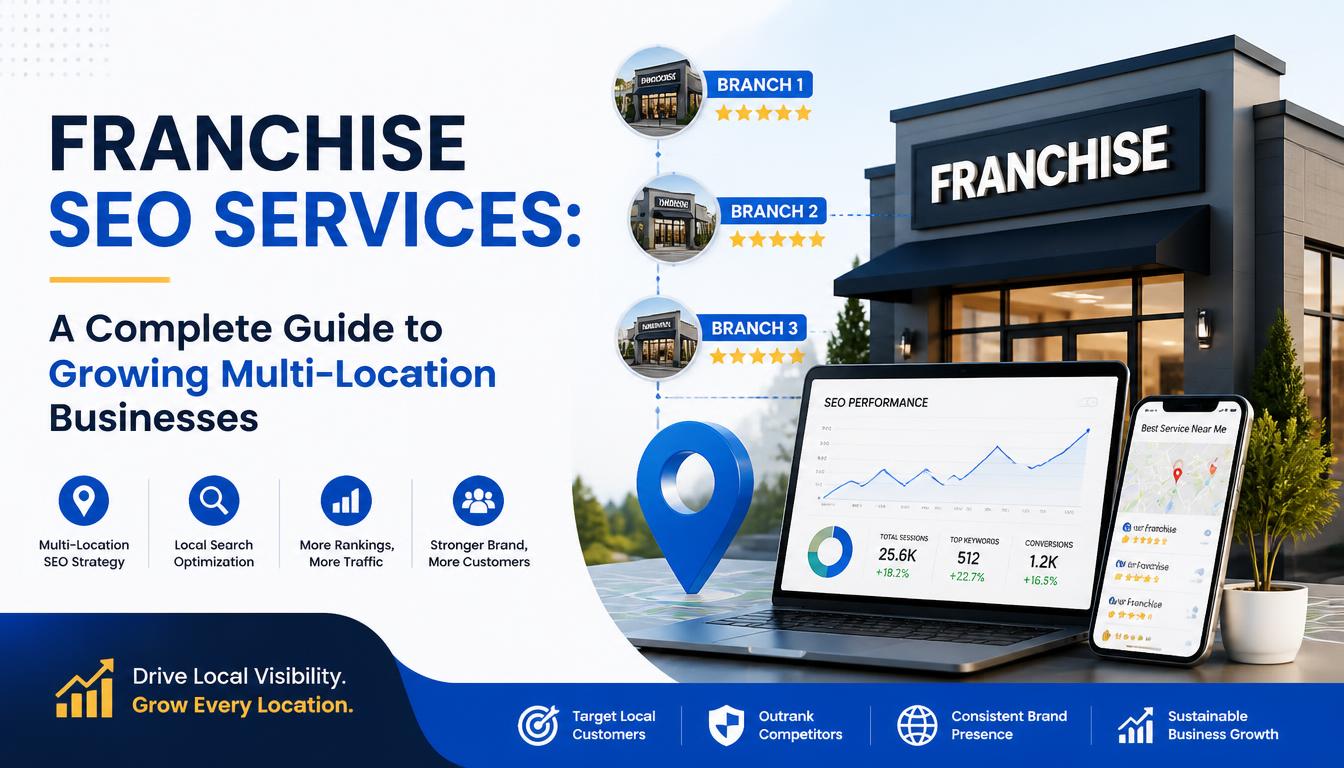
Franchise businesses face a unique SEO challenge: they need to build national brand authority while helping individual franchise locations attract customers locally. A strong franchise SEO strategy connects these goals by improving organic search visibility, strengthening local search presence, and creating a consistent customer experience across every location.
Franchise SEO services help businesses optimize their websites, Google Business Profiles, location pages, and local content to reach customers searching for relevant products or services. Whether a company operates ten locations or hundreds, a well-planned strategy can help franchise owners compete in local search results while supporting the overall brand.
This guide explains how franchise SEO works, which optimization services matter most, how to develop a scalable strategy, and what to consider when choosing a franchise SEO agency.
What Are Franchise SEO Services?
Franchise SEO services are search engine optimization solutions designed for businesses operating through multiple locations under one brand. They combine national SEO, local SEO, technical SEO, content development, and performance tracking to improve visibility across different geographic markets.
Unlike traditional SEO for a single business, franchise SEO must balance the needs of the corporate website with the requirements of individual franchise locations. The corporate team needs consistent brand messaging, while each franchise owner needs relevant local visibility and qualified leads.
For example, a franchise with locations in London, Manchester, and Birmingham may need a central website that establishes brand authority alongside dedicated location pages that target customers in each city. Each page should provide useful local information rather than simply replacing one city name with another.
The goal is to make the brand easier to discover in relevant searches while helping individual locations generate calls, enquiries, bookings, and visits.
Why Franchise Businesses Need a Specialized SEO Strategy
Managing SEO for multiple locations is more complex than optimizing a single business website. Each location may serve a different audience, face different competitors, and have different local search opportunities. A strategy that works in one city may not produce the same results elsewhere.
Franchise SEO creates a structured approach that connects corporate marketing with local search optimization. It also helps prevent duplicate content, inconsistent business information, and unnecessary competition between location pages.
A well-managed strategy can support several business objectives:
- Improve organic visibility for relevant service and location-based searches.
- Strengthen local brand awareness and help potential customers discover nearby branches.
- Generate more qualified enquiries through useful pages and clear calls to action.
- Maintain consistent business information and brand messaging across multiple locations.
Results depend on factors such as market competition, website quality, customer demand, and the consistency of implementation. SEO should therefore be measured against meaningful business outcomes rather than rankings alone.
Core Franchise SEO Services
1. Franchise Keyword Research and Mapping
Keyword research identifies the search terms potential customers use when looking for a franchise brand, its products, or its services. Franchise SEO requires research at both national and local levels.
National keywords may include broad service-related searches, while local keywords often combine a service with a city, neighbourhood, or other geographic modifier. Search intent is important because someone researching a service may need different information from someone ready to contact a nearby location.
Keyword mapping assigns relevant search terms to the most appropriate pages. The corporate homepage can target the main brand and broad service topics, while individual location pages focus on services available in their respective areas.
This structure helps search engines understand each page’s purpose and reduces unnecessary overlap between pages. Keyword selection should be guided by relevance, search intent, competition, and available data rather than keyword volume alone.
2. Local SEO for Franchise Locations
Local SEO helps individual franchise locations appear when nearby customers search for relevant products or services. Google Business Profile optimization is an important part of this process because it allows eligible businesses to manage their information in Google Search and Maps.
Each eligible location should have accurate business information, including its name, address, phone number, opening hours, website link, and available services. Categories should reflect the actual business, and each profile should be managed according to Google’s guidelines.
Local SEO also involves monitoring customer reviews, maintaining consistent business information across relevant directories, and improving the location page connected to each profile. Businesses with multiple branches should maintain clear ownership and management processes so updates remain accurate.
Local rankings depend on several factors, including relevance, distance, and prominence. No agency can guarantee a specific ranking or placement in Google’s local results.
3. Franchise Location Page Optimization
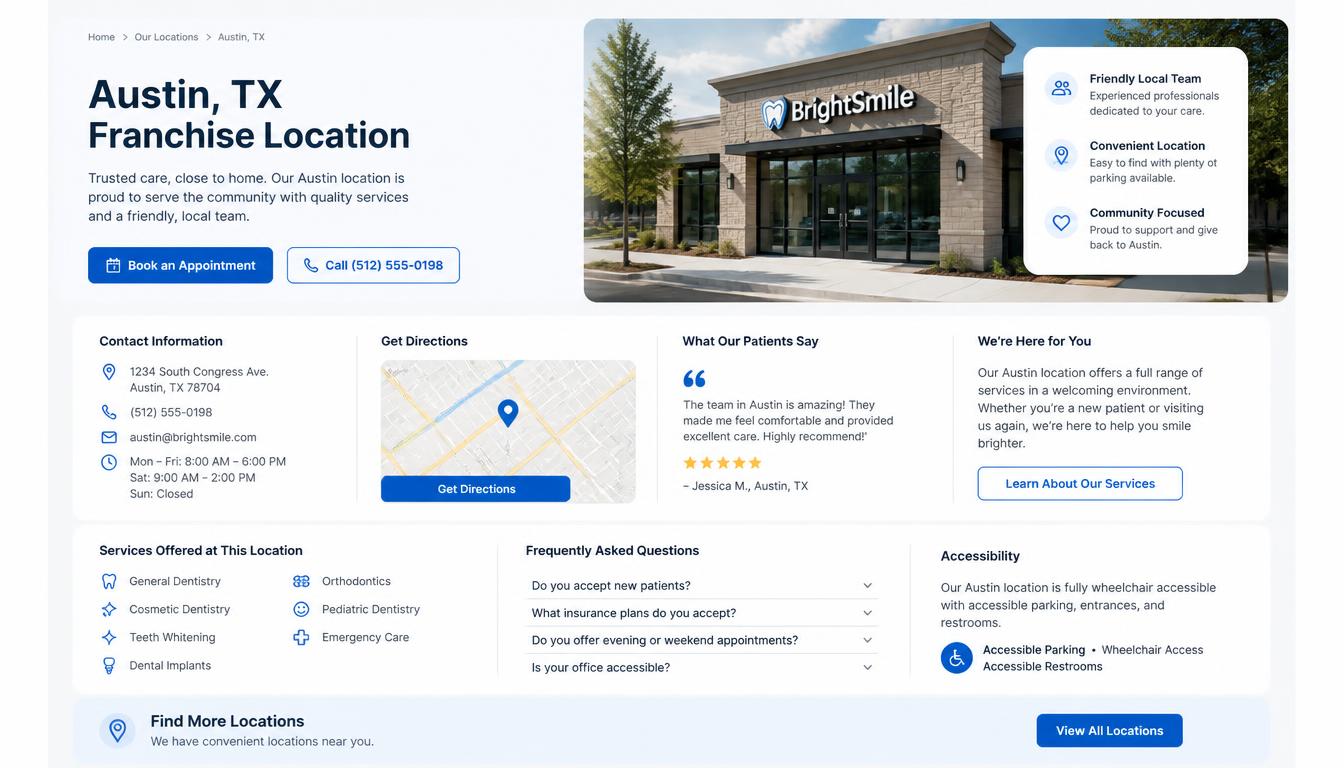
Location page optimization is essential for franchise websites because it connects a business’s services with the customers and communities it serves. A useful location page gives visitors enough information to understand what is available at that particular branch and how to contact it.
Each page should have a clear title, descriptive heading, relevant service information, accurate contact details, and a prominent call to action. Where appropriate, it can also include genuine local photographs, location-specific FAQs, customer testimonials, accessibility details, and directions.
Location pages should offer meaningful value beyond the city name. Reusing the same generic copy across dozens of pages can create a poor user experience and make it difficult for each page to stand out. Local details should be included only when they are accurate and genuinely useful.
Internal linking should connect location pages with relevant service pages and the main locations directory. This helps visitors navigate the website and gives search engines a clearer understanding of the site’s structure.
4. Technical SEO for Multi-Location Websites
Technical SEO helps search engines discover, crawl, and understand franchise websites. As the number of locations grows, technical problems can become harder to identify and manage without a consistent process.
A technical audit should review indexability, XML sitemaps, canonical tags, redirects, broken links, mobile usability, page speed, and Core Web Vitals. It should also check whether important location pages can be reached through internal links and whether unnecessary URL variations are creating duplicate or low-value pages.
Structured data may help search engines interpret relevant business information when implemented correctly. LocalBusiness structured data should reflect the actual business and location represented on the page. Markup must be accurate, consistent with visible content, and aligned with Google’s documentation.
Technical SEO does not guarantee rankings, but it can remove obstacles that prevent search engines and users from accessing important pages.
5. Franchise Content Marketing
Content marketing supports franchise SEO by answering customers’ questions and demonstrating the brand’s expertise. Useful content can include service guides, buying advice, industry explanations, frequently asked questions, and genuinely relevant local resources.
A franchise content strategy should establish clear responsibilities between corporate marketing and local franchise owners. Corporate content can address broader customer needs, while local content can cover topics that genuinely differ by market, such as service availability, local regulations, seasonal demand, or community involvement.
Publishing large numbers of nearly identical city articles is not a substitute for useful content. Each article or location page should serve a clear purpose and provide information that helps readers make informed decisions.
Content should also reflect the customer journey. Informational pages can answer early research questions, service pages can explain available solutions, and location pages can help customers contact the nearest branch.
6. Franchise Link Building and Brand Authority
Link building can help search engines discover pages and understand how a website fits into its wider online environment. For franchise businesses, it should focus on genuine relationships and relevant sources rather than acquiring links simply to increase link counts.
Corporate marketing teams may earn backlinks through industry publications, partnerships, original research, useful resources, and legitimate public relations activity. Individual franchise locations may also gain relevant visibility through local business associations, community organizations, sponsorships, and local media coverage when these relationships are genuine.
A franchise link-building strategy should follow search engine spam policies. Buying links intended to manipulate rankings, using automated link schemes, or creating artificial directory listings can introduce unnecessary risk.
The best approach is to build a credible brand presence and earn relevant mentions that make sense for the business and its audience.
7. Online Reputation and Review Management
Online reputation management helps franchise businesses monitor customer feedback, respond professionally, and identify recurring service issues. Reviews can influence how people evaluate a franchise before contacting or visiting a location.
Corporate teams should establish review management guidelines that protect brand consistency without making every response sound identical. Local managers can then address the specific concern raised by each customer.
Responses should be polite, relevant, and honest. Businesses should not publish fake reviews, offer prohibited incentives, or pressure customers to leave only positive feedback. Review requests should follow the applicable platform policies.
Review monitoring can also reveal operational patterns across locations. If customers repeatedly mention the same issue, franchise management can use that feedback to improve service delivery rather than treating reviews as an SEO task alone.
8. Franchise SEO Analytics and Reporting
SEO analytics and reporting help corporate teams and franchise owners understand which activities contribute to business performance. A useful reporting system separates overall brand performance from results for individual locations.
Google Search Console can show organic search impressions, clicks, click-through rates, and average positions. Analytics tools can help measure website engagement and conversions when tracking is configured correctly. Call tracking, enquiry forms, bookings, and other meaningful actions can provide additional insight into lead generation.
Reports should distinguish between traffic and business outcomes. An increase in visits does not necessarily mean an increase in qualified leads or revenue. Similarly, ranking changes should be interpreted alongside conversion data, seasonality, competition, and changes in demand.
A consistent reporting framework makes it easier to identify underperforming locations, prioritize improvements, and communicate results to franchise stakeholders.
How to Build an Effective Franchise SEO Strategy
Step 1: Audit the Website and Existing Locations
Begin with a review of the corporate website, location pages, Google Business Profiles, and current organic search performance. Identify technical issues, missing pages, inaccurate business information, duplicate content, and locations with weak visibility.
The audit should also document the existing website structure and how users move between the homepage, service pages, location directory, and individual branches. This creates a baseline for measuring future improvements.
Step 2: Create a Scalable Website Structure
Organize the website so customers and search engines can find each location easily. A clear structure might include the homepage, core service pages, a locations directory, and dedicated pages for individual branches.
The URL structure should remain consistent and understandable as the franchise network expands. For example, a business may use a format such as /locations/manchester/ for a location page, provided it fits the website’s overall architecture.
Each page should have a defined purpose, and internal links should help visitors move naturally between relevant services and locations.
Step 3: Map Keywords to the Right Pages
Assign keywords according to search intent and geographic relevance. Broad brand and service terms generally belong on the most relevant corporate pages, while city-specific service terms may belong on location pages when the business genuinely serves those areas.
Avoid creating a separate page for every minor keyword variation. Instead, build useful pages that cover closely related search needs without becoming repetitive. Review keyword mapping periodically as services, locations, and customer demand change.
Step 4: Optimize Local Profiles and Landing Pages
Verify that every eligible franchise location has accurate business information and an appropriate Google Business Profile. Improve location pages with relevant services, local details, clear contact information, and helpful calls to action.
Corporate teams should establish standards for business names, addresses, phone numbers, categories, photographs, and profile access. Franchise owners should know which updates they can make independently and which require corporate approval.
This balance supports consistency while allowing genuine differences between individual locations.
Step 5: Publish Helpful Content and Earn Relevant Links
Develop content around real customer questions, service needs, and local market differences. Review existing content before creating new pages so the website does not accumulate overlapping articles that compete for the same search intent.
Support the content strategy with legitimate outreach, partnerships, local involvement, and useful resources that may naturally attract relevant mentions and links. Measure content performance using engagement, relevant organic traffic, and meaningful conversions rather than publication volume alone.
Step 6: Measure Results and Improve Continuously
Set a baseline before implementation and define what success means for the business. Depending on the franchise model, useful metrics may include organic leads, calls, bookings, qualified enquiries, local visibility, and conversion rate.
Review results by location as well as across the entire network. A location with lower performance may need better content, technical fixes, improved profile information, or a closer look at local competition. Prioritize changes according to likely business impact and available evidence.
Franchise SEO Services: Pricing and Cost Factors
The cost of franchise SEO services varies according to the size and complexity of the business. A franchise with a small number of locations and a well-structured website may require less work than a large network with hundreds of branches, inconsistent business information, and substantial technical problems.
Pricing can depend on the number of locations, the competitiveness of target markets, the condition of the existing website, the amount of content required, and the level of reporting and support. Some agencies charge a monthly retainer, while others use project-based pricing or a combination of both.
Before comparing proposals, ask agencies to explain which activities are included, how location-level performance will be measured, who manages Google Business Profiles, and how technical or content issues are prioritized. Request clear deliverables rather than relying on broad promises of rankings or traffic growth.
The lowest price is not automatically the best value, and a higher price does not guarantee better results. Choose a service scope that fits the business’s goals, resources, and operational requirements.
How to Choose the Right Franchise SEO Agency

Choosing a franchise SEO agency requires more than comparing monthly fees. The provider should understand the relationship between corporate brand management and local search optimization, particularly when multiple franchise owners need to follow the same standards.
Before selecting an agency, evaluate these key areas:
- Franchise SEO experience: Look for relevant experience with multi-location websites and local search campaigns.
- Transparent reporting: Ask how the agency measures organic traffic, qualified leads, conversions, and location-level performance.
- Scalable processes: Confirm how it manages location pages, profile updates, content approvals, and new branch openings.
Request relevant case studies and ask how reported outcomes were measured. Credible examples should explain the starting situation, the work completed, the time period, and the results that can reasonably be attributed to the campaign.
Be cautious of guaranteed rankings, unexplained traffic claims, or strategies based entirely on mass-produced location pages. A good agency should communicate clearly with corporate teams and franchise owners. Responsibilities, approval workflows, reporting schedules, and account access should be established before work begins.
Common Franchise SEO Mistakes to Avoid
Franchise businesses can weaken their search performance when they publish duplicate location pages, use inaccurate business information, or allow local profiles to become outdated. These problems can confuse customers and make location management more difficult.
Another common mistake is focusing exclusively on rankings while ignoring enquiries, calls, bookings, and other business outcomes. Keyword rankings are useful indicators, but they should be considered alongside the metrics that matter to the business.
Overusing location keywords can also make content difficult to read. Each page should explain the business naturally and provide genuine value to its intended audience. Adding cities to a page without actually serving those areas can mislead customers and create unnecessary SEO risk.
Finally, neglecting technical maintenance can allow broken links, indexing issues, and outdated information to accumulate. A repeatable audit and review process helps the franchise network maintain quality as it grows.
Frequently Asked Questions About Franchise SEO Services
What Are Franchise SEO Services?
Franchise SEO services help multi-location businesses improve search visibility at both the corporate and local levels. They typically include keyword research, local SEO, location page optimization, technical SEO, content marketing, reputation management, and performance reporting.
How Is Franchise SEO Different From Local SEO?
Local SEO generally focuses on improving visibility for a particular business or location. Franchise SEO coordinates local optimization across multiple branches while maintaining consistent corporate standards, website architecture, reporting, and brand messaging.
How Long Does Franchise SEO Take to Show Results?
The timeline depends on competition, website condition, location authority, implementation quality, and the amount of work required. Some improvements may be visible relatively quickly, while stronger and more consistent organic performance can take several months or longer. No provider can guarantee a specific timeline or ranking.
Do Franchise Businesses Need Separate Pages for Every Location?
Dedicated franchise location pages are useful when each branch has a genuine presence and distinct information to provide customers. Pages should include accurate location details, relevant services, and useful local information. Creating large numbers of near-identical pages solely to target keywords should be avoided.
Can Franchise SEO Help Improve Leads and Enquiries?
Yes, franchise SEO can help potential customers discover relevant locations through organic and local search. However, lead generation also depends on factors such as service demand, competition, website usability, pricing, reputation, and the effectiveness of calls to action. Performance should be measured through meaningful conversions, not traffic alone.
What Should Franchise SEO Reporting Include?
Reporting should cover organic search performance, relevant keyword visibility, location-level traffic, conversions, technical issues, and Google Business Profile performance where suitable data is available. The exact metrics should reflect the business model and the goals established at the start of the campaign.
Read More: https://linkneon.com/seo-packages-small-business-uk/
Conclusion: Grow Your Franchise With a Scalable SEO Strategy
Franchise SEO services help multi-location businesses connect corporate brand authority with the needs of local customers. A well-organized strategy combines accurate business information, useful location pages, technical optimization, relevant content, reputation management, and consistent performance measurement.
The most effective approach is not to create as many pages or target as many keywords as possible. It is to build a useful, technically sound website that helps customers find the right location and understand the services available to them.
Whether you manage a growing franchise or an established national network, start by auditing your existing search presence, identifying the locations with the greatest opportunities, and prioritizing improvements that support real business goals. With consistent implementation and regular evaluation, franchise SEO can become a sustainable part of your wider customer acquisition strategy.