

The breakdown of a family is one of the most painful moments in a person’s life. People facing divorce, child custody or child support issues are often dealing with stress and uncertainty. In moments like these, they turn online to find a family lawyer who understands their situation and can guide them through it.
This is where family law SEO plays a key role. It helps family law firms reach people online who are looking for help with divorce, custody or other family-related legal matters. When someone searches for “divorce lawyer near me” or “emergency custody attorney,” appearing prominently in the search results gives a law firm the chance to connect with new clients.
This guide shows you how to make your firm one of the first that people find. You will follow a nine-step roadmap for 2026: audit your website, research local keywords, win the Map Pack with a strong Google Business Profile and client reviews, build practice area pages, optimize on-page and technical SEO, earn quality backlinks, prepare for AI search and track what works. You will also see how SEO compares with PPC, which mistakes to avoid and the answers to the questions firm owners ask most.
What Is Family Law SEO?
Family law SEO is the process of optimizing a firm’s website, Google Business Profile and content so it ranks when potential clients search for divorce, custody or other family law services in their area. The goal is simple: appear at the top of search engine results pages (SERPs) and on Google Maps when someone nearby needs legal help, then turn that visit into a consultation.
For many clients, this is the first time they have needed a family attorney, and they may not know anyone who has hired one. As a result, they search online. Industry surveys show that the vast majority of people seeking legal services use a search engine to find them.
How Family Law SEO Differs From General Law Firm SEO
Generic law firm SEO is not enough here. Family law searches have traits that shape every decision in your strategy:
- Hyperlocal intent: family law is governed by state law and often county court procedure, so clients want a lawyer who knows their courthouse and jurisdiction, not just their state.
- High urgency: people often search in a crisis, at unusual hours, with high emotional stakes.
- YMYL topic: legal advice can affect a person’s finances and well-being, so Google holds it to a higher quality standard (covered below).
- Heavy competition: tens of thousands of family law and divorce attorneys compete for the same searches across the U.S..
Family Law Practice Areas Your SEO Should Cover
Family lawyers handle emotionally charged cases that can touch constitutional law, real estate, taxes and sometimes criminal law. Each area below has its own search demand and deserves its own optimization:
- Divorce and legal separation
- Child custody and visitation
- Child support and spousal support (alimony)
- Adoption
- Domestic violence and protective orders
- Property division
- Prenuptial agreements, wills and custody arrangements
Why Family Law Firms Need SEO in 2026
Most family law clients now start with a search, not a referral. Unlike many legal services, family law often reaches people who have never hired a lawyer before, so online search replaces word of mouth.
How Clients Search for Family Lawyers Online
People usually find a family lawyer in one of three ways:
- A referral from a family member, friend or colleague
- Researching firms they already know by reading their website, testimonials and reviews
- Using a search engine to find firms that match their need and location
Unless they already know a local attorney, most people choose the third option. They also rarely scroll far. The top few organic results receive most of the clicks, and few users ever open the second page. Searches are also moving into Google AI Overviews and ChatGPT, so firms now compete for visibility in AI answers too.
Competition, Conversion Rates and Market Data
The numbers below show why family law SEO deserves a real budget. These are industry estimates, so treat them as planning benchmarks, not guarantees.
| Metric | Industry estimate |
| Family law and divorce attorneys competing in the U.S. | Tens of thousands |
| Monthly searches for core terms like “divorce lawyer” | Tens of thousands |
| Organic visitor-to-lead conversion for family law | Among the highest of any legal practice area |
| People seeking legal help who start with a search engine | The vast majority |
| Consumers who read online reviews for local businesses | Nearly all |
| Nearby searchers who visit a business within a day | Around three in four |
| Typical monthly SEO budget in competitive markets | Roughly $3,000 to $10,000 |
| Time to first measurable ranking movement | Often 3 to 4 months |
Key Benefits of Family Law SEO
- Increased online visibility: your firm appears among the first options when people search for divorce, custody or support
- High-intent traffic: SEO attracts people actively looking for legal guidance, so visitors are more likely to become clients.
- Stronger local reach: local SEO puts you in map searches, the Local Pack and local directories in your community.
- Trust and credibility: ranking at the top signals an established, reputable firm, especially when backed by helpful content and positive reviews.
- Cost-effective, long-term lead generation: unlike paid ads that stop when spending stops, organic rankings keep bringing leads and deliver a stronger return on investment (ROI) over time.
- Competitive advantage: your competitors are investing in SEO, so doing it better is how you become the region’s go-to practice.
- Data-driven decisions: SEO tools reveal user behavior, search trends and website performance, guiding smarter marketing choices.
How Google Ranks Family Law Websites
Google uses a complex algorithm with hundreds of ranking factors to decide which pages appear first. You do not need to master all of them, but family law SEO depends on understanding the few that matter most.
Search Intent: Information Seekers vs. Ready-to-Hire Clients
Search intent is the goal behind a query. It tells you what kind of page should rank:
- Informational intent: “how is child custody determined in Florida” means the person wants answers, so a guide or blog post fits.
- Hiring (commercial) intent: “child custody lawyer in Miami” means the person wants to hire, so a service page with a clear call to action
Matching each page to the right intent is one of the fastest ways to improve rankings and conversions.
YMYL and E-E-A-T for Family Lawyers
Law is a Your Money or Your Life (YMYL) topic because it can affect a person’s financial stability and well-being. Google therefore rewards content that shows E-E-A-T:
- Experience: real examples, case studies and client testimonials from divorce or custody matters.
- Expertise: plain-language step-by-step guides, FAQ sections and visible credentials and qualifications.
- Authoritativeness: recognition from legal directories, local news outlets, respected legal blogs and interviews.
- Trustworthiness: clear contact details, HTTPS, a privacy policy, honest reviews and transparent service information.
Core Ranking Signals at a Glance
| Ranking signal | What it means | Family law example |
| Keywords | Terms people type into Google | A Detroit divorce page ranking for “divorce lawyer Detroit” |
| Content quality | Depth, clarity and usefulness | A clear guide to the custody process in your state |
| Authority | Quality and number of backlinks | Links from a local bar association or news site |
| User engagement | Click-through rate, dwell time, bounce rate | Visitors reading your alimony guide instead of leaving |
| Technical SEO | Page speed, mobile friendliness, crawlability | A fast, mobile-friendly site for late-night phone searches |
| Freshness | New and updated content | Updating child support pages when guidelines change |
| Local signals | Proximity, relevance, prominence | A complete Google Business Profile with steady reviews |
On-page SEO covers what you control on your site, such as copy and speed. Off-page SEO covers signals earned elsewhere, such as backlinks and social media mentions.
The nine steps below turn these ranking signals into a practical plan for your firm.
Step 1: Audit Your Website and Competitors
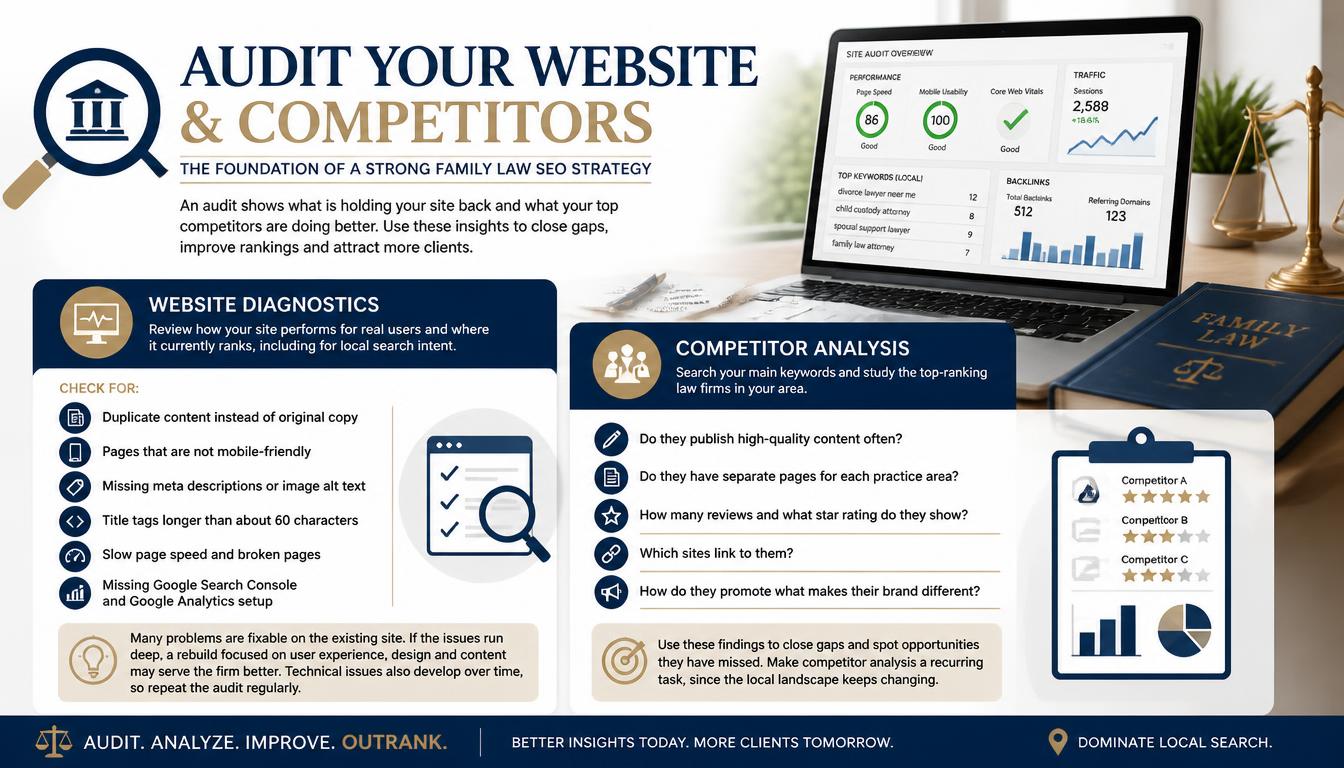
Every strong SEO campaign for a family law firm starts with a clear picture of where you stand. An audit shows what is holding your site back and what your top competitors are doing better.
Website Diagnostics
Review how your site performs for real users and where it currently ranks, including for local search intent. Check for:
- Duplicate content instead of original copy
- Pages that are not mobile-friendly
- Missing meta descriptions or image alt text
- Title tags longer than about 60 characters
- Slow page speed and broken pages
- Missing Google Search Console and Google Analytics setup
Many problems are fixable on the existing site. If the issues run deep, a rebuild focused on user experience, design and content may serve the firm better. Technical issues also develop over time, so repeat the audit regularly.
Competitor Analysis
Search your main keywords and study the top-ranking law firms in your area. Note what they do well:
- Do they publish high-quality content often?
- Do they have separate pages for each practice area?
- How many reviews and what star rating do they show?
- Which sites link to them?
- How do they promote what makes their brand different?
Use these findings to close gaps and spot opportunities they have missed. Make competitor analysis a recurring task, since the local landscape keeps changing.
Step 2: Research Family Law Keywords
Keyword research is the foundation of family law SEO because it shows the exact words your future clients type into Google. Tools like Google Keyword Planner, Ahrefs and Semrush make this process faster and data-driven.
Seed Keywords by Practice Area
Start by listing your core topics, such as divorce, child custody, spousal support, domestic violence and prenuptial agreements. For each, write a few short seed keywords:
- “divorce lawyer”
- “child custody help”
- “family law advice”
- “family law attorney”
Enter each seed term into a tool such as the Ahrefs Keyword Explorer to see related keyword ideas.
Long-Tail and Location-Based Keywords
Broad terms are very competitive. Long-tail keywords are longer and more specific, so they get less traffic but are easier to rank for and show clearer intent. Add your city, county or neighborhood to make them local.
| Seed keyword | Long-tail local keyword | Intent |
| divorce lawyer | divorce mediation lawyer in Miami | Hire |
| divorce lawyer | how much does a divorce lawyer cost in Miami | Research |
| child custody lawyer | child custody lawyer in [your city] | Hire |
| divorce | how to file for divorce in [your state] | Information |
| divorce attorney | divorce attorney near me | Hire |
| family law attorney | family law attorney in [your city] | Hire |
Prioritize by Search Volume and Keyword Difficulty
Add every keyword to a spreadsheet with two metrics:
- Search volume: how many people search the term each month.
- Keyword difficulty: how hard it is to rank, based on how many strong sites target it.
Prioritize terms with solid search volume and low difficulty. Confirm real volume for each city or county before building pages. Remember that people searching these terms are often going through something painful, so the content you build around them should be clear, accurate and compassionate.
Step 3: Dominate Local Search
Local search is where most family law cases are won. People searching for a service nearby tend to act fast, and many visit a business within a day. If your firm is missing from the Map Pack, those clients go to the competitors who appear there.
Set Up and Optimize Your Google Business Profile
Your Google Business Profile (GBP) is the most powerful local citation you have. It puts your firm on Google Maps and in the Local Pack, the three local listings that often appear above organic results.
- Sign in to your firm’s Google account and open Google Business Profile.
- Claim your existing listing, or select “Add your business.”
- Enter your business name, address, phone number, website URL, service areas and business hours.
- Verify by postcard, phone or email, depending on the options offered.
- Add a clear business description, office and team photos, and regular posts about divorce, custody or mediation.
- Keep every detail current, especially hours and locations, and reply to every review and question on your profile.
Google itself advises that complete, accurate business information helps your profile appear in the right local searches.
Choose “Family Law Attorney” as Your Primary Category
If your primary category is the generic “Lawyer,” you compete with every attorney in town. Set it to “Family Law Attorney” and add “Divorce Lawyer” as a secondary category if divorce is a core service. This single change is often the fastest local family law SEO win.
Go Hyperlocal With City and County Targeting
The Map Pack works at the city and county level, not the state level. A page targeting “divorce attorney in Oak Park” will usually rank faster and convert better than a broad “divorce attorney Chicago” page competing with dozens of established firms. Use local keywords such as “family law attorney in [city]” or “divorce lawyer near [neighborhood],” and reference your community naturally in your content.
Build NAP-Consistent Legal Directory Citations
NAP stands for name, address and phone number. These details must match exactly on your website, GBP and every directory. List your firm on trusted legal directories such as:
- Avvo
- Justia
- FindLaw
- com
These directories appear most often in family law citation audits. Even small mismatches can quietly erode your local rankings.
Earn Client Reviews Ethically and Privately
Reviews are one of the strongest local ranking signals and conversion signals. Consumer surveys consistently show that nearly all people read online reviews for local businesses, and many trust them almost as much as a personal referral.
Family law clients are often hesitant to post about something so personal, so make it easy:
- Ask at the moment of relief, such as when a decree is finalized or a custody matter resolves.
- Let clients use only a first name if they prefer.
- Automate requests through practice management software.
- Display testimonials on your website and lawyer directory sites.
Add Google Local Services Ads
Google Local Services Ads (LSAs) place your firm at the very top of local results. When linked to your GBP, they pull your business details and customer reviews, keeping your information consistent across Google.
Step 4: Create Practice Area Pages and Helpful Content
Content is what Google ranks and what clients read before they call. In family law SEO, the best content answers real questions in plain language and guides readers toward a consultation.
Build Dedicated Practice Area Pages
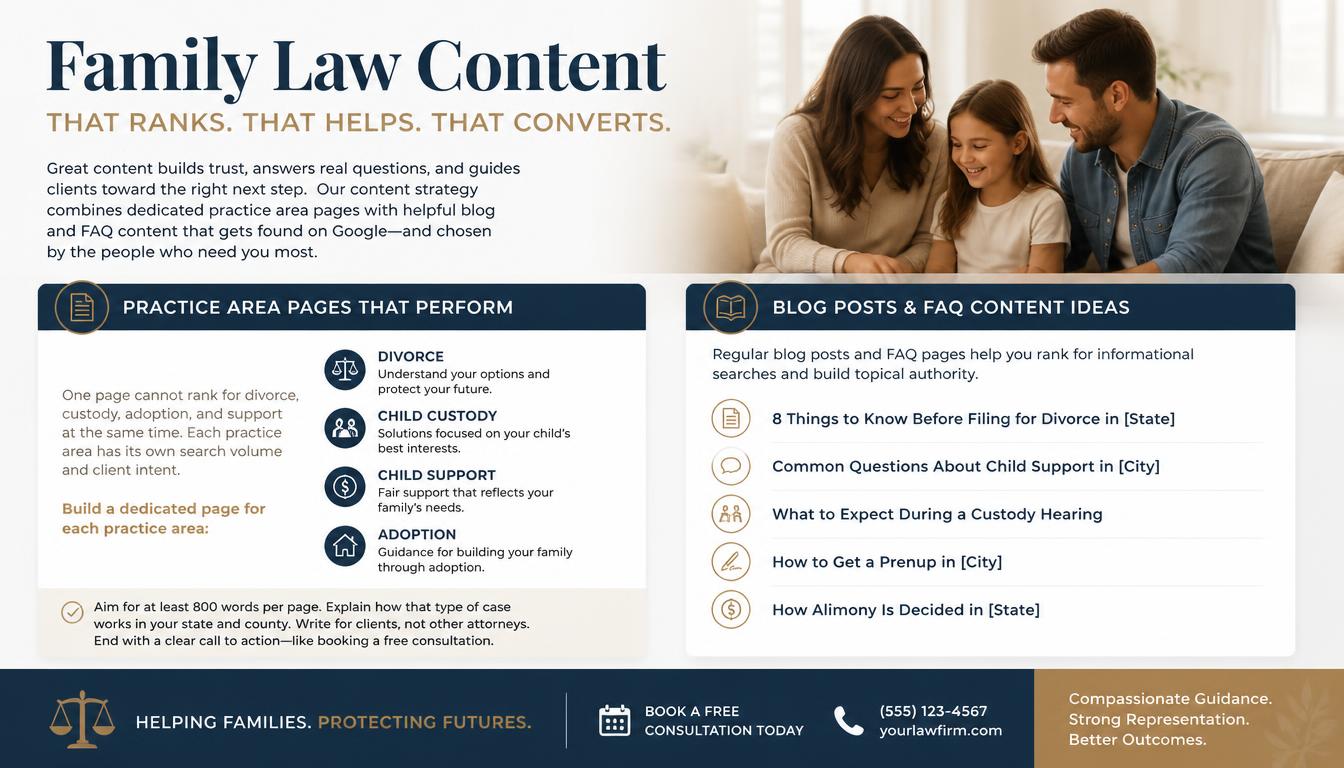
One page cannot rank for divorce, custody, adoption and support at the same time. Each practice area has its own search volume and client intent, so give each one its own service page:
- Aim for at least 800 words per page.
- Explain how that type of case works in your state and county.
- Write for clients, not other attorneys.
- End with a clear call to action (CTA), such as booking a free consultation.
Blog Post and FAQ Content Ideas
Regular blog posts and FAQ pages help you rank for informational searches and build topical authority. Ideas that match common client questions:
- 8 things to know before filing for divorce in [state]
- Common questions about child support in [city]
- What to expect during a custody hearing
- How to get a prenup in [city]
- How alimony is decided in [state]
- A step-by-step timeline of the divorce process
Keep every piece well-researched, up-to-date and easy to scan with subheadings, short paragraphs, bullet points and visuals like flowcharts or infographics. Avoid keyword stuffing and always proofread. If time is tight, a legal SEO writer can help.
Use Video to Increase Engagement
Video content, such as a custody hearing explainer or video testimonials, keeps visitors on the page longer and improves time-on-page metrics. You can also cross-post videos to YouTube, TikTok and other social media platforms to reach more people.
Write With Empathy for Sensitive Searches
Your readers are often stressed, scared or grieving. Content should be:
- Clear and jargon-free, explaining legal concepts in everyday words
- Empathetic, acknowledging how hard the situation is
- Trust-building, showing your qualifications, experience and success stories
- Action-oriented, telling readers exactly what to do next
Step 5: Optimize On-Page SEO Elements
On-page SEO makes each page easy for both Google and visitors to understand. Small details here add up to big ranking gains.
Title Tags, Meta Descriptions and URLs
- Title tag: include the primary keyword, such as “Divorce Lawyer in [Your City],” and keep it under about 60 characters.
- Meta description: write an engaging summary under about 160 characters that previews the page.
- URL: keep it short, simple and descriptive, such as /child-custody-lawyer-[city]/.
Header Tags and Keyword Placement
Use one H1 for the main topic, such as “Understanding Divorce Law,” then H2 and H3 tags for subtopics like “Custody Considerations” or “Prenuptial Agreements.” This content hierarchy helps readers scan and helps search engines understand the page. Place keywords naturally in the introduction, headings and conclusion without overstuffing.
Internal Linking Between Practice Pages
Internal links connect related pages and guide visitors deeper into your site. For example, link a blog post on mediation tips to your main family law services page, and link each practice area page to related guides. A child custody page, for instance, can link to guides on custody hearings, parenting plans and child support. This also helps Google understand your site structure.
Image Optimization and Alt Text
Give images descriptive file names, such as family-law-consultation.jpg, and add alt text that describes what the image shows. Alt text helps search engines read images and helps visually impaired users who rely on screen readers. Compress images so they do not slow the page down.
Step 6: Fix Technical SEO and User Experience
Technical SEO covers the behind-the-scenes parts of your website that affect rankings and visitor experience. Great content cannot rank well on a slow or broken site, which makes this step essential.
Page Speed and Core Web Vitals
Slow pages frustrate visitors, and people in a crisis will not wait. Test your site with Google PageSpeed Insights and improve your Core Web Vitals by compressing images, reducing heavy scripts and using reliable hosting.
Mobile Friendliness, HTTPS and Structured Data
- Mobile friendliness: many family law searches happen on phones, often late at night, so every page must work on any screen size.
- HTTPS: a secure connection protects visitors and is a basic trust signal.
- Structured data markup: schema helps search engines understand your firm, services, location and reviews. Use LegalService or Attorney schema for the firm and its lawyers.
Crawlability and Indexing
Search engines use automated bots (also called spiders) to crawl your site by following links. They then index each page, storing it in a huge database so it can appear in results. Make sure important pages are not blocked, have clean internal links and are listed in your XML sitemap.
Conversion-Focused Design and Calls to Action
Rankings only matter if visitors take the next step. A strong family law website includes:
- Calls to action on every page, such as “Book a Consultation” or “Call Now”
- Clear labeling so visitors find the right practice area fast
- A logical page flow from one topic to the next
- Attorney bios and your firm’s story to build a personal connection
- A calm, professional design that comforts people in distress
Step 7: Build Authority With Quality Backlinks
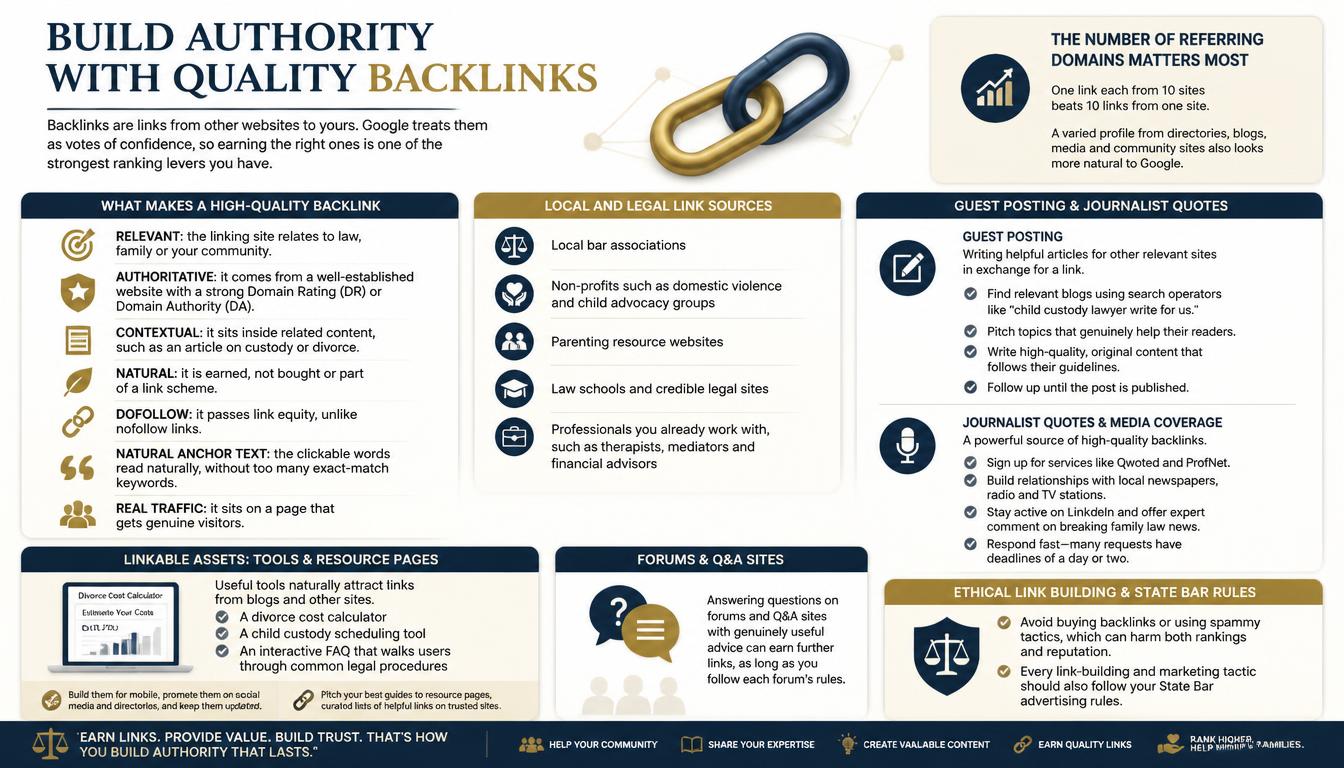
Backlinks are links from other websites to yours. Google treats them as votes of confidence, so earning the right ones is one of the strongest ranking levers you have.
What Makes a High-Quality Backlink
Quality matters far more than quantity. A strong backlink is:
- Relevant: the linking site relates to law, family or your community.
- Authoritative: it comes from a well-established website with a strong Domain Rating (DR) or Domain Authority (DA).
- Contextual: it sits inside related content, such as an article on custody or divorce.
- Natural: it is earned, not bought or part of a link scheme.
- Dofollow: it passes link equity, unlike nofollow
- Natural anchor text: the clickable words read naturally, without too many exact-match keywords.
- Real traffic: it sits on a page that gets genuine visitors.
The number of referring domains matters more than total links. One link each from 10 sites beats 10 links from one site. A varied profile from directories, blogs, media and community sites also looks more natural to Google.
Local and Legal Link Sources
Target sites that are trusted in family law and your area:
- Local bar associations
- Non-profits such as domestic violence and child advocacy groups
- Parenting resource websites
- Law schools and credible legal sites
- Professionals you already work with, such as therapists, mediators and financial advisors
Guest Posting and Journalist Quotes
Guest posting means writing helpful articles for other relevant sites in exchange for a link. To do it well:
- Find relevant blogs using search operators like “child custody lawyer write for us.”
- Study each site’s audience and content.
- Pitch topics that genuinely help their readers.
- Write high-quality, original content that follows their guidelines.
- Follow up until the post is published.
Media coverage is another powerful source. Sign up for journalist request services such as Qwoted and ProfNet, build relationships with local newspapers, radio and TV stations, stay active on LinkedIn and offer expert comment on breaking family law news. Respond fast, since many requests have deadlines of a day or two.
Linkable Assets: Calculators, Tools and Resource Pages
Useful tools naturally attract links from blogs and other sites. Ideas include:
- A divorce cost calculator
- A child custody scheduling tool
- An interactive FAQ that walks users through common legal procedures
Build them for mobile, promote them on social media and directories, and keep them updated. You can also pitch your best guides to resource pages, curated lists of helpful links on trusted sites. Answering questions on forums and Q&A sites with genuinely useful advice can earn further links, as long as you follow each forum’s rules.
Ethical Link Building and State Bar Rules
Avoid buying backlinks or using spammy tactics, which can harm both rankings and reputation. Every link-building and marketing tactic should also follow your State Bar advertising rules.
Step 8: Optimize for AI Search and AEO
More legal questions now start inside AI tools instead of a classic search box. Answer Engine Optimization (AEO) means structuring your content so tools like ChatGPT and Google AI Overviews can quote or cite it when someone asks, for example, “what are my first steps after being served divorce papers?” Being the source an AI cites builds visibility and trust, even when it does not produce a click.
Three practices make your family law SEO content AI-ready.
Write Answer-First Content
AI tools pull short, self-contained answers. Open each section with a one- or two-sentence answer, then add detail, examples and state-specific nuance below it. A question like “How is child support calculated in Texas?” should be answered directly before any background.
Strengthen Your Firm’s Entity Signals
AI systems connect facts about your firm from many places. Keep your firm name, address, practice areas and attorney credentials consistent across your website, Google Business Profile, legal directories and LinkedIn. Consistent entity signals make it easier for AI tools to link your firm to family law in your city.
Support AI Visibility With Structured Data
Add LegalService or Attorney schema sitewide and FAQPage markup on question-and-answer sections. Google now shows FAQ rich results only for a limited set of authoritative sites, but the markup still helps search engines understand your content.
Step 9: Track Results and Keep Improving
You cannot improve what you do not measure. Tracking shows which pages bring clients, which keywords are climbing and where your effort should go next.
Metrics That Matter for Family Law Firms
- Keyword rankings for your main practice area and local terms
- Organic traffic to each practice area page
- Engagement: time on page and bounce rate
- Conversions: phone calls, contact form submissions and booked consultations
- Map Pack visibility and review growth
- Backlinks and referring domains
SEO Tools to Use
| Tool | What it tracks |
| Google Search Console | Rankings, clicks, impressions and indexing issues |
| Google Analytics | Traffic, engagement and conversions |
| Semrush | Keyword rankings, competitors and site audits |
| Ahrefs | Backlinks, keyword ideas and Domain Rating |
| Moz | Backlinks, Domain Authority and site performance |
| Google PageSpeed Insights | Page speed and Core Web Vitals |
Ongoing Optimization and Algorithm Changes
SEO is an ongoing process, not a one-time task. Google’s algorithms change, AI is reshaping search and tactics that worked last year may fade. Review your results monthly, refresh older content, follow trusted SEO blogs and webinars, and adopt mobile-first improvements. Reaching page one is only half the job; staying there takes steady work.
Family Law SEO vs. PPC: Which Works Better?
The honest answer is that most competitive firms use both. SEO builds a lasting pipeline, while pay-per-click (PPC) advertising buys immediate visibility.
| Factor | SEO (organic) | PPC (paid ads) |
| Cost model | Time and investment in GBP, content and reviews | Ongoing cost per click |
| Time to results | About 3 to 4 months for movement, 6+ months for growth | Immediate |
| Long-term value | Compounds and keeps generating leads | Stops when spending stops |
| Best for | Building a durable case pipeline | Fast visibility in a new market |
| Main channels | Google Business Profile, practice area pages, reviews | Google Ads, Local Services Ads |
| Typical monthly cost | About $3,000 to $10,000 | Scales with ad spend and click costs |
A practical approach is to run PPC for urgent, high-intent searches while organic rankings grow in the background. As your Map Pack and organic listings strengthen, you can often reduce paid spend. Appearing in both paid and organic results at once also reinforces your firm’s credibility.
Common Family Law SEO Mistakes to Avoid
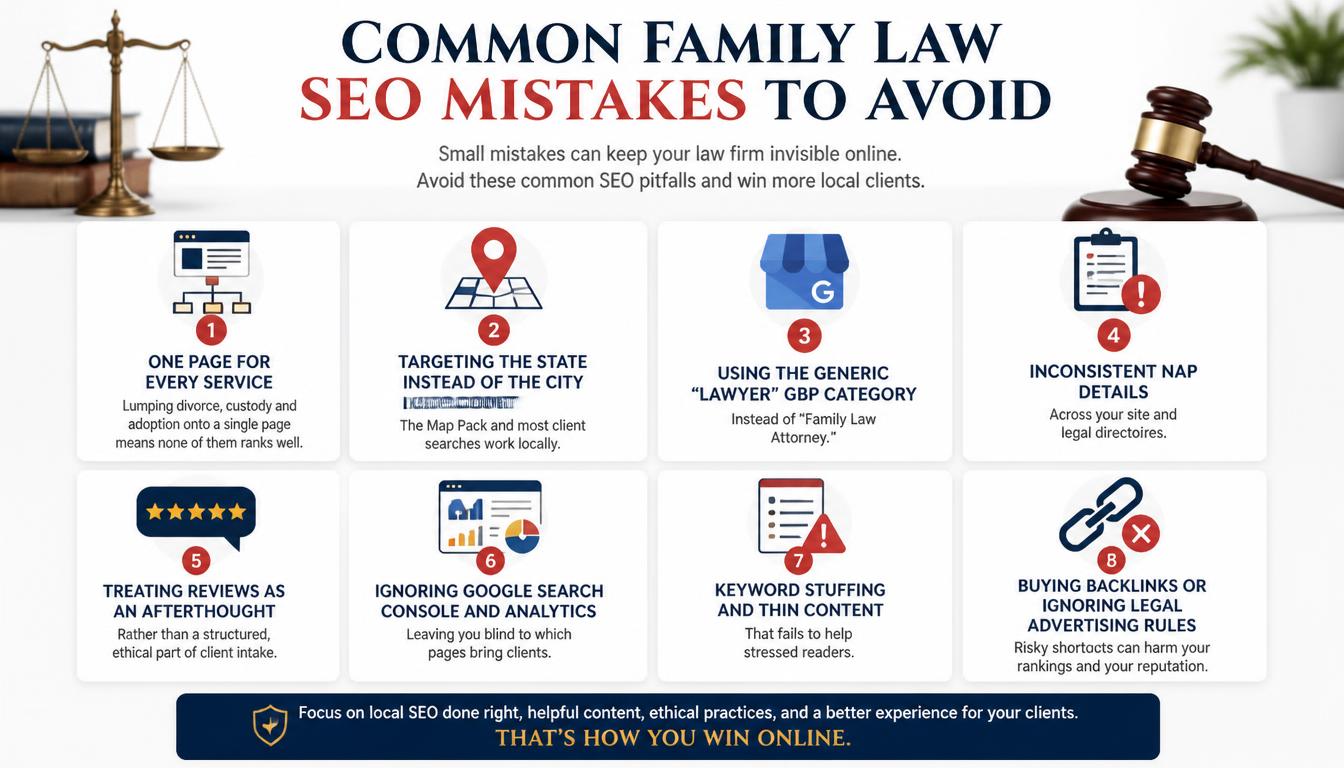
Many firms invest in SEO but lose results to a few avoidable errors:
- One page for every service: lumping divorce, custody and adoption onto a single page means none of them ranks well.
- Targeting the state instead of the city or county: the Map Pack and most client searches work locally.
- Using the generic “Lawyer” GBP category instead of “Family Law Attorney.”
- Inconsistent NAP details across your site and legal directories.
- Treating reviews as an afterthought rather than a structured, ethical part of client intake.
- Ignoring Google Search Console and Google Analytics, leaving you blind to which pages bring clients.
- Keyword stuffing and thin content that fails to help stressed readers.
- Buying backlinks or ignoring legal advertising rules.
Should You Hire an SEO Agency for Your Family Law Firm?
You can handle the basics yourself, such as completing your Google Business Profile and asking for reviews. Full-scale SEO, however, takes ongoing time and specialist skills that many busy attorneys cannot spare without hurting client work.
An experienced SEO agency can help when you need:
- Technical fixes for slow loading, broken pages or indexing issues
- Content production at a steady pace
- Link building and digital PR outreach
- Reporting that ties rankings to calls and signed cases
When choosing a partner, look for legal industry experience, a proven track record, transparent reporting and a clear understanding of legal advertising ethics.
Frequently Asked Questions About Family Law SEO
How much does family law SEO cost?
It depends on how competitive your market is and whether you work in-house or with an agency. Industry estimates put typical budgets in competitive markets at roughly $3,000 to $10,000 per month. Get a quote specific to your city before setting a budget.
How long does family law SEO take to show results?
Many firms see measurable ranking movement within about 3 to 4 months, with meaningful traffic and lead growth by month 6. Strong Map Pack positions in a competitive city can take 6 to 9 months of consistent work and review building.
Do legal directories like Avvo and Justia still matter?
Yes, mainly for NAP consistency and citation signals rather than direct traffic. Keeping your details identical across Avvo, Justia, FindLaw and Lawyers.com supports local rankings.
How can social media support a law firm’s SEO?
Sharing blog posts, updates and client resources on platforms like Facebook and LinkedIn drives traffic to your site and increases engagement. Video content can also be cross-posted to YouTube and TikTok.
Should a family law firm run PPC alongside SEO?
Many do. PPC, including Google Local Services Ads, delivers immediate visibility, while SEO builds a durable pipeline without ongoing ad spend. Firms with strong organic rankings often reduce paid spend over time.
Does AI search affect how family lawyers get found?
Yes. More people now ask legal questions in ChatGPT and see Google AI Overviews before any website. Clear, well-structured, trustworthy content gives your firm a better chance of being cited in those answers.
Read More: https://linkneon.com/seo-and-smm-services/
Conclusion
Family law SEO rewards specificity and consistency. Audit your site, research local keywords, set your Google Business Profile category to “Family Law Attorney,” build a dedicated page for every practice area, target cities and counties instead of whole states, earn reviews with care and grow authority through ethical backlinks. Then track your results and keep improving as search and AI evolve.
None of this works overnight, but firms that commit for 6 to 12 months build a steady flow of clients that outlasts any single ad campaign. Start today with the fastest win: check your GBP category and make sure every directory listing shows the same name, address and phone number.