

Not every website has the budget or the patience to chase backlinks, and the good news is that you don’t always need them. SEO without link building means growing your organic traffic by improving what’s already in your hands: the depth of your content, the structure of your site, how fast your pages load, and how well each page answers the question someone typed into Google. Instead of pitching strangers for links, you make your site so useful that it earns visibility on its own, and often picks up a few natural links along the way.
I’ve written this guide to give you the full picture. You’ll see what Google has actually said about links, which keywords you can win without them, and the content, technical, local, and AI search steps that still work in 2026. I’ll also show you where SEO without link building hits its limit, so you know when links become worth the effort. At the end, there’s a 30-day plan you can start this week.
Key takeaways
- Google’s Gary Illyes has said links aren’t a top three ranking factor, but they still matter for competitive searches.
- Ranking without links works best for long-tail, local, brand, and low-competition keywords.
- Topical depth, on-page clarity, internal linking, speed, and indexing do most of the heavy lifting.
- Google says no special optimization is needed to appear in AI Overviews, so solid SEO basics cover AI search too.
- Once you hit a ceiling in competitive niches, a few relevant editorial links become the logical next step.
What Does SEO Without Link Building Actually Mean?
When people tell me they’re doing SEO without link building, I always clarify one thing first. Links don’t disappear. You just stop manufacturing them, so there are no guest post swaps, paid links, link exchanges, or outreach campaigns.
All your effort goes into the parts of SEO that live on your own website: on-page optimization, technical health, topical coverage, and reader satisfaction.
Picture it like this. Link building pushes authority into your site from the outside. This approach builds value from the inside and lets the rest of the web respond to it naturally.
Link Building vs. Link Earning
These two sound alike, but they work in opposite directions. Link building is active: you find a site, pitch it, and get a link placed. Link earning is passive. You publish something worth citing, like original research or a definitive guide, and other writers link to it because it actually helps their readers.
SEO without link building lives entirely on the second one. It also keeps you on the safe side, because Google’s spam policies treat links created mainly to manipulate rankings as link spam.
Can You Really Rank on Google Without Backlinks?
For years, every link was treated as a vote of confidence. That idea goes back to Larry Page’s PageRank patent, which made links a signal of which sites deserve to rank higher. Then Google’s Penguin update in 2012 penalized manipulative link schemes and shifted the focus from link quantity to relevance and quality.
Since then, Google’s message has kept moving in one direction. At Pubcon Pro in Austin in 2023, Gary Illyes said links haven’t been a top three ranking factor for some time, and that it’s possible to rank without them. In April 2024, at SERP Conf, he went further and said Google Search “needs very few links to rank pages.” He’s even described a page with zero internal or external links that ranked first for Porsche cars, which Google had found only through a sitemap.
Before you get too excited, there’s a footnote. After his “very few links” line spread online, Illyes posted that he shouldn’t have said it. I’d read his words as a signal of where Google is heading, not a free pass to ignore links everywhere.
The data paints the same two-sided picture. A 2023 Ahrefs study found that 96.55% of all pages in its index get zero traffic from Google. Out of roughly 20 million pages with no referring domains, only 2,997 got more than 1,000 search visits a month, which is about 1 in every 6,671 pages. And the pages that did get traffic without links? Almost all of them covered low-competition topics.
So yes, SEO without link building works. It just works best when you pick the right battles.
Table 1: Where ranking without links works, and where it struggles
| Search situation | Can you rank without links? | Why |
| Long-tail informational queries | Usually yes | Low competition and a clear goal behind the search |
| Local service searches | Often yes | Proximity, ratings, and your business profile carry much of the weight |
| Brand and product name searches | Usually yes | Your site is the most relevant result |
| New or emerging topics | Often yes | Few competing pages exist yet |
| Niche tools and calculators | Often yes | Usefulness can beat authority |
| Competitive commercial terms (finance, software, large stores) | Rarely | Established brands with strong link profiles hold page one |
| Nationwide head terms | Rarely | Big brands own the top spots |
Pick Keywords You Can Actually Win
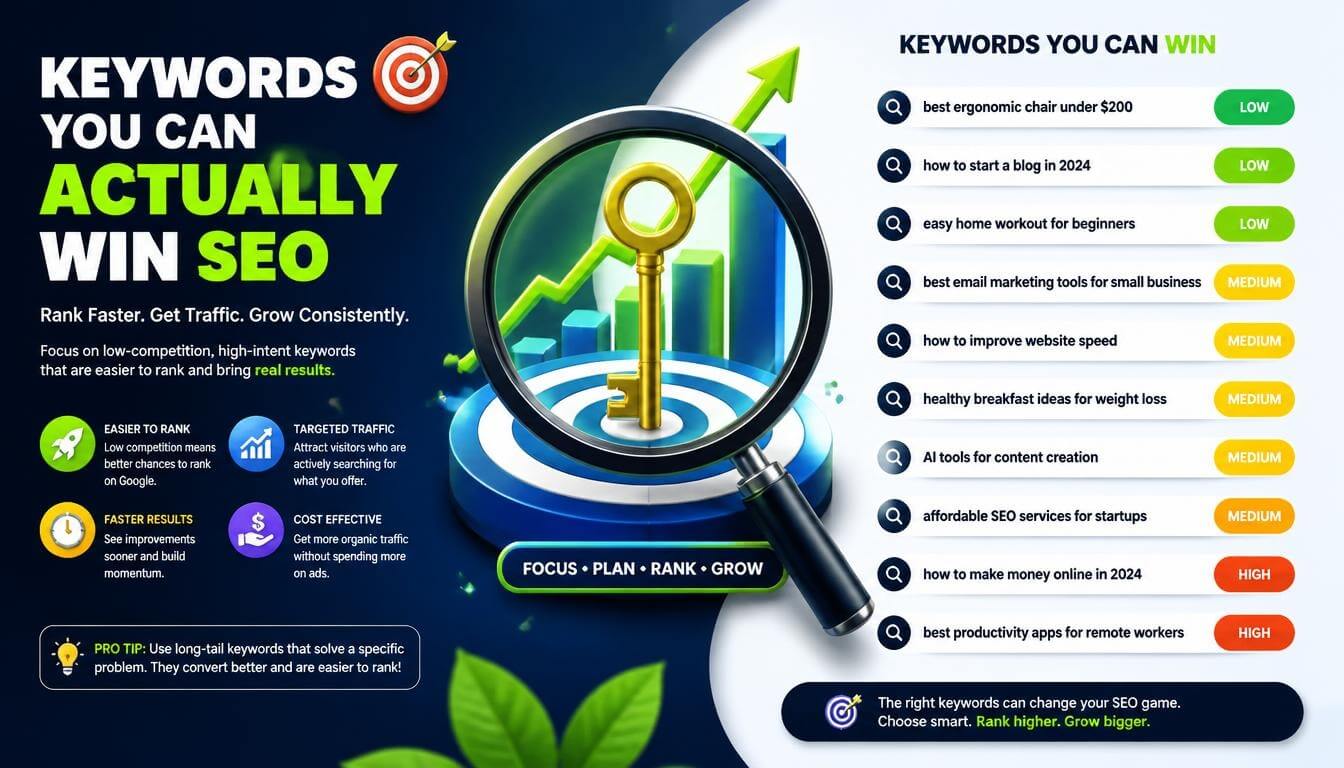
If I could give you only one piece of advice, it would be this: keyword choice is where SEO without link building is won or lost.
Go after a phrase where every page-one result has hundreds of referring domains, and no amount of great writing will move you. Look instead for long-tail phrases with a low keyword difficulty score and solid traffic potential, where the current results look weak or outdated.
Before you commit, open the first ten listings yourself. Do you see forum threads, short answers, old publish dates, or pages that only half-answer the question? That’s your opening. Then match the search intent behind the query. A “how to” search wants steps, and a “near me” search wants a nearby business. Tight query match usually beats clever writing.
One trick I keep coming back to is finding small, low-DR sites in your space that still get a healthy number of visitors. Check the terms they rank for in your favorite SEO tool. If a weak site can rank there, so can you.
Build Topical Authority With Content Clusters
Why would Google trust a site with only one article on a topic? It usually doesn’t. One lonely post about keto recipes won’t make you an authority, but fifty well-connected pages answering every related question can. That’s why depth is the backbone of SEO without link building. It shows Google you’re a reliable source even when very few sites link to you.
Start with a pillar page that covers the broad topic, then build cluster content around every narrower question your readers ask. You’ll find those questions in Google Keyword Planner, in the informational queries your competitors already answer, and in the long-tail keywords that keep appearing in your own Search Console data. Write with entity-rich language so every page carries its full meaning.
Then link every cluster article back to the pillar, and the pillar out to each cluster. That one structure turns a pile of blog posts into topical relevance Google can clearly see.
Create Content That Earns Trust and Links on Its Own
You can skip outreach and still attract links. The secret is creating pages people want to cite, such as original surveys and statistics roundups. Free tools and honest product reviews work well too. These link bait assets are the one type of link you actively invite when you’re not pitching anyone. Think of it as outreach in reverse: you make the resource, and others come to you.
Don’t be afraid to take the opposite stance when the facts support it. One pool care site published an article telling readers not to use algaecide, while every competitor explained how to use it. That honesty built reader trust, and pool supply businesses started referencing the article without being asked.
Those are the editorial links money can’t buy.
Write for people first. Back every claim with evidence, add your own photos and short clips, and share real first-hand experience. Google’s people-first content guidance describes exactly this kind of page.
Prove E-E-A-T on Every Page
E-E-A-T stands for experience, expertise, authoritativeness, and trustworthiness. Google says it isn’t a specific ranking factor, but its systems use a mix of signals to find content that shows these qualities. It matters even more in SEO without link building, because you need other ways to prove you’re credible.
Add an author bio with credentials to every article, and connect it to an About page that explains who runs the site. Show first-hand proof, like photos you took or results you got. Mistakes you made along the way count too. Cite trustworthy sources, display clear contact information, and keep HTTPS active. These trust signals become essential for YMYL (Your Money or Your Life) topics, which are the ones that can affect a person’s health, money, safety, or well-being.
Get Your On-Page SEO Basics Right
On-page work is the cheapest win in SEO without link building. Many sites that can’t rank without links don’t have an authority problem at all. They have simple on-page gaps. Run through this list on every page:
- Put your primary keyword in the page title, the URL, and the opening paragraph.
- Write a description tag that matches the query and gives people a good reason to click.
- Keep your heading order clean, with one main heading followed by logical section headings.
- Add image alt descriptions that explain what each image shows.
- Answer the main question early, then add text depth below it.
- Keep paragraphs short and easy to scan on a phone.
After that, focus on your click-through rate. Title clarity matters more than most people expect. A page in fifth position with an irresistible SERP snippet can pull more clicks than the page above it, and every satisfied visitor sends a positive engagement signal.
Use Internal Linking to Spread Authority Across Your Site
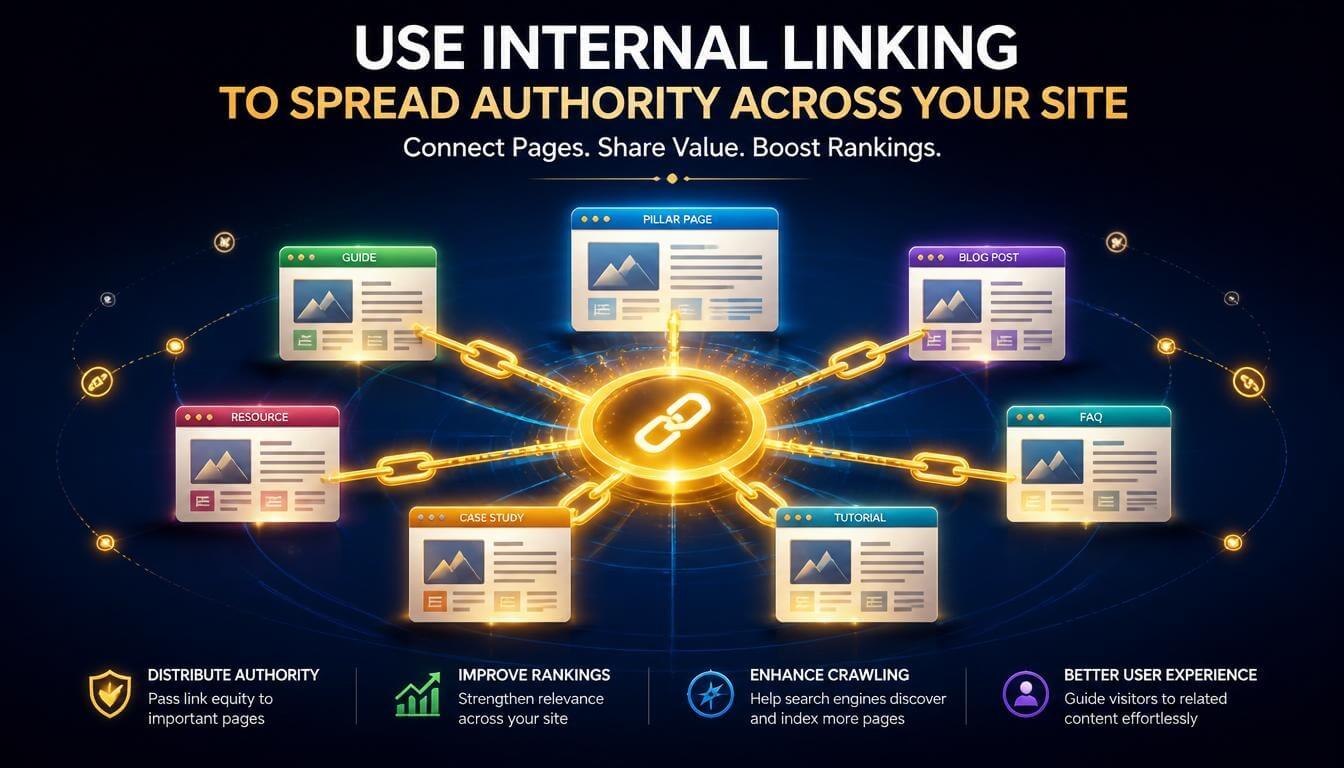
Internal linking is the one kind of link building that’s completely in your hands. That makes it one of the most useful levers in SEO without link building. Every page that earns attention can pass link equity to the pages you most want to rank.
Link from your strongest, most-visited articles to your money pages, using descriptive anchor text. Track down orphan pages that nothing points to, and connect them to your topical map.
Keep your site architecture flat. A common rule of thumb says any page should be reachable within about three clicks. Breadcrumbs help as well, because they show readers and search engines how your sections connect. Good internal paths also encourage multi-page visits and longer visits, which is the behavior you want.
Fix Technical SEO So Google Can Find and Index Your Pages
When you don’t have many links, Google has fewer paths to discover your pages, and your technical setup has to pick up that slack. Remember the Porsche page? Google found it through a sitemap alone. Use this checklist:
- Submit a sitemap file in Google Search Console and keep it updated.
- Make sure important pages aren’t blocked by robots.txt or a noindex tag.
- Use canonical tags to handle duplicate content.
- Fix 404 errors, crawl errors, and long redirect chains.
- Check that no blocked resources stop Google from rendering your pages.
- Run a technical health check with a crawler every month.
A page that isn’t indexed can’t rank, no matter how good it is. So whenever SEO without link building isn’t producing results, check indexing first.
Make Your Site Fast and Easy to Use on Every Device
Speed is a big part of some no-link success stories. One creator who builds six-figure websites without link building credits much of his success to very fast pages. He says about three-quarters of his visitors come from phones, often on weak connections. Slow pages lose those people before they read a word, while fast pages keep scroll depth and user stay time healthy.
Google measures page experience with three key metrics: Largest Contentful Paint for loading, Interaction to Next Paint for responsiveness, and Cumulative Layout Shift for visual stability. Google retired its standalone mobile-friendly test in December 2023 and pointed site owners to Chrome’s free auditing tool instead.
The fixes are usually simple. Remove add-ons you don’t need, shrink image file sizes, turn on caching, use a content delivery network, and pick a lightweight theme with reliable web hosting. Since July 2024, Google crawls and indexes sites using only its smartphone crawler, so build for phones first.
Win SERP Features and AI Search With Structured Data
Structured data helps Google understand your page and can earn enhanced listings like star ratings and product prices. Add the types that fit your content, such as Article, Product, LocalBusiness, or Organization, and check them with Google’s own testing tool.
Featured Snippets and People Also Ask
Featured snippets and People Also Ask boxes are a gap most competitors ignore. A clear, direct answer gives you a strong shot at these spots. Find the exact questions people ask with AnswerThePublic or Google autocomplete, and write a heading that mirrors each one. Answer it in two or three sentences, then expand underneath. Helpful visuals can also add search visibility through Google Images.
AI Overviews and AI Mode
A lot of site owners worry about AI search, but Google’s own guidance is calming. Google says the usual SEO best practices apply to its AI features, with no additional requirements or special optimizations needed to appear in AI Overviews or AI Mode. To appear as a supporting link, a page must be indexed and eligible to show in Search. Google has also confirmed there’s no special markup required for these AI features.
That’s good news, because the work you’re already doing for SEO without link building is what gets you cited. Write sections that answer one question each and keep the language plain. Then add what a generic AI summary can’t: your own data and concrete examples.
Win Local Search Without Building Links
Run a local business? You’re in a strong position. Google ranks local results mainly by relevance, how far the searcher is from you, and prominence, and your review count and rating factor in too. That means strong local SEO signals can carry you a long way:
- Claim and complete your business profile on Google with categories, opening times, photos, and offerings.
- Keep your business details identical on every local listing and citation site.
- Ask happy customers for ratings, and respond to every one, good or bad.
- Create local pages for each area you serve.
- Share updates and offers on your profile regularly.
Local search is the easiest place for SEO without link building to win, especially for service businesses in smaller areas and for brand-name searches.
Refresh, Prune, and Repurpose Your Existing Content
Old posts don’t stay good forever. Statistics age, screenshots go stale, and competitors publish better versions while you’re busy elsewhere. Pull a list of pages with dropping clicks in Google Search Console, and give each one a proper content refresh with new facts and better examples. Change the date only when the content has truly changed. Your readers will trust you more for it.
Then prune. Thin pages, near-duplicates, and posts that never earned a single click add little value and can weaken your site overall. Merge pages that target the same query (this is called keyword cannibalization). Use a 301 redirect to send weak pages to stronger ones, and remove what can’t be saved. Content consolidation can lift rankings by putting your best information on one strong page instead of three weak ones. It’s also a practical fix for thin coverage.
Your best articles can also live a second life as short clips, carousels, and visual summaries for people who rarely read blogs.
Build Brand Signals Beyond Your Website
The more people know your brand, search for it by name, and talk about it in communities, the more chances you have to be discovered and linked naturally. These brand signals grow from being visible where your readers already spend their time.
Share every new article on the channels your readers use. Answer the questions people are asking on Reddit, Quora, and niche forums without spamming your URL. Turn your best data into infographics that others can embed, and start an email newsletter so readers come back on their own. When you hit a milestone worth sharing, reach out to local reporters. And say yes to podcast appearances in your field.
What if someone mentions your brand without linking? A short, friendly note asking them to add a link is completely fair. You’re not building a link there. You’re helping their readers find the source. That’s the social proof side of SEO without link building.
When SEO Without Link Building Stops Working
It’s better to know where the limit is before you run into it. In crowded money niches where big brands hold page one, great content often stalls on page two, because those brands carry years of earned trust. Nationwide head terms behave the same way. Core updates can also shake pages that have thin coverage or weak engagement.
An independent study tested this directly. It checked the top 10 Google results for 200 commercial-intent phrases, which came to 1,113 unique sites. Using the highest count from four SEO tools, not one of those sites had fewer than 50 referring domains, and 96.3% had more than 1,000. The study shows correlation, not proof that links cause rankings. Still, the pattern is hard to ignore. For competitive commercial searches, a strong link profile separates page one from everything else.
Risky Shortcuts: Aged Domains and Parasite SEO
Some SEOs try to skip link building by borrowing authority. One method is buying an expired domain and building a related site on it, or pointing it at a main site. Another is publishing on a big, trusted publication so its strength carries the page. Both sit in the same risky family as PBNs.
Be careful here. Google’s spam policies treat buying an expired domain mainly to manipulate rankings with low-value content as expired domain abuse. Publishing third-party content on an established site mainly to borrow its ranking strength falls under site reputation abuse. Google announced both policies in March 2024. If you test either one, keep the topic closely matched and the content genuinely helpful.
Your 30-Day SEO Without Link Building Plan
Week 1: Fix the foundation. Verify your site in Google Search Console, submit your sitemap, and open the Page indexing report to see which pages Google can’t index. Crawl your site with Screaming Frog, fix broken pages and redirect chains, and test your main templates in PageSpeed Insights.
Week 2: Choose your battles. Build a list of 20 to 30 long-tail and local phrases with weak competing results. Group them into one or two topic clusters, and note which pages you already have and which you still need to write.
Week 3: Improve what you already have. Find pages sitting in positions 8 to 20 in the Performance report. Rewrite their titles and description tags, add direct answers under question-style headings, and link to them from your strongest articles.
Week 4: Publish and build signals. Publish your pillar page and the first cluster articles with author bios and structured data. If you serve a local area, complete your Google Business Profile and make sure your NAP details match on Bing Places, Apple Maps, and Yelp. Set up Google Alerts for your brand name, and write down your baseline numbers so you can compare them next month.
Track Your Progress and Know When to Add Links
When you aren’t counting new links, Search Console becomes your scoreboard. Results often take months rather than weeks, depending on your niche and starting point. Be patient, and watch the trend rather than the daily numbers.
Table 2: Search Console metrics to track
| Metric | Where to find it in Search Console | What it tells you |
| Impressions | Performance report | Whether Google is showing your pages at all |
| Clicks and click-through rate | Performance report | Whether your search snippet earns attention |
| Average position | Performance report | How your rankings are moving over time |
| Indexed pages | Page indexing report | Whether Google is storing your pages |
| Core Web Vitals | Core Web Vitals report | Real-user speed and stability |
| Queries per page | Performance report, Pages tab | How many searches each article reaches |
| Branded searches | Performance report filtered by your brand name | Whether demand for your brand is growing |
SEO without link building is a strong foundation, not a permanent ceiling. Your pages might be indexed, well optimized, and the best answer available, and still be stuck behind sites with far stronger link profiles. That’s your signal. A handful of relevant editorial links can help you compete with sites you couldn’t beat on content alone, and here quality over volume is what counts. Links also give Google more paths to discover your new pages.
When you reach that stage, LinkNeon can help you earn placements on real, relevant websites in your niche, so the authority you add matches the quality you’ve already built.
Frequently Asked Questions About SEO Without Link Building
Can a new website rank without backlinks?
Yes, a new website can rank without backlinks for low-competition, long-tail, and local keywords. A brand-new site gives Google very few paths to find it, so submit your sitemap in Search Console on day one and connect every new page to the rest of your site.
How long does it take to rank without links?
There’s no fixed timeline. Easy long-tail pages can sometimes appear within weeks, while broader topics can take many months, depending on your niche and how complete your content is.
Does Google still use links as a ranking signal?
Yes, Google still uses links as a ranking signal. Its documentation says it uses links to help determine how relevant pages are and to find new pages to crawl. According to Gary Illyes, links carry less weight than they used to, and they aren’t the only path to page one.
Is ranking without links enough for an ecommerce store?
It’s enough for some ecommerce pages, but rarely for all of them. Long-tail product pages and buying guides can rank on content alone. Broad category pages in competitive markets usually need some earned links.
What’s the fastest win if I’m not building links?
Start with pages that already rank in positions 8 to 20. Fix any indexing issues first, then give those pages a stronger title and fresher information to help push them onto page one.
Do social media links help SEO?
Social media links usually don’t pass ranking value directly, because many of them are nofollow. They still bring visitors and spread your content, which can lead to brand searches and mentions that support your SEO indirectly.
Read More: https://linkneon.com/seo-software-mac/
Final Thoughts: Is SEO Without Link Building Worth It?
For most websites, yes. Links still carry weight, especially in competitive niches, but they’re no longer the only way to grow. When you choose keywords you can realistically win, cover your topic in depth, and keep your pages fast and easy for Google to index, you can build steady organic traffic on your own terms.
The biggest advantage is control. You’re not waiting on other site owners or paying for placements that might not last. Every improvement you make stays on your own site and keeps working for you.
My advice is to start with the 30-day plan, watch your Search Console numbers, and polish the pages that are already close to page one. Once your content is strong but competitors still hold the top spots because of their link profiles, that’s your cue to add a few relevant, earned links on top of the foundation you’ve built.