

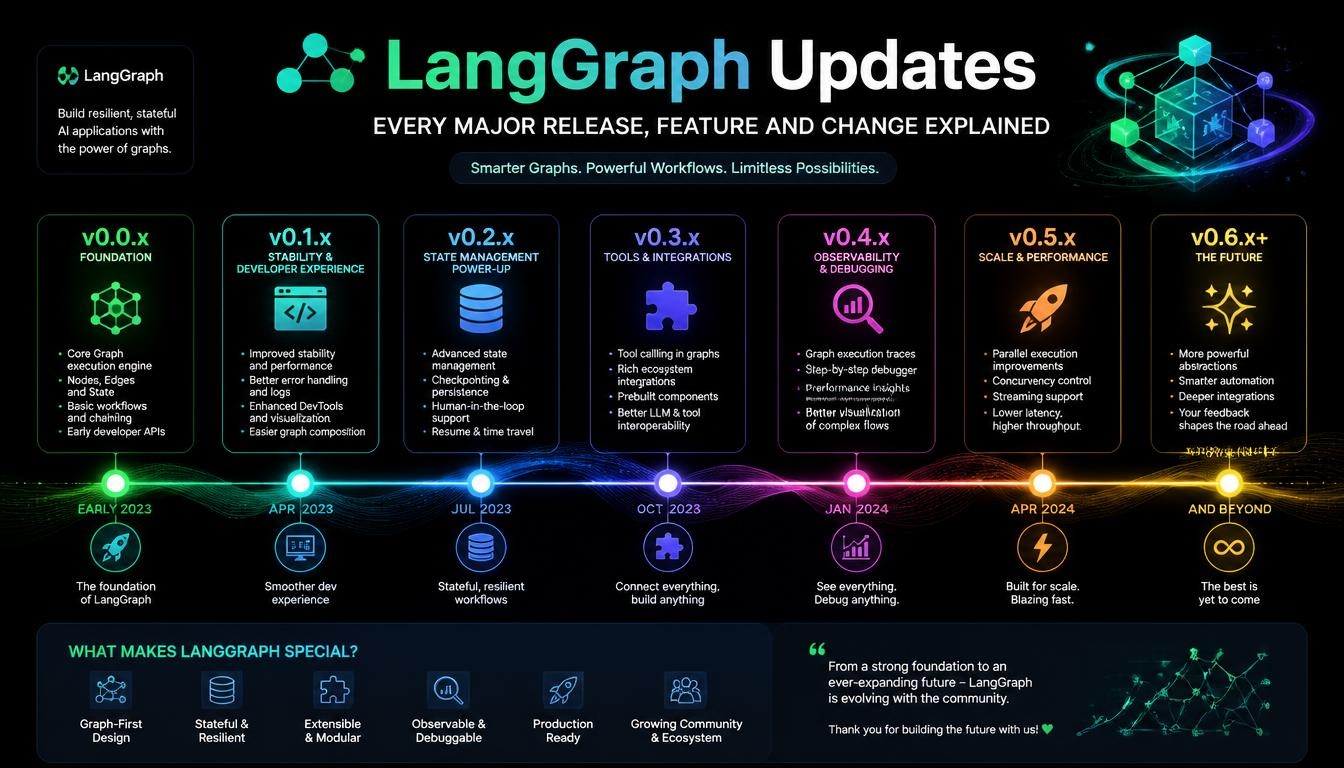
If you build AI agents with LangGraph, 2026 has been a busy year. The framework shipped more than 30 stable releases between January and early November, two feature versions, a new streaming API, production safety tools and a steady stream of human-in-the-loop improvements.
Keeping up is hard, and some articles online even describe a “LangGraph 2.0” that doesn’t exist. That’s why understanding the real LangGraph updates, straight from the official release notes, matters before you upgrade your agents.
In this guide, I’ll walk you through every major change in plain language. You’ll get a month-by-month timeline, a clear explanation of LangGraph 1.1 and 1.2, the new interrupt and approval features, MCP support, Deep Agents and deployment updates. I’ll also cover the breaking changes and gotchas to watch for, clear up the LangGraph 2.0 myth and show you how to upgrade safely.
Key Takeaways
- LangGraph stayed on the 1.x line in 2026, with version 1.1 in March, version 1.2 in May and 1.2.20 as the latest release in early November
- Version 1.1 added typed v2 output for streaming and invoke calls, with full backward compatibility
- Version 1.2 added per-node timeouts, node-level error handlers, graceful shutdown, DeltaChannel and a beta v3 streaming API
- Human-in-the-loop got safer with interrupt response schemas, per-call approvals and a strict resume mode
- MCP support moved into LangChain itself, and Deep Agents became a leaner harness built on LangGraph
- There is no official LangGraph 2.0, and LangChain has committed to no breaking changes in the 1.x line
What Is LangGraph? A Quick Refresher
Before we look at what changed, let’s make sure we agree on what LangGraph is. LangGraph is an open-source, MIT-licensed library from LangChain for building stateful agents as graphs.
You describe your agent as a StateGraph made of nodes, which are steps such as calling a model or a tool, connected by edges that decide what runs next. A shared state object flows through the graph, and a checkpointer saves that state as the graph runs, which is how LangGraph supports persistence, memory and long-running workflows.
That design gives LangGraph its main strength: durable execution. If a server restarts or a run pauses for human approval, the agent can resume from its last checkpoint instead of starting over.
LangGraph reached version 1.0 in October 2025, alongside LangChain 1.0, with a promise of no breaking changes before 2.0. In the same release, LangChain’s create_agent became the standard way to build agents, and it runs on LangGraph underneath.
That’s why many LangGraph features reach LangChain agents too. Keep these basics in mind, because most of the new LangGraph updates build on state, checkpoints and interrupts.
LangGraph is available for Python and JavaScript. The current Python package requires Python 3.10 or later.
LangGraph Updates Timeline at a Glance
Here’s how the year unfolded. This table covers the releases that changed how developers build with LangGraph, based on the LangChain changelog, the langgraph release history on PyPI and the project’s GitHub releases:
| Date | Release | What Changed |
| Jan 12 – Feb 27, 2026 | langgraph 1.0.6 to 1.0.10 | Patch releases on the 1.0 line |
| Feb 10, 2026 | deepagents 0.4.0 | Sandbox integrations and smarter summarization |
| Mar 10, 2026 | langgraph 1.1.0 | Typed v2 streaming and invoke output, Pydantic coercion |
| Apr 7, 2026 | deepagents 0.5.0 | Async subagents and multimodal file reading |
| May 12, 2026 | langgraph 1.2.0 | Node timeouts, error handlers, graceful shutdown, DeltaChannel, v3 streaming |
| Sep 1, 2026 | langchain 1.4.0 | MCP support moves into langchain.mcp |
| Sep 21, 2026 | langgraph 1.2.12 | response_schema for interrupt() |
| Oct 14, 2026 | langchain 1.4.6 | Per-call human approval for tool calls |
| Oct 26, 2026 | langgraph 1.2.18 | DeltaChannel snapshots every 100 updates by default |
| Nov 5, 2026 | langgraph 1.2.20 | Unique interrupt IDs and a strict resume mode |
Now let’s look at what each of these LangGraph updates delivered and why it matters to you.
LangGraph 1.1 (March 2026): Typed Streaming and Invoke Output
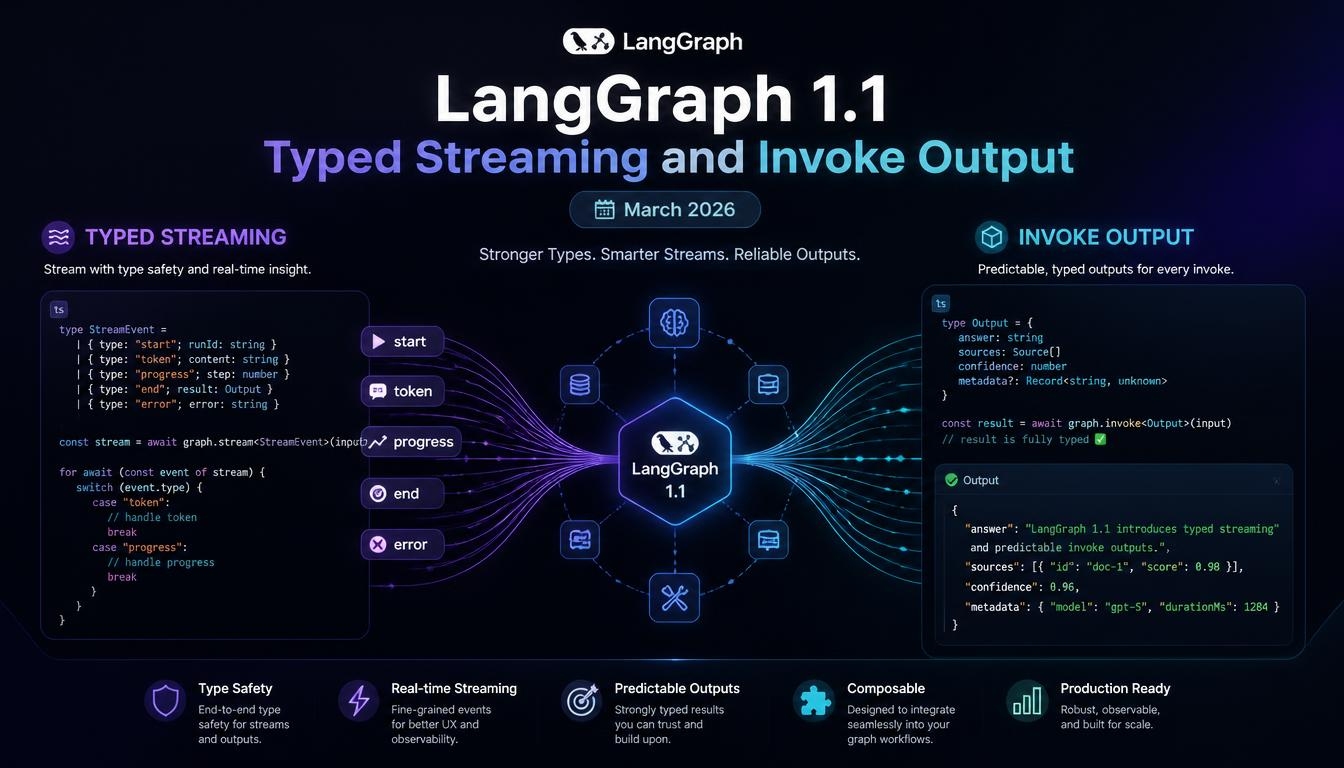
The first big release among this year’s LangGraph updates was LangGraph 1.1.0, which arrived on March 10, 2026. Its focus was type safety. Before this release, streaming output came in different shapes depending on which stream mode you used, which made client code messy.
Now you can pass version=“v2” to stream() or astream() and get a unified StreamPart output with three predictable keys: type, ns and data. Passing version=“v2” to invoke() or ainvoke() returns a GraphOutput object with a .value attribute for the result and a .interrupts attribute for any pauses.
The release also added Pydantic and dataclass coercion, so output matches the state types you declared, and fixed time travel when interrupts and subgraphs are involved.
The best part is that version 1.1 is fully backward compatible. Your existing code keeps working, and GraphOutput still supports the older dictionary-style access, although that style is now deprecated.
LangGraph 1.2 (May 2026): Production Reliability Upgrades
LangGraph 1.2.0, released on May 12, 2026, is the biggest of the LangGraph updates so far. It targets the problems teams hit when agents move from demos to production: steps that hang, errors that crash a whole run and deployments that need to stop safely.
Per-Node Timeouts
You can now cap how long a single node may run with the timeout= parameter on add_node. It accepts a number of seconds, a timedelta or a TimeoutPolicy.
A TimeoutPolicy offers a run_timeout, which is a hard wall-clock limit, and an idle_timeout, which resets whenever the node shows progress. When a limit is exceeded, LangGraph raises a NodeTimeoutError, which is retryable by default.
One important detail: timeouts only apply to async nodes. If you set a timeout on a sync node, LangGraph rejects it at compile time, so blocking code should be wrapped with asyncio.to_thread inside an async node.
Node-Level Error Handlers
The new error_handler= parameter on add_node lets a node recover from failure instead of crashing the whole graph. The handler receives a NodeError with the node name and the error, and it can return a Command that updates state and routes to a recovery step.
It runs only after any retry policy is exhausted, or right away if there’s no retry policy. This makes patterns like fallbacks and compensation steps much cleaner.
Graceful Shutdown With RunControl
Deployments sometimes need to stop a run without losing work. With a RunControl object passed to invoke or stream, calling request_drain() stops the run after the current superstep, raises GraphDrained and saves a resumable checkpoint.
You can then continue the run later. Drain is cooperative, so it never interrupts work that’s already running.
DeltaChannel (Beta)
Long-running agents build up large message histories, and saving the full state at every step gets expensive. DeltaChannel, a beta feature, stores only each step’s incremental change and writes a full snapshot every K updates through the snapshot_frequency setting. The result is lighter checkpoints for agents with long threads.
v3 Streaming API (Beta)
Version 1.2 also introduced a beta streaming API with version=“v3”. It gives you typed projections of a run, such as run.values, run.messages, run.lifecycle and run.subgraphs, so you can subscribe to exactly the part of the stream your interface needs.
At launch, the changelog noted that timeouts and error handlers were Python-only. The JavaScript package has since gained its own timeout tools, including TimeoutPolicy and NodeTimeoutError in its reference docs.
Here’s a quick summary of what version 1.2 gives you:
| Feature | Status | Problem It Solves |
| Per-node timeouts | Stable | Nodes that hang forever |
| Node-level error handlers | Stable | One failure crashing the whole run |
| RunControl and request_drain() | Stable | Stopping runs safely during deploys |
| DeltaChannel | Beta | Heavy checkpoints on long threads |
| v3 streaming | Beta | Messy, untyped stream handling |
Human-in-the-Loop Updates: Safer Interrupts and Approvals
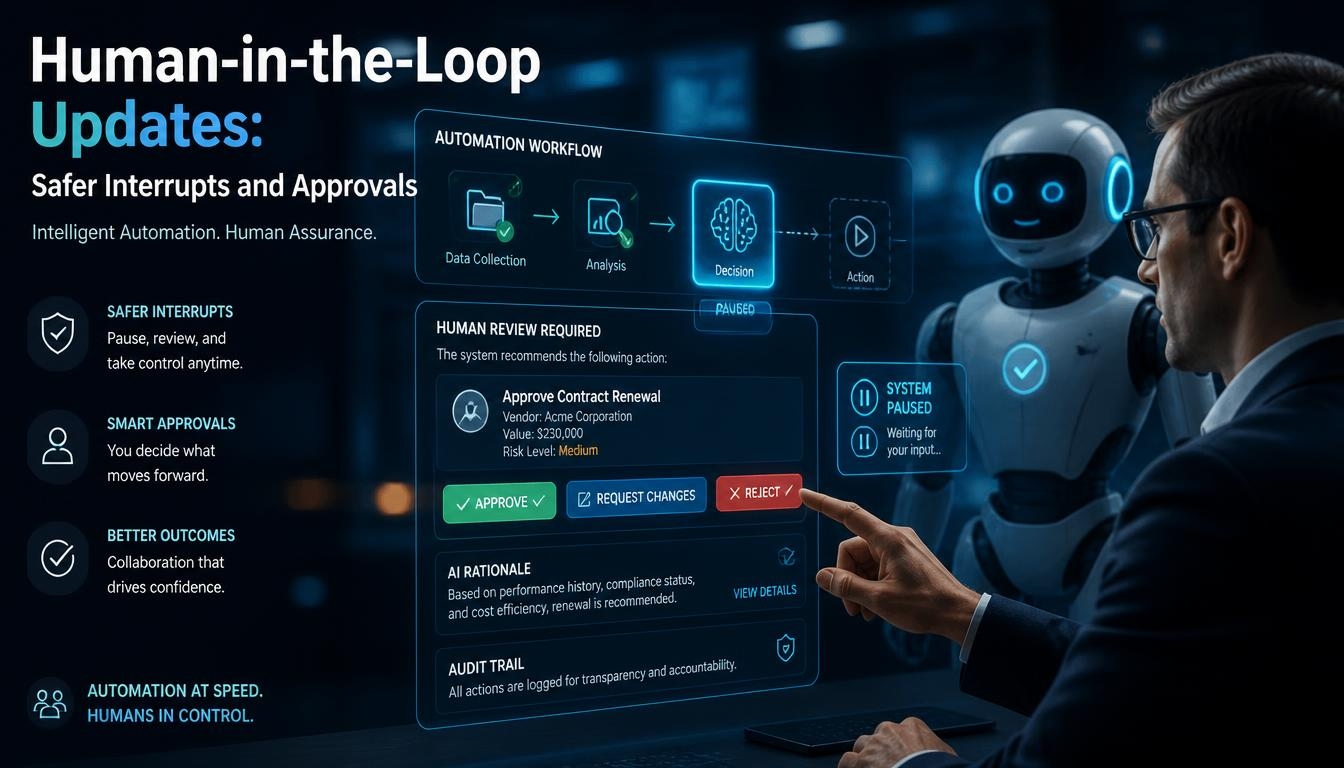
Human-in-the-loop workflows, where an agent pauses for a person to review or approve an action, kept improving across the LangGraph updates, with the biggest changes landing in the second half of the year.
On September 21, 2026, langgraph 1.2.12 added a response_schema option to interrupt(), so a pause can describe exactly what kind of answer it expects. A few weeks later, on October 14, langchain 1.4.6 added interrupt_mode=“per_call” to HumanInTheLoopMiddleware.
In this mode, each tool call that needs approval raises its own interrupt, answered by its own ID. Each interrupt carries a response_schema listing the allowed decisions, LangGraph rejects invalid answers before saving them, and an edit can’t switch to a different tool.
Batched approval is still the default, but the changelog recommends per-call mode for new agents and plans to make it the default in the next major release. Then, on November 5, langgraph 1.2.20 gave each interrupt in a task its own ID and added a strict resume mode that refuses stale answers. Together, these changes make approval flows far harder to break by accident.
MCP Support Moves Into LangChain
The Model Context Protocol (MCP) lets agents connect to external tools and data through a standard interface. On September 1, 2026, langchain 1.4.0 moved MCP support into a new langchain.mcp namespace built on FastMCP, replacing the separate langchain-mcp-adapters package. It’s one of the ecosystem-wide LangGraph updates that LangChain users are most likely to notice.
The new MCPAdapter replaces MultiServerMCPClient and works out the transport from its target. MCP elicitation requests, where a server asks the user for input, now surface as LangGraph interrupt() calls, so they fit naturally into human-in-the-loop flows.
Authentication supports bearer tokens, OAuth 2.1 with dynamic client registration and httpx.Auth, and tool metadata now includes MCP annotations such as destructive_hint. Keep in mind that the namespace is still in beta.
Deep Agents: The Agent Harness Built on LangGraph
Deep Agents is LangChain’s agent harness for complex, multi-step work, such as coding tasks that install dependencies, run tests and call command-line tools. It uses the LangGraph runtime for durable execution, streaming and human-in-the-loop, so its releases are closely tied to the LangGraph updates. Four releases stood out this year:
| Version | Date | Highlights |
| deepagents 0.4.0 | Feb 10, 2026 | Sandbox packages for Modal, Daytona and Runloop; summarization keeps full history in graph state |
| deepagents 0.5.0 | Apr 7, 2026 | Async subagents for background tasks; read_file handles PDFs, audio and video |
| deepagents 0.6.0 | May 12, 2026 | Experimental code interpreter, harness profiles, DeltaChannel storage and v3 streaming |
| deepagents 0.7.0 | Jul 24, 2026 | Leaner default prompts that cut input tokens by 65%, plus new filesystem tools |
The 0.7.0 numbers are worth noting: base input tokens on a default agent turn fell by about 65%, from roughly 6,000 to 2,000, and LangChain reports that performance stayed comparable in its evals. Note that async subagents in 0.5.0 require LangSmith Deployment.
LangSmith Deployment, Agent Server and Studio Updates
If you deploy LangGraph agents, you’ll see a new name. LangGraph Platform was renamed LangSmith Deployment in October 2025. It runs your graphs on the Agent Server and includes Studio, a visual IDE for debugging agents.
Deployment features kept arriving through late 2026. Recent changelog entries include per-thread run priority settings in langgraph.json, a kill switch that stops all in-flight runs on a deployment, deploy support for LangSmith on Azure, live subagent cards in Studio chat and the ability to deploy a Managed Deep Agent from a GitHub repository. The langgraph-cli also added a deploy metrics command in November.
Breaking Changes and Upgrade Gotchas in 2026
The 1.x promise means core LangGraph APIs didn’t break, but the LangGraph updates rolled out across the wider ecosystem did change some defaults in ways that can surprise you. Watch for these before you upgrade:
- langgraph 1.2.18 changed DeltaChannel’s default snapshot frequency from every 1,000 updates to every 100, which speeds up reads on long threads but uses more storage; pass snapshot_frequency=1000 to keep the old behavior
- deepagents 0.6.0 can’t be rolled back once threads have persisted with it
- deepagents 0.7.0 made planning todos opt-in and changed some tool output formats
- langchain-core 1.7.0 switched tool-call streaming to tool-call-delta events, so upgrade clients before servers
- Several releases were yanked from PyPI, including 1.1.7, 1.1.8, 1.2.3 and 1.2.4, so pin a known-good version
- Node timeouts work only on async nodes, and beta features like DeltaChannel, v3 streaming and langchain.mcp may still change
None of these are reasons to avoid upgrading. They’re reasons to read the changelog, pin versions and test before you deploy.
Myth Check: Is There a LangGraph 2.0?
No. Some blog posts describe a “LangGraph 2.0” released in early 2026, complete with new required settings and breaking changes. That release doesn’t appear in the official package history. As of November 5, 2026, the latest stable version on PyPI is langgraph 1.2.20, and every 2026 release has stayed on the 1.x line.
This matches LangChain’s own commitment when it launched 1.0: no breaking changes until 2.0. So if an article tells you to rewrite your agents for LangGraph 2.0, check the official changelog first. That simple habit protects you from a lot of wasted work, especially when you’re researching LangGraph updates from secondary sources.
How to Upgrade to the Latest LangGraph Safely
Getting the latest LangGraph updates into your project is straightforward if you take it in small steps. First, make sure you’re on Python 3.10 or later, then upgrade the package:
pip install -U langgraph
Next, try the new features one at a time. Here’s how the version 1.1 typed streaming and the version 1.2 node timeout look in practice:
# Typed v2 streaming (LangGraph 1.1+)
for part in graph.stream(inputs, version=”v2″):
print(part[“type”], part[“data”])
# Per-node timeout in seconds (LangGraph 1.2+, async nodes only)
builder.add_node(“fetch_data”, fetch_data, timeout=30.0)
Then follow a simple checklist:
| Step | What to Do | Why It Matters |
| 1 | Pin your current versions and note them | Easy rollback if something breaks |
| 2 | Read the changelog between your version and the latest | Catch defaults that changed, like DeltaChannel snapshots |
| 3 | Upgrade in a staging environment first | Protect production threads and checkpoints |
| 4 | Add timeouts and error handlers to risky nodes | Stop hangs and crashes from taking down runs |
| 5 | Switch new agents to per-call human approval | Validated, harder-to-break approval flows |
| 6 | Replace langchain-mcp-adapters with langchain.mcp | Stay on the supported MCP path |
Who Should Upgrade, and When?
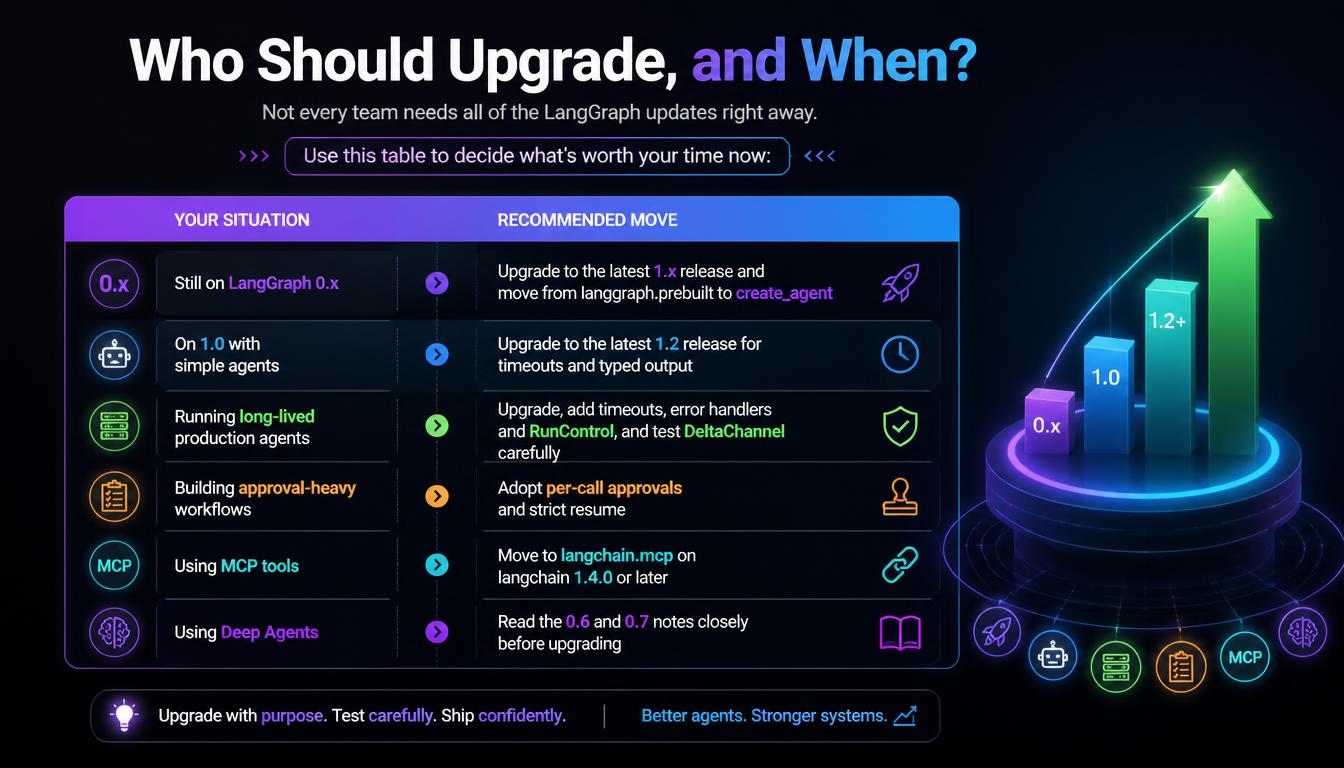
Not every team needs all of the LangGraph updates right away. Use this table to decide what’s worth your time now:
| Your Situation | Recommended Move |
| Still on LangGraph 0.x | Upgrade to the latest 1.x release and move from langgraph.prebuilt to create_agent |
| On 1.0 with simple agents | Upgrade to the latest 1.2 release for timeouts and typed output |
| Running long-lived production agents | Upgrade, add timeouts, error handlers and RunControl, and test DeltaChannel carefully |
| Building approval-heavy workflows | Adopt per-call approvals and strict resume |
| Using MCP tools | Move to langchain.mcp on langchain 1.4.0 or later |
| Using Deep Agents | Read the 0.6 and 0.7 notes closely before upgrading |
What to Watch for in LangGraph Next
The LangGraph updates so far also hint at where the framework is heading. Based on the official changelog, keep an eye on these:
- Per-call human approval, which is planned to become the default in the next major release
- DeltaChannel, v3 streaming and the langchain.mcp namespace, which are still labeled beta and may change as they mature
- JavaScript parity, as Python-first features like timeouts continue to reach the JS package
- Deployment features in LangSmith Deployment, which receives updates almost every week
With releases arriving every few days, the most reliable habit is to follow the official changelog rather than secondhand summaries.
FAQs
What are the biggest LangGraph updates this year?
The biggest changes are typed v2 streaming and invoke output in version 1.1, and per-node timeouts, node-level error handlers, graceful shutdown with RunControl, DeltaChannel and v3 streaming in version 1.2. Human-in-the-loop also gained response schemas, per-call approvals and a strict resume mode.
What is the latest version of LangGraph?
As of November 5, 2026, the latest stable Python release is langgraph 1.2.20. It requires Python 3.10 or later.
Is LangGraph 2.0 out?
No. Every 2026 release has stayed on the 1.x line, and LangChain has committed to no breaking changes before 2.0. Articles describing a LangGraph 2.0 release aren’t supported by the official release history.
Do LangGraph node timeouts work in JavaScript?
At the 1.2.0 launch, the changelog listed timeouts and error handlers as Python-only. The JavaScript package now includes TimeoutPolicy and NodeTimeoutError in its reference documentation, so check the current JS docs for your version.
What happened to LangGraph Platform?
LangGraph Platform was renamed LangSmith Deployment in October 2025. It runs LangGraph agents on the Agent Server and includes Studio for visual debugging.
Will upgrading break my existing LangGraph agents?
Usually not. Most LangGraph updates are backward compatible, because core LangGraph APIs stay stable within the 1.x line, but some defaults and related packages did change this year. Pin your versions, read the changelog and test in staging before upgrading production agents.
Read More: https://linkneon.com/claude-code-templates/
Conclusion
The LangGraph updates this year were less about flashy rewrites and more about making agents dependable. Version 1.1 made output typed and predictable.
Version 1.2 added timeouts, error handlers, graceful shutdown, DeltaChannel and a new streaming API. Interrupts became more reliable, MCP moved into LangChain, Deep Agents got leaner and LangSmith Deployment kept expanding.
If you take one thing from this guide, let it be this: upgrade in small steps, pin your versions and trust the official changelog over rumors of a LangGraph 2.0. Bookmark this overview of LangGraph updates and come back whenever a new release lands.