

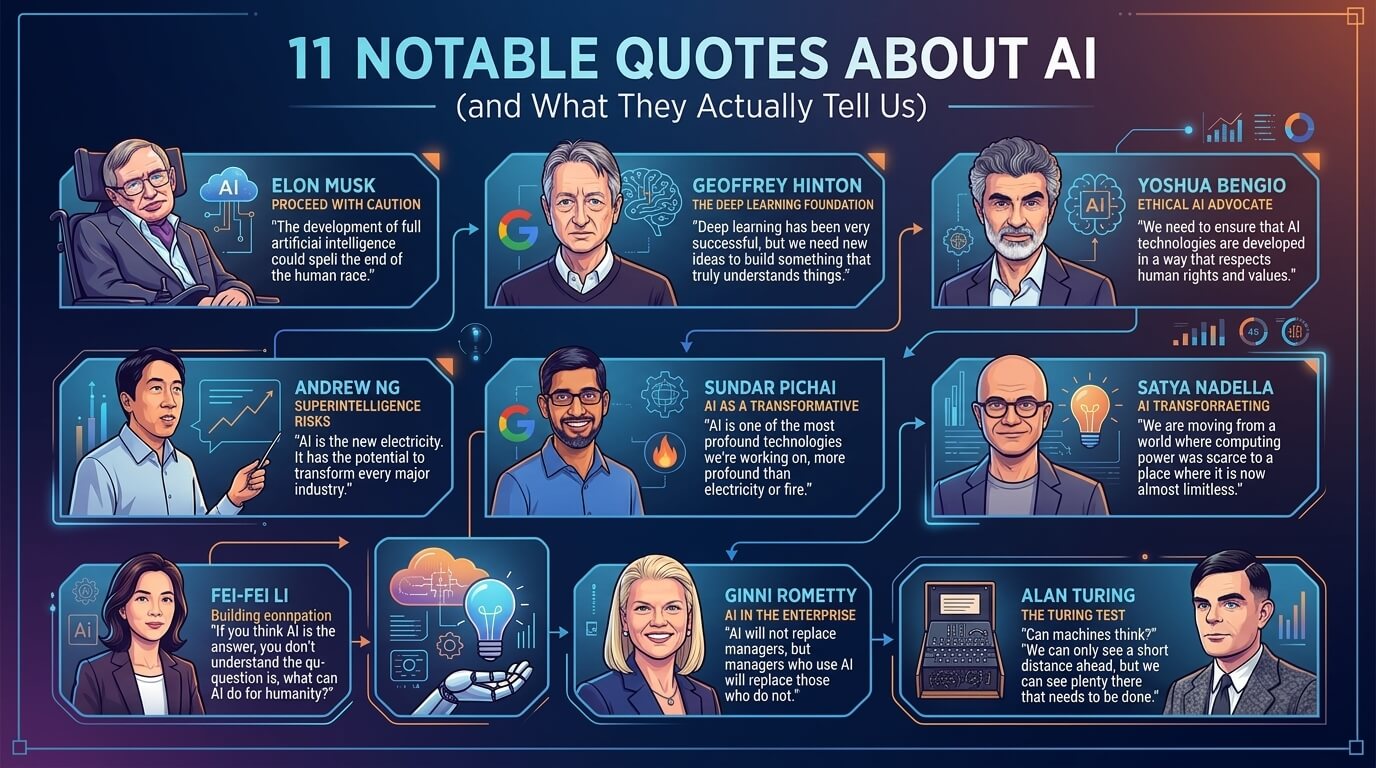
Search “quotes about AI” and most lists give you a name, a one-liner, and nothing else, no sense of when it was said, why it matters, or whether the person quoted still holds that view.
This roundup takes a different approach: real, verifiable statements from people who actually shape or study artificial intelligence, grouped by theme, with enough context to understand what each quote actually reveals rather than treating it as a standalone soundbite.
You’ll find quotes on AI safety, its transformative potential, ethics, the future of work, and the older philosophical question of whether machines can think at all, plus a short section on using quotes like these responsibly instead of stripping them of context.
Quick Reference: All 11 Quotes at a Glance
| Speaker | Quote (shortened) | Theme |
| Stephen Hawking | “Could spell the end of the human race.” | Safety / Existential Risk |
| Elon Musk | “We should have some sort of regulatory oversight.” | Safety / Regulation |
| Geoffrey Hinton | “I no longer think that” AI risk is decades away. | Safety / Reversal |
| Yoshua Bengio | “We’re losing control.” | Safety / Reversal |
| Nick Bostrom | “Small children playing with a bomb.” | Safety / Existential Risk |
| Andrew Ng | “AI is the new electricity.” | Transformative Potential |
| Sundar Pichai | “More profound than electricity or fire.” | Transformative Potential |
| Satya Nadella | “A copilot, not an autopilot.” | Transformative Potential / Design |
| Fei-Fei Li | “Human-centered AI to benefit people.” | Ethics / Responsibility |
| Ginni Rometty | “AI to change 100 percent of jobs.” | Future of Work |
| Alan Turing | “Can machines think?” | Philosophical |
Each quote is unpacked with full context and sourcing below.
What Makes an AI Quote Worth Citing
Not every widely shared “AI quote” holds up under scrutiny. Quote-aggregator sites frequently drop the original context, attribute a paraphrase as if it were exact wording, or recycle a line that’s been slightly altered so many times online that the current version doesn’t quite match what the person said.
A quote worth citing meets three bars:
- The person actually said or wrote it, ideally traceable to an interview, book, talk, or article rather than a screenshot with no source.
- The wording matches the original record closely, not a paraphrase dressed up as a direct quote.
- You know roughly when and in what setting it was said, since a one-line quote from a 2014 interview doesn’t necessarily reflect someone’s current position a decade later.
Every quote below is checked against a primary interview, article, or published work rather than pulled secondhand from another quotes list.
Quotes on AI Safety and Existential Risk
This is the theme most people associate with quotes about AI, and it spans physicists, entrepreneurs, and the researchers who built the technology themselves.
Physicist Stephen Hawking gave one of the most widely cited warnings in a 2014 BBC interview: “The development of full artificial intelligence could spell the end of the human race. It would take off on its own and re-design itself at an ever increasing rate.
Humans, who are limited by slow biological evolution, couldn’t compete, and would be superseded”. Hawking wasn’t an AI researcher himself, but his physics background and public platform made this one of the earliest mainstream warnings taken seriously outside the tech industry.
Elon Musk has made a similar case from inside the industry he helped build. Speaking with Bill Maher, Musk argued, “we should have some sort of regulatory oversight” on AI, adding: “If one agrees that AI is a potential risk to the public, then there should be some regulatory body that oversees what companies are doing so they don’t cut corners and potentially do something very dangerous”.
Musk’s position is notable partly because he’s simultaneously built AI companies while calling for the industry to be regulated, a tension worth noting rather than glossing over.
The most consequential shift came from Geoffrey Hinton, often called the “Godfather of Deep Learning” for his foundational research on neural networks. In May 2023, Hinton left his role at Google specifically to speak freely about AI risk: “I left so that I could talk about the dangers of AI without considering how this impacts Google”. He described his changed timeline directly: “I thought it was 30 to 50 years or even longer away. Obviously, I no longer think that.”
Hinton added: “I believe that the rapid progress of AI is going to transform society in ways we do not fully understand and not all of the effects are going to be good.” His quote carries particular weight because it’s not an outsider’s warning, it’s a reversal from one of the field’s own founding researchers.
A similar reversal came from Yoshua Bengio, another researcher whose early work helped establish deep learning as the dominant approach to AI. In a September 2026 interview, Bengio said plainly, “there’s a reason that companies are saying this is going too fast, that we’re losing control”.
Coming from someone who spent decades advancing the field’s core techniques, the remark carries the same weight as Hinton’s: a founding researcher, not an outside critic, naming the pace of development itself as the concern.
Philosopher Nick Bostrom made a related argument years earlier in his 2014 book Superintelligence: Paths, Dangers, Strategies: “Before the prospect of an intelligence explosion, we humans are like small children playing with a bomb.
Such is the mismatch between the power of our plaything and the immaturity of our conduct”. Bostrom’s framing predates the current wave of AI products by nearly a decade, which is worth noting since it shows this concern isn’t a reaction to recent chatbots specifically, it’s a longer-running argument about capability outpacing control.
Quotes on AI’s Transformative Potential
Not every prominent voice in AI leads with risk. Several researchers and executives frame the technology primarily around what it enables.
Andrew Ng, a Google Brain co-founder and Coursera co-founder, offered one of the field’s most repeated analogies: “We’re making this analogy that AI is the new electricity. Electricity transformed industries: agriculture, transportation, communication, manufacturing”.
The comparison holds up because it makes a specific, checkable claim, that AI functions as general-purpose infrastructure rather than a single product, similar to how electricity wasn’t one invention but a capability that reshaped dozens of industries separately.
Satya Nadella, Microsoft’s CEO, has been deliberate about drawing a boundary around how far that transformation should go unsupervised. Describing Microsoft’s product philosophy, he said: “The one big design decision we made was to think about this as a copilot, not as an autopilot”.
That distinction, a tool that assists a human who stays in control versus a system that acts independently, has become a common framing across the industry precisely because it addresses the transformative-potential and risk conversations at once.
Sundar Pichai, Google’s CEO, made one of the boldest transformative-potential claims at the 2018 World Economic Forum in Davos: “AI is probably the most important thing humanity has ever worked on. I think of it as something more profound than electricity or fire”.
It’s a stronger claim than Ng’s electricity analogy, comparing AI not just to one transformative technology but ranking it above two, and it’s worth reading alongside the safety quotes above rather than in isolation, since Pichai has also spoken publicly about AI’s risks needing careful management.
Quotes on AI Ethics and Responsibility
Fei-Fei Li, the Stanford researcher sometimes called the “Godmother of AI” for her work on ImageNet and computer vision, has consistently framed her research around a specific commitment: “I believe in human-centered AI to benefit people in positive and benevolent ways”. Li co-founded Stanford’s Institute for Human-Centered Artificial Intelligence around this same principle, that AI development should explicitly account for its effects on people rather than optimizing purely for capability.
This theme, that AI’s value depends heavily on how it’s built and deployed rather than being inherently good or bad, recurs across ethics-focused commentary more broadly. A fair way to summarize the general position among AI ethics researchers: the technology itself is neutral, but the training data, design choices, and deployment context determine whether it produces fair, transparent outcomes or reinforces existing bias, a point worth stating plainly since it doesn’t reduce to a single quotable line from any one person.
It’s worth pointing out what this section deliberately doesn’t include: a long list of paraphrased “ethics quotes” attributed vaguely to “AI researchers” or “experts,” a pattern common on quote-aggregator pages. Li’s quote works precisely because it’s traceable to a specific person with a specific research record behind it, not because it’s a tidy summary of a broader consensus.
Quotes on AI and the Future of Work
The business and workforce conversation tends to split into two honest camps: those emphasizing new capability and those emphasizing disruption, and the strongest quotes usually acknowledge both.
Andrew Ng’s electricity analogy applies here too: infrastructure-level technologies historically both create new categories of work and eliminate others, a pattern electricity itself followed a century earlier. Nadella’s copilot framing is similarly relevant to workplace AI specifically, positioning the technology as something that changes how existing jobs get done rather than something designed to replace the person doing them.
One well-documented, specific claim comes from Ginni Rometty, IBM’s former CEO, speaking at a 2019 workforce conference: “I expect AI to change 100 percent of jobs within the next five to 10 years”. Note exactly what she argued, not “eliminate,” but “change”: most jobs would remain but increasingly require analytics and AI skills, which is why she paired the statement with a call for large-scale skills training rather than treating displacement as unavoidable.
Beyond Rometty’s claim, a single, well-verified quote with a specific job-loss or job-creation number is hard to find, since these figures vary enormously by study and time horizon, and many circulating online aren’t attributed to a checkable source. The “how many jobs will AI replace” question doesn’t have one authoritative answer, only competing estimates, Rometty’s included.
Philosophical Quotes: Can Machines Really Think?
The philosophical question predates the modern AI industry by decades. Alan Turing, the British mathematician whose work laid the theoretical foundation for computer science, opened his landmark 1950 paper “Computing Machinery and Intelligence” with a single direct sentence: “I propose to consider the question, ‘Can machines think?'”.
What’s often left out of quote roundups is that Turing didn’t actually think this was the right question to answer directly. He argued the terms “machine” and “think” were too poorly defined to settle the question as stated, and proposed what’s now known as the Turing Test, an evaluation based on observable behavior, as a more concrete substitute.
That’s worth including here because it’s the opposite of quote-stripping: Turing’s most famous line is actually the question he was about to complicate and reframe, not his final answer.
How to Use AI Quotes Responsibly
A few practices separate a responsible use of quotes about AI from the misattributed, context-free versions that circulate widely online:
- Cite the original setting. Note the interview, publication, or talk a quote came from, not just the person’s name, since the same person’s view can shift meaningfully over years.
- Don’t treat one quote as someone’s complete position. Hinton’s warnings and Ng’s electricity analogy represent different emphases from different researchers; neither cancels out legitimate points from the other side of the AI conversation.
- Avoid mixing unverified quotes with verified ones. A list that includes both weakens trust in the accurate entries too, since readers can’t tell which is which.
- Update stale attributions. Job titles, company affiliations, and even publicly stated positions on AI risk change; a quote correctly attributed in 2018 may need a caveat if the person’s public stance has shifted since.
Frequently Asked Questions
Who said AI could be humanity’s biggest risk?
Several prominent figures have made this argument, most notably Stephen Hawking in a 2014 BBC interview, Nick Bostrom in his 2014 book Superintelligence, and more recently Geoffrey Hinton and Yoshua Bengio, both of whom left their usual public restraint behind specifically to speak about AI risk.
What did Alan Turing say about machines thinking?
Turing opened his 1950 paper “Computing Machinery and Intelligence” with “I propose to consider the question, ‘Can machines think?'”, though he ultimately argued the question itself needed to be reframed into something measurable, which became the basis for the Turing Test.
Are AI quotes online often misattributed?
Yes. Many quote-list sites paraphrase a statement, drop the original source, or repeat a slightly altered version of a real quote until it no longer matches the record. Checking a quote against a primary interview or publication before using it is a reasonable precaution.
What’s a good short AI quote for a presentation?
Andrew Ng’s “AI is the new electricity” is short, memorable, and well documented, making it a common choice for presentations about AI’s broad, cross-industry impact.
Do AI experts agree on whether AI is dangerous?
No, and that disagreement is itself informative. Researchers like Geoffrey Hinton have become more concerned over time, while others emphasize AI’s transformative benefits more heavily. Both positions come from credentialed people inside the field, not a fringe view versus a mainstream one.
What did Andrew Ng mean by “AI is the new electricity”?
He meant AI functions as general-purpose infrastructure that transforms multiple industries the way electricity once did, rather than being a single product confined to one use case.
Can I use these quotes for a school project or article?
Short, properly attributed quotes used for commentary or educational purposes, like the ones in this article, are standard practice. Always keep the speaker’s name and original source attached rather than presenting a quote as unattributed wisdom.
Read More: https://linkneon.com/tool-center-point-tcp-robotics/
Conclusion
The most useful quotes about AI aren’t the most dramatic ones, they’re the ones you can trace back to a real person, a real moment, and a real context. Hawking’s warning, Hinton and Bengio’s reversals, Bostrom’s decade-old caution, Pichai and Ng’s transformative framing, Nadella’s copilot distinction, Rometty’s workforce estimate, and Turing’s founding question all say something different because each person was looking at a different aspect of the same technology. None of them agree completely with each other, and that disagreement is itself part of what makes this collection useful.
The practical next step: before reusing any quote from this list or elsewhere, check it against the original source named here rather than a secondary quotes site, and keep the speaker’s name and context attached so the quote still means what it meant when they said it. A collection of quotes about AI is only as trustworthy as its weakest citation, so treat sourcing as the actual work, not an afterthought.