

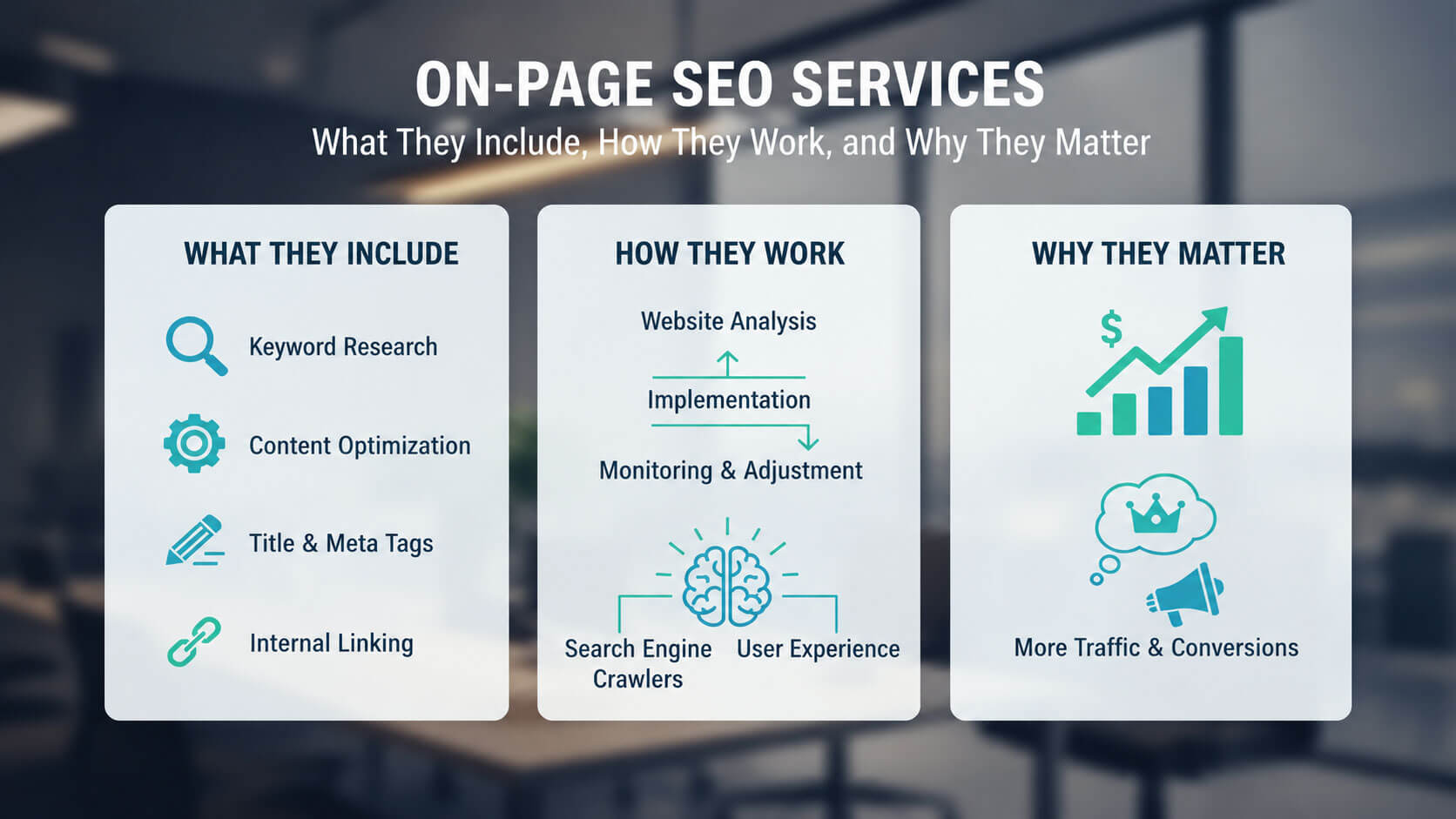
Most clients assume rankings begin with link building and off-page factors, yet my audits prove otherwise. On-page SEO services repair individual pages first, because a page Google struggles to understand rarely benefits from borrowed authority.
I sort the work into three layers: bot readability through clean HTML and indexation, then categorization via headings, schema, and internal links, and finally functionality, where page speed quietly decides whether real visitors actually stay.
People often confuse this with technical SEO, but the overlap is narrow. Here, keyword optimization and content optimization meet meta tags and alt text, small signals telling search engines what each page should rank for.
What Are On-Page SEO Services?
Clients think they’re buying rankings; in reality, they’re paying for precision applied to each of their web pages. My site audits have repeatedly taught me the service is about removing friction that search engines penalize.
The visible layer comes first: rewriting title tags and meta descriptions, refining keyword placement, and repairing a broken heading hierarchy. Then I tighten URL structure and judge content quality against what real searchers actually expect.
Underneath sits the layer clients rarely see. Schema markup clarifies meaning, descriptive alt text supports images, and deliberate internal linking distributes authority. Strong entity coverage matters more than ever, since it likely influences AI citation.
Here’s the contrarian part: perfect words fail on slow pages. That’s why page speed, Core Web Vitals, and mobile experience sit inside on-page work for me, alongside cleaning up messy redirects and completing duplicate-content resolution.
How Do On-Page SEO Services Differ From Off-Page and Technical SEO?
Clients credit backlinks for rankings, yet I’ve watched pages with strong authority stall because their page-level signals were weak. On-page work shapes what a single document says through content, headings, meta tags, and URLs.
Technical SEO sits underneath that layer. It governs site-wide infrastructure like server health, rendering, speed, and crawlability, deciding whether Googlebot can reach and process a page. Without clean indexation, optimized copy never enters the competition.
Off-page SEO happens outside your domain entirely. Brand mentions, link building, and a healthy backlink profile signal that others vouch for you. I treat external trust as an amplifier that multiplies relevance each page earns.
The borders blur in practice. Schema and internal links get built on individual pages, yet their benefit compounds across the whole site. That’s why my audits check every layer together rather than guessing which discipline failed.
What Are the Three Layers of On-Page SEO?
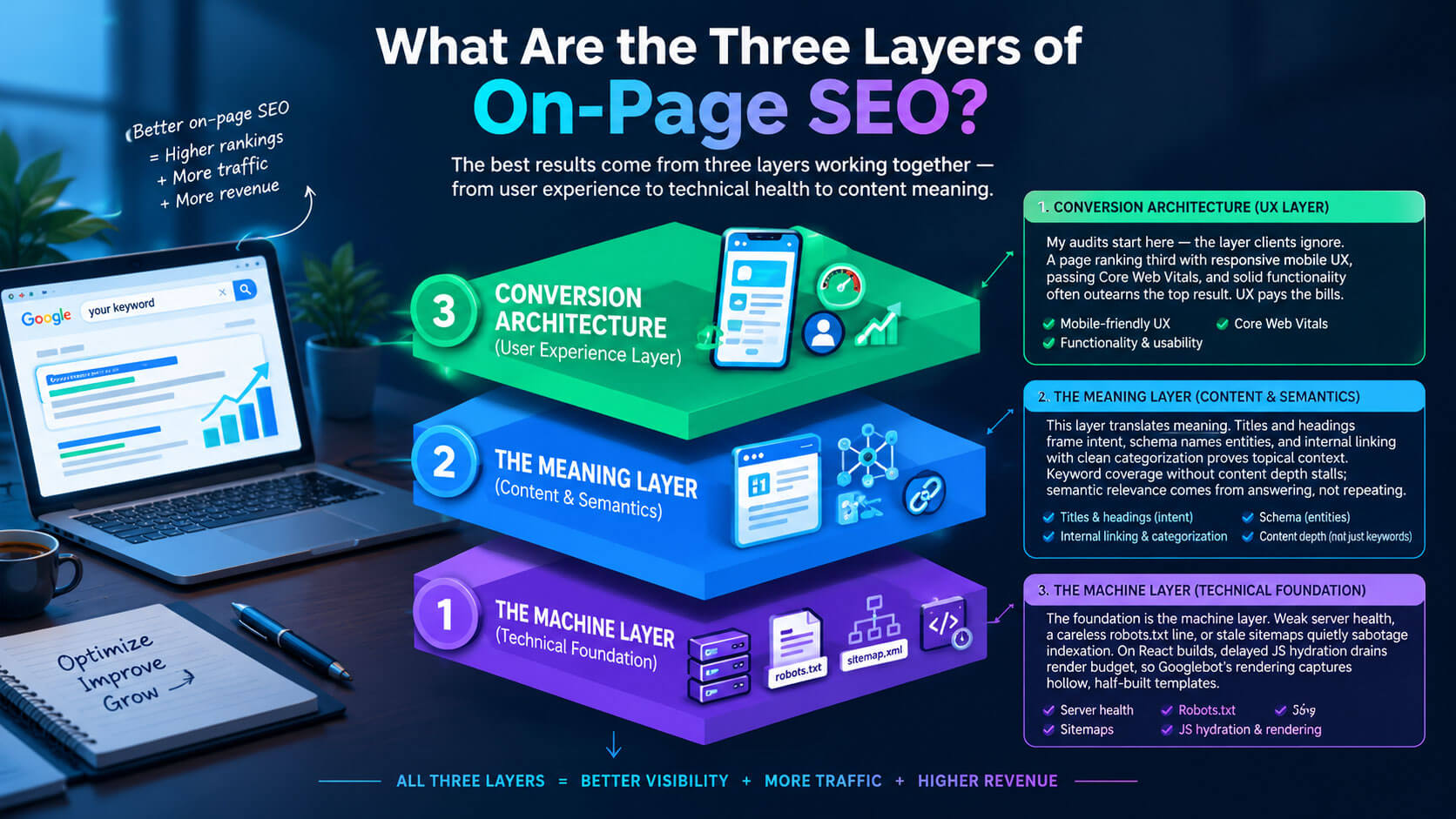
My audits start backwards, at the layer clients ignore: conversion architecture. A page ranking third with responsive mobile UX, passing Core Web Vitals, and solid functionality often outearns the top result. UX pays the bills.
The foundation is the machine layer. Weak server health, a careless robots.txt line, or stale sitemaps quietly sabotage indexation. On React builds, delayed JS hydration drains render budget, so Googlebot’s rendering captures hollow, half-built templates.
The middle layer translates meaning. Titles and headings frame intent, schema names entities, and internal linking with clean categorization proves topical context. Keyword coverage without content depth stalls; semantic relevance comes from answering, not repeating.
Why Does Your Website Need On-Page SEO Services?
Weak backlinks seldom explain the ranking losses I find; the real damage starts at the roots. Without an on-page foundation, even strong domains struggle for search visibility, because Google cannot read what each page offers.
In competitive markets, I’ve watched clients chase new content while existing pages sat untouched. Mapping targeted keywords to the right URLs, reinforcing them with structured signals like schema and headings, moves rankings faster than publishing.
The LLM era has raised the stakes. AI assistants pull answers from pages that read as clear, searchable resources, not keyword-stuffed brochures. On-page SEO services turn your website into something Google and language models trust.
What Does an On-Page SEO Audit Include?
Audits I inherit fail by starting with tools, not page intent. My full audit runs three diagnostic passes: indexation check via Search Console, content audit for thin content, and meta tag analysis exposing missing tags.
Honestly, keyword stuffing hurts less than overlap. A cannibalization check paired with keyword mapping reveals keyword gaps, while TF-IDF analysis and competitor analysis surface semantic gaps that heading structure and content quality reviews alone miss.
The final pass handles mechanics: internal link audit of anchor text and internal link structure, image optimization, URL structure, schema markup analysis, and Core Web Vitals review. Duplicate content and E-E-A-T check findings come last.
How Is Keyword Research and Mapping Done for Each Page?
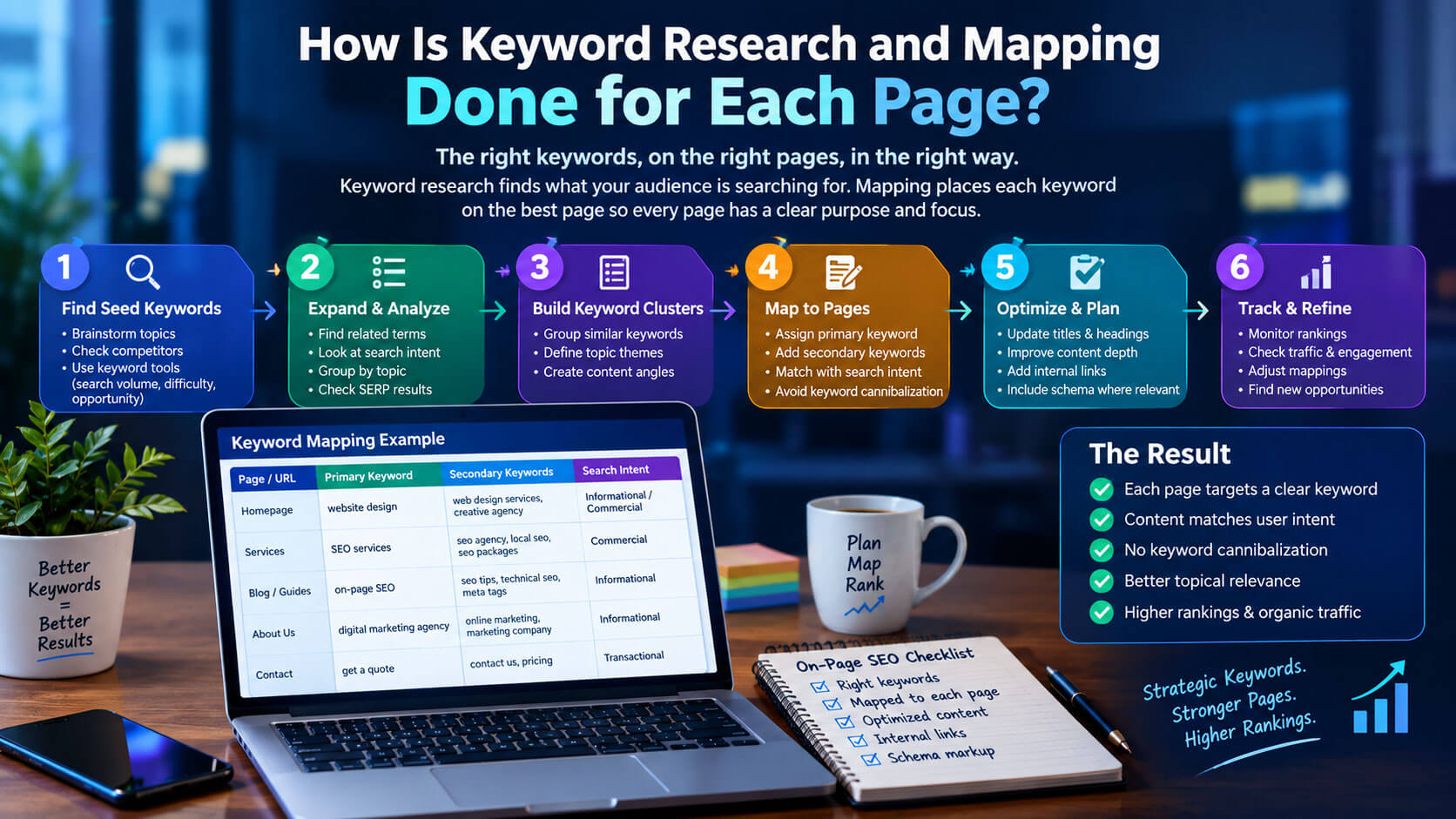
Keyword cannibalization, not weak content, explains the ranking stalls I diagnose most often. So keyword mapping starts by assigning one focus keyword per URL, then checking that no two pages chase identical search intent site-wide.
Keyword research begins in the top 10 results. A competitive analysis reveals which entity keywords, LSI keywords, and high-intent keywords competitors share, while keyword analysis separates exact match from partial match phrasing deserving keyword targeting.
Placement follows the map: the focus term lands in the first 100 words, metadata, and subheadings, with geo-targeting modifiers and semantically related keywords. Usage sits within tuned ranges near 1% keyword density, avoiding keyword stuffing.
How Are Title Tags and Meta Descriptions Optimized?
A title tag rewrite usually fails before anyone writes a word, because the keyword research never properly mapped search intent. Google rewrites weak page titles, so a descriptive, honest meta title survives longer in SERPs.
In practice, I place the focus keyword early and treat 60 characters as a ceiling, not a target. Unique titles per URL limit cannibalization, while power words earn clicks only when the page actually delivers.
A meta description isn’t a ranking factor, yet it shapes click-through rate. My recommendations keep meta descriptions near 160 characters and mirror the query’s wording, using sentiment triggers that reassure, never shout. Overhyped metadata backfires.
What Is the Right Heading Structure From H1 to H6?
Missing tags rarely sink a page. What sinks it is a heading hierarchy that tells a different story than the content beneath it. Search engines read H1–H6 as an outline, not decoration, so sequence matters.
Keep one H1 carrying the focus keyword, then let each H2 claim a distinct subtopic drawn from researched keywords. H3 and H4 levels refine those ideas, quietly distributing keyword weight without stuffing every single line.
I’ve stopped chasing a fixed rule of three headings per page. Subheadings that follow a logical flow let a table of contents generate cleanly, improve user experience, and help skimming readers find answers within seconds.
How Should URLs Be Structured for SEO?
URL trouble seldom comes from bad writing; it comes from changing URLs after launch. Every rewrite forces 301 redirects, so I treat the slug as permanent and draft static URLs that stay readable for years.
A hierarchical URL structure should mirror your site structure, folder by folder, which helps crawlability and pairs with Breadcrumb schema. Keep each segment hyphen-separated and descriptive, because underscores and ID strings rarely produce clean URLs.
Keyword-rich never means stuffed. I place one or two relevant keywords, drop stop words and dates, and respect practical character limits, keeping paths under 90 characters and adding canonical tags wherever parameters create duplicate versions.
How Do Image Optimization and Alt Text Improve Rankings?
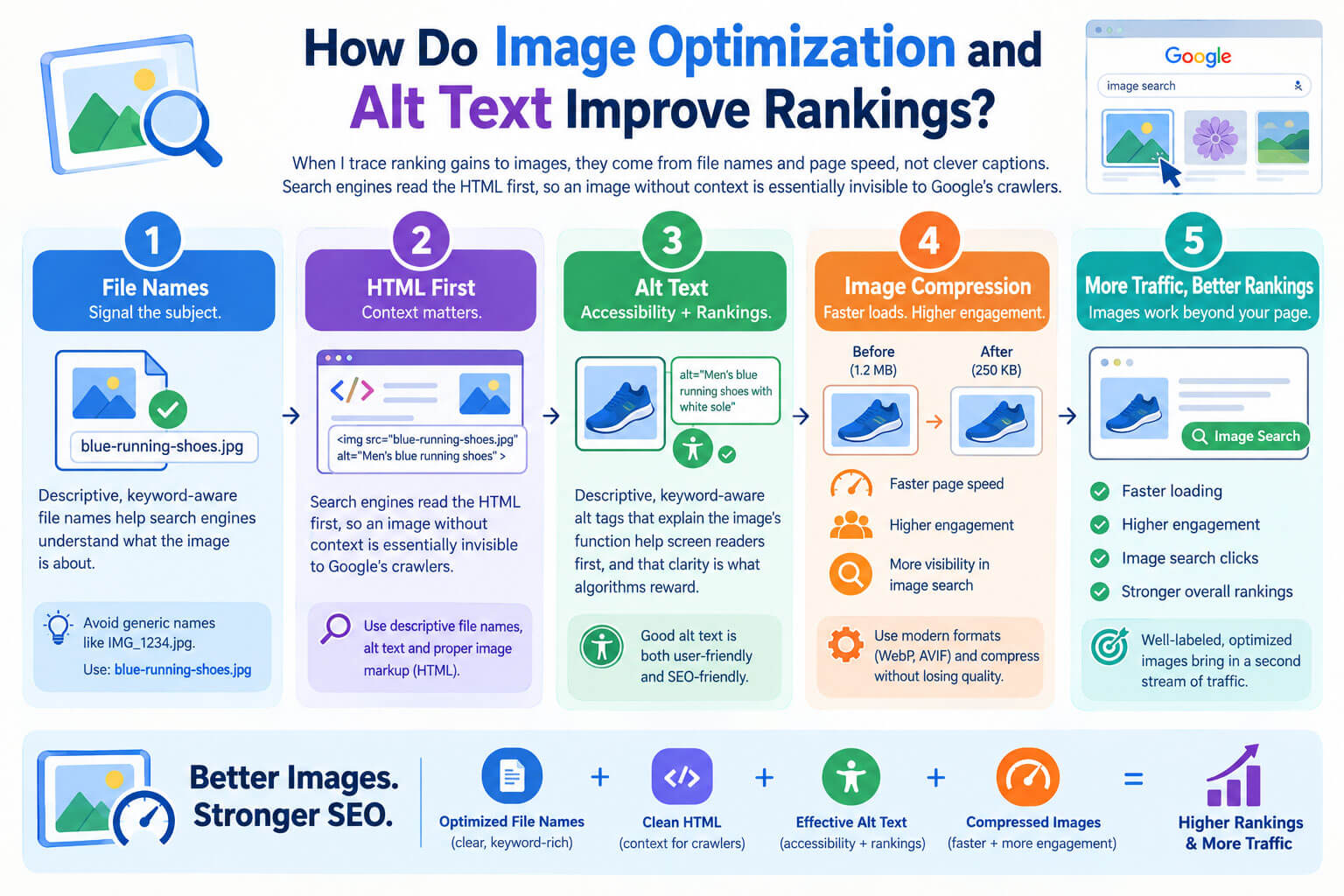
When I trace ranking gains to images, they come from file names and page speed, not clever captions. Search engines read the HTML first, so an image without context is essentially invisible to Google’s crawlers.
Writing alt text taught me something audits rarely mention: accessibility and rankings share one rulebook. Descriptive, keyword-aware alt tags that explain the image’s function help screen readers first, and that clarity is what algorithms reward.
Then comes image compression, which I treat as a ranking lever rather than housekeeping. Lighter files load faster, lift engagement, and open a second traffic stream through image search, where well-labeled visuals attract additional clicks.
How Does Internal Linking Strengthen Page Authority?
Internal links are rarely missing on sites I review; direction is. When priority pages sit four clicks deep, crawlers treat them as afterthoughts, and no amount of link equity from the homepage reaches them intact.
My fix starts with link mapping, charting every URL, then reshaping linking architecture so authority flow reaches revenue pages. Broken pages and dead ends get a 301 redirect, recapturing value the internal linking structure leaked.
Then comes anchor text strategy: descriptive anchors tell Google what each destination should rank for, lifting page authority naturally. My recommendations favor link fluidity over aggressive internal link building, and ranking movements usually confirm it.
Why Do External Links to Authoritative Sources Matter?
Years of auditing client pages taught me something counterintuitive: pages hoarding link equity often rank worse. Pointing DoFollow links toward authoritative sources, especially original statistics, sends a credibility signal telling Google your claims carry weight.
External links to industry resources reinforce Authoritativeness and Trustworthiness, pillars Google’s raters weigh. I’ve watched AI tools mirror citation patterns. Topical relevance matters most; one precise reference outweighs ten generic ones as a trust signal.
Which Schema Markup Types Do On-Page SEO Services Use?
My schema audits usually end with fewer markup types, not more. HowTo markup lost its rich results in 2023, and FAQ schema visibility shrank, so I now prioritize Organization, Service schema, Article, and Product entities.
Everything ships as JSON-LD, not microdata, because structured data survives theme updates. Local JSON schema, typically LocalBusiness markup, reinforces local signals, while advanced JSON schema nests FAQPage within one structured markup graph that crawlers parse.
How Do Page Speed, Core Web Vitals, and Mobile Experience Affect Rankings?
Across client audits, I rarely see page speed lift rankings; it behaves like a Core Web Vitals tiebreaker. When two pages match intent, the one with lower CLS, faster LCP, and snappier INP usually wins.
Under mobile-first indexing, Google judges your phone version first. My fixes start in shared templates: correct viewport tags, spaced touch targets, image compression, deferred render-blocking scripts, and SSL-backed HTTPS. Mobile optimization is simply better UX.
How Do Content Optimization, Semantics, and Entities Build Topical Depth?
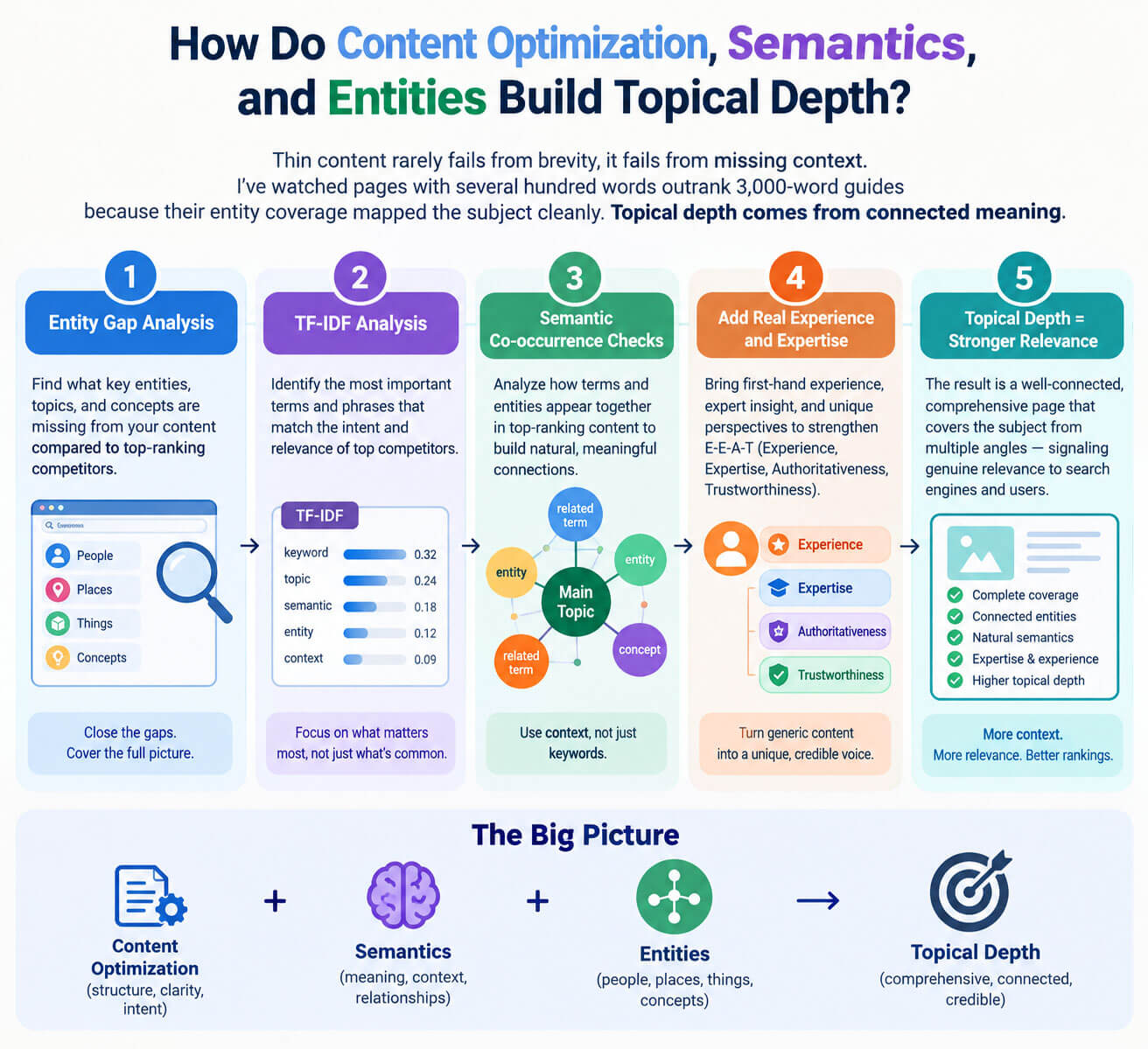
Thin content rarely fails from brevity; it fails from missing context. I’ve watched pages with several hundred words outrank 3,000-word guides because their entity coverage mapped the subject cleanly. Topical depth comes from connected meaning.
My process starts with entity gap analysis, then TF-IDF and semantic co-occurrence checks against ranking competitors. Real Experience and Expertise strengthen E-E-A-T, turning generic SEO content into unique pages whose content depth signals genuine relevance.
How Are Duplicate Content, Canonicals, and Redirects Handled?
Half-finished HTTP/HTTPS consolidation causes many of the duplication messes I inherit, so audits begin there. Every duplicate variant gets mapped, and canonical resolution points crawlers toward one preferred version, letting authority stop leaking across URLs.
Redirects are where duplicate content management gets practical. I use permanent 301s, never chains, and restore value from retired pages instead of letting them die as 404 errors. XML sitemaps list only canonical HTTPS addresses.
How Does On-Page SEO Help You Get Cited by AI Search Engines?
Here’s the uncomfortable truth: no one can force an AI citation. What on-page work controls is how easily LLMs like ChatGPT, Gemini, and Claude extract a page, and semantic clarity decides most of that outcome.
Answer Engine Optimization borrows from classic search results but rewards different habits. I open each section with direct answers, build semantic blocks that stand alone, and add FAQ sections where real questions exist, never filler.
Entity recognition matters more than keyword density here. Naming entities consistently, backing them with structured data, and using semantic formatting like tables and lists gives AI/LLM optimization a foundation that quick AEO shortcuts never match.
How Do Geo-Targeting and Local Elements Fit Into On-Page SEO?
Translation alone seldom wins abroad. Geo-targeting starts with market-specific keywords, because US search intent on Google.com often differs from what buyers in the UK, Germany, France, or the Netherlands actually type, even for identical services.
The Gulf taught me this fastest. Clients in Dubai and Abu Dhabi need Arabic keywords alongside English keywords, because UAE audiences search in both. USA and Europe pages get separate URLs with proper hreflang tags.
Local elements work at street level. A map embed, consistent business details, and LocalBusiness schema should match your Google Business Profile exactly. Depending on scope, I handle this within the Standard tier or Premium tier.
What Is the Step-by-Step Process of On-Page SEO Services?
Every project opens with an intake form, then three audits shape a roadmap for sequential optimization. Keyword analysis, page analysis, and TF-IDF content research feed the build, and a ranking report closes each repeatable cycle.
| Step | Stage | What Happens |
| 1 | Intake | You share target web pages, goals, and access details |
| 2 | Audit | On-page checker scans run alongside competitor semantic analysis |
| 3 | Optimization | Meta tags, H1, headers, and alt text are updated, often through Yoast |
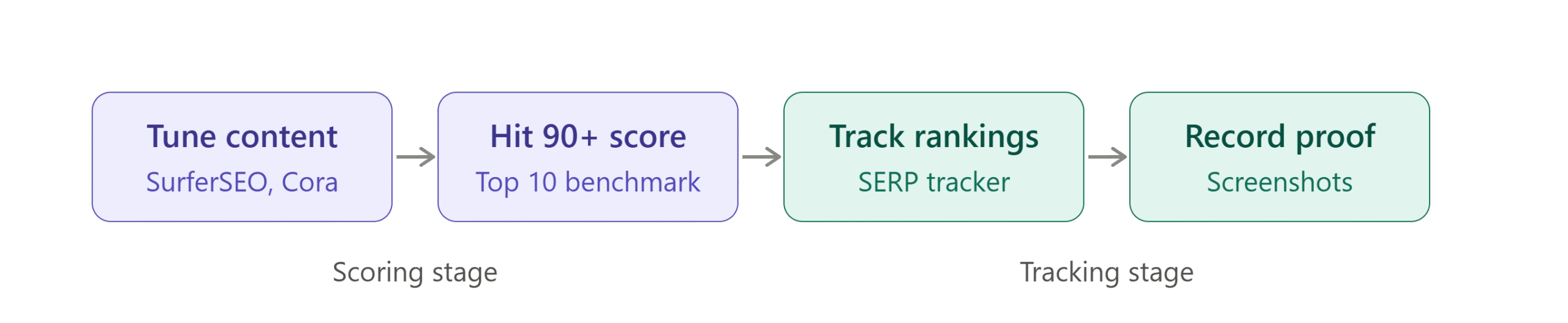
| 4 | Tuning | Content is refined in SurferSEO and Cora until it reaches a 90+ score |
| 5 | Reporting | Google Analytics data is compared against the pre-optimization baseline |
What Does a Site-Wide and Per-Page On-Page SEO Checklist Look Like?
I run ten site-wide checks first, covering SSL, site speed, and structured data, because one global flaw contaminates every URL. Individual pages are then marked pass/fail against title, meta description, heading, image, and linking standards.
| Level | Check | Standard |
| Site-wide | SSL | HTTPS on every URL, no mixed content |
| Site-wide | Site speed | Passing Core Web Vitals thresholds |
| Site-wide | Mobile | Responsive rendering on all templates |
| Site-wide | Architecture | Crawlable structure with shallow click depth |
| Site-wide | Structured data | Valid schema with no errors |
| Per-page | Title tag | Up to 60 characters, keyword near the front |
| Per-page | Meta description | Up to 160 characters |
| Per-page | H1 tags | Exactly one per page |
| Per-page | Content | LSI keywords and related terms used naturally |
| Per-page | Result | Each item recorded as pass/fail |
How Is On-Page SEO Performance Scored and Tracked?
Pages are tuned in SurferSEO and Cora until hitting a 90+ tuning score against the top 10 results for each target query. A SERP tracker monitors top-level keywords, and screenshots record performance across the campaign.
How Much Do On-Page SEO Services Cost?
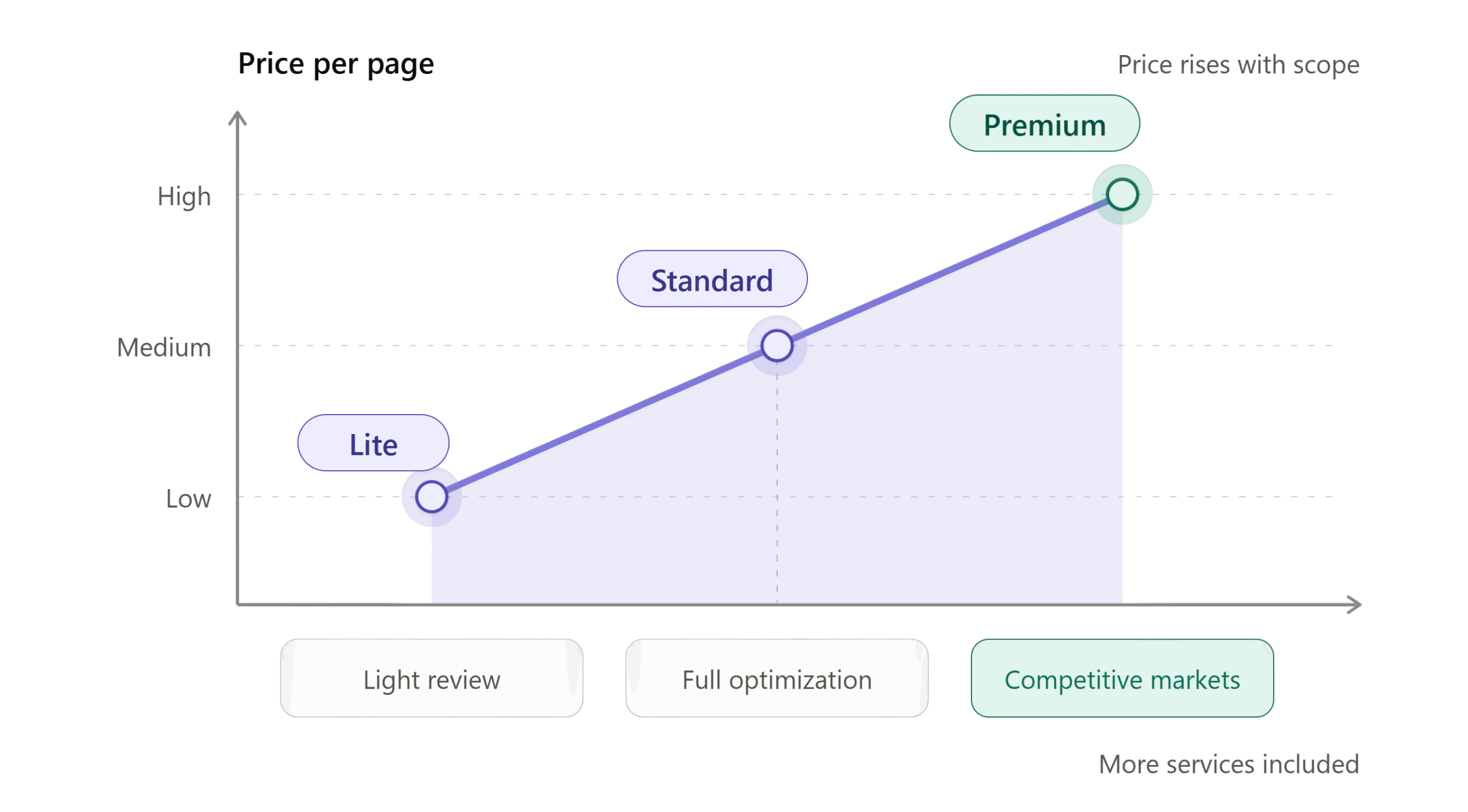
Per-page pricing across three tiers (Lite for a light review, Standard for full optimization, and Premium for competitive markets) means you only pay for what you need, backed by fixed upfront pricing and volume discounts.
How to Choose the Right On-Page SEO Service Provider
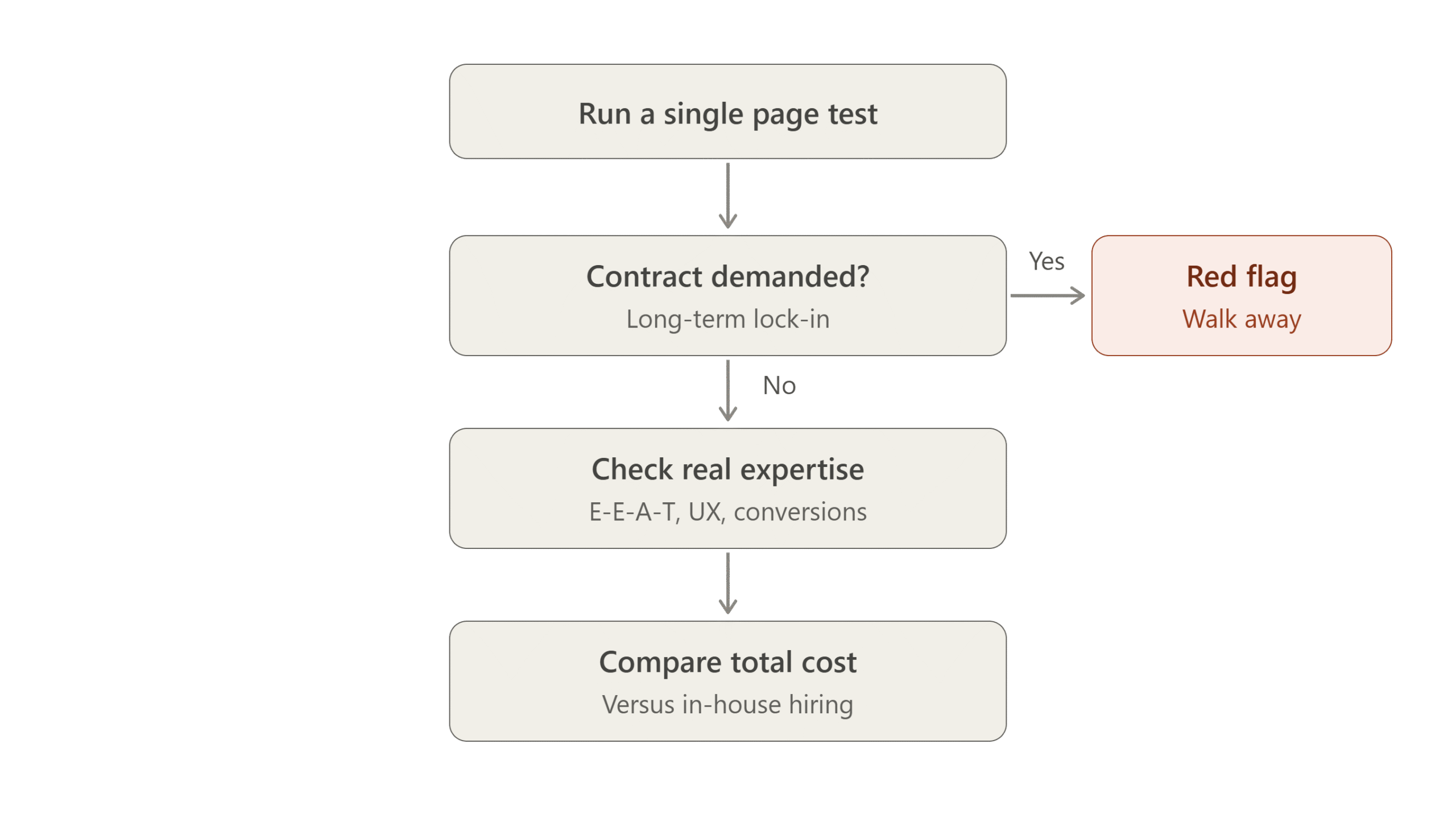
Start with a single page test before committing; a confident provider won’t demand a long-term contract. Judge whether they understand E-E-A-T, user experience, and conversions, not just keywords, and honestly compare cost against in-house hiring.
Frequently Asked Questions About On-Page SEO Services
How Long Do On-Page SEO Services Take to Show Results?
Early ranking improvements often surface within 3 weeks of implementation, especially on pages that already rank. Measurable organic traffic growth builds across 30–60 days, competitive terms need 90–120 days, and off-page SEO shapes the outcome.
Do On-Page SEO Services Guarantee Rankings?
No honest provider offers a ranking guarantee, because algorithm shifts sit outside anyone’s control. What I commit to is the audit-and-fix process: on-site issues resolved, tuning scores documented, and measurable lift reported with full transparency.
Do You Need Website Access for On-Page SEO Implementation?
Admin access, through a dedicated account rather than shared login credentials, speeds implementation and lets me edit Yoast SEO settings. Static HTML sites receive a full report with recommendations your developer applies, avoiding theme conflicts.
Will On-Page SEO Services Change Your Existing Content?
Your original content stays yours; changes are minor edits to page headings, header tags, and entities. The Standard package stays light, while the Premium package expands SEO content where top-ranking competitors show greater content depth.
What Is the Typical Turnaround Time for On-Page SEO Services?
Delivery takes 21 business days once site access arrives, longer for 20+ pages. It’s a manual process: each page is checked against search intent and recent search algorithm behavior, because rushed analysis produces generic fixes.
Key Takeaways
- Results take time: Early ranking shifts can appear within weeks, but organic growth builds over months.
- No guarantees, only proof: Choose a provider that documents tuning scores and lift instead of promising positions.
- Benchmark against real competitors: Each page should be structurally competitive and semantically competitive with the top 10 results before launch.
- Pay per page, stay flexible: No long-term contracts means you scale only when results justify it.
- Track what matters: An SEO audit tool plus rank tracking keeps progress visible and honest.
- Optimize for people and AI: An AEO-ready structure with a clear conversion focus serves both search engines and buyers.
Read More: https://linkneon.com/mad-seo/
Final Thoughts
On-page SEO rarely wins through one fix. Its cumulative ranking impact comes from steady tuning lift across every page, which is why small business websites and enterprise platforms benefit from the same disciplined, measurable process.
After years of real-world experimentation, my clearest lesson is that topical depth beats keyword repetition. Search engines reward pages that answer the whole question, and a data-driven approach shows where competitors leave gaps worth claiming.
The best time to start is before competitors do. Whether you need local relevance in one city or international SEO across markets, well-optimized pages can keep earning website traffic long after the work is finished.