

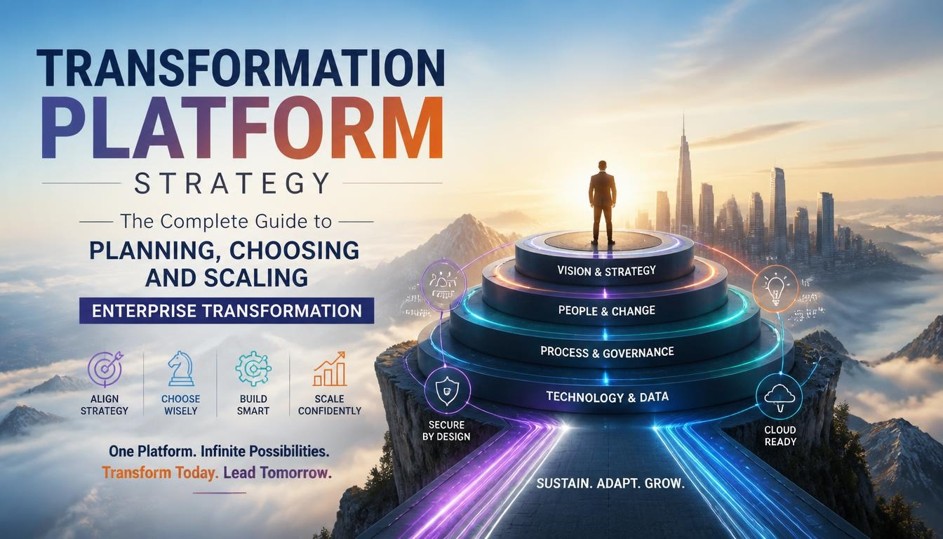
Here’s a number that surprises most business leaders. According to IDC, companies worldwide are on track to spend nearly $4 trillion on digital transformation by 2027, yet BCG found that only 1 in 4 transformations delivers value-creating, enduring change. So what goes wrong? Usually not the technology itself.
Most companies never build a clear transformation platform strategy: a plan that connects your workflows, data, automation and people on one shared foundation, so every new tool strengthens the last one instead of creating another information silo.
If your business is dealing with technical debt, a tight budget and pressure to adopt artificial intelligence, this plan decides whether you actually transform or just keep spending.
In this guide, I’ll walk you through it step by step, in plain language. You’ll learn what a platform-led approach really means, the five building blocks every plan needs, the main types of platforms, and a maturity model that shows where your business stands today.
Then we’ll go through a 7-step framework, a realistic roadmap timeline and a platform evaluation scorecard. After that come advice for your industry and company size, the KPIs that prove ROI, the mistakes to avoid, real company examples, and a checklist you can use right away.
What Is a Transformation Platform Strategy?
Let’s start with the definition. A transformation platform strategy is your plan for three things: which shared technology foundation your organization will use, which business outcomes it must deliver, and how your IT teams, business stakeholders, processes and governance will change around it.
It answers three questions in one documented plan. What enterprise value are you chasing? What platform capabilities do you need to get there? How will you get people across departments to actually use what you build? When you can answer all three, you have a strategic blueprint that carries you from strategy to execution.
What exactly is the “platform” part, then? A transformation platform is the technology foundation underneath your change effort. It connects your systems, automates work and gives your teams one common place to build, run and measure improvements. Some platforms are software products, like low-code development tools, integration platforms or process automation suites.
Others are consulting-led toolkits that combine maturity assessments, business case modeling, dynamic dashboards and AI-assisted program management. Both kinds do the same basic job. They replace fragmented tools with a unified digital ecosystem, so data flow becomes automatic, manual file transfers disappear, and you finally get a holistic view of how your business is running.
Transformation Platform vs. Transformation Software vs. Transformation Strategy
People often mix these three terms up, so here is a quick way to tell them apart.
| Term | What It Means | Example |
| Transformation software | One tool that automates or digitizes a specific task | A workflow automation app, a chatbot, an analytics dashboard |
| Transformation platform | A connected foundation that hosts, integrates and governs many tools | A low-code platform linked to your ERP, CRM and data warehouse |
| Transformation strategy | The plan that sets goals, priorities, platforms, people and metrics | A 36-month roadmap tied to customer retention and cost reduction |
In short, software solves a task, a platform connects many tasks, and the strategy tells you why you’re doing all of it and in what order.
Digitization, Digitalization and Digital Transformation: Key Differences
These three words sound almost the same, but they describe very different levels of change. Digitization simply means turning physical information into digital form, like scanning paper invoices into an electronic database.
Digitalization goes a step further: you use digital tools to improve a process you already have, such as replacing spreadsheets with a customer relationship management (CRM) system. Digital transformation is the biggest step. You redesign how your whole organization works, creates value and serves customers, with data-led decisions guiding every department.
| Level | What Changes | The Result |
| Digitization | Information | Your data becomes digital |
| Digitalization | Isolated processes | Your processes get faster |
| Digital transformation | The organization as a whole | Your operating model changes |
A platform approach works at that third level. It’s not about faster paperwork. It’s about running your business in a better way.
You’ll also hear two related terms. IT transformation modernizes the technology department itself, including its infrastructure, applications, service management and team structure, so it can move from reactive support to proactive innovation.
Enterprise-wide transformation reaches every corner of the company, including sales, finance, operations, HR and customer experience. IBM describes digital transformation as a business strategy initiative that brings digital technology into all areas of an organization.
It works across five domains: business and operating models, processes, products, employee experience and customer experience. In practice, IT transformation usually comes first, because you need a modern, cloud-ready foundation before the rest of the business can change on top of it.
Why a Transformation Platform Strategy Matters
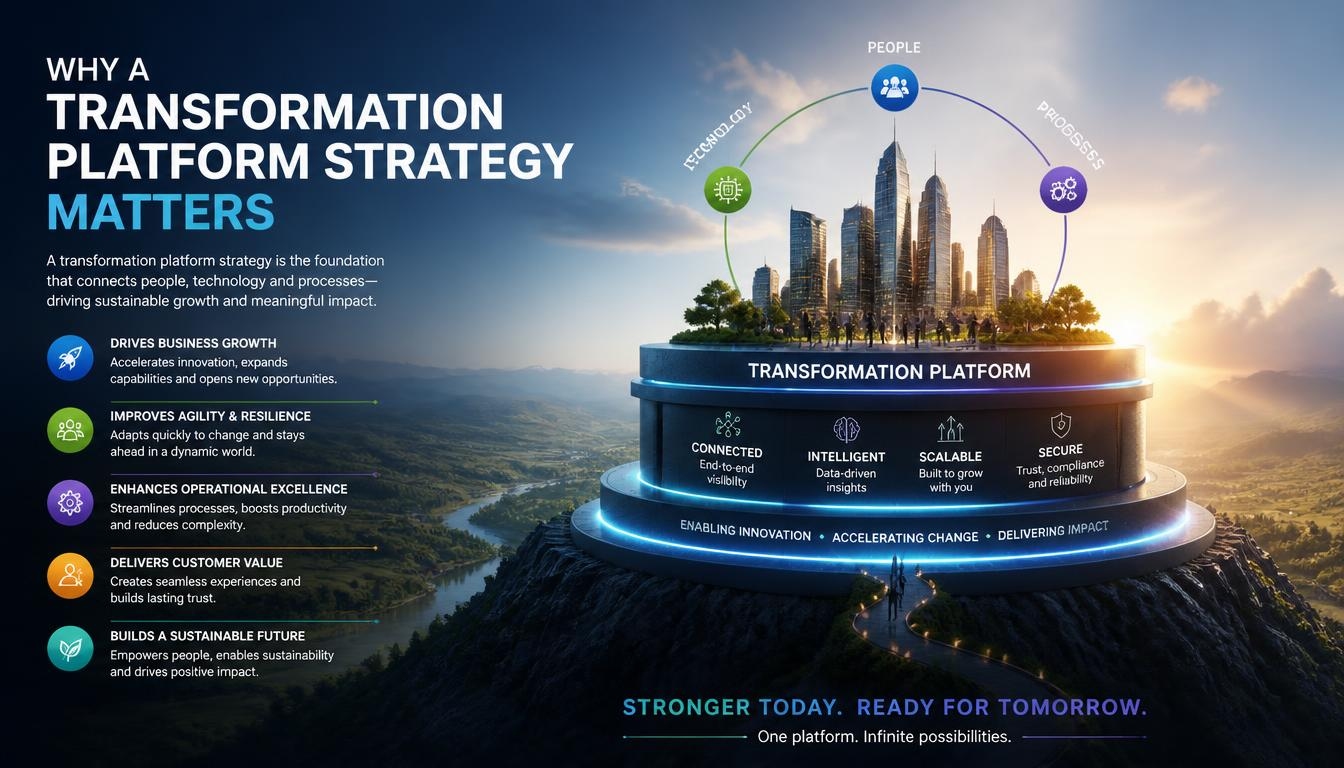
You might be thinking, “We already invest in technology. Why do we need a whole strategy around it?” The answer is that a big budget does not guarantee big results. What separates companies that capture measurable value from those that stall is how deliberately they connect technology, processes and people.
Remember that BCG finding, where only 1 in 4 transformations delivers lasting change? What usually goes wrong is rarely the technology. Companies fall into technology-first procurement, buying tools before they know what value they need. They skip setting a behavioral baseline, so they can’t tell whether anything changed.
They measure success by launch rather than adoption, celebrating go-live day even when nobody uses the new system. And they treat change as a single announcement email instead of a genuine behavior shift. McKinsey’s research on AI in the workplace shows the same pattern.
94% of employees say they are at least somewhat familiar with generative AI tools, yet only 1% of C-suite leaders describe their company’s AI deployment as mature. So the problem isn’t access to AI tools. It’s the design gap in how companies roll them out.
There’s also a cost you may not see. Picture a company where every department buys its own software, piece by piece. Before long, it has a patchwork of systems that don’t talk to each other. Every new tool adds license costs, more integration work and a bigger attack surface.
Because finance systems, operational platforms and customer-facing applications stay disconnected, leaders can’t see how one area affects another. Meanwhile, employees lose hours every week re-entering data, reconciling reports and jumping between apps. These hidden costs never show up as a single line in the budget, which is exactly why they keep growing until someone consolidates them on a platform.
What do you gain when you get this right? McKinsey studied 20 leading and 20 lagging retail banks. Between 2018 and 2022, the digital leaders earned average annual total shareholder returns of 8.1%, compared with 4.9% for the laggards, roughly 65% higher. For your business, the benefits usually show up in these areas:
- Faster time-to-market, because new apps and workflows reuse integrations you already built
- Lower operating costs, from retiring duplicate tools and automating repetitive tasks
- Better decisions, thanks to connected, real-time data analytics across departments
- Stronger security and compliance, with access controls and audit logs managed in one place
- Higher scalability, so you can double your content volume or transactions without doubling headcount
- Better customer and employee experience, through smooth, connected digital journeys
The 5 Building Blocks of a Transformation Platform Strategy
Now let’s look at what your plan actually needs. I see it as five building blocks. If even one of them is weak, the others can’t hold the structure up on their own.
People, Leadership and Change Readiness
Many companies overlook one basic truth: technology changes how work gets done, but your employees decide whether that change sticks. Getting people ready starts with visible executive buy-in, honest communication about how their roles will change, and hands-on training that happens inside their daily work, not in a separate classroom.
Gallup research shows that managers account for at least 70% of the variance in employee engagement scores across business units. In plain terms, your frontline managers are your most important channel for adoption. Give them what they need to coach their teams, set observable goals and run short weekly reviews, rather than simply announcing new tools. Over time, this builds a culture of innovation, where people feel curious and safe to experiment.
Process Redesign Before Automation
Keep this rule in mind: if you automate a broken process, you just get a broken process that runs faster. So before adding any technology, use process mapping to see how work actually moves from step to step. Look for the handoffs that cause delays and the unnecessary steps that add no value. Some workflows only need small fixes, while others need a complete redesign. Doing this first means your automation removes friction instead of hiding it.
Integration and Cloud-Ready Architecture
Older, rigid infrastructure makes every new capability slow and expensive to add. Modern flexible architectures work differently. They use APIs, prebuilt connectors and integration interfaces, so you can add, replace or upgrade apps without rebuilding everything around them. A cloud-ready foundation also gives you elastic computing resources that grow with demand, continuous delivery through DevOps, and the base you’ll need for AI workloads.
Data, Analytics and AI Capabilities
Your company creates data everywhere: in finance, operations, internal reporting and customer support. The platform brings those integrated datasets together so tools like machine learning and predictive AI can work from the complete picture. Once your data is unified, you move from reports that only look backward to predictive insights that help you plan ahead. More and more companies are also using AI agents that handle ticket routing, anomaly detection and incident response within defined guardrails.
Governance, Security and Compliance
Every new connection you add is another door an attacker could try to open, which is why security-by-design has to start on day one, not after launch. Good governance brings together role-based access control (RBAC), single sign-on (SSO), multi-factor authentication, encryption, data governance policies and firm rules about who can build, publish and change apps. If you work in a regulated US industry like healthcare, banking or insurance, compliance standards such as SOC 2 Type II reports and HIPAA requirements will often decide which platforms you can even consider.
Types of Transformation Platforms
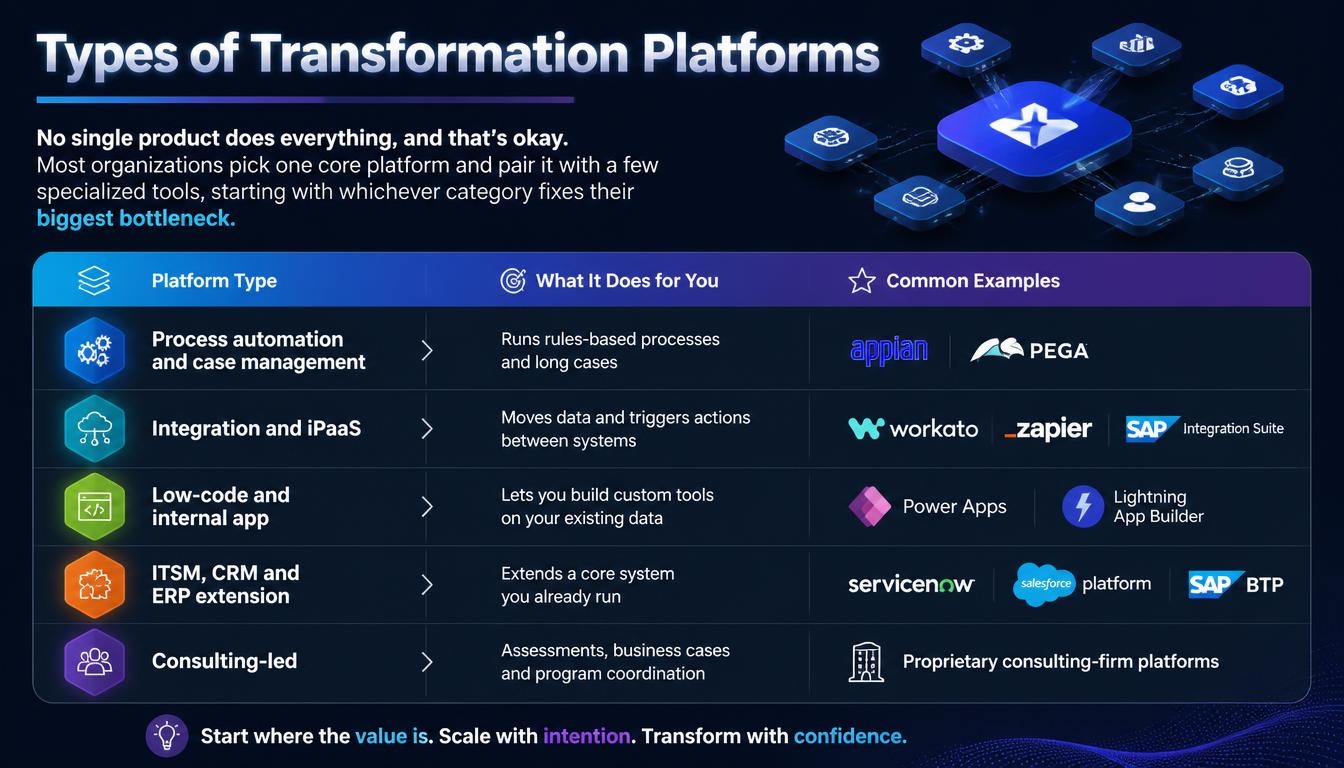
No single product does everything, and that’s okay. Most organizations pick one core platform and pair it with a few specialized tools, starting with whichever category fixes their biggest bottleneck.
| Platform Type | What It Does for You | Common Examples |
| Process automation and case management | Runs rules-based processes and long cases | Appian, Pega |
| Integration and iPaaS | Moves data and triggers actions between systems | Workato, Zapier, SAP Integration Suite |
| Low-code and internal app | Lets you build custom tools on your existing data | Power Apps, Lightning App Builder |
| ITSM, CRM and ERP extension | Extends a core system you already run | ServiceNow, Salesforce Platform, SAP BTP |
| Consulting-led | Assessments, business cases and program coordination | Proprietary consulting-firm platforms |
Process automation and case management platforms let you draw your business processes visually, apply rules, and route work between people and systems. Appian’s Case Management Studio and Pega’s Next Best Action decisioning are good examples.
Many also include robotic process automation (RPA), which handles repetitive steps in older systems that have no API. They work best when your processes follow strict rules, such as claims handling, loan approvals or government casework.
Integration Platform as a Service (iPaaS) tools are the bridges between your apps, databases and files. You set up visual workflows, which Workato calls recipes and Zapier calls Zaps, and data moves automatically between your CRM, ERP, marketing and support tools. Enterprise options add policy controls, approvals and observability, while lighter tools are perfect for small teams automating everyday tasks.
With low-code platforms like Microsoft Power Apps or Salesforce’s Lightning App Builder, both technical and non-technical people can build custom internal apps on top of the data you already have. This is often the fastest way to retire those spreadsheet-based workflows everyone quietly struggles with.
Now that AI can help build apps, look closely at row-level permissions, source control with Git and governed deployment, because that’s where these platforms really differ.
If your company already runs a major system of record, that vendor’s native platform is often your most practical starting point. ServiceNow’s Now Platform and App Engine extend IT service workflows into HR and security.
Salesforce adds Flow, Apex and the AppExchange marketplace on top of your CRM data. SAP BTP lets you build clean-core extensions around your ERP, plus AI agents through Joule Studio. The big advantage is that you build directly on data your teams already trust.
Large consulting firms also offer their own platforms, which combine maturity assessments, ROI visualization, real-time collaborative planning and execution playbooks. They focus less on building apps and more on helping leaders identify, orchestrate and realize value across many workstreams at once.
If you’re running a large multi-year program where coordination is the hardest part, this type is worth a look.
Transformation Platform Maturity Model: Where Does Your Business Stand?
Before you decide what to buy, it helps to know where you’re starting from. Knowing this saves you from two expensive mistakes: buying advanced features you’re not ready for, and skipping the basics you actually need. Use this four-stage maturity model to place your organization.
| Stage | What It Looks Like | What to Focus On |
| 1. Fragmented | Separate tools, manual tracking, little shared visibility | Take inventory, consolidate, set business goals |
| 2. Connected | Core systems linked, shared dashboards | Standardize processes, tighten governance |
| 3. Automated | Key workflows automated, self-service apps, tracked KPIs | Scale automation, grow adoption |
| 4. Intelligent | AI-driven decisions, condition-based maintenance, constant improvement | Agentic AI, data-driven business models |
At the fragmented stage, each department runs its own outdated systems and shares information through email, exports and manual tracking. If this sounds like you, don’t rush into advanced technology. Start with a complete inventory of systems, specific goals and a short list of high-value processes to connect first.
At the connected stage, your core systems like CRM, ERP and finance share data, and teams can see common dashboards. What usually remains is inconsistency, with different regions or teams doing the same job in different ways. Your focus now is process standardization, aligning flows like purchase-to-pay and order-to-cash, and setting governance rules that keep the platform clean as it grows.
At the automated stage, repetitive work runs through automated workflows, employees can build or request self-service apps, and you track numbers like mean time to resolve (MTTR) and cycle time against a baseline. Your challenge shifts from building things to scaling adoption without losing control. This is where a center of excellence pays off, because it shares templates, standards and lessons across teams.
At the intelligent stage, data and AI drive everyday decisions. Sensors and IoT connectivity spot equipment problems before they cause breakdowns, and AI agents handle tasks like access provisioning and service request fulfillment within set limits. For example, General Electric built connected equipment platforms that collect data from turbines, supporting remote monitoring and predictive maintenance. Very few companies are fully here yet, but it’s the direction your plan should point toward.
How to Build a Transformation Platform Strategy in 7 Steps
Now for the practical part. These seven steps turn your ambition into a plan you can actually execute, and each one produces something concrete you’ll use in the next.
| Step | What You’ll Have at the End |
| 1. Assess maturity and gaps | A current-state baseline and maturity score |
| 2. Define outcomes and KPIs | Measurable value targets |
| 3. Prioritize use cases | A ranked list scored by value and effort |
| 4. Design target architecture | A future-state platform design |
| 5. Select and validate the stack | Shortlisted, tested platforms |
| 6. Pilot and drive adoption | A proven pilot backed by usage data |
| 7. Scale with governance | A repeatable operating model |
Step 1: Assess Maturity, Technical Debt and Gaps
Begin by taking a clear-eyed look at what you have today: your systems, integrations, data quality, cybersecurity posture and team skills. Talk to department heads, team managers and IT directors, and ask where work slows down and which tools people quietly avoid. Place yourself on the maturity model above, and write down any legacy system complexity, such as unsupported apps or integrations nobody fully understands.
Step 2: Define Business Outcomes and KPIs
Next, turn your business priorities into specific targets you can measure, like faster order processing, better customer retention or fewer service requests handled by hand. Every target needs a baseline metric recorded before you change anything, an owner and a deadline. Skip this, and you’ll drift toward vanity metrics like “number of apps launched” instead of the value you actually deliver.
Step 3: Prioritize Use Cases by Value and Effort
Now list your possible projects and score each one on business value, effort, risk and how much it depends on other work. Your best first projects are visible, measurable and doable in one or two quarters. Pick early wins for learning speed, not size. Small, fast wins build the confidence and proof you’ll need before tackling bigger initiatives.
Step 4: Design the Target Platform Architecture
At this stage, you sketch your future setup. Decide which systems stay as your systems of record, how data moves between them, where the platform sits, and how identity, security and monitoring will work. Then choose between public, private or hybrid cloud based on how sensitive your data is, and build compliance into the design from the start.
Step 5: Select and Validate the Platform Stack
Shortlist the platforms that fit your top use cases, and then test them properly. Run a hands-on proof of concept using your own data, not a vendor’s polished demo. Score each option on integration fit, governance, speed to a first working app and total cost at your scale. You’ll find a ready-made scorecard later in this guide.
Step 6: Pilot, Learn and Drive Adoption
Launch a pilot in one department, region or workflow. Train people right where they work, track active usage and task completion, and collect feedback every week. Each pilot should end with a firm decision: scale it, adjust it or stop it. Treat adoption as a full behavior change effort, supported by manager coaching, incentives and leaders visibly using the new tools themselves.
Step 7: Scale With Continuous Governance
Once a pilot works, expand it using a written playbook of templates, standards, security rules and training paths. Set up a central governance team to review new requests, stop duplicate apps and track results. At this point, transformation stops being a short-term project and becomes an ongoing capability your company keeps improving.
Transformation Platform Roadmap and Timeline
The seven steps tell you what to do, and the roadmap tells you when. A good transformation roadmap puts your initiatives in order, assigns owners and gets updated as results come in.
| Time Frame | Main Focus | What You Should Have Done |
| First 90 days | Foundation and a first win | Baseline set, use cases ranked, platform chosen, first pilot live |
| 3 to 12 months | Expansion | Several scaled use cases, core integrations, governance model, upskilling workshops |
| 12 to 36 months | Enterprise scale | Platform across major functions, advanced AI, a continuous improvement cycle |
How long will it take you? That depends on scope. A focused initiative, like automating one type of service request or moving a single application to the cloud, can often be finished in three to six months. An enterprise-wide transformation that touches infrastructure, applications and culture usually takes several years. The trick is to deliver it in short 30 to 90 day increments, so you keep learning and adjusting instead of betting everything on one big launch.
Your roadmap document should start with a short current-state snapshot and your future-state goals. Next comes an initiative inventory, ranked by impact and showing which projects depend on others. It closes with a resource and budget plan and a review cadence for checking your KPIs. One tip makes a big difference: tie each milestone to a result, like “manual ticket handling cut by a set percentage,” rather than a technical event like “system installed.” Then revisit the roadmap at every phase and reorder it whenever business priorities shift.
How to Choose the Right Transformation Platform
Choosing a platform is a business decision first and a technical one second. The right fit for you depends on your biggest bottleneck, the systems you already run and how strict your governance needs are. To compare options fairly, use a weighted score. Score each platform from 1 to 5 on every criterion, multiply by the weight, and add up the totals. If you handle regulated data, give governance the most weight.
| Criterion | What to Ask | Suggested Weight |
| Fit for your top use case | Does it fix your biggest bottleneck directly? | 25% |
| Integration with existing systems | Does it offer connectors, APIs and legacy support? | 20% |
| Governance and security | Does it have RBAC, SSO, audit logs and certifications? | 20% |
| Speed to a first working solution | How fast can a team ship something usable? | 15% |
| Total cost at your scale | What are licenses, setup, admin time and training? | 20% |
Even a strong platform can be wrong for you. As you evaluate vendors, watch out for these warning signs:
- No published security certifications, or vague answers about how your data is handled
- Pricing you can’t estimate without going through a long sales-led buying process, especially when usage fees are unclear
- Weak or poorly documented APIs that will make future integrations expensive
- No way to export your data and apps if you ever decide to leave
- Demos that only use sample data, with a refusal to repeat them on your data
- A thin partner and support network in your region or industry
Build vs. Buy vs. Extend Existing Systems
You have three basic paths, and each suits a different situation. Building your own software gives you full control, but you’ll need skilled engineers and ongoing maintenance. Buying a platform gets you there faster and shifts maintenance to the vendor, though you’ll pay license fees and accept some vendor lock-in. Extending a system you already run keeps your data in a trusted core, but it limits you to that vendor’s ecosystem.
| Approach | Choose It When | What You Give Up |
| Build | The capability is what sets you apart from competitors | Highest cost and maintenance effort |
| Buy | You need speed and your needs are common | License costs and vendor dependency |
| Extend | One vendor already runs your core system | Flexibility outside that ecosystem |
Most companies end up mixing all three. They extend their core system, buy for automation and integration, and build only where they truly stand out.
Top Transformation Platforms Compared by Use Case
The table below compares well-known options. These are published starting prices in US dollars as of late 2026. Vendors change prices often, so please confirm current rates on each vendor’s website before you set a technology budget.
| Platform | Best For | Starting Price |
| ServiceNow | Enterprise ITSM and cross-department workflows | Custom quote |
| Microsoft Power Platform | Low-code apps, Power Automate and Power BI for Microsoft 365 companies | $20/user/month billed annually (rising to $22 on January 1, 2027) |
| Salesforce Platform | Apps and automation on CRM data | $25/user/month billed annually |
| Appian | Process automation and case management | Custom quote; free Community Edition |
| SAP BTP | Extending and integrating SAP ERP | Consumption-based; free tier available |
| Pega | Decisioning in regulated industries | Custom quote |
| Workato | Enterprise integration across SaaS apps | Quote-based for enterprise; self-service free plan available |
| Zapier | No-code automation for small teams | Free plan (100 tasks); paid from $29.99/month, or $19.99/month billed yearly |
Transformation Platform Strategy by Industry and Business Size
The five building blocks apply to everyone, but what you prioritize depends on your industry, size and resources. Let’s look at how that plays out.
If you run a large organization in banking, insurance, healthcare or government, you’re dealing with strict compliance rules, complex legacy systems and many stakeholders.
For you, governance and security usually come first when choosing a platform, followed by how well it connects to your existing systems of record. You’ll get the most out of phased programs, a dedicated transformation office and hybrid or private deployment options that keep sensitive data inside approved environments.
If you’re a mid-market company, you’ve probably outgrown spreadsheets and basic SaaS tools but don’t have a large IT team. Your best path is usually one core platform that combines integration, automation and app building, so a small team can deliver many projects.
For you, speed to value and transparent pricing matter more than deep customization. External specialists and technology vendors can fill skill gaps in the early phases.
If you’re a small business or startup, hold off on heavy enterprise platforms until your processes settle down. At this stage, lightweight no-code automation, a few well-chosen SaaS tools and clean data habits will give you most of the value. The smart move is to build in a way you won’t have to throw away later. Choose tools with good integrations and easy data export, and write down your processes as they take shape.
Who Owns the Transformation Platform Strategy?
One of the strongest signs a program will succeed is that someone clearly owns it. Without ownership, platforms multiply, priorities clash and nobody is accountable.
In most companies, ownership sits with a Chief Digital Officer (CDO) or Chief Information Officer (CIO), backed by visible CEO support.
This executive sponsor keeps the program aligned with company strategy, secures the budget, settles disagreements between departments and models the change personally.
Just as important, business unit leaders should co-own the results for their areas, so nobody dismisses the effort as “just an IT project.”
Everyone else has a part to play too. IT leaders turn the plan into delivery roadmaps, manage architecture and security, and guide their teams through platform migrations and system integrations.
Business stakeholders in finance, operations, marketing and sales define what they need, test the solutions and drive adoption in their teams.
Third-party consultants, service providers and vendors can fill capability gaps and speed up the tricky phases. Over the long run, though, your internal teams should own the knowledge.
Skills matter just as much as ownership. Many companies discover halfway through that their teams don’t yet have the skills to use the new platform well. You can close this digital skills gap through a mix of targeted hiring, cross-functional training, mentorship programs, e-learning platforms and university partnerships.
Training today also needs to go beyond “which button to press.” It should teach Human-AI Symbiosis, where your people review, guide and improve what AI produces.
LinkedIn’s 2025 Workplace Learning Report found that only 36% of organizations qualify as career development champions with mature programs. So if your company isn’t there yet, you’re in good company, and you have plenty of room to grow.
Measuring Transformation Platform ROI and Success

You’ve probably heard “what gets measured gets managed.” That’s true here, but only if you measure the right mix of things. If you track only cost savings, you’ll miss most of the value. If you track only activity, you won’t know whether anything improved.
It helps to sort your metrics into four groups. Leading metrics tell you whether people are adopting the platform. Lagging metrics tell you whether the business is improving. Guardrail metrics make sure you’re not gaining speed at the cost of quality, and operational metrics tell you whether the platform itself is reliable.
| KPI Type | Example Metrics | What It Tells You |
| Leading | Active users, workflow completion rate, apps in production | Are people actually using it? |
| Lagging | Process cycle time, cost per transaction, revenue per employee | Is the business improving? |
| Guardrail | Customer satisfaction, defect rate, security incidents | Are the gains worth the trade-offs? |
| Operational | System availability, mean time to resolve, change success rate, deployment frequency | Is the platform reliable? |
Check these at least quarterly, and don’t be afraid to drop a metric once it stops telling you something useful.
Working out your return takes three moves. Before rollout, record two or three baseline numbers, such as manual hours per week, error and rework rates, and processing time.
After about 90 days, measure the same numbers again. Then compare the gain with your total cost, including licenses, setup, training and ongoing admin work. Don’t stop at cost savings, though.
A full picture also counts the strategic wins: faster speed-to-market in new regions, the scalability to handle more work without hiring at the same rate, and less risk from retiring old systems. When you link every investment to a named business outcome, your program will be seen as a driver of long-term profitability rather than a cost center.
Common Transformation Platform Challenges and Solutions
Even the best-planned programs run into bumps. Here are the most common ones and how to handle them.
| Challenge | Why It Happens | How to Fix It |
| Legacy integration | Old systems have no modern APIs | Connectors, RPA, phased migration |
| Low adoption | Change is treated as an announcement | Manager coaching, in-context training |
| Security and compliance | More connections mean more risk | Security-by-design, central governance |
| Platform sprawl | No owner or intake process | Center of excellence, app standards |
Your older systems often hold critical data but lack modern APIs. A practical approach is to run parallel systems during the transition, so nothing breaks while you test the new setup.
Connectors and RPA can bridge the systems you can’t replace right away. Follow a sensible order: stabilize the foundation first, then modernize applications, and only then automate at scale.
Low adoption is the next common hurdle. People push back when they don’t understand why something is changing or how it affects them, and that’s completely human.
The fix is to involve employees early, explain the benefits in terms of their own daily tasks, offer hands-on training and share early success stories. Then watch the usage data instead of assuming people are on board, and step in quickly if a team falls behind.
Security deserves equal attention. Every new cloud service, connected device and integration adds entry points that attackers could use. Verizon’s 2025 Data Breach Investigations Report found that the human element was involved in about 60% of breaches, so people matter as much as tools here.
Protect yourself by building encrypted payment gateways, multi-factor authentication, access controls and regular security audits into the platform design, and train your teams to spot risks like phishing.
Finally, watch for sprawl. Low-code and AI tools make building apps so easy that you can end up with hundreds of unmanaged ones before you notice. To prevent this, set up a short intake process for new requests, agree on naming and data standards, review your apps regularly so unused ones get retired, and make sure every live app has a named owner.
Real-World Transformation Platform Strategy Examples
Sometimes the best way to understand all this is to see how real companies did it. These four examples are well documented.
| Company | What They Transformed | What Happened |
| Netflix and Capital One | Cloud-first infrastructure | Global scale and a complete exit from owned data centers |
| JPMorgan Chase | AI-powered document review | Work that took about 360,000 hours a year now done in seconds |
| Unilever | ERP consolidation | More than 200 local ERP systems moved into four regional SAP landscapes |
| Starbucks | Digital customer experience | Mobile orders reached 31% of US company-operated store transactions |
Netflix finished moving from its internal data centers to Amazon Web Services (AWS) in January 2016. The cloud migration took seven years, and along the way the company rebuilt much of its technology so it could serve millions of users and handle streaming demand spikes.
Capital One completed one of the best-known enterprise migrations in 2020. It exited all eight of its on-premises data centers after an eight-year journey and became the first US bank to announce going all in on the public cloud. The lesson from both is that cloud works best when you treat it as a multi-year program of capability-building, not a quick project.
JPMorgan Chase built a system called COIN (Contract Intelligence) that uses machine learning to review commercial loan agreements. Work that once took lawyers and loan officers around 360,000 hours every year can now be done in seconds. AI delivers the most value when you aim it at a high-volume, rules-heavy process where you can measure the before and after.
Unilever consolidated more than 200 local ERP systems into four regional SAP landscapes over roughly seven years, with the goal of managing them as one global platform. Before the change, its subsidiaries ran core processes like order handling and invoicing on separate systems, which made it very hard to operate as one global business.
The Starbucks mobile app brings ordering, payments and its loyalty program together in one place, with personalized offers based on what you’ve bought before. Mobile orders reached 31% of transactions at US company-operated stores in the quarter ending December 31, 2023, the first time that share passed 30%. It’s a strong example of how customer experience modernization can reshape the whole purchase journey.
Transformation Platform Strategy Checklist
Before you launch, and again at each phase, run through this checklist:
- An executive sponsor is named and business-unit co-owners are assigned
- Your current maturity is assessed and technical debt is documented
- Business outcomes have baselines, targets and owners
- Use cases are ranked by value and effort
- The target architecture is designed with security built in
- Platforms are evaluated with a weighted scorecard and a proof of concept
- Pilot scope, success criteria and timeline are agreed
- A training and manager coaching plan is ready
- Your governance model, intake process and app standards are in place
- A KPI dashboard is live with a quarterly review rhythm
- The roadmap is scheduled for review at every phase
Future of Transformation Platform Strategy
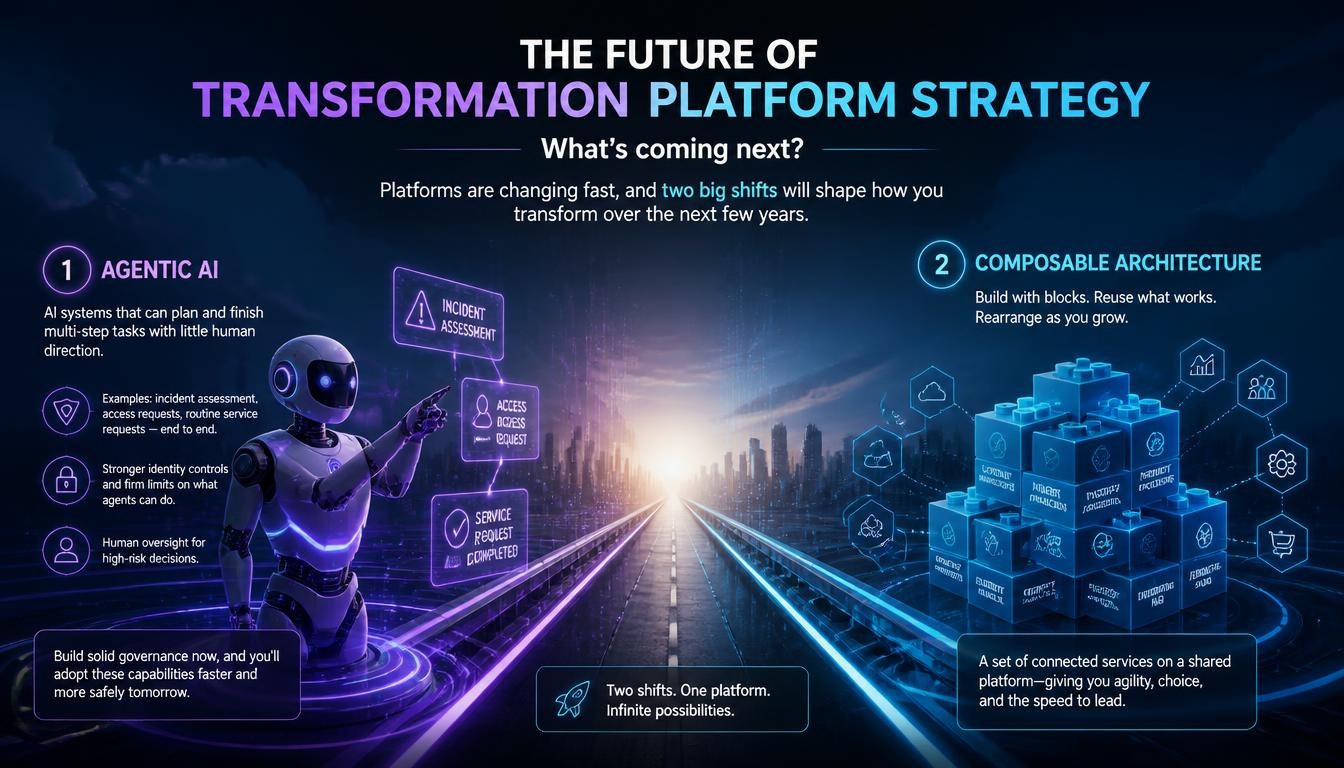
What’s coming next? Platforms are changing fast, and two big shifts will shape how you transform over the next few years.
The first is agentic AI, meaning AI systems that can plan and finish multi-step tasks with little human direction. Examples include incident assessment, handling access requests and completing routine service requests from start to finish.
As these agents move into production, your platform will need stronger identity controls, firm limits on what agents can do, and human oversight for high-risk decisions. If you build solid governance now, you’ll be able to adopt these capabilities faster and more safely later.
The second is composable architecture. Think of it like building with blocks: each business capability is a reusable piece you can rearrange as your needs change. Instead of one large, rigid system, your company becomes a set of connected services on a shared platform.
This gives you room to experiment, makes switching vendors easier and builds the business agility to respond quickly to new market demands.
FAQs
What is a transformation platform strategy?
It’s a business plan that decides which connected technology foundation you’ll build on, what results it must produce, and how your teams will adopt it. It’s the difference between buying tools one by one and building toward one shared goal.
What is the first step in building a transformation platform strategy?
Start with diagnosis, not procurement. Map your value streams, find where work stalls, and rank opportunities by value and effort before you choose any platform.
How long does a transformation platform strategy take?
A focused project can often be finished in three to six months. A company-wide program usually runs for several years and works best in short release cycles, with your roadmap reviewed at each phase.
Who should lead a transformation platform strategy?
Usually a CIO or CDO leads it, with visible CEO support and shared ownership from business-unit leaders. IT teams, business stakeholders and outside partners each play a defined role in delivery and adoption.
How do you measure transformation platform ROI?
Compare what you gained against what you spent. Track a few starting numbers, such as cycle time, manual hours and error rate, check them again after one quarter, and weigh the improvement against licenses, implementation and admin time.
Can transformation platforms integrate with legacy systems?
Yes. Most platforms offer prebuilt connectors and API support, and RPA can bridge older systems without APIs. Many can also connect to your existing databases and SaaS tools without a full data migration.
What is the biggest success factor in transformation?
Manager behavior. When managers coach their teams through change instead of just announcing it, adoption follows. That makes coaching-style managers the true adoption engine of any program.
How is a transformation platform different from transformation software?
Software handles one job. A platform links many of those jobs together under shared data, security and governance, so your whole organization works as one connected system.
Read More: https://linkneon.com/future-digital-skills-for-success-checklist/
Conclusion
If there’s one thing I’d like you to take away, it’s this: successful transformation rarely comes from buying the most advanced technology. It comes from a clear transformation platform strategy that ties every investment to a measurable outcome, connects your systems on a shared foundation, and treats people and adoption as seriously as the software itself.
Start by understanding where you stand. Choose your platforms with a disciplined scorecard, prove the value through focused pilots, and scale with strong governance. Do that, and transformation stops being a risky one-off project and becomes a lasting source of agility, resilience and competitive advantage for your business in a fast-moving global market.