

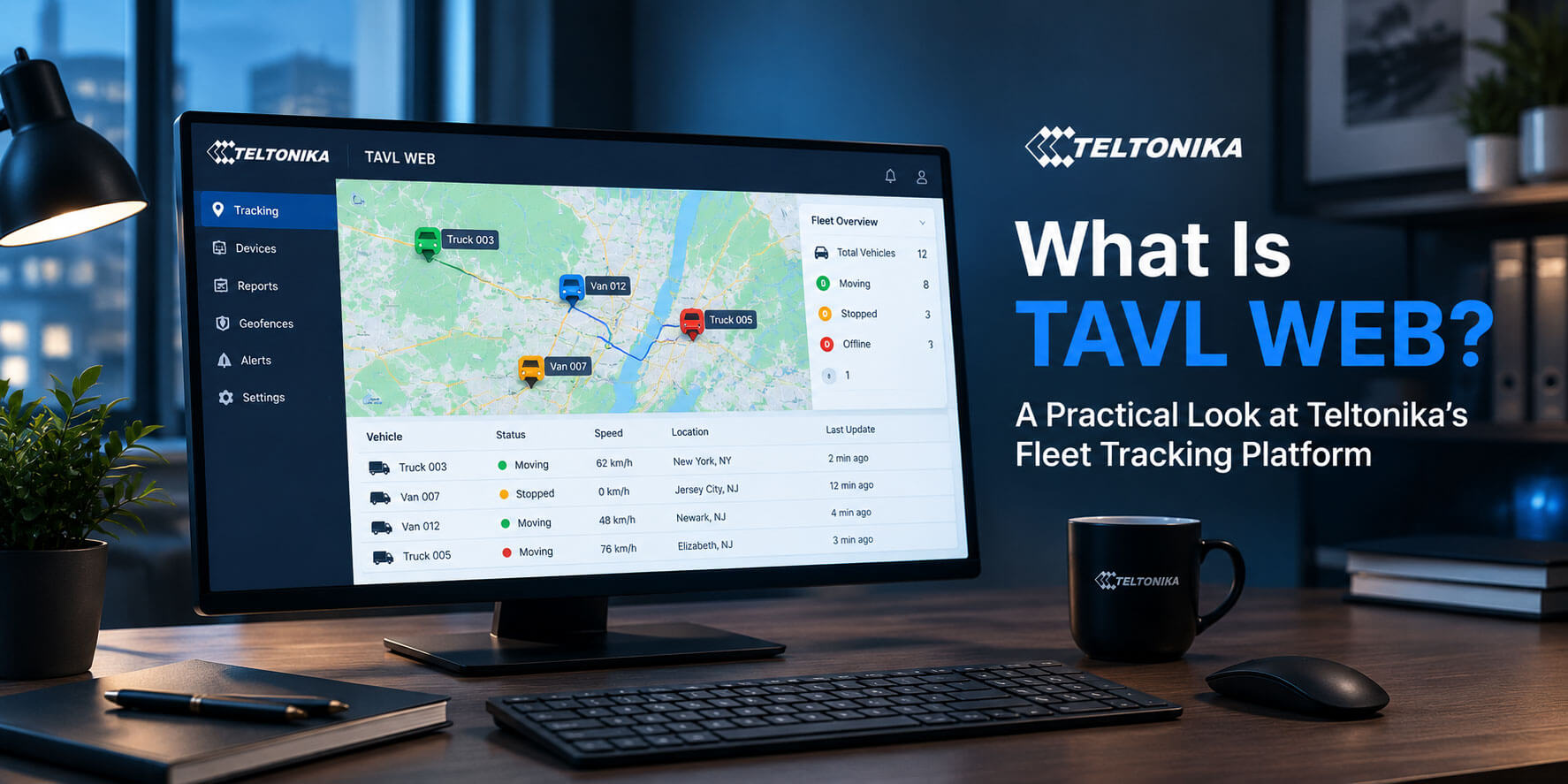
TAVL WEB is a browser-based fleet monitoring application built by Teltonika Telematics. It connects to an AVL (Automatic Vehicle Location) server and displays the location, speed, ignition status, and other data that GPS tracking devices installed in vehicles send back in real time. There’s no software to install on a computer — a fleet manager logs into a web page, and the entire vehicle fleet shows up on a map.
Important: according to Teltonika’s own official end-of-life product records, TAVL WEB has been discontinued — production ended on September 1, 2018, and official support ended on September 1, 2021. It still exists as a piece of software running on some resellers’ servers, but Teltonika itself no longer sells, updates, or supports it. Anyone evaluating it today should treat it as legacy technology, not a current product offering.
This article walks through what the platform actually does, how it connects to hardware and servers behind the scenes, where it fits into Teltonika’s broader history, the features that matter most for day-to-day fleet operations, and why it’s no longer Teltonika’s current offering. You’ll also find a comparison against the related TAVL4 desktop tool and mobile app (both similarly discontinued), a setup rundown for anyone still running it, and answers to the questions people most often ask.
Where TAVL Came From
Teltonika was founded in 1998 in Vilnius, Lithuania, by Arvydas Paukštys, and started out making unrelated electronics before entering the GPS space. The company introduced its first GPS tracking device, the TBOXN12GPS, in 2003, and launched its first fleet management platform — TAVL — in 2005. Everything covered in this article, including TAVL WEB, is the modern, browser-based descendant of that original 2005 platform, now developed under Teltonika Telematics, one of several specialized companies inside the larger Teltonika IoT Group (alongside Teltonika Networks, Teltonika Telemedic, and others).
That history matters for one practical reason: TAVL isn’t a new startup product chasing a trend. It’s a two-decade-old fleet tracking lineage — first as desktop software (TAVL4), then as the web-based version this article focuses on. But according to Teltonika’s own end-of-life records, that lineage was formally retired: TAVL WEB, TAVL4, and the TAVL mobile application were all marked with an end-of-production date of September 1, 2018, and an end-of-support date of September 1, 2021. Teltonika has since moved on to newer tracker models and a redesigned fleet telematics platform.
How the System Fits Together
Three pieces make the platform work: a tracking device installed in the vehicle, an AVL server that receives and stores the data it sends, and the web interface itself, which is where a person actually looks at that data.
Teltonika’s documentation lists older-generation trackers — models like the FM1100, FM1200, FM2200, FM3100, FM3200, FM4100, FM4200, and FM5300, along with the GH1201, GH1202, and GH3000 — as devices designed to work with this system. Each unit collects GPS coordinates via GNSS satellite positioning, reads ignition state and sensor data, then sends everything over a cellular (GSM) connection to the server. From there, the web interface turns that raw stream into a live map, historical trip logs, and reports a manager can actually read.
Because the processing happens on the server rather than on a local machine, checking a delivery van’s location works the same from an office desktop or a phone at home — nothing to install, just a browser and a login.
One structural detail matters here: this isn’t one single website. Regional Teltonika partners each run their own server instance — addresses like avl1.teltonika.lt, avl2.teltonika.lt, or a reseller’s own domain (an Icelandic partner running theirs at icecom.is is one example) all run the same underlying software, just deployed and branded differently. In practice, your login URL, and possibly your support contact, depends entirely on which reseller set up your account.
Core Features
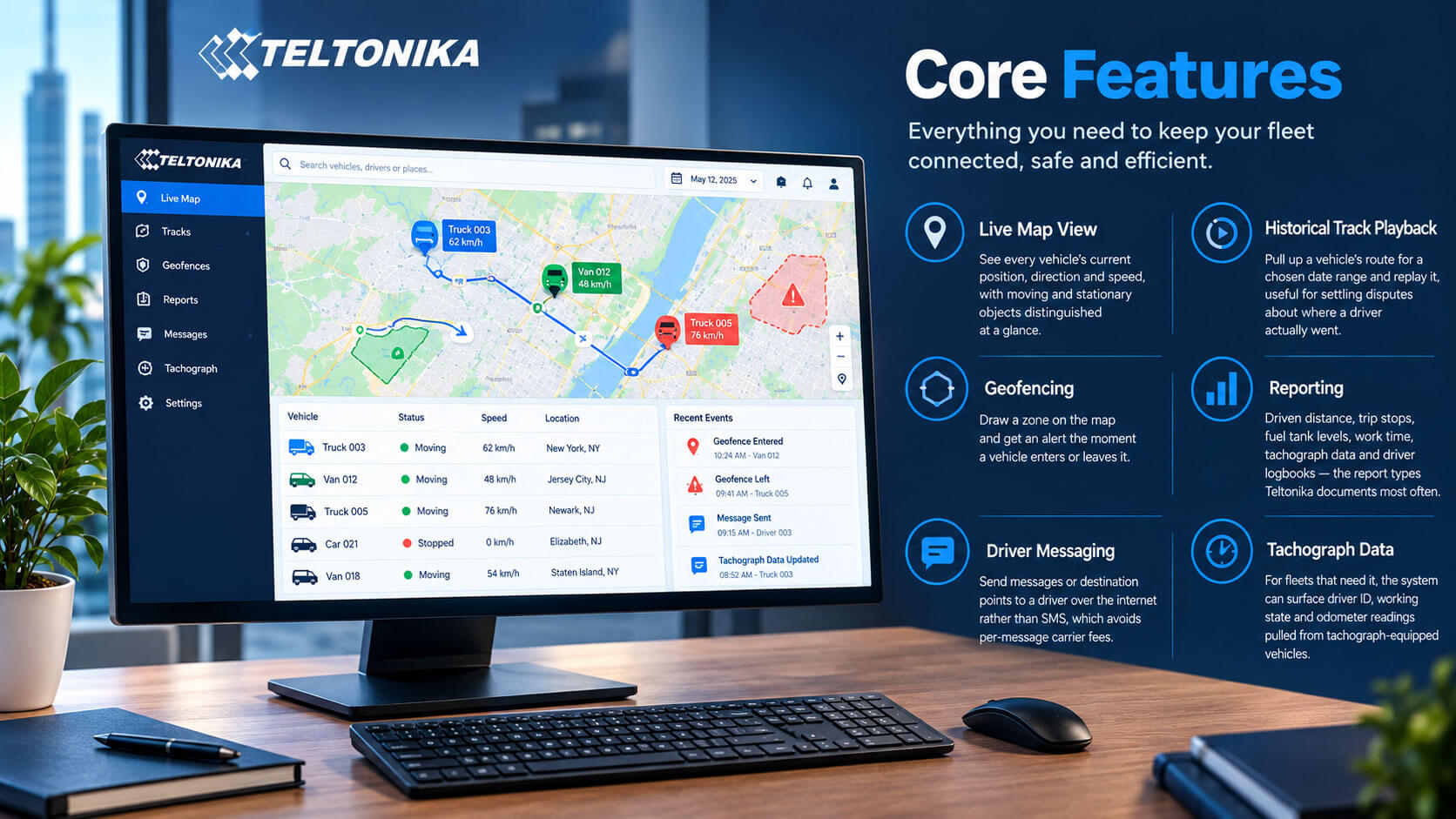
The platform carries over most of the functionality from its desktop predecessor, TAVL4, packaged into a browser-based interface. The features that show up most consistently across Teltonika’s own product pages and user guides:
- Live map view — every vehicle’s current position, direction, and speed, with moving and stationary objects distinguished at a glance.
- Historical track playback — pull up a vehicle’s route for a chosen date range and replay it, useful for settling disputes about where a driver actually went.
- Geofencing — draw a zone on the map and get an alert the moment a vehicle enters or leaves it.
- Reporting — driven distance, trip stops, fuel tank levels, work time, tachograph data, and driver logbooks are the report types Teltonika documents most often.
- Driver messaging — send messages or destination points to a driver over the internet rather than SMS, which avoids per-message carrier fees.
- Tachograph data — for fleets that need it, the system can surface driver ID, working state, and odometer readings pulled from tachograph-equipped vehicles.
Reports in particular are worth a closer look, since they’re where most of the day-to-day value shows up. A driven-distance report answers “how much ground did this vehicle cover this week”; a trip-stops report shows where and for how long a vehicle sat idle; a fuel-tank report tracks levels over time, which is often how fleets catch fuel theft rather than just monitoring consumption. None of these are exotic — they’re standard fare across the fleet-telematics category — but having them bundled into one login instead of stitched together from several tools is the practical benefit.
Where It Sits in the Wider Ecosystem
TAVL WEB is Teltonika’s own first-party interface, but it isn’t the only way to use Teltonika hardware. According to Teltonika’s own documentation, its tracking devices are also compatible with a range of third-party fleet management platforms — software built by other companies that can receive and display data from the same trackers. That’s worth knowing before assuming this is the only option: a business already committed to a different fleet software provider may be able to keep using Teltonika hardware without switching platforms at all.
Two other gaps are worth naming honestly. Teltonika doesn’t publish pricing for TAVL WEB on its own documentation pages — cost was set by whichever reseller deployed a given server instance, and since the product is discontinued, this isn’t something a current price could even be quoted for. Similarly, no official list of supported browsers or minimum system requirements turned up during research; the platform is described only as browser-based, without a documented compatibility matrix.
Given the end-of-life status, anyone comparing fleet-tracking options today should ask a reseller directly what Teltonika’s current platform is rather than requesting TAVL WEB specifically — a business signing up with an old server instance may be building on software Teltonika itself no longer maintains.
What Replaced TAVL WEB?
Teltonika’s own end-of-life listing doesn’t name a direct one-to-one software replacement for TAVL WEB, TAVL4, or the TAVL mobile app — the “replacement” column for all three is simply blank. That’s worth sitting with for a second, because it means Teltonika didn’t ship a new first-party dashboard to take over the job.
What did change is the hardware. In 2023, Teltonika introduced what it calls the FT platform — a new chipset and firmware architecture for its GPS trackers, offering improved GNSS accuracy (able to connect to up to 41 satellites, according to Teltonika), better power efficiency, and newer tracker models like the FTC921, FTC961, and FTC881. This is the current generation of Teltonika hardware, replacing the older FM-series trackers that TAVL WEB was originally built to support.
For the software side, the practical answer is the one already covered earlier in this article: current Teltonika trackers are designed to work with third-party fleet management platforms rather than a single official Teltonika-branded dashboard. In other words, Teltonika’s strategy shifted from “build our own end-to-end software” to “build reliable hardware and let specialized fleet-software companies handle the interface.” Anyone setting up a new fleet today would typically pair current-generation Teltonika trackers with one of these third-party platforms, not with TAVL WEB.
Should You Still Use TAVL WEB?
If a reseller is still running a TAVL WEB server instance and offering it as part of a package, it’s worth asking a direct question before signing on: is this instance still being maintained, and what happens if Teltonika-side support is needed for a bug or compatibility issue? Since official support ended in September 2021, any answer that amounts to “we handle it independently” should be weighed against the risk of running unsupported software for a business-critical function like fleet tracking. For a new deployment, asking about current-generation trackers and an actively supported platform is the safer starting point.
TAVL WEB vs. TAVL4 vs. the Mobile App
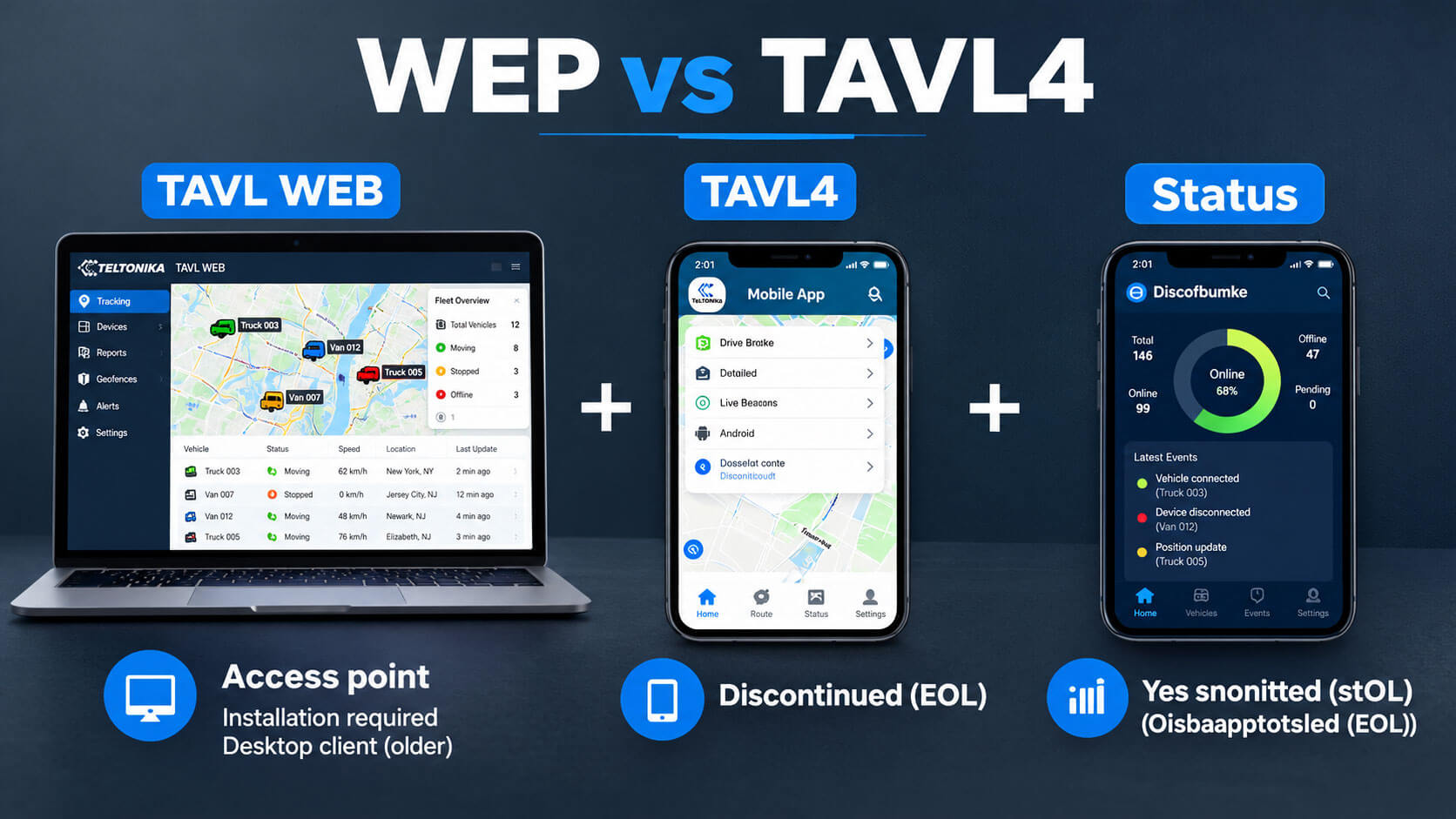
Teltonika’s naming can get confusing, since “TAVL,” “TAVL4,” and “TAVL WEB” often get used loosely to mean the same thing. Here’s the actual breakdown based on Teltonika’s own documentation — worth noting that all three are listed as discontinued (end of support: September 2021):
| TAVL WEB | TAVL4 | TAVL Mobile App | |
| Access point | Web browser | Desktop client (older) | iOS/Android app |
| Installation required | None | Yes, on a Windows machine | Yes, from app store |
| Status | Discontinued (EOL) | Discontinued (EOL) | Discontinued (EOL) |
| Core features | Live map, geofencing, reports, messaging | Same feature set, older interface | Simplified live view and alerts |
Teltonika’s own materials describe TAVL4 as the earlier desktop-based version of the same feature set, with TAVL WEB as its browser-based successor. Both were retired from official support in September 2021, which means anyone still relying on either today is running unsupported software — security patches and bug fixes are no longer guaranteed.
Who This Actually Suits
The platform shows up most often in a handful of industries where knowing exactly where a vehicle or asset is at any moment translates directly into cost savings:
- Logistics and delivery companies tracking driver routes and delivery windows
- Car rental and leasing businesses monitoring vehicle location and driving behavior
- Utility and emergency transport fleets that rely on geofencing and rapid-response location data
- Agriculture, construction, and mining operations tracking heavy equipment alongside vehicles
- E-mobility and shared-vehicle operators managing dispersed fleets
A business running two or three vehicles can technically use it too, but the reporting depth — fuel monitoring, tachograph logs, geofence alerts — is built on the assumption that manual tracking has already become impractical for someone managing a larger fleet.
Getting Set Up
Rolling a fleet onto the platform involves more than creating an account. A few things need to be in place first:
- Compatible tracking hardware. The vehicle needs a supported Teltonika GPS tracker physically wired in, which typically means a technician handles the install rather than it being a plug-and-play job.
- An active data connection. The tracker needs a SIM card or data plan to transmit information to the server.
- A server account. Since deployment happens through regional resellers rather than one universal login, you’ll need credentials specific to your provider — username, password, client code, and server domain.
- The right permission level. The system distinguishes account types; a basic “User” account only sees devices assigned to it, while higher-level accounts can manage multiple users and devices across a fleet.
This is an enterprise deployment, not a consumer app you download and pair with your phone’s own GPS — hardware installation and an ongoing relationship with a Teltonika reseller are part of the process from the start.
Strengths and Limitations
For fleet managers evaluating the platform, the appeal generally comes down to accessibility: one interface that behaves the same on a desktop or tablet, without separate software installs across a team. The reporting depth also goes further than some lighter, consumer-facing tracking apps, particularly around fuel and tachograph data.
A few limitations are worth weighing honestly before committing to it:
- It’s discontinued. This is the most important limitation: Teltonika’s own end-of-life records show production ended in 2018 and official support ended in September 2021. Any server instance still running it today is doing so without vendor updates or security patches.
- Hardware dependency. The web interface is built around Teltonika’s own tracking devices, so pairing it with hardware from another manufacturer isn’t something the documentation describes as supported.
- Inconsistent deployment. Because resellers each host their own server, the exact login process, feature availability, and support quality can differ depending on who sold you the system.
- A real learning curve. The reports are useful once understood, but someone unfamiliar with fleet telematics terms like geofencing or tachograph logs will need time to figure out which report answers which question.
- Connectivity dependence. Like any live-tracking system, the data shown is only as current as the tracker’s last successful transmission — a vehicle out of signal range won’t update until it reconnects.
None of this makes the platform’s original design a poor one, but its discontinued status is the kind of detail that changes the decision entirely for anyone evaluating it today.
Frequently Asked Questions
What is TAVL WEB used for?
Monitoring a fleet of vehicles or assets in real time — tracking location, speed, and ignition status, and generating reports on fuel use, driving behavior, and more, entirely through a browser.
Do I need to install software to use it?
No. The interface runs in a browser. The only physical installation involved is the GPS tracker fitted to the vehicle.
Is it the same as the TAVL mobile app?
No. The web platform is built for desktop or tablet browsers. The mobile app is a separate, simplified tool for checking fleet status from a phone.
Can any GPS tracker work with it?
Not according to Teltonika’s own documentation — the platform is built around its own line of tracking devices, and third-party hardware compatibility isn’t something the system is designed for.
How do I actually log in?
You’ll need a username, password, client code, and the server domain assigned by your Teltonika reseller — these details differ depending on which regional partner set up your account.
Is it worth it for a very small fleet?
It can work, though the reporting tools are built with larger fleets in mind. An operation with just one or two vehicles may find a simpler tracking app more proportionate to its needs.
What reports does the system generate?
Common types include driven distance, trip stops, fuel tank levels, work time, tachograph data, and driver logbooks.
Does Teltonika publish pricing for TAVL WEB?
Not directly, and it’s a moot point now — since regional resellers deployed and sold access to their own server instances, pricing was set by whoever the provider was rather than listed centrally by Teltonika, and the product is no longer sold at all.
Is TAVL WEB still supported by Teltonika?
No. Teltonika’s official end-of-life product records list TAVL WEB’s production as ended on September 1, 2018, and its support as ended on September 1, 2021. It’s discontinued, not a current offering.
What should I use instead of TAVL WEB?
Teltonika doesn’t list a direct software replacement — instead, current Teltonika trackers (built on its newer FT platform hardware) are designed to pair with third-party fleet management platforms rather than a single official Teltonika dashboard.
Read More: https://linkneon.com/magbook-wordpress-theme-review/
Conclusion
TAVL WEB, in its time, solved a specific problem well: giving a fleet manager real-time visibility into their vehicles without installing dedicated software on every machine, built on top of a fleet-tracking lineage that goes back to 2005. But it’s important to be direct about where things stand now — Teltonika’s own records show the product was discontinued, with official support ending in September 2021. It’s not a current option to newly adopt, and any business still running it is working with unsupported software. If you’re comparing fleet-tracking platforms today, the practical next step is contacting a Teltonika reseller directly to ask what its current platform is, rather than requesting TAVL WEB by name.
Sources
- TAVL WEB – Teltonika Telematics Wiki
- Teltonika TAVL – Teltonika Telematics Wiki
- Supported Third Party Platforms (Fleet Management) – Teltonika Telematics Wiki
- Teltonika – Wikipedia
- Teltonika Company History
- Teltonika EOL Products Page (confirms TAVL WEB discontinued status)
- Teltonika FT Platform Announcement